
Downloaded from hlayiso.com
INTERMEDIATE PHASE
GRADE 6
NOVEMBER 2016
ENGLISH FIRST ADDITIONAL LANGUAGE P2
MARKS: 40
TIME: 1 hour
NAME:
*6EFAL2*
This question paper has 10 pages.
Skip to contentAll 2016 papers 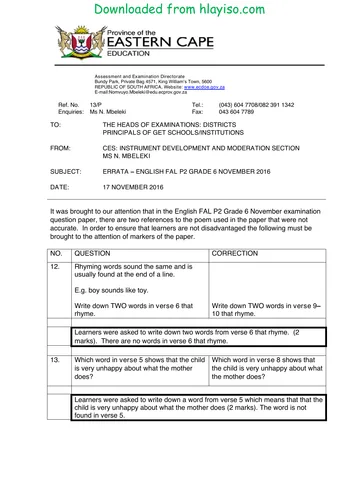
View all
English FAL Grade 6 Paper 2 November 2016 Question Paper
Grade 6 English FAL Paper 2 question paper from the November Exam 2016, 10 pages. Read online or get the free PDF download, memo linked when available.
English Fal · Grade 6 · November Exam · 2016. Question paper, 10 pages. Read online or download the PDF.
- Subject
- English FAL
- Grade
- Grade 6
- Document type
- Question paper
- Year
- 2016
- Exam period
- November Exam
- Paper
- 2
- Curriculum
- CAPS
- Pages
- 10
- File size
- 379.4 KB
Free to read online, no sign-up needed
Loading document…
Loading document…
1 of 10
This exam
November Exam 2016
- Paper 2Question paperMemoErrata
- Paper 3Question paperMemo
Questions in this paper
- Question 1.3Writing & Presenting (Term 1)2 marks
- Question 1.4Writing & Presenting (Term 1)2 marks
- Question 1.5Writing & Presenting (Term 1)2 marks
- Question 1.6Writing & Presenting (Term 1)1 marks
- Question 1.7Writing & Presenting (Term 1)12 marks
- Question 33.1Language Structures & Conventions (Term 1)1 marks
Show all 7 questions
Document textSearch extracted text and jump to a page.
Downloaded from hlayiso.com
2 ENGLISH FIRST ADDITIONAL LANGUAGE P2 (EC/NOVEMBER 2016)
INSTRUCTIONS AND INFORMATION
1. This paper consists of TWO sections namely:
SECTION A: Information text (10 marks)
Summary (5 marks)
Poem (10 marks)
SECTION B: Language structure and conventions (30 ÷ 2)(15 marks)
2. Number the questions correctly according to the numbering system used in
the question paper.
3. Pay attention to spelling and sentence construction.
4. Keep your work neat and tidy.
Copyright reserved Please turn over
Downloaded from hlayiso.com
(EC/NOVEMBER 2016) ENGLISH FIRST ADDITIONAL LANGUAGE P2 3
SECTION A: COMPREHENSION
QUESTION 1
Read the text below and answer QUESTIONS 1–7.
HOW TO OPEN A BANK ACCOUNT
1 Imagine that you want to save money to buy something.
Perhaps you want to buy a bicycle or a computer or a CD
player? You can save towards this by putting money into the
bank.
2 Firstly, it is important to find the right bank. You will need to go
to two or three different banks for information. This will help
you to decide which bank is right for you. You can judge the
service they give you and the products they offer.
3 Secondly, you need to know what kind of account to open. Think about how
you will use your bank account. This will help you to decide. If you want to use
your account to save, then you will probably open a savings account. This type
of account allows you to save money over a period of time. You normally have
to leave a sum of money in the account. You can earn interest on any extra
money you put into the account. Remember to ask about banking fees. There
may be monthly charges. Each time that you draw money from an ATM, the
bank charges you. Find out how much you will be charged if you draw money
at your own bank’s ATM and how much you will be charged for using another
bank’s ATM.
4 Thirdly, you will have to provide information to the bank. This means that you
need to show some form of identification and give proof of your address. If you
are younger than 18 years, you will need the permission of your parents.
5 Fourthly, there are terms and conditions that you must agree to.
Circle only the letter of the correct answer for the multiple-choice questions
1–2.
1. How can you judge the different banks? By the …
A service they give you.
B colour of the bank.
C free products they give.
D size of the building.
2. Which account will you open if you want to save your money?
A Cheque account.
B Credit card account
C Savings account
D Student account (1)
Copyright reserved Please turn over
Downloaded from hlayiso.com
4 ENGLISH FIRST ADDITIONAL LANGUAGE P2 (EC/NOVEMBER 2016)
Answer the following questions in full sentences.
1.3 Name ONE reason why the bank will charge you.
(1)
1.4 What information should you give to the bank before you can open an
account? Name any TWO.
(2)
1.5 Who has to help you to open an account?
(2)
1.6 What should you agree to before you open an account?
(1)
1.7 Tick (√) one of the following boxes.
Is it safe to put your money in the bank? Yes No
Give a reason for you answer.
(2)
Copyright reserved Please turn over
Downloaded from hlayiso.com
(EC/NOVEMBER 2016) ENGLISH FIRST ADDITIONAL LANGUAGE P2 5
8. SUMMARY
Your friend asks for advice from you about opening a bank account.
Summarise the above passage, by writing down FOUR hints to remember
when opening a bank account. Make sure that your spelling is correct.
RUBRIC
CRITERIA MARK LEARNER’S MARK
ALLOCATION
Four hints correctly
4
provided
Spelling 1
TOTAL 5
Copyright reserved Please turn over
Downloaded from hlayiso.com
6 ENGLISH FIRST ADDITIONAL LANGUAGE P2 (EC/NOVEMBER 2016)
Read the following poem and then answer QUESTIONS 9–14.
1 My mother does my homework.
She thinks its loads of fun.
3 She says that she’s just “helping” me
but, soon enough, it’s done.
5 We sit down at the dinner table
every single night.
7 She answers all the questions
And she always gets them right.
9 And now and then she’ll tell me
I should go and take my bath.
11 When I get back, I find she’s done
my science and my math.
13 You’d think that I’d be overjoyed
To never have to work.
15 But every time she “helps” me out”
I nearly go berserk.
17 I ask if I can do it, but
she shrugs off my requests.
19 So all my marks are dropping
since she doesn’t take my tests.
[Source: Adapted poem by Kenn Nesbitt from www.poetry4kids]
9. Which ONE word in the verse 1 means that the mother enjoys doing
homework?
(1)
10. Fill in ONE word to complete the following sentence:
The child usually does his homework during the (1)
11. What does the mother do when the child goes to bath?
(2)
Copyright reserved Please turn over
Downloaded from hlayiso.com
(EC/NOVEMBER 2016) ENGLISH FIRST ADDITIONAL LANGUAGE P2 7
12. Rhyming words sound the same and is usually found at the end of a line.
E.g. boy sounds like toy.
Write down TWO words in verse 6 that rhyme.
and (2)
13. Which word in verse 5 shows that the child is very unhappy about what
the mother does?
(2)
14. Circle the letter of the correct answer.
What would be the best title for this poem?
A I hate doing homework
B My mother does my homework
C I love doing homework
D I always do my homework (2)
TOTAL SECTION A: 25
Copyright reserved Please turn over
Downloaded from hlayiso.com
8 ENGLISH FIRST ADDITIONAL LANGUAGE P2 (EC/NOVEMBER 2016)
SECTION B: LANGUAGE STRUCTURE AND CONVENTIONS
Read the text below and answer QUESTIONS 15–34.
ENVIRONMENTAL FESTIVALS OF LIMPOPO
1 The Limpopo Province in SA is rich in nature and culture. The province also
has much for geologists and archaeologists to study. Each one of its four
regions has something unique to celebrate.
2 Every harvesting season, the Valley of the Olifants region celebrates the
harvest of the Marula fruit. The Marula fruit, which is called the ‘food of
kings’ by the Tsonga people is used in medicine, cosmetics, food dishes and
drinks. The big companies that make products from the fruit bring money to
the region in many ways. The harvest of the fruit helps the local community
to earn a crucial income. It empowers the women to feed their families.
The companies also run projects, such as brick-making, when it is not
harvest time.
3 There are many other environmental festivals in South Africa, for example
the Whale Festival in the Western Cape; and the Cherry Festival in
Ficksburg in the Free State. All around the country people celebrate the
unique features of their regions and invite visitors to join in!
[Source: Adapted from New Generation English Learner Book]
15. Circle the letter of correct answer.
What do we call people who study nature and culture?
A Agriculturists and neurologists
B Geologists and archaeologists
C Bakers and zoologists
D Chefs and biochemists (1)
16. Rewrite the sentence in the present progressive tense.
The companies run projects and make bricks.
(2)
17. Rewrite the sentence in the future tense.
It empowers the women to feed their families.
(2)
Copyright reserved Please turn over
Downloaded from hlayiso.com
(EC/NOVEMBER 2016) ENGLISH FIRST ADDITIONAL LANGUAGE P2 9
18. Underline the adjective in the sentence.
Each region of Limpopo has something unique to celebrate.
(1)
19. Write the apostrophe in the correct place.
The fruit is the king’s food.
(1)
20. Write the antonyms/opposite of the bold underlined words.
Limpopo Province is rich in nature and culture.
(1)
21. Underline the correct possessive pronoun.
Empowered women have to feed (their/them) families. (1)
22. Change the following sentence to a question, starting with the given word.
The people make medicine with Marula fruit.
Can (1)
23. Rewrite the sentence in the negative form.
The Tsonga people use the fruit to make medicine.
(2)
24. Choose the correct word from the brackets.
The people (it/eat) delicious fruit.
(1)
25. The harvest (help/helps) the people to earn a living.
(1)
26. Punctuate the following sentence correctly.
what do the Tsonga people do with the fruit
(3)
Copyright reserved Please turn over
Downloaded from hlayiso.com
10 ENGLISH FIRST ADDITIONAL LANGUAGE P2 (EC/NOVEMBER 2016)
27. The word enable is formed from the word able.
The word empower is formed from which word?
(1)
28. Rewrite these sentences in a reported speech/indirect speech.
“The Marula fruit is the king’s food,” said the Tsonga people.
(2)
29. Underline the correct word in the brackets.
There (is/are) many other environmental festivals.
(1)
30. Write down the correct preposition in brackets.
Medicine, cosmetics and food dishes are made (from/in) the fruit.
(1)
31. Join the two sentences using the conjunction (because).
The women work hard to harvest the fruit. The women have to look after
their families.
(2)
32. In your own words explain the meaning of the word unique in paragraph 3.
(2)
33. 33.1 Write the following abbreviation from paragraph 1 in full.
SA (1)
33.2 Write down the abbreviation of the following word in paragraph 3.
Western Cape (1)
34. Write down only the adverb from the following sentence.
People celebrate their festivals annually.
(2)
[30]
TOTAL SECTION B (30 ÷ 2): 15
GRAND TOTAL: 40
Copyright reserved Please turn over
Study this subject
Recommended for this subject
Errata
English FAL Grade 6 Paper 2 November 2016 Errata
Memorandum
English FAL Grade 6 Paper 2 November 2016 Memo
Question paper
English FAL Grade 6 Paper 3 November 2016 Question Paper
Question paper
English FAL Grade 6 Paper 2 November 2018 Question Paper
Question paper
English FAL Grade 6 Paper 2 November 2017 Question Paper
Question paper
English FAL Grade 6 Paper 2 November 2014 Question Paper
More from Grade 6 English FAL
Memorandum
English FAL Grade 6 Gauteng June 2024 Memo
Memorandum
English FAL Grade 6 North West November 2024 Memo
Memorandum
English FAL Grade 6 Gauteng June 2023 Memo
Memorandum
English FAL Grade 6 Gauteng November 2023 Memo
Memorandum
English FAL Grade 6 Gauteng June 2022 Memo
Memorandum