
Downloaded from hlayiso.com
1
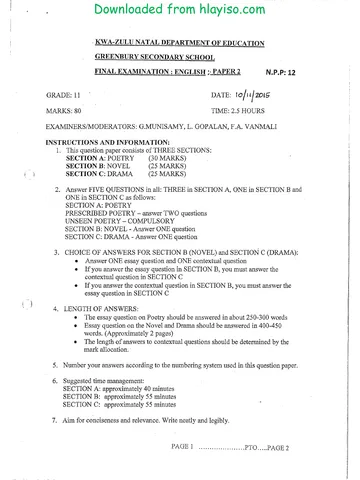
KWA-ZULU NATAL DEPARTMENT OF EDUCATION
GREENBURY SECONDARY SCHOOL
NPP IS
ENGLISH HOME LANGUAGE - PAPER 2
GRADE: 11 ~ DATE: 10 og [2015
MARKS: 80 TIME: 2.5 HOURS
EXAMINERS/MODERATORS: G.MUNISAMY, L. GOPALAN, F.A. VANMALI
INSTRUCTIONS AND INFORMATION:
1. This question paper consists of THREE SECTIONS:
SECTION A: POETRY (30 MARKS)
SECTION B: NOVEL (25 MARKS)
SECTION C: DRAMA (25 MARKS)
2. Answer FIVE QUESTIONS in all: THREE in SECTION A, ONE in SECTION B and
ONE in SECTION C as follows:
SECTION A: POETRY
PRESCRIBED POETRY — answer TWO questions
UNSEEN POETRY —- COMPULSORY
SECTION B: NOVEL - Answer ONE question
SECTION C: DRAMA - Answer ONE question
3. CHOICE OF ANSWERS FOR SECTION B (NOVEL) and SECTION C (DRAMA):
® Answer ONE essay question and ONE contextual question
® Ifyou answer the essay question in SECTION B, you must answer the
contextual question in SECTION C
® Ifyou answer the contextual question in SECTION B, you must answer the
essay question in SECTION C
4. LENGTH OF ANSWERS:
« The essay question on Poetry should be answered in about 250-300 words
e Essay question on the Novel and Drama should be answered in 400-450
words. (Approximately 2 pages)
¢ The length of answers to contextual questions should be determined by the
mark allocation,
5. Number your answers according to the numbering system used in this question paper.
6. Suggested time management:
SECTION A: approximately 40 minutes
SECTION B: approximately 55 minutes
SECTION C: approximately 55 minutes
7, Aim for conciseness and relevance. Write neatly and legibly.
PAGEL ees PTO.....PAGE 2
You're offline
Skip to contentQuestion paper and memo 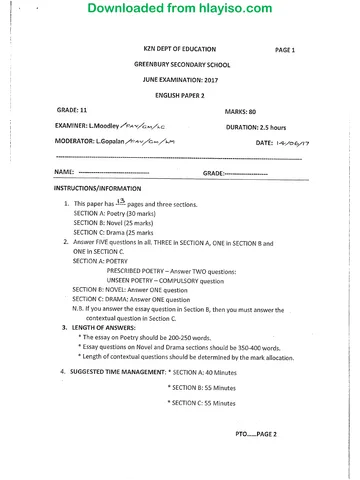


View all

ENG-JUNE-2015-P2-QP-and MEMO_hlayiso.com_.pdf
English Fal · Grade 11 · KwaZulu Natal June · 2015. Question paper and memorandum, 24 pages. Read online or download the PDF.
- Subject
- English Fal
- Grade
- Grade 11
- Document type
- Question paper and memo
- Year
- 2015
- Exam period
- KwaZulu Natal June
- Paper
- 2
- Pages
- 24
- File size
- 2.0 MB
Loading document…
Loading document…
1 of 24
Document textSearch extracted text and jump to a page.
Downloaded from hlayiso.com
2
SECTION A: POETRY
PRESCRIBED POETRY
Answer any TWO of the following questions.
Question One: Poetry - Essay Question
A woman is not a potted plant
her roots bound
to the confines
of her house
a woman is not
a potted plant
her leaves trimmed
to the contours
of her sex
a woman is not
a potted plant
her branches
espaliered
against the fences
of her race
her country
her mother
her man
her trained blossom
turning this way
and
that
to follow
the sun
of whoever feeds
and waters
her
a woman
is wilderness
unbounded
holding the future
between each breath
walking the earth
only because
she is free
and not creeper vine
or tree
Nor even honeysuckle
or bee.
Alice Walker
veer ees eeee neve eee PTO....PAGE 3
©
L)
Downloaded from hlayiso.com
3
This poem explores how women are viewed by society.
In a well-constructed essay of 250-300 words (about 1 page), discuss at least THREE
techniques Alice Walker uses to convey the speaker’s views regarding women.
[10]
Question Two: Poetry - Contextual Question
OZYMANDIAS Percy Bysshe Shelley ,
I met a traveller from an antique land 1
Who said: Two vast and trunkless legs of stone
Stand in the desert. Near them on the sand,
Half sunk, a shatter'd visage lies, whose frown
And wrinkled lip and sneer of cold command 5
Tell that its sculptor well those passions read
Which yet survive, stamp'd on these lifeless things, |
The hand that mock'd them and the heart that fed.
And on the pedestal these words appear:
"My name is Ozymandias, king of kings: 10
Look on my works, ye Mighty, and despair!"
Nothing beside remains: round the decay
Of that colossal wreck, boundless and bare,
The lone and level sands stretch far away. 14
2.1 Refer to Lines 4-5, “whose frown, And........ sneer of cold command”
What do these lines reveal about the character of Ozymandias? (2) |
2.2 Account for the poet’s use of the word “stamped” in Line 7. (2)
2.3 Refer to Lines 10-11: “My name is Ozymandias... Mighty, and despair!”
Discuss the irony of these words. (3)
2.4 Refer to Lines 12-14: “Round the decay ...... stretch far away”
Critically discuss how the poet effectively conveys mood and feeling in these final
lines. (3)
[10]
PAGE 3 vocceceecceeeeeeeeeeee PTO.,..PAGE 4
Downloaded from hlayiso.com
4
Question Three: Poetry - Contextual Question
the night train
there is no comfort here
in this third class coach
on this green resisting seat
itwitch and glance around -
there are few too few travellers
on the night train
crossing my legs and flicking
my cigarette i turn to stare
through the window
into the darkness outside
(or is it my reflection i stare at)
and glance impatiently at the wrong
stations we stop at
out
imust get out of here soon
for in this coach there is a smell
which haunts me
not the smell of stale man but
the whispering nagging smell of fear
Fhazel Johennesse
10
15
19
3.1 In what way does the lack of punctuation add to the overall impact of the poem? (2)
3.2 Refer to Line 14: “out”
Account for the poet’s use of this single word line. (2)
3.3 Comment on the significance of the word “haunt” (Line 17) in the context of the poem.
(3)
3.4 Refer to Line 19: “the whispering nagging smell of fear”
Critically discuss how the personification in Line 19 helps to convey the main idea of the
poem.
(3)
[10]
OR
Downloaded from hlayiso.com
5
Question Four: Poetry — Contextual Question
Walking Away C Day Lewis
(for Sean)
It is eighteen years ago, almost to the day —
A sunny day with leaves just turning,
The touch-lines new-ruled — since I watched you play
Your first game of football, then, like a satellite
Wrenched from its orbit, go drifting away
Behind a seatter of boys. I can see
You walking away from me towards the school
With the pathos of a half-fledged thing set free
Into a wilderness, the gait of one
Who finds no path where the path should be.
That hesitant figure, eddying away
Like a winged seed loosened from its parent stem,
Has something I never quite grasp to convey
About nature’s give-and-take — the small, the scorching
Ordeals which fire one’s irresolute clay.
Ihave had worse partings, but none that so
Gnaws at my mind still. Perhaps it is roughly
Saying what God alone could perfectly show —
How selfhood begins with a walking away,
And love is proved in the letting go.
4.1 Refer to Line : The touch-line’s new ruled.
Suggest why the speaker took particular notice of the “new-ruled” touch lines.
4.2 Refer to Line 11: “That hesitant figure, eddying away “
Show what the diction in this line indicates about the boy’s state of mind.
10
15
20
(2)
3)
4.3 Critically discuss how the image in lines 14-15 contributes to your understanding of the
poem,
3)
4.4 Comment briefly on the significance of the poet referring to “God” (Line 18) in the final
lines of the poem.
AND
PAGE S.. ees ceeeeeee PTO.....PAGE 6
@)
{10}
Downloaded from hlayiso.com
6
UNSEEN POETRY (COMPULSORY)
Question Five: Contextual Question
Nightfall in Soweto Oswald Mtshali
Nightfall comes like
a dreaded disease
seeping through the pores
of a healthy body
and ravaging it beyond repair
A murderer’s hand,
lurking in the shadows,
clasping the dagger,
strikes down the helpless victim.
Iam the victim.
Tam slaughtered
every night in the streets.
Tam cornered by the fear
gnawing at my timid heart;
in my helplessness I languish.
Man has ceased to be man
Man has become beast
Man has become prey.
Tam the prey;
Tam the quarry to be run down
by the marauding beast
let loose by cruel nightfall
from his cage of death.
Where is my refuge?
Where am I safe?
Not in my matchbox house
Where I barricade myself against nightfall.
I tremble at his crunching footsteps,
I quake at his deafening knock at the door.
“Open up!” he barks like a rabid dog
thirsty for my blood.
Nightfall! Nightfall!
You are my mortal enemy.
But why were you ever created?
Why can’t it be daytime?
Daytime forever more?
PAGE 6......06000 PTO....PAGE7
15
18
23
27
31
36
Downloaded from hlayiso.com
GLOSSARY:
lurking — hiding
languish - grow weak
quarry - one being chased
marauding — searching and destructive
barricade — block or defend
5.1 What impression of nightfall is created in stanza 1? (2)
5.2 Explain how “gnawing” (Line 14) captures the feelings expressed by the speaker in the
third stanza. (2)
5.3 Refer to Lines 16-18: “Man has ceased...... become prey”
Comment of the effectiveness of the repetition in Lines 16 to 18. (3)
5.4 Critically discuss how the last stanza highlights the central idea of the poem. (3)
[10]
TOTAL SECTION A: 30
PTO... PG 8 SECTION B: NOVEL
PAGE 7.....0ccseee PTO.....PAGE 8
Downloaded from hlayiso.com
SECTION B: NOVEL
NERVOUS CONDITIONS —TSITSI DANGAREMBGA
ANSWER EITHER QUESTION 6 (essay question) OR QUESTION 7 (contextual question).
Question 6 - NERVOUS CONDITIONS —~ ESSAY QUESTION
Various limitations are placed on female Africans in Nervous Conditions.
By referring to specific incidents in the text, critically discuss the validity of this statement in a
well-balanced essay of 400 — 450 words (2 pages).
[25 marks]
OR ( }
Question “t —- NERVOUS CONDITIONS — CONTEXTUAL QUESTION
Read the extracts below and then answer the questions that follow:
EXTRACT A
The beginning of the crop year was a busy time. My uncle insisted that Nhamo
be home for it on the grounds that there were no examinations pending to justify
his staying at the mission. Thus Nhamo was forced once a year to return to his
squalid homestead, where he washed in cold water in an enamel basin or a
flowing river, not in a bathtub with taps gushing hot water and cold; where he ate 6
sadza regularly with his fingers and meat hardly at all, never with a knife and
fork; where there was no light beyond the flickering yellow of candles and home-
made paraffin lamps to enable him to escape into his books when the rest of us
had gone to bed.
All this poverty began to offend him, or at the very least to embarrass him after 10
he went to the mission, in a way that it had not done before. Before he went to
the mission, we had been able to agree that although our squalor was brutal, it
was uncompromisingly ours; that the burden of dispelling it was, as a result, ours
too. But then something that he saw at the mission turned his mind to thinking
that our homestead no longer had any claim on him, so that when he did come ‘15
home for his vacations, it was as if he had not: he was not very sociable. Helping
in the fields or with the livestock or the firewood, any of the tasks he used to do
willingly before he went to the mission, became a bad joke. When the rains came
early at the end of his first year at the mission, he had pointed out that most of
the work had already been done and we had coped very well: when the rains 222
PAGE 8 viseeeteeeenee PTO....PAGE 9
Downloaded from hlayiso.com
came late, as they did at the end of his second year there, he reminded us that
we had managed without him the previous year. The only times that he would
expend any energy to help around the homestead were the times when
Babamakuru sent word that he was coming to visit. On such days Nhamo would
rise at dawn with the rest of us, working so hard that the dirt ingrained itself into 25
the skin of his hands and the sweat ran down his bare back, leaving him smelling
and looking for all the world like an archetypal labourer. His strategy was perfect.
He never returned to the homestead, no matter how tedious and heavy the task
at hand, until Babamakuru, having arrived home and found it deserted, drove
down to the fields. CHAPTER 1.
7.1.1,
7.1.2.
7.1.3.
7.1.4.
Discuss the effectiveness of the first person narrative in this novel. (3)
Refer to lines 10-11: “All this poverty began ... not done before.”
Account for the change in Nhamo’s attitude as revealed in the above lines. (3)
“His strategy was perfect.” (Line 27)
Show how Tambu’s tone reflects her view of Nhamo’s character. (3)
Refer to lines 29-30: “...Babamakuru,...drove to the fields.”
Using the above statement as a starting point, discuss the difference in character
between the educated Babamakuru and the educated Nhamo. (4)
EXTRACT B
‘My wife and | were very surprised,’ said Babamakuru, ‘that the crops had failed,
because other people were telling us that there had been good hatvests.
Anyway, that is another matter. When we heard that both Nhamo and heyo — ef,
this girl - er, Tambudzai had returned to school, we were very pleased that you
had used the money sensibly, Jeremiah.’ Babamakuru put his penknife away and $
sat tall in his chair. His presence became grave and weighty. As though giving
way beneath its weight, my father, Babamunini Thomas and Tete inclined
themselves attentively towards their brother.
PAGE9 wee PTO.....PAGE 10
Downloaded from hlayiso.com
‘What | have been thinking,’ Babamakuru began again after a lengthy pause,
which made it evident that indeed he had been thinking deeply and effectively 10
about the matter in hand, ‘what | have been thinking is this: providing money for
school fees is good but it is not all that must be done to ensure a child’s success
in school. A child must also be provided with the correct atmosphere which will
encourage his mind to develop even when he is not in the classroom.’
‘True, Mukoma, you speak the truth,‘ sighed my father, having gauged and i&
approved the direction of Babamakuru’s speech. “Look at our Nhamo. | have
never seen a child who loves his books the way he does, that Nhamo of ours.
But how can he study when there is no electricity? How can he read when there
are no books? Even going to school, how can he do that everyday when there is
so much work to be done on the homestead? | feel sorry for the boy but he — 20
does he say anything? No. He just keeps quiet and works hard here and at. ( }
school. | was blessed when | was given that son. Truly, | was blessed.’ He shook
his head in sorrow and syrnpathy for his son's suffering.
‘You are right, Jeremiah. | have observed that Nhamo is a promising scholar,’
agreed Babamakuru. ‘What we must do is to let Nhamo stay with us at the 25
mission, let him go to school there. He must come at once, because the sooner
he is given the best, the sooner will the best be returned.’ CHAPTER 3
7.2.4,
7.2.2.
7.2.4,
Refer to lines 1-2: “My wife and |....been good harvests.”
Outline the reasons for the failure of Jeremiah’s crops that year. (3)
“True, Mukoma, you speak the truth.” (line 15)
Discuss the irony of Jeremiah’s words. Provide evidence from the text to substantiate (
your response. (3)
To what extent is Babamakuru responsible “for his son’s (Nhamo’s) suffering.” (L.23)
Justify your answer by providing evidence from the text. (3)
Refer to lines 26 — 27: ‘ He must come... the best will be returned.’
Explain how the above statement reflects the value system of this society. (3}
[TOTAL 25]
PAGE 10.......... PTO...PAGE 11
Downloaded from hlayiso.com
SECTION C : DRAMA : MACBETH
Answer EITHER QUESTION 8 (Essay question) OR QUESTION 9 (Contextual
question)
QUESTION 8 : MACBETH - ESSAY QUESTION
In the play, Macbeth’s punishment exceeds his crime.
Critically discuss this statement.
Your response should take the form of a well constructed essay of 350-400 words (about
2 pages). (25)
OR
QUESTION 9 : MACBETH - CONTEXTUAL QUESTION
Read the extracts below and then answer the questions that follow.
EXTRACT A
LADY MACBETH
Infirm of purpose !
Give me the daggers. The sleeping and the dead
Are but as pictures; ‘tis the eye of childhood
That fears a painted devil. Ifhe do bleed, |
T’ll gild the faces of the grooms withal, 5
For it must seem their guilt. [ Exit. Knocking within] '
MACBETH Whence is that knocking? |
How is’t with me, when every noise appals me ?
- What hands are here ? Ha ! they pluck out mine eyes.
{) Will all great Neptune’s ocean wash this blood 10 |
Clean from my hand ? No : this my hand will rather |
The multitudinous seas incarnadine, |
Making the green one red.
Re-enter Lady Macbeth
LADY MACBETH
My hands are of your colour; but I shame
To wear a heart so white. [Knock within.] hear a knocking 15 |
At the south entry; retire we to our chamber. a
A little water clears us of this deed.
How easy is it then! Your constancy
Hath left you unattended. [Knock within.] Hark ! more knocking.
Get on your gown, lest occasion call us 20
And show us to be watchers. Be not lost
PAGE 11........,.PTO.....PAGE 12
Downloaded from hlayiso.com
So poorly in your thoughts.
MACBETH
To know my deed, ‘t were best not to know myself. [Knock within. ]
Wake Duncan with thy knocking; I would thou couldst !
[Act 2, Scene 3 J
9.1 Place the extract in context.
9.2 Refer to lines 1 to 4: “Infirm of purpose ! ....a painted devil.”
Comment on the tone used by Lady Macbeth in these lines.
9.3 Refer to lines 7-13 :Whence is that .... green one red.”
9.3.1 Account for the use of the many question marks.
9.3.2 Show how the image adds to your understanding of Macbeth’s attitude
at this stage of the play.
9.4 Discuss the irony of Lady Macbeth’s words , “A little water clears us of
this deed. How easy is it then !” (lines 17-18)
AND
(2)
3)
2)
GB)
(3)
EXTRACT B
MACDUFEF
Despair thy charm,
And let the angel whom thou still has serv’d
Tell thee, Macduff was from his mother’s womb
Untimely ripp’d
MACBETH
Accursed be that tongue that tells me so, 5
For it hath cow’d my better part of man;
And be these juggling fiends no more believ’d
That palter with us in double sense,
That keep the word of promise to our ear
And break it to our hope. I’Il not fight with thee. 10
MACDUFF
Then yield coward,
And live to be the show and gaze o’ th’ time.
We'll have thee, as our rare monsters are,
Painted upon a pole and underwrit,
“Here may you see the tyrant.’ 15
MACBETH
PAGE 12.0000, PTO...PAGE 13
©)
Downloaded from hlayiso.com
I will not yield
To kiss the ground before young Malcolm’s feet
And to be baited with the rabble’s curse.
Though Birnam Wood be come to Dunsinane
And thou oppos’d being of no woman born, 20
Yet I will try the last. Before my body,
I throw my warlike shield. Lay on, Macduff,
And damn’d be him that first cries, “Hold enough’.
[Exuent, fighting. Alarums.]
[Act 5, Scene 8]
9.5 What does Macbeth realise about the “juggling fiends” (line7)? (3)
9.6 Is Macduff justified when he refers to Macbeth as a “tyrant”? (line 15)?
Provide evidence from the text to motivate your answer. (3)
9.7 Why does Macbeth refuse to “yield” in line 16? (2)
9.8 By referring to events in the play, discuss whether Macbeth’s or
Malcduff’s character has been constant throughout .
Your response should include both characters, (4)
@5)
GRAND TOTAL : 30+25+25 = 80
GREENBURY SECONDARY SCHOOL
PAGE 13
Downloaded from hlayiso.com
©
)
Downloaded from hlayiso.com
SUGGESTED ANSWERS
Question One
e FORM — The poem is written in free verse suggesting women are free beings and not
confined, either to a “pot” or by their gender; family; rules and conventions.
e STRUCTURE AND SHAPE - the lines are organised in the shape of a strong plant,
firmly embedded and growing upright and sturdy without restrictions or controls as
symbolised by lines of different length which begin and end in different places. The
elongated, tall appearance also echoes the speaker’s feelings of pride in the free and
independent woman who “‘is not a potted plant”
e SYMBOLISM/IMAGERY - the extended metaphor and the different plants reflect the
various aspects of a woman’s true nature. She is not “espaliers” which need to be
supported rather she is independent of “country, man, mother”. She is not “Blossoms”
that go seeking the “sun” because she does not need anyone to “feed and water”.
Finally, she is “wilderness unbounded” — the epitome of freedom as all things grow
unrestricted in the wilderness. The final lines mention “honeysuckle or bee” which
again reflects her independence both in its presentation as a strong, short, empathic
statement and in its claim of her independence for unlike these things she needs
nobody.
e REPETITION — the title, as well stanzas 1, 2 and 3 start with the refrain “a woman is
not a potted plant” to highlight and emphasize the central idea of her freedom and
independence. [10]
NOTE: the mini essay must have structure ~ short introduction and conclusion plus
paragraphs in the body.
REFER TO RUBRIC.
Question Two
2.1 Ozymandias is presented as an absolute ruler and cruel man (“cold command”), He
lacked any kindness and compassion but was rather arrogant (“frown, sneer”)
Authoritative, haughty, proud, defiant, disapproving. (2)
2.2 “Stamped” conveys the idea (connotation) of something firmly embedded thus showing
even the work of the sculpture lasted longer than the power or anything of the arrogant
Ozymandias. (2)
2.3 Ozymandias proudly commissioned the statue believing that it would be an everlasting
reminder of his great reign and power. The reality, however is that the statue and all the
represented his power are now completely destroyed and with it has gone the memory of him
as well. (HOLISTIC, LOGICAL RESPONSE) GB)
2.4 The long sentence with the enjambment as well as multiple alliterative words capture the
mood of despair, loss and waste by emphasising the vastness of the “boundless and bare”
dessert where there is no evidence of any of Ozymandias power but a great deal of nature’s
wealth. The harsh b sound contributes to this heavy mood. The despair in the destruction and
absence of evidence of Ozymandias power is contrasted by nature’s all-consuming presence
in “sand’s stretch”. There is so much of sand and nothing of Ozymandias, (3)
Downloaded from hlayiso.com
Question Three
3.1 The lack of punctuation results in ongoing, uninterrupted, run-on lines which mimic the
rhythm of a moving train. Also the rules of grammar are ignored just as the rules of mutual
respect and dignity which are meant to govern human relations were ignored in Apartheid
South Africa. Finally, it shows this is a spontaneous, honest, unedited expression of the
speaker’s feelings and thoughts and thus makes the poem more authentic. (2)
3.2 The single word line stands out clearly highlighting the key idea of the speaker’s urgency
or desperation to get out. Also the word stands alone just like the speaker who feels
desperately, terrifyingly alone in the night train, It is a visual representation of his personal
plight. (2)
3.3 Firstly, the fear, anxiety, nervousness “haunt” him since they never leave but remain an
unshakable constant. Secondly, he feels “haunted” because like a ghost, the danger seems to
lurk, unseen. Thirdly, his darting eyes are unrelenting in their search and observation of the
lonely night train. This mimics the behaviour of one who is haunted and constantly on the
lookout the invisible ghost. QB)
3.4 The main idea of the speaker’s fear is accentuated by the personification. Firstly, it makes
the fear into something tangible thus giving it greater strength and power. Secondly, a person
is generally perceived as having greater power over another than a mere feeling has, Thirdly,
the fear is personified as “nagging” which means it is relentless and unshakable beyond one’s
control. Added to this, is the harsh sound of the double g in “nagging” which echoes the
harshness and pain of the speaker’s fear. (3)
[10]
Question Four
4.1 It was particularly significant as it reminded him of the “new rules” that now governed
his relationship with his son. Q)
4.2 “hesitant” has connotations of uncertainty/a lack of confidence while “eddying” suggests
that he is drifting, unsure of the path ahead/future. (3)
* each word to be explained
4.3 A clay creation has to be burnt under intense heat in a kiln for it to become a strong and
resilient of great beauty to be valued and admired. Similarly, the speaker realises that his son
~a young man ~ has to experience the “fires” of life (trials and tribulations) in order to
become a strong and independent man worthy of respect, (HOLISTIC, LOGICAL
RESPONSE). (3)
4.4 He is acknowledging that this is the way God (the Creator) meant for it to be. It is the
natural order and necessary for growth OR It indicates that he is deeply religious and would
not question God’s grand plan for He knows best. Q)
[10]
©)
Downloaded from hlayiso.com
10
Question Five
5.1 Nightfall is personified as a terrifying predator which “comes” to destroy/kill like a
“dreaded disease”. The malevolent nature of nightfall is also captures in “seeping through the
pores”. The use of the hard d sound in the alliteration together with the simile “like a dreaded
disease” suggest the terrifying, destructive nature which brings death.
Nightfall is destructive and fatal like a “dreaded disease” / sickness. It is opportunistic and
contaminates/poisons/destroys everything in its path and is relentless in its pursuit. (2)
*any | point explained
5.2 The word emphasises the fear and helplessness of the speaker. “Gnawing” means biting
off small bits, slowly. This suggests that the fear is an ever present constantly niggling feeling
that never goes away. (2)
5.3 The repetition of “Man has become” effectively illustrates how man has degenerated into
“beast” and “prey”. It emphasise the point that “Man has ceased to be Man” but is now hunter
(“beast”) and hunted (“prey”). The repetition of “Man has become” is a constant reminder
that this is not man’s natural state but something that he has turned into. (3)
*any 2 points discussed.
5.4 The central idea is that nightfall is a hated, terrifying time of grave danger. This idea is
highlighted in a number of ways in the final stanza:
e “Nightfall! Nightfall!” This single word followed by an exclamation mark and
repeated emphatically conveys the speaker’s extreme anger and bitterness. The word
is spewed out in a repetitive rant which is curse-like in its fervour. The single word
also heightens the emotional charge.
® The choice of diction, coupled with the personification of nightfall as “mortal enemy”
shows that he lays blame at its feet because it is under the cover of darkness that
“Man becomes beast” and “prey”. Nightfall is responsible as it provides the
conditions that supports man’s degeneration as well as the speaker’s terror and
endangerment.
e The rhetoric questions appear in quick succession to show the speaker’s desperation
to be rid of nightfall and his hatred for this time. It also reflects his lack of
understanding of a need for this time which brings nothing but grave danger and
extreme terror.
e The single words, together with the short, choppy lines capture the speaker’s anxiety,
terror and tension. (3)
*any 2 points well explained.
[10]
Downloaded from hlayiso.com ;
SUGGESTED ANSWERS - JUNE 2015 — NERVOUS CONDITIONS.
@.6 The following main points should be included in your essay:
Tambu's attitude towards Nhamo because of his treatment of Netsai / He was chosen over her (Tambu)
when it came to education / reasons: he was male, eldest, intelligent and would uplift the
family from their destitute conditions. Tambu felt that she was entitled to an education that
would free her from the entrapment of her poverty.
Her determination — mielie patch —father scorns and Nhamo sabotages.
Tambo being trapped by male domination — not only by Nhamo but also her father and Babamakuru
(include in discussion her father’s attitude when she decides to grow crops to raise money to he
educated / her reaction when Babamakuru decides that Nhamo should be educated).
In general the entrapment of all women because of the roles that they accept eg.they are wives, ( )
mothers — also responsible for the growing of crops, raising their children, seeing to the needs of
their husbands etc.
They are denied an education thus they become trapped in this situation.
(Discussion should also include Maiguru / MaShingai / Nyasha ) chapter 1-4
TAAL
(3
7.4.2,
7.1.3.
()
7.1.4,
Downloaded from hlayiso.com
Firstly, the novel is about the life of an individual trapped by a society that sees females as
inferior so Tambu who is affected directly is clear in giving a personal account of female
entrapment.
Secondly, the first person narrative authenticates her experiences and struggles which will
impact on the reader who will become sympathetic to Tambu’s plight.
Authentative voice — narrator in control of order, style, nature of events.
Allows for freedom: Order vs younger narrator / view
Captures reality — gives sense of Immediacy
(1% x 2)
Attitude of indifference / non-acceptance
Prior to his attending the mission school he accepted the conditions of the homestead but once
he began to attend the mission school and experience the luxuries / western way of life ie.
hot/cold water, tea -bags, books etc. he was unable to reconcile himself to the living conditions
of the’ homestead. He felt that the others, especially the females could live in these conditions —
saw himself as superior / elevated / above them / he was a patriarch just like his father. He was
also influenced by western society / values (dressing, luxuries etc.) and quick to forget / discard
his culture. Sadistic streak in character.Lazy / work-shy.Power struggle between him and Tambu.
(1 for attitude — 2 for point well discussed)
Tone of sarcasm / conviction / matter — of-fact
Normally lazy, refused to involve himself with the chores of the homestead “helping in the
fields... became a bad joke.”
He was very deceptive, when he knew that Babamakuru was coming he put ona front / show
that he is hardworking “Nhamo would rise at dawn ... archetypal labourer.”
(1 for tone ~ 2 for one of two points discussed)
Babamakuru was the head of the family, well-educated and followed / adhered to the
patriarchal system — was totally involved / concerned in the homestead / planting and progress
of crops and his extended family. Sincere, remained humble, committed to family / dutiful.
7.2.1.
7.2.2,
7.24,
Downloaded from hlayiso.com
Nhamo lazy, work-shy, felt superior, did not want to do chores or get Involved in the family crop
planting/ selfish ~ self-advancement without taking into account the family’s needs. False/
ingratiating.
(2 (Babamakuru) x 2 (Nhamo))
Jeremiah was lazy ~ not prepared to use the plough that Babamakuru had provided ~ good for
nothing, irresponsible man who left the chores etc. to be done by his wife and daughters.
(“other people... good harvests’) - the question is why? Poor farming methods —no crop
rotation,
Also at this point Tambu’s mother was pregnant and unable, after completing her chores to still
work the fields.
(1% x2)
The irony is that while Jeremiah acknowledges the value of truth, he is dishonest anda liar by
omission. Pretends he has spent money sent by Babamakuru on Nhamo and Tambu’s education
and does not correct Babamakuru’s misconception. Money had been spent on himself-maybe
on alcohol.
(1%x2)
Babamakuru is partly.responsible for Jeremiah’s attitude as he does nothing to correct him as
the head of the family — instead he is always coming to Jeremiah’s rescue by giving him money,
monitoring crops etc. while Jeremiah just basks in this. Had he admonished Jeremiah to be
responsible the situation would be different — there will be no need for Nhamo to be educated
and uplift the destitute family.
The family’s poverty was so extensive that it was impossible to uplift them by himself
(Babamakuru) ~Jeremiah showed no signs of change / made no attempt to work and support
his family — he was content to let things be the way it was,
(1%x2)
The male — in this case — Nhamo (boy child) is chosen to be educated so that not only he but also
the family can benefit. An educated Nhamo will uplift his family (as male he will not leave the
family) one day in the future become patriarchal head of family like Babamakuru.
According to Jeremiah if a girl is educated she is of no value / benefit to her family as she will
marry and go to her husband’s home (they will benefit).
There will be no ‘returns’ for her family.
(1%x 2)
()
Downloaded from hlayiso.com
| SUBS ESTED ANSWERS
0,8: Maceetit CBSSAY)
imal Assecswrent 40 consiche Strcctare. , canlent aveof
Sty le
ater DOR wre Le encase wed ;
C= coucte [wos :
le Mae betho laser Veg lus beerushwerb — seatesbas oh
an King is bles bremeus of snatilagiie :
virdves ee. deur thot erreac| y, ara =p. how!
° Subrc ar ee ~ae Ae hohe iS
Beung vee wracleur, ‘verrolty AL ahve" Whew lec
voc wos oteah alee “rete enon AE elecdlemess
; fall aualb avbav 2 Decals wee C Ne btones
ccanla eaves aT bleent f3 cu sews) St
* Ew bavke ew Leen Basges,
TW ncet. fe Guly ate 5 - wlegeterdenaine wll de
* Neglect het, Mecletw~. estanges|
-Bulbve eucthewally wan telly, Hejecely
te aa vec tov £ Setlnte
me hea fs ole, cy ews eet. a ave wal ule esate ).
Downloaded from hlayiso.com _
Gusstion 4) MACE STH Coonires.TUAL) _
1 Thus ncwleut occevs rest afb Di De erence
wmaliveley orl leas ohelow
ee Taw bens wag savcashe leo Ieaclay Mercloe ft
ALB OL Mehhety Beeb scvelly he lrav twee Gon aud ly
Chiowusses hae wetredter acons—Las ’ pistes’ 0 gasrach auc bikes
Mackety dl wmartericby Creete of inl Lolli) Sbe @
duvthe, tevumenis /hecztea\ lata,
4,8. Li Lsepedag lees Maehotd woleensic. Rew errect few
Leaglty png buceles ease tae beets bb le boca!
I<
Ce
Fo Dehashes. Le hua wuibet ove fetle =k
9.3.2 The mane ob treEcn bolobed by besard
VA nel is Plchmed Th wiigue tly sth eh ‘thre
wagnawinuley al lao abuae, Ab the stage Maclel
haou wed bu youre vine Me. luo terkdle Cate sa0~)
He jen toes rea ea a ae 3a) & 3)
Las rae dey veay i: ween” she toe sulers—
oul Dlaunect 8 peb? fetes beat ole a lee Lf ace}
ew Lev anole, & he will se Sgunet! =e
4
Te id nab eaou to led — wictclar + Manele 4
Downloaded from hlayiso.com
wave + Peace oh vuviel auel oleadd bodlene ( (ao A ww heel y
2th,
weg vies fee es Sate REC (hel oho doe es) i, (>
ae he chee ee ges lbs a sguceceshag.
wbty a ee, Led sce, Lee ues reve te be here
Hse Laverty Sod wctkewblet! ten fescpoecces accovilurs to
hie. chswes tr, scene! abba brew ‘be weeced Thee? vee
toads Wows, 2 use be rey venvarsvatty @. L Comernte lee
Seebow . Cay S (®
1.6, Yes, \e ts cid mevavless aucl euthod e =e Gite
neve! 3 uuekveve hy Wen Baunsve cond lus aor! re ba
rs cweualkn the ectiewe —~ bredles ne of fae hen
Eniignee ) Cae a) ©
4.9. Maecbetty. wi (| vet Buvrrencer evrare wh bocce
attitude. aud wedi net 6uccornrk to 4 eLunrg MNeteelug
Leet” Chvicte-) Ne ithe, wolf he be hevecsbe three lv the
exfreoke mi Sestiavet Ly ee come bo view then pee”
des sgt revel cgettioly fo te Oreuhy ~canel LS
I (ile pone wes “Slee ae!) (2
2S Mock ff, Cousistenrtly lead batuiebes avucl
yitiveus. QOuty, tee who to ee covke = aha Kase
Machety by Cert ellenuctwe beunquet Encafec be Lda lowct fo
gece ence AL Evglucly aut, Leo Het be mang Satye
Downloaded from hlayiso.com
i Macketly ew the wiley lero) wes ince " Beller brnchee, wes out
2
Ww _the, verse bs Here clio nrercnrcd for ld
fel ceracyass Sen Havel tke Yl excel tt, ale, eres hey
[king Bien. (Macetull Va + Mas betty Ue) (22_
Recommended for this subject
Published documents with matching subject and grade metadata.
Question paper and memo
ENG-JUNE-P1-QP-and MEMO_hlayiso.com_.pdf
Question paper and memo
ENG-JUNE-P2-QP-and MEMO_hlayiso.com_.pdf
Question paper and memo
ENG-2016-P1-JUNE-QP and MEMO_hlayiso.com_.pdf
Question paper and memo
ENG-2016-P1-NOV-QP and MEMO_hlayiso.com_.pdf
Question paper and memo
ENG-2016-P2-NOV-QP and MEMO_hlayiso.com_.pdf
Question paper and memo
ENG-JUNE-2015-P1-QP-and MEMO_hlayiso.com_.pdf
Related documents
Matched using subject, grade, language, document type and exam metadata.
Question paper and memo
ENG-NOV-2015--P2-QP-and MEMO_hlayiso.com_.pdf
Memorandum
ENG-2016-P2-JUNE-QPMEMO_hlayiso.com_.pdf
Question paper and memo
ENG-NOV-2015-P1-QP-and MEMO_hlayiso.com_.pdf
Memorandum
ENGFAL P1 GR11 MEMO NOV 2015_hlayiso.com_.pdf
Memorandum
ENGFAL-P3 GR11 MEMO-NOV 2015_hlayiso.com_.pdf
Question paper
ENGFAL P1 GR11 QP NOV 2015_hlayiso.com_.pdf
More from Grade 11 English Fal
Explore more published documents in this catalogue.
Annual teaching plan
Gr 11 English FAL ATP 2023-24.pdf
Memorandum
ENGLISH FAL P1 MEMO GR11 NOV 2022_hlayiso.com_.pdf
Memorandum
ENGFAL P2 GR11 MEMO NOV2022_hlayiso.com_.pdf
Memorandum
ENGFAL P3 GR11 MEMO NOVEMBER 2022_hlayiso.com_.pdf
Question paper
ENGLISH FAL P1 GR11 QP NOV 2022_hlayiso.com_.pdf
Question paper