
Downloaded from hlayiso.com
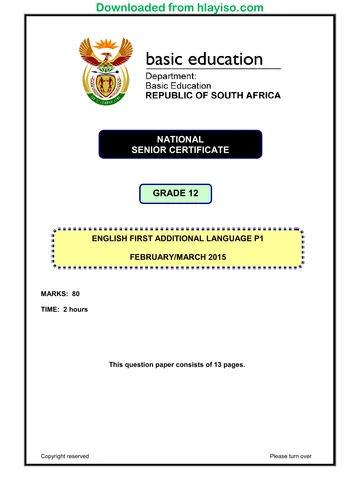
NATIONAL
SENIOR CERTIFICATE
GRADE 12
ENGLISH FIRST ADDITIONAL LANGUAGE P2
FEBRUARY/MARCH 2015
MARKS: 70
TIME: 2 hours
This question paper consists of 28 pages.
Copyright reserved Please turn over
You're offline
Skip to contentQuestion paper 
View all

English FAL P2 Feb-March 2015_hlayiso.com_.pdf
English Fal · Grade 12 · NSC Supplementary · 2015 · English. Question paper, 28 pages. Read online or download the PDF.
- Subject
- English Fal
- Grade
- Grade 12
- Language
- English
- Document type
- Question paper
- Year
- 2015
- Exam period
- NSC Supplementary
- Paper
- 2
- Pages
- 28
- File size
- 819.2 KB
Loading document…
Loading document…
1 of 28
Document textSearch extracted text and jump to a page.
Downloaded from hlayiso.com
English First Additional Language/P2 2 DBE/Feb.–Mar. 2015
NSC
INSTRUCTIONS AND INFORMATION
Read this page carefully before you begin to answer the questions.
1. Do NOT attempt to read the entire question paper. Consult the Table of
Contents on the next page and mark the numbers of the questions set on the
texts you have studied this year. Read these questions and choose the ones
you wish to answer.
2. This question paper consists of FOUR sections:
SECTION A: Novel (35)
SECTION B: Drama (35)
SECTION C: Short stories (35)
SECTION D: Poetry (35)
3. Answer questions from TWO sections, as follows:
SECTION A: NOVEL
Answer the question on the novel that you have studied.
SECTION B: DRAMA
Answer the question on the drama that you have studied.
SECTION C: SHORT STORIES
Answer BOTH questions.
SECTION D: POETRY
Answer BOTH questions.
Use the checklist to assist you.
4. Follow the instructions at the beginning of each section carefully.
5. Number your answers exactly as the questions are numbered in the question
paper.
6. Start EACH section on a NEW page.
7. Spend approximately 60 minutes on each section.
8. Write neatly and legibly.
Copyright reserved Please turn over
Downloaded from hlayiso.com
English First Additional Language/P2 3 DBE/Feb.–Mar. 2015
NSC
TABLE OF CONTENTS
SECTION A: NOVEL
Answer ANY ONE question.
QUESTION NO. MARKS PAGE NO.
1. To Kill a Mockingbird 35 5
2. Lord of the Flies 35 8
3. A Grain of Wheat 35 11
SECTION B: DRAMA
Answer ANY ONE question.
4. Romeo and Juliet 35 14
5. Nothing but the Truth 35 18
SECTION C: SHORT STORIES
Answer BOTH questions.
6.1 The secret life of Walter Mitty 18 22
6.2 The soft voice of the serpent 17 23
SECTION D: POETRY
Answer BOTH questions.
7.1 Let me not to the marriage of true
17 25
minds
7.2. An elementary school classroom in a
18 27
slum
Copyright reserved Please turn over
Downloaded from hlayiso.com
English First Additional Language/P2 4 DBE/Feb.–Mar. 2015
NSC
CHECKLIST
NOTE:
• Answer questions from ANY TWO sections.
• Tick the sections you have answered.
SECTION QUESTION NO. OF TICK
NUMBERS QUESTIONS
TO ANSWER
A: Novel 1–3 1
B: Drama 4–5 1
C: Short Stories 6 1
D: Poetry 7 1
NOTE: Ensure that you have answered questions on TWO
sections only.
Copyright reserved Please turn over
Downloaded from hlayiso.com
English First Additional Language/P2 5 DBE/Feb.–Mar. 2015
NSC
SECTION A: NOVEL
In this section, there are contextual questions on the following novels:
• TO KILL A MOCKINGBIRD by Harper Lee
• LORD OF THE FLIES by William Golding
• A GRAIN OF WHEAT by Ngũgĩ wa Thiong'o
Answer ALL the questions on the novel you have studied.
QUESTION 1: TO KILL A MOCKINGBIRD
Read the following extracts from the novel and answer the questions set on each. The
number of marks allocated to each question serves as a guide to the expected length
of your answer.
NOTE: Answer the questions set on BOTH extracts, i.e. QUESTION 1.1 AND
QUESTION 1.2.
1.1 [Atticus speaks to Scout.]
'I never thought Jem'd be the one to lose his head over this – thought I'd
have more trouble with you.'
I said I didn't see why we had to keep our heads anyway, that nobody I
knew at school had to keep his head about anything.
'Scout,' said Atticus, 'when summer comes you'll have to keep your head 5
about far worse things … it's not fair for you and Jem, I know that, but
sometimes we have to make the best of things, and the way we conduct
ourselves when the chips are down – well, all I can say is, when you and
Jem are grown, maybe you'll look back on this with some compassion and
some feeling that I didn't let you down. This case, Tom Robinson's case, is 10
something that goes to the essence of a man's conscience – Scout, I
couldn't go to church and worship God if I didn't try to help that man.'
'Atticus, you must be wrong ...'
'How's that?'
'Well, most folks seem to think they're right and you're wrong ...' 15
'They're certainly entitled to think that, and they're entitled to full respect
for their opinions,' said Atticus, 'but before I can live with other folks I've got
to live with myself. The one thing that doesn't abide by majority rule is a
person's conscience.'
[Chapter 11]
Copyright reserved Please turn over
Downloaded from hlayiso.com
English First Additional Language/P2 6 DBE/Feb.–Mar. 2015
NSC
1.1.1 Choose a description from COLUMN B that matches the word in
COLUMN A. Write only the letter (A–D) next to the question
number (1.1.1(a)–1.1.1(c)) in the ANSWER BOOK.
COLUMN A COLUMN B
(a) Mrs Dubose A narrator of the novel
(b) Atticus B the malevolent phantom
(c) Scout C addicted to morphine
D lawyer defending Tom (3)
1.1.2 Refer to lines 1–2: 'I never thought ... trouble with you.'
(a) To what does 'this' (line 1) refer? (1)
(b) What is the consequence of Jem's actions? (1)
(c) Why does Atticus say, 'thought I'd have more trouble with
you' (lines 1–2)? (1)
1.1.3 Refer to lines 3–7: 'I said I didn't see … best of things'
(a) Explain the FIGURATIVE meaning of 'keep our heads' (line 3). (1)
(b) Quote no more than THREE consecutive words to prove that
the following statement is TRUE:
Atticus is aware that his children do not deserve the treatment
they will receive. (1)
1.1.4 Using your OWN words, explain the lesson Atticus teaches Scout
in lines 16–19 ('They're certainly entitled … a person's
conscience.') (3)
1.1.5 What does the decision to take on Tom Robinson's case reveal
about Atticus? State THREE points. (3)
1.1.6 Do you think Tom Robinson can be seen as a Mockingbird?
Discuss your view. (4)
AND
Copyright reserved Please turn over
Downloaded from hlayiso.com
English First Additional Language/P2 7 DBE/Feb.–Mar. 2015
NSC
1.2 [Atticus is speaking to Aunt Alexandra.]
'Atticus, it's all right to be soft-hearted, you're an easy man, but you have
a daughter to think of. A daughter who's growing up.'
'That's what I am thinking of.'
'And don't try to get around it. You've got to face it sooner or later and it
might as well be tonight. We don't need her now.' 5
Atticus's voice was even: 'Alexandra, Calpurnia's not leaving this house
until she wants to. You may think otherwise, but I couldn't have got along
without her all these years. She's a faithful member of this family and you'll
simply have to accept things the way they are. Besides, sister, I don't want
you working your head off for us – you've no reason to do that. We still need 10
Cal as much as we ever did.'
'But Atticus – '
'Besides, I don't think the children've suffered one bit from her having
brought them up. If anything, she's been harder on them in some ways than
a mother would have been . . . she's never let them get away with anything, 15
she's never indulged them the way most coloured nurses do. She tried to
bring them up according to her lights, and Cal's lights are pretty good – and
another thing, the children love her.'
I breathed again. It wasn't me, it was only Calpurnia they were talking about.
[Chapter 14]
1.2.1 Choose the correct answer to complete the following sentence.
Write only the answer (A–D) in the ANSWER BOOK.
Aunt Alexandra is …
A Atticus' sister.
B Calpurnia's friend.
C Jem and Scout's grandmother.
D the Finches' neighbour. (1)
1.2.2 Refer to lines 4–5: 'And don't try … need her now.'
(a) What does Aunt Alexandra want Atticus to do? (1)
(b) How does Atticus respond to her request? Use your OWN
words. (1)
(c) Using your OWN words, explain Calpurnia's role in Atticus's
household. State THREE points. (3)
1.2.3 Discuss Aunt Alexandra's opinion of Calpurnia. (2)
1.2.4 State TWO ways in which Aunt Alexandra is similar to most of the
people of Maycomb. (2)
Copyright reserved Please turn over
Downloaded from hlayiso.com
English First Additional Language/P2 8 DBE/Feb.–Mar. 2015
NSC
1.2.5 Write down ONE word which best describes Scout's feelings in
line 19 ('I breathed again'). Do NOT use a word from the extract. (1)
1.2.6 Discuss the theme of racism as seen in this extract. (2)
1.2.7 Do you admire Atticus? Discuss your view. (4)
[35]
OR
QUESTION 2: LORD OF THE FLIES
Read the following extracts from the novel and answer the questions set on each. The
number of marks allocated to each question serves as a guide to the expected length
of your answer.
NOTE: Answer the questions set on BOTH extracts, i.e. QUESTION 2.1 AND
QUESTION 2.2.
2.1 [The boys introduce themselves.]
'We'd better all have names,' said Ralph, 'so I'm Ralph.'
'We got most names,' said Piggy. 'Got 'em just now.'
'Kids' names,' said Merridew. 'Why should I be Jack? I'm Merridew.'
Ralph turned to him quickly. This was the voice of one who knew his own
mind. 5
'Then,' went on Piggy, 'that boy – I forget – '
'You're talking too much,' said Jack Merridew. 'Shut up, Fatty.'
Laughter arose.
'He's not Fatty,' cried Ralph, 'his real name's Piggy!'
'Piggy!' 10
'Piggy!'
'Oh, Piggy!'
A storm of laughter arose and even the tiniest child joined in. For the
moment the boys were a closed circuit of sympathy with Piggy outside: he
went very pink, bowed his head and cleaned his glasses again. 15
Finally the laughter died away and the naming continued. There was
Maurice, next in size among the choir boys to Jack, but broad and grinning all
the time. There was a slight, furtive boy whom no one knew, who kept to
himself with an inner intensity of avoidance and secrecy. He muttered that his
name was Roger and was silent again. Bill, Robert, Harold, Henry; the choir 20
boy who had fainted sat up against a palm trunk, smiled pallidly at Ralph and
said that his name was Simon.
Jack spoke.
'We've got to decide about being rescued.'
[Chapter 1]
Copyright reserved Please turn over
Downloaded from hlayiso.com
English First Additional Language/P2 9 DBE/Feb.–Mar. 2015
NSC
2.1.1 Choose a description from COLUMN B that matches the name in
COLUMN A. Write only the letter (A–D) next to the question
number (2.1.1(a)–2.1.1(c)) in the ANSWER BOOK.
COLUMN A COLUMN B
(a) Ralph A fear and insecurity
(b) The beast B dangerous and arrogant
(c) Jack C lost and confused
D reasonable and caring (3)
2.1.2 Choose the correct answer to complete the following sentence.
Write only the answer (A–D) in the ANSWER BOOK.
Ralph's decision to ask all the boys to introduce themselves shows
that he …
A wants to get to know the boys.
B needs to take control.
C is naturally curious.
D wants to count the boys. (1)
2.1.3 What does Jack's response in line 3 (' "Kids' names," said ... Jack?
I'm Merridew." ') tell us about him? State TWO points. (2)
2.1.4 Refer to lines 13–15: 'A storm of ... his glasses again.'
(a) Explain the meaning of 'A storm of laughter' (line 13). (1)
(b) Explain both the LITERAL and FIGURATIVE meaning of the
word 'outside' (line 14). (2)
2.1.5 Quote no more than SEVEN consecutive words to show that the
following statement is TRUE:
Roger appears to be a brooding and dangerous boy. (1)
2.1.6 Why is the conch important in the lives of the boys? State TWO
points. (2)
2.1.7 State ONE difference between Jack and Ralph which becomes
evident in this extract. (2)
2.1.8 Discuss your view on the way in which Piggy dies. (3)
AND
Copyright reserved Please turn over
Downloaded from hlayiso.com
English First Additional Language/P2 10 DBE/Feb.–Mar. 2015
NSC
2.2 [The English officer arrives on the island.]
The officer looked at Ralph doubtfully for a moment, then took his hand
away from the butt of the revolver.
'Hullo.'
Squirming a little, conscious of his filthy appearance, Ralph answered
shyly. 5
'Hullo.'
The officer nodded, as if a question had been answered.
'Are there any adults – any grown-ups with you?'
Dumbly, Ralph shook his head. He turned a half-pace on the sand. A
semicircle of little boys, their bodies streaked with coloured clay, sharp sticks 10
in their hands, were standing on the beach making no noise at all.
'Fun and games,' said the officer.
The fire reached the coco-nut palms by the beach and swallowed them
noisily. A flame, seemingly detached, swung like an acrobat and licked up the
palm heads on the platform. The sky was black. 15
The officer grinned cheerfully at Ralph.
'We saw your smoke. What have you been doing? Having a war or
something?'
Ralph nodded.
The officer inspected the little scarecrow in front of him. The kid needed a 20
bath, a hair-cut, a nose-wipe and a good deal of ointment.
'Nobody killed, I hope? Any dead bodies?'
'Only two. And they've gone.'
The officer leaned down and looked closely at Ralph.
'Two? Killed?' 25
Ralph nodded again. Behind him, the whole island was shuddering with
flame. The officer knew, as a rule, when people were telling the truth. He
whistled softly.
[Chapter 12]
2.2.1 Describe Ralph's feelings in lines 4–5 ('Squirming a little … Ralph
answered shyly.') (2)
2.2.2 Refer to lines 9–11: 'Dumbly, Ralph shook ... noise at all.'
Why are the boys no longer making a noise (ululating)? Give
THREE reasons for your answer. (3)
2.2.3 Identify the officer's tone in line 12 ('Fun and games'). (1)
Copyright reserved Please turn over
Downloaded from hlayiso.com
English First Additional Language/P2 11 DBE/Feb.–Mar. 2015
NSC
2.2.4 Refer to lines 13–15: 'The fire reached … sky was black.'
(a) Relate the events that led to the island being set on fire.
State TWO points. (2)
(b) Identify the figure of speech in line 14 ('A flame seemingly …
like an acrobat.') (1)
(c) Explain why this figure of speech is suitable in this extract. (2)
2.2.5 Identify and discuss the theme shown by the behaviour of the boys
in this extract. (3)
2.2.6 Whom do you admire, Ralph or Jack? Discuss your view. (4)
[35]
OR
QUESTION 3: A GRAIN OF WHEAT
Read the following extracts from the novel and answer the questions set on each. The
number of marks allocated to each question serves as a guide to the expected length
of your answer.
NOTE: Answer the questions set on BOTH extracts, i.e. QUESTION 3.1 AND
QUESTION 3.2.
3.1 [Margery and Karanja are having coffee.]
Margery came back with two cups of coffee.
'Do you take sugar with your coffee?'
'No,' he said automatically, and knew, at the same time, he lacked the
courage to ask about the rumours. Karanja loathed coffee or tea without lots
of sugar. 5
Margery sat opposite Karanja and crossed her legs. She put her cup on
the arm of the chair. Karanja held his in both hands afraid of spilling a drop on
the carpet. He winced every time he brought the cup near his lips and nostrils.
'How many wives have you?' she asked. This was her favourite question to
Africans; it began the day she discovered that her latest cook had three 10
wives. Karanja started as if Margery had tickled a wound that had only healed
at the surface. Mumbi.
'I am not married.'
'Not married? I thought you people – Are you going to buy a wife?'
'I don't know.' 15
'Have you a friend, a woman?' she pursued, her curiosity mounting; her
voice was timbred with warmth. Something in the quality of her voice touched
Karanja. Would she understand? Would she?
'I had a woman. I – I loved her,' he said boldly. He closed his eyes with
sudden, huge effort, gulped down the bitter coffee. 20
'Why didn't you marry her? Is she dead or –'
'She refused me,' he said.
[Chapter 4]
Copyright reserved Please turn over
Downloaded from hlayiso.com
English First Additional Language/P2 12 DBE/Feb.–Mar. 2015
NSC
3.1.1 Choose a description from COLUMN B that matches the name in
COLUMN A. Write only the letter (A–D) next to the question
number (3.1.1(a)–3.1.1(c)) in the ANSWER BOOK.
COLUMN A COLUMN B
(a) Margery A Gikonyo's wife
(b) Mumbi B is a homeguard
(c) Karanja C had an affair with Mr Van Dyke
D a cruel district officer (3)
3.1.2 Margery and Karanja are having coffee.
(a) Relate the events that lead to Margery and Karanja having
coffee. (2)
(b) Give TWO reasons why Karanja appears uncomfortable. (2)
3.1.3 Refer to lines 11–12: 'Karanja started as ... the surface. Mumbi.'
This line contains a metaphor. Explain this metaphor. (2)
3.1.4 Refer to line 14: 'Not married? I ... buy a wife?'
Discuss Margery's attitude to Karanja in this line. (2)
3.1.5 Refer to lines 19–20: 'He closed his ... the bitter coffee.'
Explain both the LITERAL and FIGURATIVE meaning of these
lines. (2)
3.1.6 Discuss how Margery and Mumbi's personalities differ. (2)
3.1.7 Do you think Karanja deserves sympathy? Discuss your view. (3)
AND
Copyright reserved Please turn over
Downloaded from hlayiso.com
English First Additional Language/P2 13 DBE/Feb.–Mar. 2015
NSC
3.2 [Mugo thinks about Kihika after Kihika has left his hut.]
He took out a dirty handkerchief to wipe his face and neck; but half-way in the
act, he forgot about the cold sweat; the handkerchief slumped back to his
knees. He had once heard noises in the wind, long ago, and had been unable
to pick one consistent note; now the noises were in his head.
A few minutes ago, lying on the bed, in his room, the future held promise. 5
Everything in the hut was in the same place as before, but the future was
blank. He expected police or homeguards to come, arrest him or shoot him
dead. He saw only prison and death. Kihika was a man desperately wanted
by the government especially after the destruction of Mahee. To be caught
harbouring a terrorist meant death. Why should Kihika drag me into a struggle 10
and problems that I have not created? Why? He is not satisfied with
butchering men and women and children. He must call on me to bathe in the
blood. I am not his brother. I am not his sister. I have not done harm to
anybody. I only looked after my little shamba and crops. And now I must
spend my life in prison because of the folly of one man! 15
[Chapter 13]
3.2.1 Choose the correct answer to complete the following sentence.
Write only the letter (A–D) in the ANSWER BOOK.
(a) Kihika is hiding after the death of …
A Tom Robson.
B General R.
C Mr Rogers.
D John Thompson. (1)
(b) Explain why Kihika decides to go to Mugo's hut. (2)
3.2.2 Refer to lines 1–7: 'He took out ... future was blank.'
(a) Using your OWN words, describe Mugo's state of mind. (2)
(b) Why does he feel this way? (2)
(c) Quote FIVE consecutive words from the extract to show that
Mugo believes that his life ahead is uncertain. (1)
3.2.3 Using your OWN words, explain why Kihika can be admired. (2)
3.2.4 Identify and discuss the theme as shown by the character Mugo in
this extract. (3)
3.2.5 Do you think sacrifice is necessary in the struggle for
independence in this novel? Discuss your view. (4)
[35]
TOTAL SECTION A: 35
Copyright reserved Please turn over
Downloaded from hlayiso.com
English First Additional Language/P2 14 DBE/Feb.–Mar. 2015
NSC
SECTION B: DRAMA
In this section, there are contextual questions on the following dramas:
• ROMEO AND JULIET by William Shakespeare
• NOTHING BUT THE TRUTH by John Kani
Answer the question on the drama you have studied.
QUESTION 4: ROMEO AND JULIET
Read the following extracts from the play and answer the questions set on each. The
number of marks allocated to each question serves as a guide to the expected length
of your answer.
NOTE: Answer the questions set on BOTH extracts, i.e. QUESTION 4.1 AND
QUESTION 4.2.
4.1 [Romeo and Juliet meet at the balcony.]
ROMEO: (aside) Shall I hear more, or shall I speak at this?
JULIET: 'Tis but thy name that is my enemy.
Thou art thyself, though not a Montague.
What's Montague? It is nor hand nor foot
Nor arm nor face nor any other part 5
Belonging to a man. O, be some other name!
What's in a name? That which we call a rose
By any other word would smell as sweet.
So Romeo would, were he not Romeo called,
Retain that dear perfection which he owes 10
Without that title. Romeo, doff thy name;
And for thy name, which is no part of thee,
Take all myself.
ROMEO: I take thee at thy word.
Call me but love, and I'll be new baptised. 15
Henceforth I never will be Romeo.
JULIET: What man art thou that, thus bescreened in night,
So stumblest on my counsel?
ROMEO: By a name
I know not how to tell thee who I am. 20
My name, dear saint, is hateful to myself,
Because it is an enemy to thee.
Had I it written, I would tear the word.
JULIET: My ears have yet not drunk a hundred words
Of thy tongue's uttering, yet I know the sound. 25
Art thou not Romeo, and a Montague?
ROMEO: Neither, fair maid, if either thee dislike.
[Act 2 Scene 2]
Copyright reserved Please turn over
Downloaded from hlayiso.com
English First Additional Language/P2 15 DBE/Feb.–Mar. 2015
NSC
4.1.1 Refer to line 1.
Complete the following sentence by filling in the missing words.
Write only the word next to the question number (4.1.1(a)–4.1.1(c))
in the ANSWER BOOK.
Romeo comes from the (a) … household and Juliet comes from the
(b) … household. These two families are sworn (c) … (3)
4.1.2 Relate the events which lead to Romeo's appearance in the
Capulet garden. (2)
4.1.3 Explain what is meant by 'thou art thyself' (line 3). (2)
4.1.4 Refer to line 6: 'O, be some other name!'
(a) Why does Juliet make this request? (1)
(b) Why is this an unfair request? (2)
4.1.5 If you were the director of this play, what would you tell Romeo to
do before Juliet discovers his presence? (1)
4.1.6 Identify and discuss the theme shown by Romeo and Juliet's
actions in this extract. (3)
4.1.7 Do you think Romeo is irresponsible when he buys the poison?
Discuss your view. (3)
AND
Copyright reserved Please turn over
Downloaded from hlayiso.com
English First Additional Language/P2 16 DBE/Feb.–Mar. 2015
NSC
4.2 [Lady Capulet speaks to Juliet about her extreme sadness.]
LADY CAPULET: (within) Ho, daughter! Are you up?
JULIET: Who is't that calls? It is my lady mother.
Is she not down so late, or up so early?
What unaccustomed cause procures her hither?
Enter Lady Capulet. 5
LADY CAPULET: Why, how now, Juliet?
JULIET: Madam, I am not well.
LADY CAPULET: Evermore weeping for your cousin's death?
What, wilt thou wash him from his grave with tears?
And if thou couldst, thou couldst not make him live. 10
Therefore have done. Some grief shows much of love;
But much of grief shows still some want of wit.
JULIET: Yet let me weep for such a feeling loss.
LADY CAPULET: So shall you feel the loss, but not the friend
Which you weep for. 15
JULIET: Feeling so the loss,
I cannot choose but ever weep the friend.
LADY CAPULET: Well girl, thou weepest not so much for his death
As that the villain lives which slaughtered him.
JULIET: What villain, madam? 20
LADY CAPULET: That same villain Romeo.
JULIET: Villain and he be many miles asunder –
God pardon him! I do, with all my heart.
And yet no man like he doth grieve my heart.
LADY CAPULET: That is because the traitor murderer lives. 25
JULIET: Ay, madam, from the reach of these my hands.
Would none but I might venge my cousin's death!
LADY CAPULET: We will have vengeance for it, fear thou not.
Then weep no more.
[Act 3 Scene 5]
4.2.1 Refer to lines 1–4: '(within) Ho, daughter! ... procures her hither?'
(a) Write down ONE word which best describes Juliet's reaction
when she hears her mother calling. (1)
(b) Explain Juliet's reaction. State TWO points. (2)
(c) What does the word 'unaccustomed' (line 4) suggest about
Lady Capulet? (1)
4.2.2 Give TWO possible reasons why Juliet says, 'Madam, I am not
well' (line 7). (2)
Copyright reserved Please turn over
Downloaded from hlayiso.com
English First Additional Language/P2 17 DBE/Feb.–Mar. 2015
NSC
4.2.3 Refer to line 19: 'As that the villain lives which slaughtered him.'
(a) Explain why 'slaughtered' is an appropriate description of
Tybalt's death. (1)
(b) Write down ONE word which best describes Lady Capulet's
tone in this line. (1)
4.2.4 Explain why the following statement is FALSE:
Romeo feels that his punishment is fair. (1)
4.2.5 Compare Lady Capulet and Juliet's view of Romeo as it is
expressed in this extract. (4)
4.2.6 Choose the correct answer to complete the following sentence.
Write only the answer (A–D) in the ANSWER BOOK.
Romeo is banished to …
A Verona.
B Rome.
C Mantua.
D Venice. (1)
4.2.7 Do you approve of Juliet's dishonesty in this play? Discuss your
view. (4)
[35]
OR
Copyright reserved Please turn over
Downloaded from hlayiso.com
English First Additional Language/P2 18 DBE/Feb.–Mar. 2015
NSC
QUESTION 5: NOTHING BUT THE TRUTH
Read the following extracts from the play and answer the questions set on each. The
number of marks allocated to each question serves as a guide to the expected length
of your answer.
NOTE: Answer the questions set on BOTH extracts, i.e. QUESTION 5.1 AND
QUESTION 5.2.
5.1 [Sipho goes off to meet his uncle and Reverend Haya.]
MANDISA: Bloody Hell! That was some welcome!
THANDO: Please understand that the whole thing took my father by
surprise. He never expected this [pointing to the urn]. He's talked
about nothing these past days but his brother's funeral.
He will be OK once he has spoken to his uncle and Reverend 5
Haya. He is happy to see you here. That's why you must stay
here with us until you go back to London. I know that is what
he wants also. Please stay.
MANDISA: All right, I will stay here if it's OK with you.
THANDO: It is OK with both my father and me. That's what your 10
father would have wanted.
MANDISA: Can I use the phone to call the Garden Court Plaza
and cancel my reservation?
THANDO: There it is ... in the corner there.
She starts taking the suitcases into the room. 15
MANDISA [dialling]: Everything was arranged by my travel agent.
Mom and I did not anticipate an elaborate funeral ... Hello ...
Hello ... My name is Ms Mandisa McKay …McKay … I have a
reservation with you. UK … yes … I wish to cancel this
reservation ... yes, I know ... that is unfortunate, I am going to 20
stay with my family.
THANDO [softly]: My family!
[Act 1, Scene 2]
5.1.1 Refer to line 1.
(a) Choose the correct answer to complete the following
sentence. Write only the letter (A–D) in the ANSWER BOOK.
In this extract, Mandisa reacts …
A humorously.
B tearfully.
C angrily.
D sarcastically. (1)
(b) Describe the incident that leads to Mandisa's reaction in line 1. (3)
Copyright reserved Please turn over
Downloaded from hlayiso.com
English First Additional Language/P2 19 DBE/Feb.–Mar. 2015
NSC
5.1.2 Refer to lines 3–6: 'He never expected ... and Reverend Haya.'
(a) Give ONE word describing Sipho's reaction. (1)
(b) What does Thando mean when she says, 'he never expected
this' (line 3)? (1)
(c) Why is it important for Sipho to speak to his uncle and
Reverend Haya? (2)
5.1.3 Explain why Mandisa refers to herself as 'Mandisa McKay' in
line 18. (1)
5.1.4 Compare Thando and Mandisa's upbringing. (4)
5.1.5 Explain Thando's response in line 22 ('[softly]: My family!'). (1)
5.1.6 Do you think Themba lost his African identity? Discuss your view. (3)
AND
Copyright reserved Please turn over
Downloaded from hlayiso.com
English First Additional Language/P2 20 DBE/Feb.–Mar. 2015
NSC
5.2 [Sipho talks to Mandisa and Thando.]
THANDO: All these years we have lived together you've kept this
in your heart, alone. You've never shared with me, your own
daughter. Why?
SIPHO: How could I tell you? It was best to say nothing.
THANDO: So Uncle Themba took my mother from you? 5
SIPHO: He took everything.
THANDO: No, not everything. I am here with you. I am not
going with Mandisa.
SIPHO [pushing her away]: No Thando. You must leave with
Mandisa. 10
THANDO: I am staying here with you.
SIPHO: I do not need you anymore.
THANDO: How long had Uncle Themba been sleeping with my mother?
SIPHO [pushing her away]: I do not know. Please do not ask me
that. 15
THANDO: For how long?
MANDISA: What does it matter for how long? It happened. Leave
it now. Can't you see you are hurting your father more by
these questions?
THANDO: I want to know for how long, Daddy? 20
SIPHO [bursting into tears]: For three years.
THANDO: Oh my God! No! It can't be. You mean there could be
a possibility that I could be ... No. It's not possible!
MANDISA: I told you to leave it alone. I begged you to stop. No, you
wanted to go on. You wanted to know the truth. 25
THANDO: Yes! But tell me I am wrong! Tell me it is not so! I can't
take this anymore.
She exits, sobbing.
[Act 2 Scene 1]
Complete the following sentence by filling in the missing words. Write only the
word next to the question number (5.2.1(a)–5.2.1(c)) in the ANSWER BOOK.
5.2.1 Sipho works as an assistant (a) … and Thando works as an (b) …
at the Truth and Reconciliation Commission. Mandisa is a (c) …
designer. (3)
5.2.2 Why did Sipho think it 'was best to say nothing' (line 4)? Give TWO
reasons. (2)
5.2.3 Explain what Sipho means when he says, 'He took everything'
(line 6). State THREE points. (3)
5.2.4 If you were the director of this play, what would you tell Thando to
do when saying 'I am staying here with you' (line 11)? (1)
Copyright reserved Please turn over
Downloaded from hlayiso.com
English First Additional Language/P2 21 DBE/Feb.–Mar. 2015
NSC
5.2.5 Using your OWN words, explain Thando's and Mandisa's feelings
about what Sipho says. (2)
5.2.6 Identify and discuss ONE of the themes as shown in this extract. (3)
5.2.7 Do you think the way in which Themba and Sipho are raised,
influences them as adults? Discuss your view. (4)
[35]
TOTAL SECTION B: 35
Copyright reserved Please turn over
Downloaded from hlayiso.com
English First Additional Language/P2 22 DBE/Feb.–Mar. 2015
NSC
SECTION C: SHORT STORIES
In this section, questions have been set on the following short stories:
• 'THE SECRET LIFE OF WALTER MITTY' by James Thurber
• 'THE VOICE OF THE SERPENT' by Nadine Gordimer
Answer BOTH questions.
QUESTION 6
Read the following extracts from the short stories and answer the questions set on
each. The number of marks allocated to each question serves as a guide to the
expected length of your answer.
NOTE: Answer the questions set on BOTH extracts, i.e. QUESTION 6.1 AND
QUESTION 6.2.
6.1 'THE SECRET LIFE OF WALTER MITTY' by James Thurber
[Walter Mitty is driving.]
'Not so fast! You're driving too fast!' said Mrs Mitty. 'What are you
driving so fast for?'
'Hmm?' said Walter Mitty. He looked at his wife, in the seat beside
him, with shocked astonishment. She seemed grossly unfamiliar, like
a strange woman who had yelled at him in a crowd. 'You were up to 5
fifty-five,' she said. 'You know I don't like to go more than forty. You
were up to fifty-five.' Walter Mitty drove on toward Waterbury in
silence, the roaring of the SN202 through the worst storm in twenty
years of Navy flying fading in the remote, intimate airways of his
mind. 'You're tensed up again,' said Mrs. Mitty. 'It's one of your days. 10
I wish you'd let Dr Renshaw look you over.'
Walter Mitty stopped the car in front of the building where his wife
went to have her hair done. 'Remember to get those overshoes while
I'm having my hair done,' she said. 'I don't need overshoes,' said Mitty.
She put her mirror back into her bag. 'We've been through that,' 15
she said, getting out of the car. 'You're not a young man any longer.'
He raced the engine a little. 'Why don't you wear your gloves? Have
you lost your gloves?'
6.1.1 Complete the following sentence by using the word in the
list below. Write only the word next to the question number
(6.1.1(a)–6.1.1(b)) in the ANSWER BOOK.
fantasy; wild; soldiers; characters
Walter Mitty lives in a (a) … world, where he assumes the roles of
various (b) … (2)
Copyright reserved Please turn over
Downloaded from hlayiso.com
English First Additional Language/P2 23 DBE/Feb.–Mar. 2015
NSC
6.1.2 Name TWO roles he assumes. (2)
6.1.3 Refer to lines 1–3: 'Not so fast … said Walter Mitty'
(a) Choose the correct answer to complete the following
sentence. Write only the letter (A–D) in the ANSWER BOOK.
Mrs Mitty's tone can be described as …
A panic-stricken.
B sarcastic.
C excited.
D patronising. (1)
(b) In your OWN words describe Walter's state of mind in line 3
('Hmm?'). (1)
6.1.4 Explain what Mrs Mitty means by: 'It's one of your days.' (line 10) (2)
6.1.5 Discuss Mrs Mitty's behaviour in their relationship. (3)
6.1.6 Compare Walter Mitty's reality to his 'secret life'. (4)
6.1.7 Do you think Walter Mitty is happy? Discuss your view. (3)
AND
6.2 'THE SOFT VOICE OF THE SERPENT' by Nadine Gordimer
[The man and the woman are in the garden.]
In a week or two he did not have to read all the time; he could let himself
put down the book and look about him, watching the firs part silkily as a child's
fine straight hair in the wind, watching the small birds tightroping the
telephone wire, watching the fat old dove trotting after his refined patrician
grey women, purring with lust. His wife came and sat beside him, doing her 5
sewing, and sometimes they spoke, but often they sat for hours, a whole
morning, her movements at work small and unobtrusive as the birds', he
resting his head back and looking at a blur of sky through half closed eyes.
Now and then her eye, habitually looking inwards, would catch the signal of
some little happening, some point of colour in the garden, and her laugh or 10
exclamation drawing his attention to it would suddenly clear away the silence.
At eleven o'clock she would get up and put down her sewing and go into the
house to fetch their tea; crunching slowly away into the sun up the path, going
easily, empowered by the sun rather than her own muscles. He watched her
go, easily … He was healing. In the static quality of his gaze, in the relaxed 15
feeling of his mouth, in the upward-lying palm of his hand, there was
annealment …
6.2.1 Explain why the man had to 'read all the time' (line 1). (2)
Copyright reserved Please turn over
Downloaded from hlayiso.com
English First Additional Language/P2 24 DBE/Feb.–Mar. 2015
NSC
6.2.2 What are the man and the woman doing in the garden in the above
extract? (2)
6.2.3 Why is there 'silence' (line 11) between the man and the woman? (2)
6.2.4 Quote no more than SEVEN consecutive words to prove that the
following statement is FALSE:
The woman did not easily stick to a daily routine. (1)
6.2.5 Refer to lines 14–15: 'He watched her go easily …'
What does the word 'easily' tell the reader about the man's mental
state? (1)
6.2.6 Explain the difference between the condition of the man and the
locust. (2)
6.2.7 Discuss why the locust can be regarded as 'the soft voice of the (3)
serpent'.
6.2.8 Do you feel sorry for the man in this short story? Discuss your
view. (4)
[35]
TOTAL SECTION C: 35
Copyright reserved Please turn over
Downloaded from hlayiso.com
English First Additional Language/P2 25 DBE/Feb.–Mar. 2015
NSC
SECTION D: POETRY
In this section, questions have been set on the following poems:
• 'Let me not to the marriage of true minds' by William Shakespeare
• 'An elementary school classroom in a slum' by Stephen Spender
Answer BOTH questions.
QUESTION 7
7.1 Read the poem carefully and then answer the questions which follow. The
number of marks allocated to each question serves as a guide to the
expected length of your answer.
Let me not to the marriage of true minds – William Shakespeare
Let me not to the marriage of true minds
Admit impediments. Love is not love
Which alters when it alteration finds,
Or bends with the remover to remove.
O, no, it is an ever-fixèd mark 5
That looks on tempests and is never shaken;
It is the star to every wand'ring bark,
Whose worth's unknown, although his height be taken.
Love's not Time's fool, though rosy lips and cheeks
Within his bending sickle's compass come; 10
Love alters not with his brief hours and weeks,
But bears it out even to the edge of doom.
If this be error and upon me proved,
I never writ, nor no man ever loved.
7.1.1 Complete the following sentence by using the words in the
list below. Write only the word next to the question number
(7.1.1(a)–7.1.1(c)) in the ANSWER BOOK.
separation; accept; union; resist; deny; parting;
This poem refers to love as a (a) … of two people who should
(b) … anything that threatens to destroy it. (2)
7.1.2 Give a reason why the speaker uses the word 'minds' (line 1)
instead of 'persons'. (2)
7.1.3 Refer to lines 2–3: 'Love is not love … it alteration finds'.
Explain how love can 'alter' according to the speaker. State TWO
points. (2)
Copyright reserved Please turn over
Downloaded from hlayiso.com
English First Additional Language/P2 26 DBE/Feb.–Mar. 2015
NSC
7.1.4 Refer to line 5: 'O, no, it is an ever-fixèd mark'
(a) Choose the correct answer to complete the following sentence.
Write only the letter (A–D) in the ANSWER BOOK.
The above line suggests that love is …
A romantic.
B frightening.
C indestructible.
D appealing. (1)
(b) Give a reason for your choice in QUESTION 7.1.4(a). (1)
(c) Identify the speaker's tone in line 5. (1)
7.1.5 What image does the speaker convey about love in line 7 by calling it
'the star to every wand'ring bark'? (2)
7.1.6 Quote no more than FOUR consecutive words from the poem to
prove that the following statement is FALSE:
Beauty fades with age and this has an impact on any relationship. (1)
7.1.7 Refer to lines 13–14: 'If this be … man ever loved.'
Explain the meaning of these two lines. (2)
7.1.8 Do you agree that the speaker is idealistic and not realistic about love
in this poem? Discuss your view. (4)
AND
Copyright reserved Please turn over
Downloaded from hlayiso.com
English First Additional Language/P2 27 DBE/Feb.–Mar. 2015
NSC
7.2 Read the following poem and then answer the questions set on it.
An elementary school classroom in a slum – Stephen Spender
Far far from gusty waves these children's faces.
Like rootless weeds, the hair torn round their pallor.
The tall girl with her weighed-down head. The paper-
seeming boy, with rat's eyes. The stunted, unlucky heir
Of twisted bones, reciting a father's gnarled disease, 5
His lesson from his desk. At the back of the dim class
One unnoted, sweet and young. His eyes live in a dream
Of squirrel's game, in tree room, other than this.
On sour cream walls, donations. Shakespeare's head,
Cloudless at dawn, civilised dome riding all the cities. 10
Belled, flowery, Tyrolese valley. Open-handed map
Awarding the world its world. And yet, for these
Children, these windows, not this world, are world.
Where all their future's painted with a fog,
A narrow street sealed in with a lead sky, 15
Far far from rivers, capes, and stars of words.
Surely, Shakespeare is wicked, the map a bad example
With ships and sun and love tempting them to steal –
For lives that slyly turn in their cramped holes
From fog to endless night? On their slag heap, these children 20
Wear skins peeped through by bones and spectacles of steel
With mended glass, like bottle bits on stones,
All of their time and space are foggy slum.
So blot their maps with slums as big as doom.
Unless, governor, teacher, inspector, visitor, 25
This map becomes their window and these windows
That shut upon their lives like catacombs,
Break O break open till they break the town
And show the children to green fields and make their world
Run azure on gold sands, and let their tongues 30
Run naked into books, the white and green leaves open
History theirs whose language is the sun.
Copyright reserved Please turn over
Downloaded from hlayiso.com
English First Additional Language/P2 28 DBE/Feb.–Mar. 2015
NSC
7.2.1 Refer to stanza 1.
(a) Using your own words, describe the children mentioned in
lines 1–5 ('Far far from ... father's gnarled disease'). (3)
(b) Quote no more than THREE consecutive words from
stanza 1 which support the idea that there is a child in the
class dreaming of a better life. (1)
7.2.2 Refer to stanza 2.
(a) Explain both the LITERAL and FIGURATIVE meaning of
'sour cream walls' (line 9). (2)
(b) Give TWO reasons why the 'donations' (line 9) in this stanza
are appropriate. (2)
7.2.3 Explain the meaning of 'Where all their future's painted with a fog'
(line 14). (1)
7.2.4 Refer to line 24: 'slums as big as doom'
(a) Identify the figure of speech. (1)
(b) Explain why this figure of speech is suitable in this line. (2)
7.2.5 Using your OWN words, state TWO things that the speaker wishes
for these children. (2)
7.2.6 Should the officials mentioned in the last stanza be held
accountable for these children's future? Discuss your view. (3)
[35]
TOTAL SECTION D: 35
GRAND TOTAL: 70
Copyright reserved
Recommended for this subject
Published documents with matching subject and grade metadata.
Question paper
ENGLISH FAL P3 GR12 QP SEPT 2025_watermark.pdf
Question paper
English FAL P2 May-June 2025.pdf
Question paper
English FAL P3 May-June 2025.pdf
Question paper
ENGLISH FAL P1 QP GR12 SEPT 2024_hlayiso.com_.pdf
Question paper
English FAL P2 Nov 2024.pdf
Question paper
English FAL P2 Nov 2024 MG.pdf
Related documents
Matched using subject, grade, language, document type and exam metadata.
Question paper
English FAL P1 Feb-March 2015_hlayiso.com_.pdf
Question paper
English FAL P3 Feb-March 2015_hlayiso.com_.pdf
Question paper
English FAL P2 June July 2015_hlayiso.com_.pdf
Question paper
English FAL P2 Feb-March 2017_hlayiso.com_.pdf
Question paper
English FAL P2 Feb-March 2014_hlayiso.com_.pdf
Memorandum
English FAL P3 Feb-March 2015 Memo_hlayiso.com_.pdf
More from Grade 12 English Fal
Explore more published documents in this catalogue.
Memorandum
ENGLISH FAL P1 MEMO GR12 SEPT 2025_watermark.pdf
Memorandum
ENGLISH FAL P2 MEMO GR12 SEPT 2025_watermark.pdf
Memorandum
English P1 (FAL) June 2025 Possible Answers.pdf
Memorandum
ENGLISH FAL P3 GR12 MEMO SEPTEMBER 2023_hlayiso.com_.pdf
Question paper
ENGLISH FAL P3 GR12 QP SEPT2023_hlayiso.com_.pdf
Question paper