
Downloaded from hlayiso.com
NATIONAL SENIOR CERTIFICATE EXAMINATION
NOVEMBER 2019
ENGLISH HOME LANGUAGE: PAPER I
MARKING GUIDELINES
Time: 3 hours 100 marks
These marking guidelines are prepared for use by examiners and sub-examiners,
all of whom are required to attend a standardisation meeting to ensure that the
guidelines are consistently interpreted and applied in the marking of candidates'
scripts.
The IEB will not enter into any discussions or correspondence about any marking
guidelines. It is acknowledged that there may be different views about some
matters of emphasis or detail in the guidelines. It is also recognised that,
without the benefit of attendance at a standardisation meeting, there may be
different interpretations of the application of the marking guidelines.
IEB Copyright © 2019 PLEASE TURN OVER
Skip to contentMemorandum 
View all
English HL Grade 12 IEB Paper 1 2019 Memo
IEB Grade 12 English HL Paper 1 memorandum from the 2019, 12 pages. Read online or get the free PDF download, question paper linked when available.
Publisher: IEB
English HL · Grade 12 · 2019. Memorandum, 12 pages. Read online or download the PDF.
- Subject
- English HL
- Grade
- Grade 12
- Document type
- Memorandum
- Year
- 2019
- Paper
- 1
- Publisher
- IEB
- Curriculum
- IEB
- Pages
- 12
- File size
- 171.1 KB
Loading document…
Loading document…
1 of 12
Document textSearch extracted text and jump to a page.
Downloaded from hlayiso.com
NATIONAL SENIOR CERTIFICATE: ENGLISH HOME LANGUAGE: PAPER I – MARKING GUIDELINES Page 2 of 12
The Marking Guidelines are to be used in conjunction with the Generic
Descriptors.
QUESTION 1 COMPREHENSION
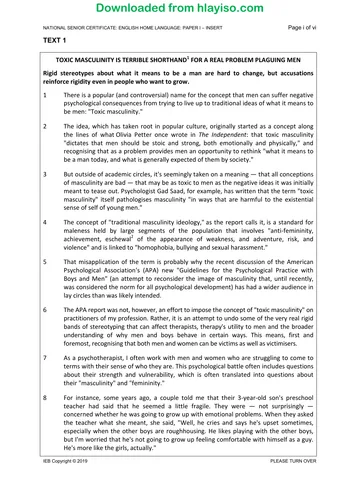
1.1 Using the term "shorthand" implies that a full understanding of the issues
facing men has not been achieved and that the problem has been
oversimplified.
[For 2 marks there needs to be an understanding of "shorthand".]
1.2 The term draws on stereotypes and often labels men who are trying to
change these stereotypes. It is a very broad term that defines masculine
behaviour too loosely and does not necessarily identify the types of
behaviour that are considered toxic and therefore simply labels all male
behaviour as being so.
[Candidates must deal with why the term could be considered controversial
and that the broadness of the term is problematic. Must deal with
stereotypes.]
1.3 1.3.1 The term was originally intended to highlight the societal
expectations that men felt pressured to subscribe to and was
intended to act as a label for the behaviour that should be avoided.
The term was intended to empower men to be able to identify and
steer clear of "toxic" behaviour.
[Candidates must use their own words. If candidates argue that the
term disempowers men, give credit. The response must be well
substantiated.]
1.3.2 The word implies that toxic masculinity has a life of its own – that it is
passed down from one generation to the next and does not leave
much space to evaluate the impact that it has on one. Many men find
it difficult to think outside of this framework and opt for an alternative
way of being.
[Candidates must make overt reference to the text.]
1.4 1.4.1 The original intention of the report was to inform psychologists so
that they could be better equipped to treat men from various walks of
life and not fall into the trap of stereotyping masculine behaviour.
1.4.2 The APA report was distributed beyond its intended audience and
became part of the mainstream, which led to the widespread usage
of the term "toxic masculinity". She is trying to make it clear that the
term was never meant to be used as an affront.
IEB Copyright © 2019 PLEASE TURN OVER
Downloaded from hlayiso.com
NATIONAL SENIOR CERTIFICATE: ENGLISH HOME LANGUAGE: PAPER I – MARKING GUIDELINES Page 3 of 12
1.5 By placing these words in inverted commas it would serve to undermine the
idea of struggling and battling with their identity. It would imply the opposite.
This would then negate the necessity for people to see a psychologist as
the issues stated in the paragraph would not exist. The men and women
referred to would feel comfortable with who they are and not need to
unpack anything with a psychologist. They would be comfortable with their
strengths and vulnerabilities and would have no identity issues.
[Candidates must make overt reference to the words "struggling" and
"battle" and link them to the paragraph. The shift must be dealt with overtly.
If it is only implied, then award 1½ marks.]
1.6 [Candidates must take a stance on whether or not the writer positions
herself convincingly or not. A maximum of 3½ marks may be awarded if
candidates have dealt with how she positions herself excellently. There may
be candidates who present a counter-argument – be open-minded.]
The writer is trying to position herself as an expert in the field of psychology.
It is important within the context of this article as she needs to establish
herself as an expert in the field and that the opinions that she holds are
therefore professional and divorced from any emotionalism connected to
the term. She tries to straddle the line between trying to inform and not to
offend those who have strong feelings on the topic. The repetition of her
role is therefore important to maintain the reader's perspective.
1.7 The writer may balk at the image of masculinity being portrayed and would
question the stereotypical nature of the message being conveyed. The
image only addresses one type of masculinity and does not consider that
masculinity is more nuanced than the image and the text attached to it
suggests. The bearded man smoking a pipe and eating razors excludes
other expressions of masculinity and excludes men who are perhaps not as
hirsute or "tough".
[Candidates must draw on both the article and the meme in their discussion
and must link the two intelligently. Overt reference must be made to both
texts and answers must be well synthesised for full marks to be awarded.]
IEB Copyright © 2019 PLEASE TURN OVER
Downloaded from hlayiso.com
NATIONAL SENIOR CERTIFICATE: ENGLISH HOME LANGUAGE: PAPER I – MARKING GUIDELINES Page 4 of 12
QUESTION 2 SUMMARY
Global marking, giving credit for concise and coherent sentences expressed in the
candidate's own words.
Very good Good Average Below average Very weak
10 8 6½ 5 3
9 7½ 6 4½ 2
8½ 7 5½ 4 1
Very Good: Candidates producing a very good summary, which has adhered to
all instructions, will demonstrate that they can successfully select relevant
information from the different parts of the texts. Candidates will expertly synthesise
that information to suit the new context and fulfil the specific requirements of the
summary task. The register will be consistently appropriate, and the summary will
stand alone as a successful, cohesive text. Expression will be excellent and will
demonstrate a mastery of the language. Full and coherent sentences will be used
resulting in a well-crafted, stylistically superior text. A summary in this category
that exceeds the word limit can be awarded a maximum of 9 marks.
Good: A candidate producing a good summary will be able to discern which
aspects of the texts are relevant, and will be able to synthesise these and convey
them in his/her own words. The summary will successfully meet most of the
requirements specified in the instructions. Candidates will use the appropriate
register and this will be well-sustained throughout the summary. The expression in
such summaries will demonstrate clarity that is not evident in the average
summary. Full and coherent sentences will be used and will be well-sustained
throughout the summary. A summary in this category that exceeds the word limit
can be awarded a maximum of 7 marks.
Average: A candidate producing an average summary will demonstrate an ability to
discern which aspects of the texts are relevant, and will be able to put these into
his/her own words most of the time. The summary might not take into
consideration the most important requirements specified in the instructions.
There may be instances of lifting or lapses that display faulty selection, the incorrect
emphasis, or difficulty with synthesis. The register will mostly be appropriate for the
task although minor lapses may occur. Expression will be merely competent and
there may be lapses in the construction of full sentences. A summary in this
category that exceeds the word limit can be awarded a maximum of 5½ marks.
Below average: A candidate producing a below average summary will demonstrate
an ability – some of the time – to discern which parts of the texts are relevant, but may
not be able to put this into his/her own words effectively. In some instances, large
sections of the original texts will be lifted and reproduced. It is likely that the register
will not be appropriate or that the new text will not meet the requirements of the task.
Expression is likely to be flawed but will not impede understanding. A summary in this
category that exceeds the word limit can be awarded a maximum of 4 marks.
Very Weak: Summaries in this category will show extremely limited – if any –
understanding of the texts. This will be evident through an inability to select
appropriate parts of the texts to summarise or through excessive cutting and
pasting. Register will not be appropriate. Expression is likely to be poor, impeding
understanding.
• Stop reading from 10 words over the word count.
• Subtract 1 mark:
‒ if no word count is provided, or
‒ if an inexcusably inaccurate word count has been provided.
[The summary must reflect the opening words of a debate.]
IEB Copyright © 2019 PLEASE TURN OVER
Downloaded from hlayiso.com
NATIONAL SENIOR CERTIFICATE: ENGLISH HOME LANGUAGE: PAPER I – MARKING GUIDELINES Page 5 of 12
QUESTION 3 SEEN POETRY
3.1 The speaker makes use of the metaphor of people knocking on her front
door to gain access to her thoughts as a means to express how vulnerable
she feels. It contributes to the coy/teasing/playful tone of the poem by
ignoring the obvious pleas of the listener for her to reveal her secret.
[Candidates must explain the metaphor for 2 marks.]
3.2 The speaker makes use of the characteristics of each season to convey her
own development as the poem progresses. Winter is presented as a
dangerous season, something to be protected from. Spring is an uncertain
time, unpredictable. The speaker is mistrustful of spring as it is neither hot
nor cold, even though it is a time when new life comes into being. The
speaker suggests that summer is the season in which her secret is most
likely to be revealed and she therefore stands unprotected and exposed
and therefore the audience may guess her secret.
[Candidates must engage with the seasons and what they may represent.
Credit must be given to candidates who argue the opposite point of view.]
3.3 The use of the personal pronouns contribute to the reader's understanding
that the secret referred to by the speaker is an intensely personal thing and
that it is possibly closely linked to her identity. Give credit if candidates have
correctly identified "my" as a possessive adjective.
3.4 One's impression when reading the poem may be that the speaker is simply
teasing the reader and does not intend to say anything significant at all, that
her secret may simply be "just my fun". There may be no secret ("none") or
she may just be speaking "nonsense". The fact that there may be "no secret
after all" would reflect the original title of the poem correctly and the use of
the original title would also indicate to the reader that the speaker will not
reveal anything at the end of the poem.
[Candidates must deal with both titles. If only one is dealt with and it is done
very well, they may be awarded a maximum of 2½ marks.]
3.5 "My Secret" makes use of assumed questions to which the speaker
responds. She refers to the characteristics of each season in providing
reasons for why she cannot reveal her secret. Each stanza reveals specific
insights into why she will not reveal her secret. The use of punctuation in
"My Secret" also slows down the pace at which the poem is read and
emphasises how painstaking it may be to draw the secret out of the
speaker, a secret which may not even exist. In "Rain After Drought" the
speaker is having a very different experience of the social gathering to
everyone else. The use of rhyme emphasises the rhythmic falling of the rain
and the fact that she is isolated within herself. The variation of the rhyme
scheme in the final stanza and the placement of the final line of the poem
emphasises her isolation. Both speakers are isolated in the sense that they
are carrying something that they cannot express to those around them.
[This is a comparative response – candidates must refer to the structural
elements of both poems in their response. They must also be clear to
indicate which poem conveys the poet's intention more powerfully. Award 4
marks if a candidate addresses all the elements of the question and displays
an overt understanding of which poem conveys the poet's intention more
powerfully. If a candidate makes reference to both poems and displays a
IEB Copyright © 2019 PLEASE TURN OVER
Downloaded from hlayiso.com
NATIONAL SENIOR CERTIFICATE: ENGLISH HOME LANGUAGE: PAPER I – MARKING GUIDELINES Page 6 of 12
sound understanding of how the structure of the poem contributes to the
writer's intention, but fails to make an overt choice, only 3½ marks may be
awarded. If both poems are referred to coherently, a choice is made, but a
flawed understanding of how structure drives intention is provided, 3 marks
may be awarded for a well-synthesised response. Elements that may be
discussed under structure could include: the varied length of stanzas, length
of lines, repetition, the use of clauses, punctuation, indentation of lines, the
use of direct speech, enjambment, dramatic monologue.]
QUESTION 4 UNSEEN POETRY
4.1 The speaker finds himself standing at the end of a driveway on a country
road at the end of the day. The speaker has removed himself from what he
has been doing to go out and admire the evening sky. The speaker
becomes aware of the enormity of the heavens as he looks over towards
his neighbour's farm and notices that the stars provide so much light that all
else appears silhouetted against them. Everything appears to find its
meaning in the light of the stars as they illuminate the countryside.
4.2 The use of alliteration emphasises specific words and phrases to draw our
attention to them. In stanza 1 the speaker draws the reader's attention to
the alliteration in "bare branches", the "shirt sleeves" and the "black banks"
of the river. All of these elements are mentioned in contrast to the brilliance
of the night sky. The repetition of these consonants provides a steady
rhythm which contributes to the meditative mood of the poem.
4.3 He marvels at the sheer number of stars in the sky and how they permeate
everything in the darkness. They stand in stark contrast to him, a lonely
figure on a country road, trying to escape the mundanity of everyday life.
The speaker describes the manner in which he looks up at the sky
"straining my head back like a boy drinking rain/to see more of them, star
behind star" which illustrates his fixation with them.
[Allow for a variety of well-substantiated responses. Candidates must quote
from the text.]
4.4 The extensive use of commas throughout stanza 2 slow down one's reading
of the poem and draws one's attention to the descriptions of the night sky.
No full stops are used which links all the speaker's thoughts to one another
like a stream of consciousness, revealing the connection that he feels to
something that is bigger than him at that point in time.
4.5 The diction used in "Stars" is very descriptive and evokes a sense of being
present in that space with the speaker. The use of the present tense and
personal pronouns creates a relatable immediacy in the poem and draws
the reader in. The tone is pensive/contemplative and provides the sense
that the speaker could be Everyman. The speaker in "When I Heard the
Learn'd Astronomer" is portrayed as being world-weary ("I became tired and
sick") at the sound of all the analysis and dissection of the universe by the
expert. However, there is a shift in the tone in line 7 when he glides out of
the room to admire the stars and he is inspired by them.
[Candidates must make overt reference to the diction and tone of both
poems and answers must be well-synthesised to be awarded full marks.]
IEB Copyright © 2019 PLEASE TURN OVER
Downloaded from hlayiso.com
NATIONAL SENIOR CERTIFICATE: ENGLISH HOME LANGUAGE: PAPER I – MARKING GUIDELINES Page 7 of 12
QUESTION 5 VISUAL AND CRITICAL LITERACY
5.1 5.1.1 The intention of the Facebook post is to draw attention to the belief
that Anti-Vaxxers have: that those who advocate for vaccinating their
children do so without all the information. This has been conveyed
through the use of clever visuals (the person peering over the text
box with wide eyes) and the speech bubble indicating that the Pro-
Vaxxer in the image has never read a package insert for medication.
The image is important as it drives the intention of the social media
post.
5.1.2 That they are ignorant and place their children at risk because they
do not know all the facts.
5.1.3 [Candidates' responses should show whether the advertiser gains
credibility or loses it. Credit valid alternative responses.]
Critical, condemnatory, sarcastic, patronising (any valid response
that conveys the sense that Pro-Vaxxers are being presented in a
negative light). This has been achieved by posting a long explanation
of what a package insert is and it comes across as being very
patronising. The words "never even" in the caption suggest that Pro-
Vaxxers are ignorant and the question in the speech bubble also
contributes towards this impression.
5.1.4 It suggests that the information provided on the package insert may
be inaccurate, one-sided and not researched rigorously enough to be
taken seriously. The alleged one-sided nature of the research is part
of the reason why Anti-Vaxxers choose not to vaccinate their
children and distrust the information provided on package inserts.
[Candidates must deal with "biased" and "limited" in their response.]
5.2 5.2.1 Text 4 provides a rebuttal against the information provided in Text 3.
It portrays Anti-Vaxxers in a negative light and presents information
in simple terms so that it can be easily understood by those who
disagree and makes a mockery of the intelligence of Anti-Vaxxers.
5.2.2 The tone is grimly mocking/cynical/sardonic/patronising/demeaning.
The conversational style of the advertisement reinforces the idea that
there is a debate of sorts taking place and that the Pro-Vaxxers are
trying to educate the uneducated Anti-Vaxxers. The use of statistics
and diagrams could be considered over-the-top but serves to
illustrate the point that the Anti-Vaxxers require as much help as they
can get to understand the importance of vaccinating their children.
The "voice" of the Anti-Vaxxer sounds all-knowing ("Clearly") but is
corrected by the Pro-Vaxxer in a magnanimous manner.
IEB Copyright © 2019 PLEASE TURN OVER
Downloaded from hlayiso.com
NATIONAL SENIOR CERTIFICATE: ENGLISH HOME LANGUAGE: PAPER I – MARKING GUIDELINES Page 8 of 12
5.3 Both parties have adopted a rather cutting approach in that they make use
of sarcasm ("a guide for anti-vaxxers, so easy a 5th grader could understand
it"). Text 3 relies on a more academic approach in that the advertiser tries to
educate Pro-Vaxxers about the importance of reading the package insert
before vaccinating their children, whilst the Pro-Vaxxers (Text 4) make use
of easily understandable/accessible text and visuals to explain how
infectious diseases are spread. Text 4 also makes use of statistics to
strengthen the argument for vaccination and imply that Pro-Vaxxers do not
understand how dangerous it is to not vaccinate. Text 4 presents Pro-
Vaxxers as the voice of reason and responsibility whilst Text 3 presents
Pro-Vaxxers as being irresponsible and ignorant. In terms of layout,
candidates may choose to discuss the positioning of the speech bubble in
Text 3, and in Text 4 they may discuss how the images are laid out.
[Credit valid alternative responses.]
5.4 Candidates may be given credit if they mention that the image works as a
visual pun. Also accept irony, parody and satire.
'Measles' is a play on words on Beatles (the band), as they did have a
Reunion Tour during which they played at a number of venues. This would
be considered a welcome occurrence by Beatles fans and contradicts the
notion of a reoccurrence of a measles outbreak, which would be most
unwelcome.
If candidates choose irony, they may explain that a reoccurrence of a
measles outbreak is not a welcome phenomenon and that it would be the
result of people not vaccinating their children. They may make reference to
the slogan "Unvaccinated!Life 2019" on the T-shirt to emphasise the
consequences of not vaccinating children.
IEB Copyright © 2019 PLEASE TURN OVER
Downloaded from hlayiso.com
NATIONAL SENIOR CERTIFICATE: ENGLISH HOME LANGUAGE: PAPER I – MARKING GUIDELINES Page 9 of 12
QUESTION 6 LANGUAGE
6.1 The repetition of the word "five" echoes the number of words used in each
sentence and reinforces the idea that repetition (if overused) can become
tedious.
6.2 monotony/monotone – Accept any grammatically correct sentence.
6.3 its – it's
6.4 The repeated use of "and" at the start of sentences creates a less formal
register and enhances the conversational style of the text.
6.5 The passage starts off with very basic, simple sentences that emphasise
the monotony of the writing. As the passage progresses the sentences
become longer and more complex, which reinforces the point that he is
trying to make about using varying sentence types to keep one's writing
interesting. Candidates must understand the difference between simple and
complex sentences.
6.6 The ellipsis in this instance indicates that more information is to follow/
creates a pause which mimics the silence that is being called for by the
words "Now listen …". It also reinforces the point that the writer is trying to
make about varying one's sentence structure to create more interesting,
nuanced sentences.
[Award 1 mark for use and 1 mark for effect. Marks may be awarded for
"dramatic pause".]
Total: 100 marks
IEB Copyright © 2019 PLEASE TURN OVER
Downloaded from hlayiso.com
NATIONAL SENIOR CERTIFICATE: ENGLISH HOME LANGUAGE: PAPER I – MARKING GUIDELINES Page 10 of 12
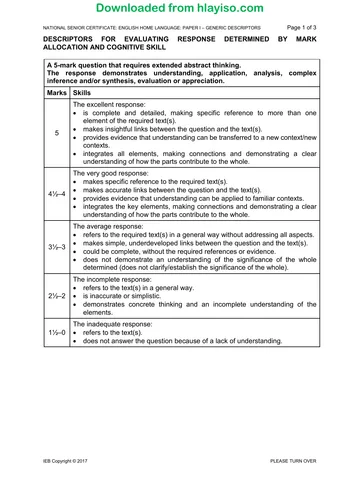
DESCRIPTORS FOR EVALUATING RESPONSES DETERMINED
BY MARK ALLOCATION AND COGNITIVE SKILL
A 5-mark question that requires extended abstract thinking.
The response demonstrates understanding, application, analysis, complex
inference and/or synthesis, evaluation or appreciation.
Marks Skills
The excellent response:
• is complete and detailed, making specific reference to more than one
element of the required text(s).
5 • makes insightful links between the question and the text(s).
• provides evidence that understanding can be transferred to a new context.
• integrates all elements, making connections and demonstrating a clear
understanding of how the parts contribute to the whole.
The very good response:
• makes specific reference to the required text(s).
• makes accurate links between the question and the text(s).
4–4½
• provides evidence that understanding can be applied to familiar contexts.
• integrates the key elements, making connections and demonstrating a
clear understanding of how the parts contribute to the whole.
The average response:
• refers to the required text(s) in a general way without addressing all aspects.
• makes simple, underdeveloped links between the question and the text(s).
3–3½
• could be complete, without the required references or evidence.
• does not demonstrate an understanding of the significance of the whole
determined (does not clarify/establish the significance of the whole).
The incomplete response:
• refers to the text(s) in a general way.
2–2½ • is inaccurate or simplistic.
• demonstrates concrete thinking and an incomplete understanding of the
elements.
The very partial response:
1–1½ • refers to the text(s).
• does not answer the question because of a lack of understanding.
The inadequate response:
0–1 • attempts to deal with only one aspect of the question, but does so very
poorly. Very limited understanding displayed.
IEB Copyright © 2019 PLEASE TURN OVER
Downloaded from hlayiso.com
NATIONAL SENIOR CERTIFICATE: ENGLISH HOME LANGUAGE: PAPER I – MARKING GUIDELINES Page 11 of 12
A 4-mark question that requires relational thinking.
Demonstrates understanding, application, analysis, complex inference or
synthesis. This answer could require evaluation or appreciation.
Marks Skills
The excellent response:
• is complete, addressing all aspects of the question and drawing them
together accurately.
4 • links all the ideas and provides the required evidence.
• demonstrates understanding applied to familiar contexts.
• integrates all elements, making connections and demonstrating a clear
understanding of how the parts contribute to the whole.
The good response:
• shows that the significance of each element is understood, but an aspect
of the answer is not clearly explained.
3–3½ or
• addresses each element, but does not successfully link them.
• is not entirely convincing and/or does not convey a clear understanding of
how the parts contribute to the whole.
The average response:
• is multi-structural, but addresses the elements in an incomplete or flawed
way.
2½
• does not link elements or does not demonstrate an understanding of the
significance of the elements.
• omits or misunderstands a key element.
The incomplete response:
2 • is one-dimensional, omitting more than one element.
• indicates a flawed understanding of the question and/or the text(s).
The very partial response:
• attempts to address aspects of the question, but indicates only partial
1–1½
understanding.
• does not answer the question because of a lack of understanding.
The inadequate response:
0–1 • attempts to deal with only one aspect of the question, but does so very
poorly. Very limited understanding displayed.
IEB Copyright © 2019 PLEASE TURN OVER
Downloaded from hlayiso.com
NATIONAL SENIOR CERTIFICATE: ENGLISH HOME LANGUAGE: PAPER I – MARKING GUIDELINES Page 12 of 12
A 3-mark question that requires multi-structural thinking.
Demonstrates understanding, application, analysis, inferential comprehension of
implied and figurative meanings
Marks Skills
The excellent response:
• engages with all aspects of the question and provides the required
3
evidence.
• indicates a clear understanding of the significance of each element.
The good response:
• is multi-structural, but not integrated.
2½ or
• is convincing but incomplete.
• provides evidence if required.
The average response:
• is either one-dimensional, without sufficient evidence, or is superficial and
2 general.
• does not provide enough relevant justification.
• demonstrates that the candidate understands the issue.
The incomplete response:
• demonstrates a flawed or incomplete understanding of what has been
asked.
1½
• indicates an understanding of the text/s.
• attempts to use the text/s to answer the question, but reasoning is concrete
or simplistic.
The inadequate response:
0–1
• indicates only partial/limited/no understanding of this aspect of the text/s.
A 2-mark question that requires uni-structural thinking.
Demonstrates understanding and application, literal comprehension and
reorganisation
Marks Skills
The excellent response:
2
• is complete and accurate.
The good response:
• is partially complete and accurate.
1½
or
• is complete and mostly accurate.
The incomplete response:
0–1
• Includes only one half of the required response or is inaccurate.
IEB Copyright © 2019
Study this subject
Revise the topics in this paper, then practise them question by question.
- Grade 12 English Hl notes
CAPS revision notes with worked examples.
- English Hl questions by topic
Past exam questions sorted by CAPS topic, with memos where available.
- All Grade 12 English Hl past papers
Past papers by year, with memos where available.
- Grade 12 IEB past papers
More English HL and other subjects in this collection.
Recommended for this subject
More papers and memos for this grade and subject.
MemorandumIEB
English HL Grade 12 IEB Paper 2 2019 Memo
MemorandumIEB
English HL Grade 12 IEB Paper 1 2018 Memo
MemorandumIEB
English HL Grade 12 IEB Paper 2 2018 Memo
MemorandumIEB
English HL Grade 12 IEB Paper 1 2017 Memo
MemorandumIEB
English HL Grade 12 IEB Paper 2 2017 Memo
MemorandumIEB
English HL Grade 12 IEB Paper 1 2016 Memo
Related documents
Question paperIEB
English HL Grade 12 IEB Paper 1 2019 Question Paper
AddendumIEB
English HL Grade 12 IEB Paper 1 2019 Addendum
Question paperIEB
English HL Grade 12 IEB Paper 2 2019 Question Paper
Question paperIEB
English HL Grade 12 IEB Paper 1 2018 Question Paper
AddendumIEB
English HL Grade 12 IEB Paper 1 2018 Addendum
Question paperIEB
English HL Grade 12 IEB Paper 1 2017 Question Paper
More from Grade 12 English HL
Question paperIEB
English HL Grade 12 IEB Paper 2 2018 Question Paper
Question paperIEB
English HL Grade 12 IEB Paper 2 2017 Question Paper
Question paperIEB
English HL Grade 12 IEB Paper 1 2017 Question Paper
AddendumIEB
English HL Grade 12 IEB Paper 1 2017 Addendum
Question paperIEB
English HL Grade 12 IEB Paper 1 2016 Question Paper
Question paperIEB