
Downloaded from hlayiso.com
NATIONAL SENIOR CERTIFICATE EXAMINATION
NOVEMBER 2016
ENGLISH HOME LANGUAGE: PAPER I
MARKING GUIDELINES
Time: 3 hours 100 marks
These marking guidelines are prepared for use by examiners and sub-examiners,
all of whom are required to attend a standardisation meeting to ensure that the
guidelines are consistently interpreted and applied in the marking of candidates'
scripts.
The IEB will not enter into any discussions or correspondence about any marking
guidelines. It is acknowledged that there may be different views about some
matters of emphasis or detail in the guidelines. It is also recognised that,
without the benefit of attendance at a standardisation meeting, there may be
different interpretations of the application of the marking guidelines.
IEB Copyright © 2016 PLEASE TURN OVER
Skip to contentMemorandum 
View all
English HL Grade 12 IEB Paper 1 2016 Memo
IEB Grade 12 English HL Paper 1 memorandum from the 2016, 9 pages. Read online or get the free PDF download, question paper linked when available.
Publisher: IEB
English HL · Grade 12 · 2016. Memorandum, 9 pages. Read online or download the PDF.
- Subject
- English HL
- Grade
- Grade 12
- Document type
- Memorandum
- Year
- 2016
- Paper
- 1
- Publisher
- IEB
- Curriculum
- IEB
- Pages
- 9
- File size
- 439.1 KB
Loading document…
Loading document…
1 of 9
Document textSearch extracted text and jump to a page.
Downloaded from hlayiso.com
NATIONAL SENIOR CERTIFICATE: ENGLISH HOME LANGUAGE: PAPER I – MARKING GUIDELINES Page 2 of 9
The Marking Guidelines are to be used in conjunction with the Generic Descriptors.
QUESTION 1 COMPREHENSION
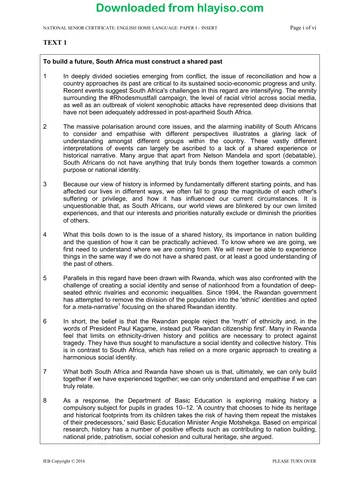
1.1 Paragraph 1 provides a number of examples of divisions: the enmity surrounding
the #Rhodesmustfall campaign, racial hatred on social media and xenophobic
attacks.
[Two examples from paragraph 1. They do not need to be concrete. ONE
generalisation may score 1 mark]
1.2 It can be argued that the diction and tone make the writers very reliable, because of
how invested they are in the topic, or, more likely, that their subjectivity
undermines the reliability of the argument because they have exaggerated. The
emotive diction and use of subjective adjectives and adverbs suggest that the
writers' opinion is based on their personal fears and experiences. Examples are
'massive polarisation', 'alarming inability', 'glaring lack of understanding', 'vastly
different'. Also accept references to generalisations. The tone is one of urgency and
the extent of the divide is expressed in a catastrophic manner, as if their analysis is
indisputable. The comment '(debatable)' is sceptical.
[The answer must refer to both diction and tone and examples should be provided.
The interpretation of reliability must be founded on the examples given. Candidates
can argue either position.]
1.3 1.3.1 By using the words 'our' and 'we', the writers show that they are the same as
the audience, not set apart and therefore not intending to be judgmental.
This softens the readers' attitude and encourages the audience to be more
accepting and understanding, focusing on their similarities and shared
experiences.
[The answer must refer to the readers' attitude, not only the intention or
meaning of the words 'our' and 'we'.]
1.3.2 The writers' message is about how divided South African society is, yet
ironically they are writing about all South Africans and what they have in
common.
1.4 Both South Africa and Rwanda have a background of serious divisions between
racial and ethnic groups, and have had to forge a new society and national identity
in order to leave that past behind. They are also both societies with huge
differences between rich and poor.
[There must be more than one similarity, e.g. similar past and similar challenges in
the present. Award up to 1 mark for an answer that does not use own words. The
word 'meta-narrative' is difficult to replace with own words, so do not penalise.]
IEB Copyright © 2016 PLEASE TURN OVER
Downloaded from hlayiso.com
NATIONAL SENIOR CERTIFICATE: ENGLISH HOME LANGUAGE: PAPER I – MARKING GUIDELINES Page 3 of 9
1.5 The 'rainbow nation' meta-narrative is positive because it appeals to 'universal
truths' or 'universal values' by using the rainbow as an image with positive
connotations of hope and beauty to construct an identity for South African citizens.
It can also be negative if it is an overriding device that legitimises power and
culture without allowing individual narratives. The story of the 'rainbow' nation has
been used as a meta-narrative in the tourist board material, glossing over the
divisions and oversimplifying the painful struggle for unity.
[The answer should clearly examine whether or not the 'rainbow nation' image is
positive or negative, looking at the complexity in Extract A and demonstrating a
sound understanding of meta-narrative. The answer does not have to evaluate both
aspects and the image can be portrayed as either positive or negative, or both. The
answer must demonstrate a thorough understanding of the rainbow image and of
meta-narrative and quote from both extracts. If there is no quotation from the
extracts (NOT Text 1) maximum 3½ marks]
1.6 'Manufacture' implies a process that is predictable, carefully planned and managed
and inflexible. It suggests that the process of reconciliation was overseen by the
government, standardised and implemented through conscious and deliberate
actions. 'Organic' implies something natural, that grows and takes shape if it is
nurtured. In contrast to the top-down approach in Rwanda, 'organic' suggests that
South African efforts at reconciliation were left to emerge from the people and take
shape in response to the environment, to grow and change as necessary.
[The answer must provide specific connotations for each word, relate them to the
process of reconciliation and point out the contrast between the two.]
1.7 The semicolon balances the two ideas expressed in these two sentences, making the
two points closely related and dependent on each other in a way that would not be
so apparent if the sentences were written separately. The second sentence can be
viewed as an explanation of the first. They have a cumulative, dramatic effect by
being written without a full stop.
[Award 2 marks for any one explanation.]
1.8 Teaching history is intended to contribute to nation building and to enable young
people to learn from our past in order not to repeat the same mistakes. The
Minister of Basic Education argues that it encourages social cohesion and cultural
heritage and therefore builds patriotism and pride. On the other hand, it might not
succeed in uniting young people if not taught carefully. How the history is
communicated could potentially be divisive. Not everyone agrees on the same
narrative.
[The answer should examine both aspects of the argument and refer closely to the
text. There is scope for own VALID perspectives (not just personal opinions)
because of the instruction 'To what extent'.]
1.9 The validity of these words is contested. Doubt is cast over whether there is even
such a thing as truth and objectivity when referring to history.
IEB Copyright © 2016 PLEASE TURN OVER
Downloaded from hlayiso.com
NATIONAL SENIOR CERTIFICATE: ENGLISH HOME LANGUAGE: PAPER I – MARKING GUIDELINES Page 4 of 9
QUESTION 2 SUMMARY THESE WILL BE REWRITTEN FOR 2017 SAGS
FIRST read and allocate it to a category based on content, language, synthesis, etc.
Then, depending on word count and following instructions, it will be placed at the
top, middle or bottom of the category. Do not read over 100 words.) Global marking,
giving credit for concise and coherent sentences expressed in the candidate's own words.
Very Good Good Average Below Average Very Weak
10 8 6½ 5 3
9 7½ 6 4½ 2
8½ 7 5½ 4 1
Very Good: Candidates producing a very good summary, which has adhered to all
instructions, will demonstrate that they can successfully select relevant information from
the different parts of the text. Candidates will expertly synthesise that information to suit
the new context and fulfil the specific requirements of the summary task. The register will
be consistently appropriate, and the summary will stand alone as a successful, cohesive
text. Expression will be excellent and will demonstrate a mastery of the language. Full and
coherent sentences will be used resulting in a well-crafted, stylistically superior text. A
summary in this category that exceeds the word limit can be awarded a maximum of
9 marks. [The summary will successfully meet the requirements specified in the
instructions.] (If it is not a speech, OR if it does not address WHY she was chosen, but
is still a very good summary with the correct register, it is 8 ½ max).
Good: A candidate producing a good summary will be able to discern which aspects of the
text are relevant, and will be able to synthesise these and convey them in his/her own
words. Candidates will use the appropriate register and this will be well sustained
throughout the summary. The expression in such summaries will demonstrate clarity that is
not evident in the average summary. Full and coherent sentences will be used and will be
well sustained throughout the summary. A summary in this category that exceeds the word
limit can be awarded a maximum of 7 marks.
Average: A candidate producing an average summary will demonstrate an ability to
discern which aspects of the text are relevant and will be able to put these into his/her own
words most of the time. There may be instances of lifting or lapses that indicate faulty
selection, the incorrect emphasis, or difficulty with synthesis. The register will mostly be
appropriate for the task although minor lapses may occur. Expression will be merely
competent and there may be lapses in the construction of full sentences. A summary in this
category that exceeds the word limit can be awarded a maximum of 5½ marks.
Below Average: A candidate producing a below average summary will demonstrate an
ability – some of the time – to discern which parts of the text are relevant but may not be
able to put this into his/her own words effectively. In some instances, large sections of the
original texts will be lifted and reproduced. It is likely that the register will not be
appropriate or that the new text will not meet the requirements of the task. Expression is
likely to be flawed but will not impede understanding. A summary in this category that
exceeds the word limit can be awarded a maximum of 4 marks.
Very Weak: Summaries in this category will show extremely limited – if any –
understanding of the text. This will be evident through an inability to select appropriate
parts of the text to summarise or through excessive cutting and pasting. Register will not be
appropriate. Expression is likely to be poor, impeding understanding.
Stop reading from 10 words over the word count.
IEB Copyright © 2016 PLEASE TURN OVER
Downloaded from hlayiso.com
NATIONAL SENIOR CERTIFICATE: ENGLISH HOME LANGUAGE: PAPER I – MARKING GUIDELINES Page 5 of 9
Subtract 1 mark if no word count is provided or if an inexcusably inaccurate word
count has been provided. No penalty if more than one paragraph, only if point form
it will be AVERAGE.
"Penalise" from 94 words by moving the mark to the bottom of the category (see
descriptors). Write words from descriptor to indicate your thinking. Stop reading at
100 words.
QUESTION 3 SEEN POETRY
3.1 The image of the Table Mountain, struck by lightning and on fire, in the days
before Mandela's release suggests some kind of prophetic significance. Although
the heavens didn't fall, the speaker is looking for an omen, which suggests that the
'we' anticipates the enormity of Mandela's release with some anxiety. The image of
flames writhing against the black sky like snakes is dramatic. Snakes are frequently
associated with evil but also with mystical power of rebirth, transformation, and
healing. It suggests that the 'we' was fearful of the unknown after Mandela's release
and could be identified with the voice of white South Africa.
[The answer must analyse at least two elements of the image: e.g. fire and snakes,
and/or perhaps the significance of the lightning and the mountain. This must be
linked to the speaker, speaking on behalf of a group ('we') and the significance of
the imagery for this group should be explored. Many candidates began with line 15.
This may also be accepted as part of the answer. The imagery requirement is half
the question, so no imagery discussed will result in a maximum of 2 marks]
3.2 The repetition that is evident in lines 25 and 33 frames this stanza and works as a
way of conveying certainty, calm and reassurance. The line in the middle is
indented, depicting the only members of the crowd who would be considered 'out
of place', but drawing attention to the fact that even they are in harmony and affirm
the rightness of the event, despite standing out from the crowd by being armed.
[For full marks the answer should identify any two of:
the repetition,
the use of the dash,
the measured use of the commas or general use of punctuation
the use of parenthesis
the indented line
and link these to the meaning. 1 mark for meaning, two marks for
structure.]
3.3 The answer should analyse the possible significance of the hadedah image and draw
a conclusion about whether it unifies or divides South Africans. An appropriate
quotation from the poem should be used to illustrate the reasoning. There must be
enough substantiation to justify full marks. [Watch that the answer refers to the
hadehah as an image, not the poem as divisive or unifying.] A strange
interpretation plus a quotation e.g. xenophobia "exotic" 1 mark.
3.4 The answer should meet all the requirements of the question: an evaluation of each
poem's importance in a contemporary South African context would demonstrate a
clear understanding of the poem's meaning and a link to what it could mean today,
e.g. an important historical moment or an exploration of 'belonging'. Once each
poem has been evaluated, the candidate should argue convincingly for the inclusion
of one of the poems in an anthology. Synthesis and complexity of reasoning should
be rewarded.
IEB Copyright © 2016 PLEASE TURN OVER
Downloaded from hlayiso.com
NATIONAL SENIOR CERTIFICATE: ENGLISH HOME LANGUAGE: PAPER I – MARKING GUIDELINES Page 6 of 9
QUESTION 4 UNSEEN POETRY
4.1 Words are compared to flowers and/or jewels. ½ mark if that is all that is written.
This shows how they are used as decorations, add beauty or are precious.
If this point is well expressed, the answer may be awarded full marks without
including the first point above.
4.2 Words are compared to wild horses galloping beyond the writer's reach. She no
longer sees words as simple decoration but as powerful and this makes them even
more desirable because she wants to capture them and use them. Her attitude has
shifted from adorning herself with words to ploughing with them, harnessing them
to achieve her purposes.
[Identify the metaphor and then discuss how this conveys a shift in attitude.]
4.3 Lines 8 and 9 suggest that through words we can conquer forces that seem to be
overwhelming. If we can't name them, we can't tame them. Poetry can be used as a
means of reconciliation by helping society to name and recognise the forces such as
racism underlying the turmoil. It gives us a shared experience that can create
empathy.
4.4 The poet is mesmerised by the power of words and the possibilities they contain.
She depicts this fascination through her use of sound techniques such as alliteration
and rhyme which enhance the impact of her words, e.g. 'wild words', 'unnameable
to tame', 'noose' and 'loose'.
[Award full marks if candidates identify an example of rhyme and of alliteration
and offer an explanation. There must be convincing reference to the poet's
relationship with words.]
4.5 In Lasso she loves words and wants to capture them and use them, whereas in the
Whitman poem the speaker wants to escape words and leave them behind, staring
up at the sky in silence. Despite these differences, their intentions are the same, as
seen in the image which unites the idea of a lasso with the idea of connecting to the
moon. They both are trying to grasp hold of a pure/real experience of the world – in
the first poem to explore possibilities of meanings and make sense of life. In the
second poem he wants an authentic, personal connection.
[The answer should identify each speaker's different attitude, the overlap between
their intentions and how that is depicted in the image and the poems. The answer
should include close references or quotations from both poems.]
IEB Copyright © 2016 PLEASE TURN OVER
Downloaded from hlayiso.com
NATIONAL SENIOR CERTIFICATE: ENGLISH HOME LANGUAGE: PAPER I – MARKING GUIDELINES Page 7 of 9
QUESTION 5
5.1 5.1.1 In Frame 1, the slogan refers to education in apartheid South Africa and
equal education for black and white, whereas in frame 2 it focuses on equal
opportunities and access to tertiary institutions in particular.
5.1.2 In Frame 1 the closed eyes and open mouths show desperation and
frustration. The faces in Frame 2 have open eyes that appear to be rolling
skyward in irritation. The violent background of armed soldiers, bodies and
smoke from Frame 1 is not apparent in Frame 2 – there is no threatening
police presence in the image. It also differs because of the hashtag,
indicating that this protest also takes place on social media.
[Award 2 marks for detailed discussion of facial expressions. Award 2
marks for two other visual details. Some details mentioned in candidates'
answers may not be in the guidelines. If only the 1976 frame is analysed in
depth compared to the lack of those details in the Today frame, those
answers may also score full marks.]
5.2 Instead of emotion being conveyed through an exclamation mark, the line seems to
be said in a matter-of-fact manner, with an air of resignation/acceptance. If tone is
not mentioned, the answer may be awarded only 1 mark
5.3 5.3.1 The answer could identify any one of the posters as more visually effective.
The discussion of font and layout can refer to neater, densely packed words
with larger words for emphasis (TEXT 4), compared with words that appear
to be written more hastily and with more urgency. TEXT 5 also uses emojis
and symbols in the place of words and has fewer words and more blank
space. The answer can consider these factors in arguing for which is more
effective.
[The answer can focus mainly on the selected poster, but there must be
sufficient comparison of both font and layout. If the answer does not
explicitly refer to both texts, award a maximum of 2 marks.]
5.3.2 In Text 4 the diction calls attention to the 'future' and to the 'brightest minds'
of the country. The use of the more formal diction and the rhetorical
question indicates that the protestor wants to reason with the authorities and
appeal to their logic as well as their imagination. In the first poster in Text 5,
the use of 'R.I.P.' is emotive and it refers directly to death. The short,
ungrammatical statement declares that the students' future is dead, making a
similar point to Text 4, but in a more direct and emotive way. The intention
is to evoke guilt. The second poster in Text 5 is a command. It addresses the
object of the protest directly. It also refers to the future and is emotive by
referring to 'dream'. It uses the arrow symbol instead of the word to indicate
costs rising. The intention here is to express anger.
[For full marks an answer must quote diction and refer to the different
sentence types in each poster. Reference to sentence types should be linked
to the diction discussed. The answer should avoid oversimplifying or
generalising but deal with each poster separately.]
IEB Copyright © 2016 PLEASE TURN OVER
Downloaded from hlayiso.com
NATIONAL SENIOR CERTIFICATE: ENGLISH HOME LANGUAGE: PAPER I – MARKING GUIDELINES Page 8 of 9
5.4 5.4.1 The word 'protestors' positions the reader to take sides and either support or
oppose the students, by focusing on their issues and their role, rather than on
their youth and inexperience which the word 'student' would do. It is
potentially less sympathetic than 'students' because it presents that
participants as hostile, and detracts from the reason why they are protesting,
as if the protest is the only reason for their presence, not as young people
who want to study.
[Award full marks only if the 'how' and 'why' of the question is answered.]
5.4.2 Activists are usually more radical and committed to supporting a cause in
many ways in addition to protesting. Demonstrators picket or protest in a
more passive way at a specific event. The term 'demonstrators' is more
suited to this situation as there is no evidence that these campaigns are
linked to other actions.
[Award 2 marks for a well-reasoned answer that engages with the specific
meaning of the chosen word. 1 mark for the 'activist' section, 1 for the
'demonstrator' section. Both words must be discussed in the answer,
but not necessarily in the same detail.] [The candidate must distinguish
the words successfully, even if the marker does not necessarily agree with
the details of the distinction.]
5.5 In Text 4 'our' refers to the country/the audience and protestors collectively (1
mark), whereas in Text 5 'our' refers to the students alone (1 mark). [Very few other
answers are likely to be permissible.]
5.6 It is an abbreviation of the phrase 'rest in peace'. It is not pronounced as the word
'rip', therefore it is not an acronym.
[Award ½ mark for abbreviation and ½ mark for the reason. Does not need to
mention acronym]
[The answer does not need to include the meaning of 'rest in peace'.]
5.7 It turns a verb into a participle (or non-finite verb) OR it indicates the continuous
aspect OR it converts the word into a gerund/ verbal noun.
[The full mark is for a grammatical term. Award ½ a mark for an answer that
expresses meaning e.g. it is happening now or it is ongoing].
IEB Copyright © 2016 PLEASE TURN OVER
Downloaded from hlayiso.com
NATIONAL SENIOR CERTIFICATE: ENGLISH HOME LANGUAGE: PAPER I – MARKING GUIDELINES Page 9 of 9
QUESTION 6
6.1 The word 'humble' is the opposite of 'brag', therefore, two contradictory words are
side by side.
6.2 humblebrag: noun A boastful statement, which can be interpreted as a complaint or
a plea for sympathy, but actually reveals the speaker's privilege. [Origin: English
neologism in recent English, popular in social media, consisting of the words
humble+brag]
OR
humblebrag: verb A neologism often used in social media. Boasting in an indirect
way, by sounding as if you are complaining or asking for sympathy. [Origin:
English neologism consisting of the words humble+brag]
[Note that:
the part of speech (1 mark) must match the way it is defined or it receives no
marks.
1 mark for the meaning only.
an answer may be awarded the 3rd mark for explaining the concept of
neologisms well and not mention the origin – see example 2 above.
The answer does not have to be set out in the typical dictionary format.]
6.3 I was impressed by the celebrity's humility/humbleness. (the word alone is ½ a
mark, the word in context is 1 mark even if it's not a proper sentence)
6.4 6.4.1 Accept either: I find it so hard to buy clothes that fit me OR
I find it so hard to buy clothes
6.4.2 Sentence A is more effective as an example of a humblebrag because it
leads with the problem or a plea for sympathy. Sentence B may alienate the
listener by starting with a perceived boast.
If Sentence B is proposed, may be awarded 1 mark for a good reason that
indicates an understanding of the term.
6.5 Graduating from two universities (1) means you get double the calls asking for
money. (1) They get really pushy too!
OR
Graduating from two universities (1) means you get double the calls asking for
money; (1) they get really pushy too!
OR a co-ordinating conjunction can be added.
[Ignore additional changes or errors that have been included.]
Total: 100 marks
IEB Copyright © 2016
Study this subject
Revise the topics in this paper, then practise them question by question.
- Grade 12 English Hl notes
CAPS revision notes with worked examples.
- English Hl questions by topic
Past exam questions sorted by CAPS topic, with memos where available.
- All Grade 12 English Hl past papers
Past papers by year, with memos where available.
- Grade 12 IEB past papers
More English HL and other subjects in this collection.
Recommended for this subject
More papers and memos for this grade and subject.
MemorandumIEB
English HL Grade 12 IEB Paper 1 2019 Memo
MemorandumIEB
English HL Grade 12 IEB Paper 2 2019 Memo
MemorandumIEB
English HL Grade 12 IEB Paper 1 2018 Memo
MemorandumIEB
English HL Grade 12 IEB Paper 2 2018 Memo
MemorandumIEB
English HL Grade 12 IEB Paper 1 2017 Memo
MemorandumIEB
English HL Grade 12 IEB Paper 2 2017 Memo
Related documents
Question paperIEB
English HL Grade 12 IEB Paper 1 2016 Question Paper
AddendumIEB
English HL Grade 12 IEB Paper 1 2016 Addendum
MemorandumIEB
English HL Grade 12 IEB Paper 2 2016 Memo
Question paperIEB
English HL Grade 12 IEB Paper 2 2016 Question Paper
Question paperIEB
English HL Grade 12 IEB Paper 1 2019 Question Paper
AddendumIEB
English HL Grade 12 IEB Paper 1 2019 Addendum
More from Grade 12 English HL
Question paperIEB
English HL Grade 12 IEB Paper 2 2019 Question Paper
Question paperIEB
English HL Grade 12 IEB Paper 1 2018 Question Paper
Question paperIEB
English HL Grade 12 IEB Paper 2 2018 Question Paper
AddendumIEB
English HL Grade 12 IEB Paper 1 2018 Addendum
Question paperIEB
English HL Grade 12 IEB Paper 1 2017 Question Paper
Question paperIEB