
Downloaded from hlayiso.com
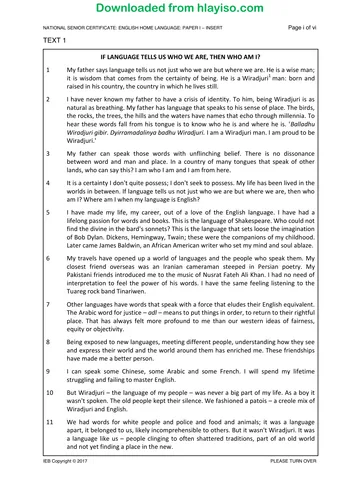
NATIONAL SENIOR CERTIFICATE EXAMINATION
NOVEMBER 2017
ENGLISH HOME LANGUAGE: PAPER I
MARKING GUIDELINES
Time: 3 hours 100 marks
These marking guidelines are prepared for use by examiners and sub-examiners,
all of whom are required to attend a standardisation meeting to ensure that the
guidelines are consistently interpreted and applied in the marking of candidates'
scripts.
The IEB will not enter into any discussions or correspondence about any marking
guidelines. It is acknowledged that there may be different views about some
matters of emphasis or detail in the guidelines. It is also recognised that,
without the benefit of attendance at a standardisation meeting, there may be
different interpretations of the application of the marking guidelines.
IEB Copyright © 2017 PLEASE TURN OVER
Skip to contentMemorandum 
View all
English HL Grade 12 IEB Paper 1 2017 Memo
IEB Grade 12 English HL Paper 1 memorandum from the 2017, 11 pages. Read online or get the free PDF download, question paper linked when available.
Publisher: IEB
English HL · Grade 12 · 2017. Memorandum, 11 pages. Read online or download the PDF.
- Subject
- English HL
- Grade
- Grade 12
- Document type
- Memorandum
- Year
- 2017
- Paper
- 1
- Publisher
- IEB
- Curriculum
- IEB
- Pages
- 11
- File size
- 189.8 KB
Loading document…
Loading document…
1 of 11
Document textSearch extracted text and jump to a page.
Downloaded from hlayiso.com
NATIONAL SENIOR CERTIFICATE: ENGLISH HOME LANGUAGE: PAPER I – MARKING GUIDELINES Page 2 of 11
The Marking Guidelines are to be used in conjunction with the Generic
Descriptors.
QUESTION 1 COMPREHENSION
1.1 The father knows who he is and where he comes from. His language
connects him to the land where he lives and ensures continuity with the past.
[Two factors that are linked to language and identity. Quotations with no
explanation are awarded a maximum of 1½ marks].
Who is linked to language; where is linked to origin.
1.2 The rhetorical question shows that Australia is a country filled with many
immigrants and citizens, with ancestral origins in other countries. It implies
that not many people know who they really are because they are
disconnected from where they come from.
[Award a maximum of 1 mark for the concept of immigrants or family origins
from other countries.]
• Not their own language;
• Many languages;
• Distanced from your heritage;
• Speaking a language not linked to your origin;
• Not your 'place'.
• Candidates must make reference to his father in answering the
question.
• Must address the disconnect between language and identity.
1.3 Since the writer's main language is English, he struggles to pinpoint a
specific origin and identity or sense of belonging. This is because English is
not an indigenous Australian language but is spoken internationally by
many different cultures.
[To achieve full marks the answer should explore the role of language
linked to place and identity and explain why English complicates these
categories.]
[Award a maximum of 1½ marks for an answer that relies too heavily on the
text.]
• English is divorced from identity because of the different cultures;
• Do not have to include Australian.
1.4 The writer describes his passion for words, literature, poetry, music and
song. He writes of how these inspired him throughout his life. He also
describes international travel and the close connections he made with
diverse people. His experiences portray him as creative, cosmopolitan,
open-minded and friendly. He seems to be insightful and artistic. He is
deeply moved by words and the sound of them, as well as by music. He is
friendly and adventurous.
[For full marks the answer should identify key elements of the writer's
experiences such as his literary influences, travel and friendships and link
these to conclusions about his character. The answer should express an
opinion of the writer based on the information he shares.]
Focus on his response to language; diversity of his experiences – link that
to character.
IEB Copyright © 2017 PLEASE TURN OVER
Downloaded from hlayiso.com
NATIONAL SENIOR CERTIFICATE: ENGLISH HOME LANGUAGE: PAPER I – MARKING GUIDELINES Page 3 of 11
1.5 The answer can be 'yes' or 'no'. It could be slang because the text states
that outsiders would not have understood it and it belonged to the users.
OR
A creole is a mixed version of a language that is a separate phenomenon from
slang. It is simply a mixture of languages that can be equated to a dialect.
[The answer can be either 'yes' or 'no' and does not need to consider both
options. It could demonstrate a sound understanding of the definition of
slang and evaluate the patois in that light (in relation to slang), or it could
engage soundly with the meaning of patois as a dialect. The reasoning
must be consistent.]
Must understand that outsiders are 'othered' by the use of slang …
Mixture of languages = dialect
No mark awarded for simply saying slang or dialect.
1.6 When the writer was young, the language had a low status. It was not
spoken by the elders and the young people used it in a casual way. It
seemed old, as if it was dying. There was a hostile attitude because it was
seen as a threat or as unacceptable in town. This attitude shifted over time.
More recently there is a sense of pride in using it, connecting people and
showing a sense of belonging and identity. It has become an important tool
of resistance and liberation.
The attitude shifts from hostile to proud. Should engage with what the
attitude was and why, and what it changes to, and why.
1.7 The inverted commas show that the writer questions the idea of traditional
names or casts doubt over the term or the origin of the names. He does not
fully agree with the term or the use – there is some ambivalence towards
the idea.
Critical, judgemental, disapproval, ambivalence …
[If the answer focuses on quoting, he could simply be signalling that this is
how the names are termed by those who use them, but then he is still
separating himself by showing this is not his own word. His attitude must be
acknowledged in the answer for full marks].
1.8 In paragraph 11 the pronouns indicate how the writer identifies completely
with the Wiradjuri as his own people when he is young, by using 'we' and
'us'. In paragraph 13 he writes of the Wiradjuri who have reclaimed their
language, names and identity, but he uses the pronoun 'they' to refer to
them. He has distanced himself from the group because he does not see
himself as primarily one of them. When he speaks of colonial names 'they'
were born with, he separates himself, despite his own name.
Must refer to personal pronouns overtly. Must discuss in relation to when he
was young and when he was older.
IEB Copyright © 2017 PLEASE TURN OVER
Downloaded from hlayiso.com
NATIONAL SENIOR CERTIFICATE: ENGLISH HOME LANGUAGE: PAPER I – MARKING GUIDELINES Page 4 of 11
1.9 The quotation refers to the part of his identity that is essentially 'him' and
cannot be erased or replaced, so he has some certainty and does not feel
that he will lose or betray his origins or 'ancestors and … family' by turning
into something else. This is despite the fact that he values all the different
'layers' of his identity and has carved out a place for himself. The quotation
affirms/reinforces it. The writer argues that 'all identity is a construction'. He
does not want to be constrained by the 'expectations or definitions of
others,' however, he feels obliged to justify himself by using the quotation. It
is ironic though that the quotation that supports his indigenous identity is
from Shakespeare, demonstrating the strong colonial influences that others
reject. It shows that English is the strongest factor in determining who he is
and where he belongs.
Must engage with identity as a construct.
IEB Copyright © 2017 PLEASE TURN OVER
Downloaded from hlayiso.com
NATIONAL SENIOR CERTIFICATE: ENGLISH HOME LANGUAGE: PAPER I – MARKING GUIDELINES Page 5 of 11
QUESTION 2 SUMMARY
Global marking, giving credit for concise and coherent sentences expressed in the
candidate's own words.
Below
Very Good Good Average Very Weak
Average
10 8 6½ 5 3
9 7½ 6 4½ 2
8½ 7 5½ 4 1
Very Good: Candidates producing a very good summary, which has adhered to
all instructions, will demonstrate that they can successfully select relevant
information from the different parts of the text/s. Candidates will expertly
synthesise that information to suit the new context and fulfil the specific
requirements of the summary task. The register will be consistently appropriate,
and the summary will stand alone as a successful, cohesive text. Expression will
be excellent and will demonstrate a mastery of the language. Full and coherent
sentences will be used resulting in a well-crafted, stylistically superior text. A
summary in this category that exceeds the word limit can be awarded a maximum
of 9 marks.
Good: A candidate producing a good summary will be able to discern which
aspects of the text/s are relevant, and will be able to synthesise these and convey
them in his/her own words. The summary will successfully meet most of the
requirements specified in the instructions. Candidates will use the appropriate
register and this will be well-sustained throughout the summary. The expression in
such summaries will demonstrate clarity that is not evident in the average
summary. Full and coherent sentences will be used and will be well sustained
throughout the summary. A summary in this category that exceeds the word limit
can be awarded a maximum of 7 marks.
Average: A candidate producing an average summary will demonstrate an ability
to discern which aspects of the text/s are relevant and will be able to put these into
his/her own words most of the time. The summary might not take into
consideration the most important requirements specified in the instructions.
There may be instances of lifting or lapses that indicate faulty selection, the
incorrect emphasis, or difficulty with synthesis. The register will mostly be
appropriate for the task although minor lapses may occur. Expression will be
merely competent and there may be lapses in the construction of full sentences. A
summary in this category that exceeds the word limit can be awarded a maximum
of 5½ marks.
Below Average: A candidate producing a below average summary will
demonstrate an ability – some of the time – to discern which parts of the text/s are
relevant but may not be able to put this into his/her own words effectively. In some
instances, large sections of the original texts will be lifted and reproduced. It is likely
that the register will not be appropriate or that the new text will not meet the
requirements of the task. Expression is likely to be flawed but will not impede
understanding. A summary in this category that exceeds the word limit can be
awarded a maximum of 4 marks.
IEB Copyright © 2017 PLEASE TURN OVER
Downloaded from hlayiso.com
NATIONAL SENIOR CERTIFICATE: ENGLISH HOME LANGUAGE: PAPER I – MARKING GUIDELINES Page 6 of 11
Very Weak: Summaries in this category will show extremely limited – if any –
understanding of the text/s. This will be evident through an inability to select
appropriate parts of the texts to summarise or through excessive cutting and
pasting. Register will not be appropriate. Expression is likely to be poor, impeding
understanding.
• Stop reading from 10 words over the word count.
• Subtract 1 mark if no word count is provided or if an inexcusably inaccurate
word count has been provided.
• Penalise from 94 words by moving the mark to the bottom of the category (see
descriptors).
QUESTION 3 SEEN POETRY
3.1 The imagery of a criminal who has been condemned shows that the pauper
is the lowest in society. He is not free and has no rights.
Qualify his position in society.
3.2 The pauper is illuminated by the lights of a luxury car. Because he is so
thin, his ribs and bones reflect the light. He becomes an object, passive and
helpless in contrast to the smart car and the observer fails to see his
humanity.
Must deal with the pauper in relation to the observer.
• A well-explained contrast that goes beyond the obvious = 3 marks;
• A well-explained contrast that tries to go beyond the obvious =
2½ marks;
• A clear contrast = 2 marks.
3.3 The poem could demonstrate the conflict of man vs man because of the
struggle between rich and poor in society. The poem speaks of 'human
indifference' to the plight of the pauper. Even his title as 'pauper' is
dehumanising. A convincing argument could be created for the conflict of
man vs God, man vs no God, man vs society or man vs reality. The theme
is definitely more complex than that of a straightforward 'man vs man'
conflict, because the pauper, the wealthy and the observer are not
humanised.
[It is highly unlikely that full marks can be awarded for an answer that
argues simply for the conflict of man vs man, unless the alternative conflict
is well chosen, analysed and then rejected, based on convincing reasoning.
The marks are awarded for a consideration of man vs man and ONE other
conflict, so do not reward any extra scenarios that are discussed.]
Candidates cannot get between 3 and 4 without close reference.
Must mention why it is not 'man vs man' vs one other (explained in detail).
If candidates only deal with man vs man, it can only go to 2½ (but then the
response must be superb).
IEB Copyright © 2017 PLEASE TURN OVER
Downloaded from hlayiso.com
NATIONAL SENIOR CERTIFICATE: ENGLISH HOME LANGUAGE: PAPER I – MARKING GUIDELINES Page 7 of 11
3.4 The register in the poem Da Same, Da Same is informal because of the
accent and non-standard diction e.g. 'you doesn't look anader man in da
eye'.
Candidates do not have to give explicit terminology as long as they can
convey the idea of what diction is.
Diction and quote together without register can get 1½ marks.
3.5 The answer expresses the opinion of the candidate with regard to social
protest or criticism in The Pauper, which uses formal style, diction and
rhetorical questions, compared to the informal, colloquial, conversational,
descriptive, emotive, flowing and repetitive style of Da Same, Da Same.
[For full marks the answer must demonstrate an understanding of the
intention of each poem as a form of social protest and discuss the style and
structure of both poems convincingly, with sufficient quotes to illustrate the
answer.]
If candidates discuss only one poem, but do so well, 2½ marks may be
awarded.
Style: chanting of a refrain as a form of protest. The style adds to our
understanding of why the issue needs attention.
Structure: very little punctuation; enjambment linked to suffering.
'The Pauper': more explicit.
'Da Same, Da Same': more accessible; repetition makes it more
memorable.
Candidates must quote.
IEB Copyright © 2017 PLEASE TURN OVER
Downloaded from hlayiso.com
NATIONAL SENIOR CERTIFICATE: ENGLISH HOME LANGUAGE: PAPER I – MARKING GUIDELINES Page 8 of 11
QUESTION 4 UNSEEN POETRY
4.1 The run-on lines shows the flow of time and the effort to hold on to it or
make the most of it (or a similar, convincing interpretation).
4.2 4.2.1 Alliteration
4.2.2 The mood is wistful, linking to the idea of love, longing and memory.
The repetition and alliteration draw out the sounds, demonstrating
the desire to hold on.
Sad; melancholy; mournful
4.3 Just as starlight appears to us on earth even though the star may no longer
exist, so too, the dogs' presence is felt even though they have died. Their
energy remains, like the light of a star. This is why it is described as a
'Lingering presence, charged by the lives they lived'. Starlight is also
beautiful and hopeful, and in the same way the very tangible memory of the
dogs' presence 'undoes darkness and melancholy', which creates optimism.
Links to starlight must be explicit.
4.4 The flow in lines 1–3 recreates the flow of conversation circling around the
speaker. Rhythm is created through the use of commas, pauses between
conversation. The sharp change in rhythm to the staccato syllables of 'I
hear the rain', shows how the sound of the rain stands out for the speaker
(and is more significant than the conversation).
4.5 Attitude to nature: Poem 1, close affinity for dogs and romantic
understanding of the energy of rocketing starlight that has the power to
transform. This shows that for this speaker death is not the end, because
life energy and memory transcends death. In the second poem, the speaker
is bleaker. The rain represents a type of finality, also reflecting the
speaker's emotions and understanding of death. The 'thirsty tree' shows
that she has an emotional need that cannot be met. She focuses on the
concrete present reality of nature: the rain and the 'unquiet grass' that
reflects her sadness, rather than
the universal and comforting aspects from the first poem.
• Candidates have to make reference to the speakers' attitude to nature
and this must be linked to their understanding of death. There must be
an explicit link to both.
• A response that does not engage with the poems will not be awarded
full marks (perhaps 2½ at the very most). 2½ implies a
misunderstanding of a key element (like proving their understanding of
death).
• Attitude to nature –
Poem 1: Awe/appreciation of nature.
Poem 2: Bleak; sense of melancholy; the pathetic fallacy of her mind.
IEB Copyright © 2017 PLEASE TURN OVER
Downloaded from hlayiso.com
NATIONAL SENIOR CERTIFICATE: ENGLISH HOME LANGUAGE: PAPER I – MARKING GUIDELINES Page 9 of 11
QUESTION 5
5.1 The scales demonstrate that each side will be weighed equally and the
evidence and opposition will be compared.
5.2 The blindfold means she is not biased or prejudiced or influenced by who
she serves – she serves all fairly.
5.3 A blindfolded woman in this context has negative connotations. Since the
woman in TEXT 4 is not the figure traditionally associated with justice, the
meaning could be misconstrued. The blindfold could show ignorance and
may be linked to turning a blind eye to corruption. For the NPA, justice
needs to be practised with open eyes, to observe all the facts. In addition,
black African women are often depicted as weaker than others. If a blindfold
were used in this case, the woman may be portrayed as a victim.
It could also be considered discriminatory towards Black women and may
carry connotations of disempowerment and racial discrimination.
5.4 The association with the head emphasises thought and wisdom. It also
represents the strength and effort or work that goes into protecting justice.
Could refer to logic and judgement; stereotypical South African image.
5.5 TEXT 3, with the blindfold and more abstract presentation of justice as a
concept, depicts the more Western interpretation of objectivity or a form of
neutrality. When things are returned to their rightful place, it is done in
consideration of the context, not with eyes blindfolded. One sometimes
has to take sides. The contextualised NPA picture in TEXT 4 is more suited
to the word 'adl'. TEXT 4 is more engaged, specifically South African and
'hands-on', which demonstrates wisdom and an understanding of the
important issues. It still reinforces justice shown by the scale. The image is
linked to context and rightful place.
Do not dismiss TEXT 3 if the justification is valid.
5.6 5.6.1 Just.
5.6.2 We are looking for a just solution. (adjective)
[Do not accept a sentence that uses the adverb e.g. we have just
finished.]
(½ awarded for sentence and ½ for part of speech)
5.6.3 Justify, justifiable or similar
The new word must be linked to the notion of justice.
IEB Copyright © 2017 PLEASE TURN OVER
Downloaded from hlayiso.com
NATIONAL SENIOR CERTIFICATE: ENGLISH HOME LANGUAGE: PAPER I – MARKING GUIDELINES Page 10 of 11
5.7 TEDx encourages conversations and is in the form of speeches. OR The 'x'
is in a mathematical superscript position used to show a power, which
suggests that this version is very powerful or transformative. OR The 'x'
represents 'extra' because it is a special type of experience. Acronym being
linked to the purpose – 'Technology, Entertainment and Design' X goes
beyond the initial purpose.
[The answer only needs to consider one visual aspect and link it to the
purpose.] Candidates must discuss purpose and link it to the logo.
5.8 Before being exposed to the ideas of Martin Luther King, the people are
segregated, but after seeing his ideas (shown by passing through his brain
on a walkway), the people come out changed or transformed. The colours
no longer separate but integrate, showing how racism is overcome.
Candidates must make some reference to the issue that has changed.
[The answer must engage with ideas being changed e.g. racism,
segregation, equality etc., not just the literal, physical depiction of being
separated and then integrated.] Detail – effect of the change.
5.9 5.9.1 Sentence A is in the active voice. Sentence B is in the passive voice.
If candidates identify a shift in the subject and object = ½.
Show a difference in each subject/identify each subject = ½.
5.9.2 In TEXT 6 the focus is on the ideas, in the same way as in the active
sentence. In sentence B the focus is on 'the world' which has been
foregrounded. The picture is too stylised. A stronger presentation of
the world would be more suitable for sentence B.
Must deal with ideas and 'the world' for 2 marks. Award 1½ marks
for a good explanation of one.
Ideas are significant in bringing about change.
5.10 Reward original concepts that are explained in sufficient detail and add to
the message showing how ideas change the world.
• Must take cognisance of original elements: clear visual image that
illustrates how ideas change the world / the visual described must show
how ideas change the world and how ideas are spread. Must include a
justification for their response;
• Must show a shift – before and after;
• Their justification must link back to how ideas change the world;
• Must be linked to a youthful audience;
• The image must show a link to the slogan.
IEB Copyright © 2017 PLEASE TURN OVER
Downloaded from hlayiso.com
NATIONAL SENIOR CERTIFICATE: ENGLISH HOME LANGUAGE: PAPER I – MARKING GUIDELINES Page 11 of 11
QUESTION 6
6.1 It shows possession/ownership
6.2 'Sets' should be set.
6.3 The clouds can be the literal clusters of water vapour in the sky, or the term
for a virtual internet space where digital information is stored.
6.4 It is a proper noun – the name of the day. Must make a link between a
holiday and capital letters.
6.5 6.5.1 The values are 'freedom', 'independence', business efficiency,
reliability and excellence, patriotism.
TWO values that explain the diction may be awarded 3 marks.
Responses must speak to values.
6.5.2 The advertisement links MainOne to the country. It makes people
associate the company with Nigeria's values of pride, patriotism and
independence. It capitalises on the values of Nigerian Independence
day and resonates with what the population wants or needs
('freedom').
Independence Day links to independence in business.
Total: 100 marks
IEB Copyright © 2017
Study this subject
Revise the topics in this paper, then practise them question by question.
- Grade 12 English Hl notes
CAPS revision notes with worked examples.
- English Hl questions by topic
Past exam questions sorted by CAPS topic, with memos where available.
- All Grade 12 English Hl past papers
Past papers by year, with memos where available.
- Grade 12 IEB past papers
More English HL and other subjects in this collection.
Recommended for this subject
More papers and memos for this grade and subject.
MemorandumIEB
English HL Grade 12 IEB Paper 1 2019 Memo
MemorandumIEB
English HL Grade 12 IEB Paper 2 2019 Memo
MemorandumIEB
English HL Grade 12 IEB Paper 1 2018 Memo
MemorandumIEB
English HL Grade 12 IEB Paper 2 2018 Memo
MemorandumIEB
English HL Grade 12 IEB Paper 2 2017 Memo
MemorandumIEB
English HL Grade 12 IEB Paper 1 2016 Memo
Related documents
Question paperIEB
English HL Grade 12 IEB Paper 1 2017 Question Paper
Question paperIEB
English HL Grade 12 IEB Paper 1 2017 Question Paper
AddendumIEB
English HL Grade 12 IEB Paper 1 2017 Addendum
Question paperIEB
English HL Grade 12 IEB Paper 2 2017 Question Paper
Question paperIEB
English HL Grade 12 IEB Paper 1 2019 Question Paper
AddendumIEB
English HL Grade 12 IEB Paper 1 2019 Addendum
More from Grade 12 English HL
Question paperIEB
English HL Grade 12 IEB Paper 2 2019 Question Paper
Question paperIEB
English HL Grade 12 IEB Paper 1 2018 Question Paper
Question paperIEB
English HL Grade 12 IEB Paper 2 2018 Question Paper
AddendumIEB
English HL Grade 12 IEB Paper 1 2018 Addendum
Question paperIEB
English HL Grade 12 IEB Paper 1 2016 Question Paper
Question paperIEB