
SENIOR PHASE – SOCIAL SCIENCES
GRADE 8
TERM 3 WORKBOOK – History
TEACHER’S GUIDE
GDE SP-Social Sciences: History Workbook – Grade 8, Term 3 Page 1 of 31
Skip to contentAll 2021 papers 
View all
Social Sciences Grade 8 NSC Term 3 Workbook 2021 Memo
Grade 8 Social Sciences memorandum from the NSC Term 3 Workbook 2021, 31 pages. Read online or get the free PDF download, question paper linked when available.
Social Sciences · Grade 8 · NSC Term 3 Workbook · 2021. Memorandum, 31 pages. Read online or download the PDF.
- Subject
- Social Sciences
- Grade
- Grade 8
- Document type
- Memorandum
- Year
- 2021
- Exam period
- NSC Term 3 Workbook
- Curriculum
- CAPS
- Pages
- 31
- File size
- 876.2 KB
Free to read online, no sign-up needed
Loading document…
Loading document…
1 of 31
This exam
NSC Term 3 Workbook 2021
- Other filesQuestion paperMemo
Document textSearch extracted text and jump to a page.
Table of content
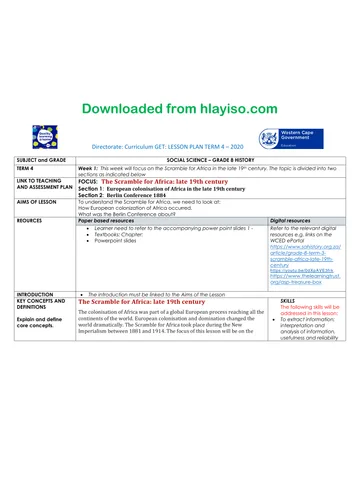
Week 1 Revision from Term 2
The kind of society existed in the Kingdom of Mali
Trade that took place in Kingdom of Mali
How was trade in the Kingdom of Mali different to the Transatlantic
slave trade
The impact of Transatlantic slave on Africa
How the growth of industrialisation in Europe paved the way for the
Scramble for Africa.
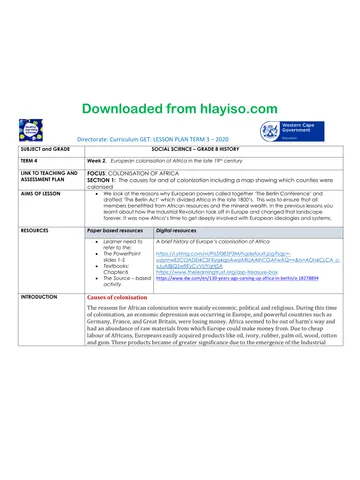
Week 2 European colonisation of Africa in the late 19th century
European colonization of Africa in the late 19th century:
Berlin conference 1884
Week 3 European colonisation of Africa in the late 19th century
Map of Africa (showing different colonising countries)
Causes of colonisation
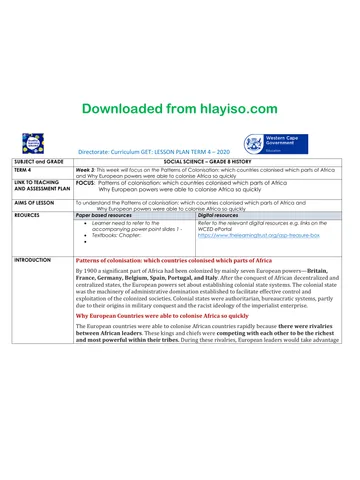
Week 4 European colonisation of Africa in the late 19th century
Patterns of colonisation: which countries colonised which parts of
Africa
Why European powers were able to colonise Africa so quickly
Week 5 European colonisation of Africa in the late 19th century
Results of colonisation
Week 6 Case study: The Ashanti Kingdom
The rise of the Ashanti and their early contact with European traders and
explorers
Week 7 Case study: The Ashanti Kingdom
The British and the colonisation of the Gold Coast
Week 8 Case study: The Ashanti Kingdom
Results of colonisation for Ashanti Kingdom and Britain
Week 9 Revision and consolidation
Annexure A and B
GDE SP-Social Sciences: History Workbook – Grade 8, Term 3 Page 2 of 31
Week 1
Revision from Term 2
The kind of society existed in the Kingdom of Mali
Trade that took place in Kingdom of Mali
How was trade in the Kingdom of Mali different to the Transatlantic slave trade
The impact of Transatlantic slave on Africa
How the growth of industrialisation in Europe paved the way for the Scramble for
Africa.
1.1 Refer to Source 1A about African countries and their colonizers to answer the following
question.
Source 1A
1.1.1 Give TWO reasons why it was economically desirable for Europeans to 2x2(4) L2
colonize Africa?
Gaining raw material from Africa to help with Britain’s Industrialization
process and providing markets to manufactured goods. ✓✓
To combat over productivity in Europe and sell, trade the goods to the
indigenous people in Africa. ✓✓
People that are unemployed in Europe will be sent to the different
colonies. Increase technology, improve transport routes.
European government traded to gain a monopoly (complete control of
trade along the African coastline)
(Accept other relevant answer)
GDE SP-Social Sciences: History Workbook – Grade 8, Term 3 Page 3 of 31
1.1.2 Look at the cartoon. What impression do you get from the characters on 1x2(2) L2
the backs of the Africans?
They represent the major powers of the world. ✓✓
The image also portrays how Europeana oppressed Africans people.
The European powers had control over African colonies.
(Accept other relevant answer)
1.1.3 What is your impression of Britain? 1x2(2) L2
Britain is the most powerful nation, front leader of colonization. ✓✓
1.1.4 Why the cartoonist refers to Africa as the dark continent? 1x2(2) L2
The land portrays a dark continent with no civilization/development. ✓✓
Barren field can also portray that all the natural resources are depleted.
1.1.5 What is the cartoonist view of colonization? 1x2(2) L2
The cartoonist gives a bad view of colonization because it presents
colonization as something that oppresses people. ✓✓
1.1. 6 Name two the natural resources that were traded for European goods in 2x1(2) L1
Africa?
Gold, ✓ Ivory, ✓ Ostrich, Rubber Diamonds, Cotton, Coffee. Any TWO
1.1.7 What did they use Ivory and 0strich feathers for? 2x1(2) L1
Ivory was used to make cutlery handles and piano keyboards. ✓
Ostrich feathers from Africa were used to decorate hats✓
Week 2
European colonisation of Africa in the late 19th century
European colonization of Africa in the late 19th century: Berlin conference 1884
2.1 Study the MAP on European colonies in Africa and answer the questions below
GDE SP-Social Sciences: History Workbook – Grade 8, Term 3 Page 4 of 31
Source: By Noleen Dodgen and Subject Advisor Suezette Enge
2.1.1 What does Scramble for Africa mean? 1x1(1) L1
It was the invasion, occupation, annexation, partition, colonization of African
territory by European powers during the period between 1881 to 1914✓
2.1.2 Explain the term Colonization? 1x1(1) L1
The term by which the central system of power dominates the surrounding land
and its components. ✓
Accept other relevant expalnations
2.1.3 Identify the European powers that were involved in colonizing Africa 7x1(7) L1
Britain✓; France✓; Belgium✓; Spain✓; Portugal✓; German✓; Italy✓
GDE SP-Social Sciences: History Workbook – Grade 8, Term 3 Page 5 of 31
2.1.4 Examine why the European powers were involved in the ‘Scramble for 2x2(4) L3
Africa’?
Minerals- Africa was rich in minireals; ✓✓
Cheap Labour – African chiefs sold their own people to Europeans as slaves;
✓✓
Europeans forcefully captured africans as slaves;
Markets/Trade – Eurpeans exchanged items (guns/cloths) to Africans leaders
for slaves/mineral (gold);
Religion – missionaries introduced christianity to Africans
Education – missionaries introduced formal education and built schools
Accept other relevant expalnations
2.1.5 During the Berlin Conference, African Countries were not invited. Do you 1+2x2 L3
agree or disagree with the statement? Support your answer
Agree: ✓
(5)
They did not want to fight amongst themselves✓✓ [14]
They believe that they will bring peace in Africa✓✓
2.2 Study the source about the first meeting in the Berlin conference and answer the questions
below:
2.2.1 In which year was Berlin Conference? 1x1(1) L1
1884✓
GDE SP-Social Sciences: History Workbook – Grade 8, Term 3 Page 6 of 31
2.2.2 Where was it held? 1x1(1) L1
Berlin✓
2.2.3 What was the task that the conference needed to agree on? 1x1(1) L1
to regulate European colonization and trade in Africa by identifying which
European nations would be allowed to control which parts of Africa.✓
2.2.4 What was the task that they needed to agree on regarding the Congo 1x1(1) L1
and Niger Rivers?
They agreed to consider them(rivers) neutral and open to trade✓
2.2.5 Which part of Africa was colonized at the time of the conference? 1x1(1) L1
Only the Coastal areas of Africa✓
2.2.6 How long did the conference last? 1x1(1) L1
THREE months✓
2.2.7 What were the main three reasons for colonisation? 3x1(3) L1
[09]
Economic; ✓Political✓ and Religious✓
Week 3
European colonisation of Africa in the late 19th century
Map of Africa (showing different colonising countries)
Causes of colonisation
3.1 Refer to the map of Africa and answer the following questions.
GDE SP-Social Sciences: History Workbook – Grade 8, Term 3 Page 7 of 31
http://exploringafrica.matrix.msu.edu/wp-content/uploads/2015/06/Colonialism-
1914-Map.jpg (Accessed 18/8/2022)
3.1.1 According to the map, which European power colonised most of 1x1(1) L1
Southern Africa?
Great Britain√
3.1.2 Refer to the map, list three countries in North Africa that this power 3x1(3) L1
colonised.
Egypt, Nigeria, Sierra Leone, Sudan, Gold Coast √ √ √
(Any THREE)
3.1.3 What is the current name of a country referred to as the Gold Coast in 1x1(1) L1
the North Western part of the map?
GDE SP-Social Sciences: History Workbook – Grade 8, Term 3 Page 8 of 31
Ghana√
3.1.4 Why was this country called Gold Coast? 1x1(1) L1
Europeans had identified the region as the Gold Coast because of
the large supplies of and market for gold that existed there. √
3.1.5 Give evidence from the map that the entire Africa was not colonised. 1x1(1) L1
The Empire of Ethiopia was an independent/not colonised country.
√
3.1.6 Use your own knowledge and the map to explain the main goal of 1x2(2) L2
European countries when they divided Africa?
European divided Africa was to gain profit from the riches of Africa,
and not to benefit the Africans. √√
3.1.7 On the map, there are many different borders and boundaries. Explain 2x2(4) L2
the impact you think this had on African people living in Africa?
It divided existing groups of people. √√
The creation of borders had a negative impact on Africa's political
and social structures by either dividing groups that wanted to be
together or combining ethnic groups that were enemies. √√
Europeans placed colonies into administrative districts and forced
the Africans to go along with their demands.
(Accept other relevant answers)
3.1.8 Africa's imperially imposed borders affected the continent politically, 8 L3
economically, and socially. Do you agree with the statement? Write a [21]
paragraph to support your answer.
weak states,
dependence on cash crop economies,
lack of interstate trade
ethnic conflict/ rivals
resource depletion,
labor exploitation,
unfair taxation,
lack of industrialization,
prohibition of trade,
the breaking up of traditional African society and values,
GDE SP-Social Sciences: History Workbook – Grade 8, Term 3 Page 9 of 31
lack of political development
It also dehumanized African labour force and traders.
It forced Africans to work in colonial plantations at very low wages
and displaced them from their lands.
3.2 Write an essay, of about one and half pages to explain how each of the 10/15 L3
following contributed to colonisation:
a) Nationalism
b) Imperialism
c) Capitalism
d) Racism
a) Nationalism
Europeans desired to spread their culture to other lands.
This was a time when colonies became a symbol of the
greatness of a nation hence the desire to colonize territories in
Africa.
b) Imperialism
Rivalry between European Nations
Trading Resources
Strategy and Convenience
Economic Benefits
c) Capitalism
The industrial revolution led to an increase in mechanized production
which created surplus labour. There was, therefore, the need to export
the surplus labour to the colonies.
The Europeans were searching for markets for their surplus
manufactures as a result of the industrial revolution of the 18th century.
They also needed raw materials to feed the industries.
Colonies provided room for the Europeans to invest their surplus
capital.
d) Racism
Europe has viewed the people of Africa through the distorting veil of
racism and racial theory
GDE SP-Social Sciences: History Workbook – Grade 8, Term 3 Page 10 of 31
Week 4❌
European colonisation of Africa in the late 19th century
Patterns of colonisation: which countries colonised which parts of Africa
Why European powers were able to colonise Africa so quickly
4.1 Refer to the source below showing the battle between the British and the Sudanese.
https://www.google.com/url?sa=i&url=https%3A%2F%2Fwww.gettyimages.dk%2Fdetai
l%2Fnews-photo%2Fbritish-history-illustration-the-war-in-the-sudan-british-news-
photo%2F78952916&psig=AOvVaw0B0SEQzzaoTmlYHhjZfw2U&ust=166876021288200
0&source=images&cd=vfe&ved=0CBAQjRxqFwoTCJD8krubtfsCFQAAAAAdAAAAABA
t
4.1.1 According to the source above, what advantage did the British have over 2x1(2) L1
the Sudannese?
The British had technological advantages such as guns for the war,
when the Sudannese were using spears and shields/less advanced
weapons✓
Europeans had means to transport theit military✓
GDE SP-Social Sciences: History Workbook – Grade 8, Term 3 Page 11 of 31
4.1.2 Use own knowledge and explain why Europeans colonised Africa quickly? 4x2(8) L2
African leaders were not unified to resist colonialists due to wars and conflict
during slave trade✓✓
Africa lost its strongest men and women to slavery just before the scramble✓✓
Medical advances for treating tropical deases like malaria gave Europeans
advantage to travel safely in africa✓✓
Better transportation made colonisation possible✓✓
Natural disasters such as drought/famine, plague if locusts destroyed the crops,
death of livestock, deathe of people ue to starvation and smallpox deseases
weakned africans and they could not resist/fight against cononizers. ✓✓
[10]
Week 5
European colonisation of Africa in the late 19th century
Results of colonisation
5.1 Read sources A and B and answer the questions that follow:
Source A
“When the missionaries came to Africa they had the Bible and we had the land.
They said,’Let us pray’ We closed our eyes.When we opened them we had the
Bible and they had the land”-Archbishop Desmond Tutu.
Social Sciences TODAY grade 8
GDE SP-Social Sciences: History Workbook – Grade 8, Term 3 Page 12 of 31
Source B
“I would say colonialism is a wonderful thing.It spread civilisation to Africa.Before
they had no written languages,no wheel as we know it,no schools,no hospitals,not
even normal clothing”
Platinum Social Sciences grade 8
5.1.1 Define the following concepts: 3x2(6) L1
a) Civil war
A war between citizens of the same country.✓✓
b) Resistance
The refusal to accept or comply with something.✓✓
c) Civilisation
The process by which a society or place reaches an advanced stage of
social and cultural development and organization.✓✓
5.1.2 What point of view does source A have of colonialism? Give THREE 3x2(6) L3
examples to substantiate your answer.
Negative point of view.✓The colonialists robbed the indigenous people
of their inheritance/livelihood.✓
Examples
Introduced the Africans to Christianity and that destroyed the
culture,knowledge and experience of the indigenous people.✓
Africans lost their land to Colonialists.✓
Those who resisted colonialism were killed.✓
They created hatred among ethnic groups.✓
Africans were forced to do all the hard work at little or no pay.✓
Racism was rife towards Africans,treated as servants because of the
colour of their skin.
GDE SP-Social Sciences: History Workbook – Grade 8, Term 3 Page 13 of 31
(accept reasonable answers)
5.1.3 What point of view does source B have of colonialism? Give examples to 2+ L3
substantiate your answer. 2x1(4)
Positive point of view. The Colonialists brought civilisation to Africa.✓ ✓
Examples
Built hospitals✓
Built schools.✓
Taught the indigenous people to read and write.
Invented modern transport modes.
Clothes,as they would wear skins.
(accept reasonable answers)
5.2 Write an essay of about one and half pages to discuss the (15)
results/consequences of colonisation. Follow the guidelines below:
Definition of colonisation
Factors that enabled European powers to colonize Africa
The results/consequences of colonisation
Definition of colonisation
Practice of assuming political control of another country.Settlers from the
colonising power come to live in and control the colonised territories or
areas.
Factors that enabled European powers to colonize Africa
The Europeans powers had weapons
Religious Ideologies that were influential
Experience in winning wars
The results/consequences of colonisation
Slavery-Africans were sold as slaves and made to work for the
Colonialists.
GDE SP-Social Sciences: History Workbook – Grade 8, Term 3 Page 14 of 31
Political control-They created artificial borders and controlled the
different areas.
Loss of identity-African culture and tradition were eroded ,they had to
abandon their roots.
Poverty,famine-no free access to natural resources as these were now
controlled by the Colonialists.
Civil war, Rivalries between ethnic groups-the different ethnic groups
started fighting with each other.They made people to think that they are
different from each other and started hating each other.
Spread of christianity-The African spirituality was lost among Africans.
Land repossession,taking of natural resources-The colonisers controlled
raw materials and minerals-Africans were forced to work for very low
wages.
5.3 Indicate whether the following statements TRUE or FALSE 5x1(5)
Statement Answer
a. Some African leaders attended the Berlin true ✓
Conference
b. The artificial boundaries created by colonial rulers false ✓
made people to live in harmony.
c. Ethiopia and Liberia were the two territories in true ✓
Africa without colonial influence.
d. Britain colonised most of Southern Africa true ✓
e. King Leopard referred to Africa as a magnificent false✓
cake.
5.4 Refer to Source C about division of Africa to answer questions below.
GDE SP-Social Sciences: History Workbook – Grade 8, Term 3 Page 15 of 31
5.4.1 What event is the cartoon about (source B)? 1x1(1) L1
The Berlin conference 1884✓
5.4.2 Who do the men around the cartoon represent ? 1x1(1) L1
The men are the representatives of their countries included in the negotiations.
✓
5.4.3 Did all the European powers at the Berlin conference get a piece of Africa 2x2(4) L1
,explain the reason for your answer
No✓✓
They did not all get a piece of Africa, it depended on the power that the
countries had . e.g Britain and France had more powers so it got larger pieces.
✓✓
5.4.4 What does the cartoonist think about this event ? 2x1(2) L2
The cartoonists used the word mad to describe the proceedings , this shows
that he feels negatively about them . he saw the event as insane and out of
control . ✓✓
5.4.5 Explain why were Europeans so keen to get their hands on Africa ? 2x2(4) L2
• Europeans wanted to gain access to raw materials,(main reason )
✓✓
• Africans were also a massive market ✓✓
• Political : nationalism
• Christianity to Africans
GDE SP-Social Sciences: History Workbook – Grade 8, Term 3 Page 16 of 31
Week 6
Case study: The Ashanti Kingdom
The rise of the Ashanti and their early contact with European traders and
explorers
6.1 Refer to the two maps to answer the questions below
6.1.1 What is the central symbol of the Ashanti flag and what does it 1x2(2) L1
represent?
It is the Golden stool. It represents the independence, the pride and the
power of the Ashanti people. ✓✓
6.1.2 Describe the symbols seen on the Gold Coast flag. 1x2(2) L1
The elephant and the jungle scene and the letters G.C. represent the Gold
Coast. The Union Jack is the British flag and is in the left top corner of the
colonial flag. ✓✓
7 The local farmers who still had access to land, were forced to sell their 1x1(1) L1
crops very cheaply. What became one of the largest profitable crops for
the British Empire?
The British made the most profit from the cocoa export✓
8 What is the basic ingredient of chocolate? 1x1(1) L1
Cocoa ✓
9 Match the following definitions with the correct term.
Terms Definition Answer
GDE SP-Social Sciences: History Workbook – Grade 8, Term 3 Page 17 of 31
1. Values a. Goods sold to other Exports ✓
places
2. Exports b. Important beliefs Values ✓
3. System c. Element in a food ingredient ✓
product
4. Ingredient d. Way of doing things System ✓
5. Abolished e. To have power over Control ✓
something
6. Control f. To do away with Abolished✓
something
10 Who made the profit from the cocoa exports?
The British made the most profit from the cocoa export. ✓
11 Write an essay on who you think benefitted the most with the colonisation
of the Gold Coast. Explain the benefits and how it changed the lives of the
people. The essay should be approximately 6-8 lines.
The results of colonisation of the Ashanti for the British were that they made a
lot of money. They exported cocoa and that quickly became the colony`s major
export. In 1901, the country also experienced a “gold rush”. The British
controlled the gold and other minerals of the Ashanti. That developed the
infrastructure at the Gold coast. The British controlled the trading routes. The
Ashanti had to give up a lot of their culture and traditions. The Ashanti had to
do everything Britain wanted. New ways
Week 7
Case study: The Ashanti Kingdom
The British and the colonisation of the Gold Coast
7.1 7.1 Match the terms in Column A with the descriptions in Column B. e. g
7.1.11 O
10x1( L1
Column A Column B Answer 10)
7.1.1 While the British were looking for the A. Elmina J✓
Golden Stool, the Ashanti made a final
attempt to resist British takeover of their
kingdom. Who led the resistance?
GDE SP-Social Sciences: History Workbook – Grade 8, Term 3 Page 18 of 31
7.1.2 People who speak or do things for (on B. King Prempeh I✓
behalf) of a group of people
7.1.3 Important because of its position, part of C. Gold, ivory, H✓
a bigger plan and slaves
7.1.4 Countries that are ruled by foreign D. The Gold F✓
Coast
powers
7.1.5 The dividing lines between two E. Osei Tutu G✓
countries/frontiers
7.1.6 The first Ashanti King who unified the F. Colonies E✓
Ashanti states
7.1.7 The new name of Ashanti after it was G. Borders D✓
colonised by British
7.1.8 Items of trade between the Ashanti and H. Strategic C✓
Europeans.
7.1.9 In 1890, he to reunite Ashanti Kingdom. I. B✓
The British responded by sending him into
Representatives
exile
7.1.10 J. Yaa A✓
The name of the fort the Portuguese built on
Asantewaa
the coast of the Ashanti Kingdom; it means
the ‘mine’
7.2 Study Source 7A about the colonisation of the Gold Coast by Britain and
answer the questions below:
Source 7.A
Britain occupied some land in the Gold Coast in the 19th century. She was
represented by the African Company of Merchants in the Gold Coast in 1817.
When the company became weak, the Gold Coast was given to Governor
MacCarthy of Sierra Leone. The British used force to control some Ashanti
areas in 1824.
So, in 1830 they chose Captain George MacLean to be the British leader in
the Gold Coast. During his rule there were no wars between because of his
GDE SP-Social Sciences: History Workbook – Grade 8, Term 3 Page 19 of 31
punishment methods. In 1844 Britain appointed commander H Worsley Hill
as the first Governor of the Gold Coast.
Hill immediately signed a Bond of 1844 treaty with the local chiefs.
According to this treaty chiefs had to report all serious crimes to the governor.
In return Britain promised them the protection against their enemies.
Adapted from History of Ghana, FP Miller and AF Vandome, Alphascript
Publishing, Mauritius, 2009
7.2.1 From your knowledge, what was the capital of Ashanti Kingdom? 1x1(1) L1
Kumasi✓
7.2.2 Why was this area of Ghana called the Gold Dust? Why do you think it 2x2(4) L2
was so eagerly colonised by British?
It was called Gold Dust because of its rich gold minerals/deposits✓✓.
Britain wanted to get an access to gold minerals✓✓
7.2.3 Explain the Bond of 1844 treaty. 2x1(2) L2
Agreement signed by Governor Hill and local chiefs, chiefs to report
crimes to the Governor to earn protection from their enemies✓.
7.2.4 Explain why Prempeh I was arrested and exiled. 2x2(4) L2
Prempeh I was arrested because he began to reunite the Ashanti Kingdom
and built up the economy✓✓
Britain could not accept his attempts at building up a new empire✓✓
7.3 Study Source 7.B and answer the questions below:
https://ghanaportals.com/yaa-asantewaa/
7.3.1 Using prior knowledge what did the golden stool symbolize and 2x2(4) L1
represent?
It was a symbol of nationalism represented the nation’s soul brought good
fortune and ✓✓
kept the nation united it also represented the Ashanti people’s
independence. ✓✓
7.3.2 Did the Ashanti agreed to be colonised? Give 2 reasons to support your 1+(2x L2
answer.
No✓, They resisted the Britain rule. ✓✓ There were 4 wars between British
2) (5)
and the Ashanti called Anglo-Ashanti wars. ✓✓
7.3.3 Write a paragraph about the role played by Yaa Asantewaa in the Ashanti (8) L3
Kingdom.
GDE SP-Social Sciences: History Workbook – Grade 8, Term 3 Page 20 of 31
She played an important role in the Ashanti Kingdom. [38]
She led the Ashanti into the last resistance against the British forces.
She reminded the people that they have a heritage of strong and great
leaders who would have fought to defend themselves.
She motivated men by questioning their bravery.
To protect the Golden Stool, she led an army of 5000.
Her bravery inspired a movement to fight for the return of Prempeh I and for
independence.
Uses evidence in an elementary manner
LEVEL e.g., shows little or no understanding. MARKS:
1 Uses evidence partially to report on topic or 0-2
cannot report on topic.
Evidence is mostly relevant and relates to a
LEVEL MARKS:
great extent to the topic.
2 3-5
Uses evidence in a very basic manner.
Uses relevant evidence e.g., demonstrates a
thorough understanding of the topic.
LEVEL MARKS:
Uses evidence very effectively in an
3 6-8
organised paragraph that shows an
understanding of the topic.
Week 8
Case study: The Ashanti Kingdom
Results of colonisation for Ashanti Kingdom and Britain
8.1 8.1 SOURCE 1A, about the kingdoms on the west coast of Africa before European
colonisation
Before colonisation in the West African region was part of thriving trade network. West
Africa produced and traded millet, sorghum, kola, ivory and cloth and gold. West Africa
exchanged goods from traders in Sahara. In 17 the century Akan was divided into
independent kingdoms. Europeans were astonished by the richness of gold in the area,
and they called it the gold coast The Queen wore glasses made of gold. The Queen was
called Ashantewaa and the King was called Shantehene. At first Portuguese traders were
interested on Gold, but later they expanded to include slaves.
Refer to source 1A 3x1(3) L1
8.1.1 Identify any three goods from the source that were produced by West
GDE SP-Social Sciences: History Workbook – Grade 8, Term 3 Page 21 of 31
African countries.
millet✓
sorghum✓
kola✓
ivory
cloth
gold
8.1.2. Define the concept colonisation in your own words 2x1(2) L1
Colonisation is a system where by one country control another ✓✓
8.1. 3 According to the source how was Akan Kingdom like? 2x1(2) L2
It was divided into independent kingdoms.
8.2 Refer to SOURCE 1B, that explains how the British colonisation of the Gold
Coast and answer the questions that follow.
Source 1B
By the year 1824 the British fought against the Ashanti, but the British
defeated the Ashanti at the end and became part of British colony called
Gold Coast because of rich of gold .In 1896 the British occupied the Ashanti
Capital of Kumasi. Chiefs and Elders were sent to exile. Major Hodgson
became the British Governor. War between the British and Ashanti came
into being which was called the war of Golden Stool and in 1902 the
Ashanti was defeated. British took over the Gold Coast became the British
colony.
Adapted from:Addy E.A. Ghana:A history for primary school, Longmans,
Green and Company
8.2.1 According to the source what was the name of colony controlled by the 1x1(1) L1
Britain
Gold coast ✓
8.2.2 Use the source and your knowledge to explain why the British colonised 2x2(4) L2
the Gold Coast ?
It was rich of gold✓✓
there were lot of natural resources✓✓
(accept any other relevant answer)
8.3 Read SOURCE 1C about the results colonisation of Ashanti Kingdom and the British.
Source 1C
After the Ashanti was defeated the British collected all gold treasures. The Ashanti had no
political rights , they lost power, people were forced off their land. The Ashanti were forced
to work for wages and to pay taxes. The British took as much as they can. The British
spent money to improve their ability to remove wealth and natural resources from Gold
Coast. They built roads and railway to get to the resources to ship them to Europe.
Comments by Sir James Robertson a former Governor General in West Africa
8.3.1 According to the source what did the British collect? 1x1(1) L1
GDE SP-Social Sciences: History Workbook – Grade 8, Term 3 Page 22 of 31
All gold treasures ✓
8.3.2 Use the source to name any two things that the Ashanti lost to the British 2x1(2) L1
Political rights✓
lost power ✓
lost land
8.3.3 Use the source and your knowledge to explain how source 1B support 2x2(4) L3
source 1C
Source 1b: explains how the British colonised the gold coast. ✓ ✓
source 1c: tells us about the Ashanti kingdom colonised by the British✓ ✓
Source1b: explains about the British took all gold treasures
Source 1c: tells us about the British when they took as much resource as
they can.
8.3.4 Use the source and your knowledge to write a paragraph of eight line to 8 L3
explain how was West Africa before colonised by the British and what
were the results brought by the British colonisation of Ashanti Kingdom.
Paragraph writing
[27]
It was a networking trade(source1a)
Ashanti produced millet, sorghum,
It was divided into independent kingdoms
European were interested in gold
Ashanti became British colony after they were defeated
Elders and chiefs were sent to exile
Ashanti lost land
Ashanti lost power
They lost their rights natural resources were taken from gold coast
Any other relevant answer
Uses evidence in an elementary manner e.g.,
LEV shows little or no understanding. MARKS:
EL 1 Uses evidence partially to report on topic or 0-2
cannot report on topic.
Evidence is mostly relevant and relates to a
LEV MARKS:
great extent to the topic.
EL 2 3-5
Uses evidence in a very basic manner.
Uses relevant evidence e.g., demonstrates a
thorough understanding of the topic.
LEV MARKS:
Uses evidence very effectively in an organised
EL 3 6-8
paragraph that shows an understanding of the
topic.
GDE SP-Social Sciences: History Workbook – Grade 8, Term 3 Page 23 of 31
Week 9
Revision and consolidation
9.1 9.1 .1 Define the following terms: 5x1(5) L1
a) Colonisation
The movement of people from their mother country to another country to
form colonies ✓
b) Scramble
Quick movement by countries to gain colonies✓
c) Empire
A group of colonies controlled by an emperor✓
d) Cash crops
Crops that are grown to sell rather than to feed the family✓
e) Chancellor
Head of state in Germany or Austria✓
f) Nationalism
The desire of a nation to be successful and independence✓
9.2 9.2.1 Refer to the cartoon on the Berlin Conference to answer the following
questions.
GDE SP-Social Sciences: History Workbook – Grade 8, Term 3 Page 24 of 31
https://www.pbslearningmedia.org
9.2.1 In which year was the conference held? 1x1(1) L1
1884✓
9.2.2 Which country is represented by the person holding the knife? 1x1(1) L1
Germany✓
9.2.3 What is represented by the cake being cut? 1x1(1) L1
African continent ✓
9.2.4 Name two main players who were invited to the conference. 2x1(2) L1
Britain, ✓ France, ✓Portugal, Belgium, Germany (any TWO)
9.2.5 Explain TWO reasons why the conference was held. 2x2(4) L2
To prevent war over the control of Africa✓✓
To discuss ways to divide Africa peacefully✓✓
Decide how to expand countries rule over Africa without conflict
(Accept Other Relevant Answers)
9.2.6 Who called the conference? 1x1(1) L1
Chancellor Otto Van Bismarck✓
9.2.7 From which country was the leader named in 9.2.6? 1x1(1) L1
Germany✓
9.2.8 Describe any TWO agreements made at the Berlin Conference. 2x2(4) L2
ANY European country that wanted to take over any part of Africa had to
tell other countries and get approval. ✓✓
Congo was given to King Leopold of Belgium✓✓
Niger River was opened for trade to all European countries
German East Africa (Great Lakes) became a colony of Germany
(Any Two)
GDE SP-Social Sciences: History Workbook – Grade 8, Term 3 Page 25 of 31
9.3 Write down FIVE causes of the colonisation of Africa by Europe 5x1(5) L1
Where to get raw material✓
Markets to sell products, ✓
To get mineral wealth✓
To make profit✓
Get more space and food✓
Promote Christianity
Growth of nationalism in Europe
To be regarded as powerful√ - (Any FIVE) Accept other relevant answers
9.4 Refer to the cartoon to answer the questions below.
en.wikipedia.org.
9.4.1 Who is the person shown on the above picture? 1x1(1) L1
Cecil John Rhodes✓
9.4.2 What is he standing on? 1x1(1) L1
GDE SP-Social Sciences: History Workbook – Grade 8, Term 3 Page 26 of 31
He is standing on the continent of Africa✓
9.4.3 Why are his feet and arms spread? 2x1(2) L2
He wanted to build railway line to control the whole of Africa from Cape to
Cairo✓✓
9.4.4 How did John Rhodes reward himself in Africa? 2x1(2) L2
He started a colony that he named after himself Rhodesia✓✓
9.4.5 What is the present name of the reward? 1x1(1) L1
Zimbabwe✓
9.5 Write an essay of one and half pages to explain the advantages and 15 L3
disadvantages of Colonization. Your essay must have an introduction, two main
paragraphs and a conclusion.
Essay Question – The benefits and disadvantages of Colonization
Introduction: Brief overview of essay
Negative Aspects – Topic sentence
There were several negative effects of colonialism that became
evident after many African nations became independent.
African cultures and traditions were destroyed
Africans were robbed of their independence / autonomy (the right or
condition of self-government) and became depressed
Foreign system of government imposed on African kingdoms
British representatives replaced traditional chiefs
New Military systems introduced with which African states could
Many lost their land/homes and were displaced or sold into slavery
Europeans implemented tax systems –
Africans were forced to work in order to pay taxes
Many were forced to work as laborers on mines and European
plantations for low wages
Colonial fashion (new clothes) and building replaced traditional African
clothes and buildings
New borders mixed African tribes – new artificial boundaries created
new tribal tensions
new calendar, languages and writing were introduced
Missionaries brought Christianity, which influenced Africans to stop
following their traditions
Those who resisted were imprisoned or killed
GDE SP-Social Sciences: History Workbook – Grade 8, Term 3 Page 27 of 31
Positive Aspects – Topic sentence
Africa would most likely still be behind the rest of the world without
colonialism though.
Europeans established boundaries, making the process of
independence easier with predetermined state formation.
Western live was introduced which included a new economy which
included a more sophisticated money system and banking.
Europeans introduced medicine, education, and improved infrastructure,
Christianity, and boundaries.
The growth of the African population was aided by the Western medicine
introduced by Europeans.
Africans were introduced to formal education by Europeans which led to
improved literacy rates
New irrigations methods and new mining industrial technology was
introduced.
Improved African infrastructure with the addition of road systems,
railroads, water, electricity, and communication systems.
Christian missions promoted literacy and health care in Africa. The
Christian religion made African spirituality simpler and took away the
need for sacrifices and rituals.
Conclusion: bring it all together – recap on main points
9.6 Refer to the case study on the Ashanti Kingdom to answer questions that follow.
Asante empire, Asante also spelled Ashanti, West African state that occupied what is
now southern Ghana in the 18th and 19th centuries. Extending from the Comoé River in
the west to the Togo Mountains in the east, the Asante empire was active in the slave
trade in the 18th century and unsuccessfully resisted British penetration in the 19th.
In their struggle against the suzerain state of Denkyera and lesser neighbouring states,
the Asante people made little headway until the accession, probably in the 1670s, of Osei
Tutu. After a series of campaigns that crushed all opposition, he was installed
as Asantehene, or king of the new Asante state, whose capital was named Kumasi. His
authority was symbolized by the Golden Stool, on which all subsequent kings were
enthroned
https://www.britannica.com/editor/The-Editors-of-Encyclopaedia-Britannica/4419
9.6.1 Who was the first king of Ashanti? 1x1(1) L1
King Osei Tutu✓
9.6.2 In which country is the city of Kumasi? 1x1(1) L1
Ghana✓
GDE SP-Social Sciences: History Workbook – Grade 8, Term 3 Page 28 of 31
9.6.3 What was the most important symbol of kingship to Ashanti people? 1x1(1) L1
The golden stool✓
9.6.4 Who were the first traders to arrive in Kumasi? 1x1(1) L1
Portuguese✓
9.6.5 What were the two main exports from Ashanti? 2x1(2) L1
Gold✓, slaves✓
9.6.6 What did Ashanti mainly import from Europe? 1x1(1) L1
Guns✓
9.6.7 Where did the traders build their fort and what was its name? 2x1(2) L1
On the coast, Elmina✓✓
9.7 Read the extact about the British and the colonisation of the Gold Coast to answer questions
below.
During the 1800s the British fought many wars with the Ashanti kingdom. The
main reason for those fight was the control of trade route and to stop slave trade.
The British took control of coastal area but Ashanti remained independent towards
the north. In 1824 the British attacked Kumasi and defeated the Ashanti
9.7.1 How did the 1824 war weakened Ashanti? Give three facts 3x2(6) L2
They set fire to part of the city Kumasi, they blew up the king’s palace, ✓✓
They took golden artworks, ✓✓
They encouraged many smaller states to break away, civil war weakened
Ashanti further✓✓
(Any Three)
9.7.2 Who was the queen mother who resisted the British take over? 1x1(1) L1
Queen Yaa Ashantiwaa✓
9.7.3 What happened to queen mother after the defeat? 1x2(2) L2
GDE SP-Social Sciences: History Workbook – Grade 8, Term 3 Page 29 of 31
She was sent into exile to the Seychelles where she died in 1921✓✓
9.7.4 In a paragraph discuss the results of colonisation for both nations in a 8 L3
paragraph of 6-10 lines
Ashanti kingdom became part of the Gold Coast colony.
Like in other British colonies where a local leaders rule the exiled king
returned and rule
The king did not have any real power- British sent soldiers and officials
to rule the Gold Coast
Britain became very wealthy from its African colonies
British companies took over gold mines,
They bought crops from farmers and sent them to Britain e.g. cocoa
beans
The Gold Coast became independent in 1957 as Ghana
Gold Coast was the first African colony to be independent
Most Ashanti people lives in Ghana and farm in cocoa beans
The King is still the highly respected leader in Ghana
The Golden Stool and gold items kept in Kumasi museum are a
reminder of Ashanti history
Yaa Asantewaa Girls’ Secondary School was established in recognition
and respect of the mother queen- Accept other relevant answers
Annexure A
ESSAY MARKING RUBRIC – 10 MARKS
MARKING MATRIX FOR ESSAY: TOTAL: 10
LEVEL 7 LEVEL 6 LEVEL LEVEL LEVEL 3 LEVEL LEVEL
5 4 2 1*
PRESENTATION Very well Very well Well Planned Shows Attempts Little or
planned and planned and planned and some to no
structured essay. structured and construct evidence of structure attempt to
Good synthesis essay. structured ed an a planned an structure
of information. Developed a essay. argument. and answer. the essay.
Developed an relevant line Attempts Evidence constructed Largely
original, well of argument. to used to argument. descriptiv
balanced and Evidence develop a some Attempts to e or some
CONTENT independent line used to clear extent to sustain a attempt at
of argument with defend the argument. support line of developin
the use of argument. Conclusio the line of argument. g a line of
evidence and Attempts to n drawn argument. Conclusion argument.
sustained and draw an from the Conclusio s not clearly No
defended the independent evidence ns supported attempt to
argument conclusion to support reached by draw a
throughout. from the the line of based on evidence. conclusio
Independent evidence to argument. evidence. n.
conclusion is support the
drawn from line of
evidence to argument.
support the line
of argument.
LEVEL 7
Question has been fully answered. Content 9–10 8–9
selection fully relevant to line of argument.
GDE SP-Social Sciences: History Workbook – Grade 8, Term 3 Page 30 of 31
LEVEL 6
Question has been answered.
Content selection relevant to a line of
8–9 8 7
argument.
LEVEL 5
Question answered to a great extent. Content 7 7 7 6 5
adequately covered and relevant.
LEVEL 4
Question recognisable in answer.
Some omissions or irrelevant content selection. 6 5 5
LEVEL 3
Content selection does relate to the question,
but does not answer it, or does not always
relate to the question.
5 5 4
Omissions in coverage.
LEVEL 2
Question inadequately addressed. Sparse
content. 4 3 2
LEVEL 1*
Question inadequately addressed or not at all.
Inadequate or irrelevant content. 2 0–1
* Guidelines for allocating a mark for Level 1:
Question not addressed at all/totally irrelevant content; no attempt to structure the essay = 0
Question includes basic and generally irrelevant information; no attempt to structure the essay = 1
Paragraph Rubric
Level 1 Uses evidence in an elementary MARKS: 0-2
manner e.g. shows little or no
understanding. Uses evidence partially
to report on topic or cannot report on
topic
Level 2 Evidence is mostly relevant and relates MARKS: 3
to a great extent to the topic. Uses
evidence in a very basic manner
Level 3 Uses relevant evidence e.g. MARKS: 4-5
demonstrates a thorough
understanding.
Uses evidence very effectively in an
organised paragraph that shows an
understanding of the topic.
GDE SP-Social Sciences: History Workbook – Grade 8, Term 3 Page 31 of 31
Study this subject
Recommended for this subject
Question paper
Social Sciences Grade 8 NSC Term 3 Workbook 2021 QP
Question paper
Social Sciences Grade 8 March Test 2021 Question Paper
Question paper
Social Sciences Grade 8 P2 November Mock 2026 QP (Eng)
Question paper and memo
Social Sciences Grade 8 2025 QP & Memo
Question paper
Social Sciences Grade 8 Limpopo June 2025 Question Paper
Question paper
Social Sciences Grade 8 June 2020 Question Paper
More from Grade 8 Social Sciences
Question paper
Social Sciences Grade 8 March Test 2020 Question Paper
Question paper
Social Sciences Grade 8 March Test 2020 Question Paper
Question paper
Social Sciences Grade 8 March Test 2020 Question Paper
Question paper
Social Sciences Grade 8 November 2020 Question Paper
Question paper
Social Sciences Grade 8 November 2020 Question Paper
Question paper