
GAUTENG DEPARTMENT OF EDUCATION
PROVINCIAL EXAMINATION
NOVEMBER 2021
GRADE 9
ENGLISH
FIRST ADDITIONAL LANGUAGE
TIME: 2 hours
MARKS: 70
12 pages
P.T.O.
Skip to contentAll 2021 papers 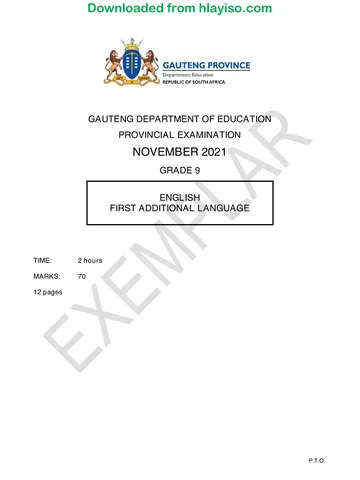

View all
English FAL Grade 9 Gauteng November 2021 Question Paper
Grade 9 English FAL question paper from the Gauteng November Exam 2021, 12 pages. Read online or get the free PDF download, memo linked when available.
English Fal · Grade 9 · Gauteng November Exam · 2021 · English. Question paper, 12 pages. Read online or download the PDF.
- Subject
- English FAL
- Grade
- Grade 9
- Language
- English
- Document type
- Question paper
- Year
- 2021
- Exam period
- Gauteng November Exam
- Curriculum
- CAPS
- Pages
- 12
- File size
- 521.1 KB
Free to read online, no sign-up needed
Loading document…
Loading document…
1 of 12
This exam
Gauteng November Exam 2021
- Other filesQuestion paperQuestion paper (2)MemoMemo (2)
Document textSearch extracted text and jump to a page.
ENGLISH FIRST ADDITIONAL 2
LANGUAGE GRADE 9
INSTRUCTIONS AND INFORMATION
1. This paper consists of FOUR sections namely:
SECTION A: COMPREHENSION (25)
SECTION B: VISUAL LITERACY (15)
SECTION C: SUMMARY (10)
SECTION D: LANGUAGE IN CONTEXT (20)
2. Answer ALL the questions.
3. Read carefully through ALL the questions.
4. Number the answers according to the numbering system used in this question
paper.
5. Where one-word answers are required, write only the correct word.
6. For multiple choice questions, write ONLY the correct letter (A – D) next to the
question number in the ANSWER BOOK.
7. Pay special attention to correct language use.
8. Write neatly and legibly.
P.T.O.
ENGLISH FIRST ADDITIONAL 3
LANGUAGE GRADE 9
SECTION A: COMPREHENSION
QUESTION 1
Read the text below and answer the questions that follow.
TEXT A
Devastating Infectious Disease
By Wynne Parry, Elizabeth Peterson – Live Science February 10, 2020
1. Contagious diseases have shaped human history and they remain with us today.
Here's a look at some of the worst of these infections.
The new coronavirus
2. Coronaviruses are a large family of viruses that cause respiratory illnesses.
This family includes the viruses that cause SARS (Severe Acute Respiratory
Syndrome) and MERS (Middle East Respiratory Syndrome).
3. SARS, first appeared in 2002 in the Guangdong province of southern China,
according to the World Health Organisation. The virus likely emerged in bats,
initially, then hopped into nocturnal mammals called civets before finally infecting
humans. After triggering an outbreak in China, SARS spread to 26 countries
around the world, infecting more than 8000 people and killing more than 770
over the course of two years.
4. The disease causes fever, chills and body aches, and often progresses to
pneumonia, a severe condition in which the lungs become inflamed and filled
with pus. SARS has an estimated mortality rate of 9.6%, and as yet, has no
approved treatment or vaccine.
5. The 2019 novel coronavirus (2019-nCoV) is a new strain of coronavirus that first
appeared in Wuhan, China, in December 2019. Though it was only just
discovered, 2019-nCoV has already spread rapidly in China and around the
world. The ongoing outbreak prompted an extensive quarantine of Wuhan and
nearby cities. Travel restrictions to and from affected countries were
implemented. A worldwide effort to develop diagnostics, treatments and
vaccines has followed.
6. The disease caused by SARS-CoV-2, called COVID-19, has an estimated
mortality rate of about 2.3%. People who are older or have underlying health
conditions seem to be most at risk of having severe disease symptoms or
complications. Common symptoms include fever, dry cough and shortness of
breath, and in severe cases, the disease can progress to pneumonia.
7. Smallpox, which is caused by the variola virus, is an acute infectious disease
that begins with a high fever, headache, and back pain and then proceeds to form
sores on the skin that leaves the face and limbs covered with cratered pockmarks,
or pox.
P.T.O.
ENGLISH FIRST ADDITIONAL 4
LANGUAGE GRADE 9
8. For centuries smallpox was one of the world’s most dreaded plagues, killing as
many as 30 percent of its victims, most of them children. Those who survived
were permanently immune to a second infection, but they faced a lifetime of
disfigurement and in some cases blindness. But smallpox was also one of the
first diseases to be controlled by a vaccine. In 1967 the World Health
Organisation (WHO) began a global vaccination programme against smallpox,
and in 1980 the disease was officially declared eradicated.
9. Unlike smallpox, the bubonic plague, an ancient killer commonly called ‘the
plague’, is still with us. Smallpox is caused by a bacterium transmitted from
rodents to humans by the bite of infected fleas. The disease comes in three
forms, but the best known is the bubonic plague, which is marked by buboes, or
painfully swollen lymph nodes.
10. The symptoms of the bubonic plague were gruesome. They started with fever
and sweating but progressed to blackish-blue boils across the groin. If the boils
weren’t lanced, they grew larger and people would die from the toxic build-up.
Likewise, lancing the buboes was often just as deadly and could lead to the
pathogen (infectious agent) becoming airborne.
11. The plague was the cause of some of the most devastating epidemics in history.
It was the disease behind the Black Death of the 14th century, when as much
as one-third of Europe’s population died. Huge pandemics also arose in Asia in
the late 19th and early 20th centuries, eventually spreading around the world
and causing millions of deaths.
12. Today, thanks to strict public health measures and modern antibiotics, the
plague no longer strikes down great numbers of people, nor is it as deadly for
those whom it strikes. Nevertheless, it persists in some parts of the world.
[Adapted from: https://www.livescience.com and https://www.britannica.com]
1.1 Choose the correct answer. Write only the correct letter (A – D) next to the
question number.
Contagious diseases are …
A illnesses that are found around the globe.
B illnesses that affect the respiratory system.
C illnesses that are infectious.
D viruses. (1)
1.2 Choose the correct answer. Write only the correct letter (A – D) next to the
question number.
Which organ in the body is affected by respiratory illnesses?
A Brain
B Lungs
C Skin
D Heart (1)
P.T.O.
ENGLISH FIRST ADDITIONAL 5
LANGUAGE GRADE 9
1.3 What type of illness does the family of coronaviruses cause? (1)
1.4 Name 2 illnesses caused by the coronaviruses. (2)
1.5 Why is SARS considered to be the deadliest virus? (2)
1.6 Which illness does the SARS-CoV-2 cause? (1)
1.7 Why is the 2019-nCoV called a novel coronavirus? (1)
1.8 What measures did China implement to contain the outbreak of the
SARS-CoV-2 in Wuhan? (2)
1.9 Do you think these measures were successful? Explain your answer. (2)
1.10 Who is most at risk of experiencing complications from COVID-19? (1)
1.11 What type of complications do you think someone can experience if they are
severely affected by COVID-19? (2)
1.12 What physical marks remain on the skin of a person infected by smallpox? (1)
1.13 Find one word in paragraph 8 that means to get rid of something forever. (1)
1.14 Choose the correct answer. Write only the correct letter (A – D) next to the
question number.
When a person is “permanently immune to a second infection” it means …
A the person will never be infected again.
B the person will later become infected again.
C the person will be able to fight the infection the second time.
D the person will be infected in the second year after the first sickness. (1)
1.15 Why do you think those who survived smallpox were permanently immune to a
second infection? (2)
1.16 Describe in your own words what a rodent is and give one example. (2)
1.17 Use your own words to explain what you think the word ‘lanced’ means.
(paragraph 10). (1)
1.18 Explain why lancing the buboes can be deadly. (1)
TOTAL SECTION A: 25
P.T.O.
ENGLISH FIRST ADDITIONAL 6
LANGUAGE GRADE 9
SECTION B: VISUAL LITERACY
QUESTION 2
Study the text carefully before answering the questions.
TEXT B
[Adapted from: WHO & CDC – 20 March 2020: www.who.int]
2.1 Choose the correct answer. Write only the correct letter (A – D) next to the
question number.
This type of visual text is an example of a/an …
A cartoon.
B infographic.
C advertisement.
D brochure. (1)
2.2 What is the main idea of the text? (1)
2.3 Which 2 frequently occurring symptoms are common for both the flu and
COVID-19? (2)
2.4 What is the purpose of the small squiggly lines surrounding the headache
picture? (1)
P.T.O.
ENGLISH FIRST ADDITIONAL 7
LANGUAGE GRADE 9
2.5 Mention the 2 organisations that supplied the information for the text. (2)
2.6 Which symptom occurs frequently in COVID-19 but never for colds and flu? (1)
2.7 When a person has the symptom of ‘fatigue’ how does he/she feel? (2)
2.8 Which two things in the fever illustration show the heat a person feels during a
fever? (2)
2.9 Which picture is used to represent diarrhoea? Do you think this picture is
appropriate? Comment on the use of the picture. (3)
TOTAL SECTION B: 15
P.T.O.
ENGLISH FIRST ADDITIONAL 8
LANGUAGE GRADE 9
SECTION C: SUMMARY
QUESTION 3
Read the passage (TEXT C) below. Summarise how vaccines work and the
importance of vaccinations in seven points.
INSTRUCTIONS:
• List your SEVEN points in full sentences.
• Use your OWN words as far as possible.
• Number your sentences 1 – 7.
• Write only ONE point per sentence.
• Write each sentence on a new line.
• Your seven-point summary should not be more than 50 – 60 words.
• Indicate the total number of words you have used in brackets at the end of your
summary.
TEXT C
1. Diseases that used to be common in this country and around the world, including
polio, measles, diphtheria, whooping cough, rubella (German measles), mumps
and tetanus, can now be prevented by vaccination. Over the years, vaccines have
prevented countless cases of disease and saved millions of lives.
2. Your body’s immune system is designed to seek and destroy invading pathogens –
but it’s not always easy, and pathogens can be clever. Vaccines give your immune
system a leg up in the fight by teaching it how to quickly recognise a pathogen.
3. There are several different types of vaccines, but they all essentially serve to
introduce a germ or part of a germ into your body in a way that can’t make you
sick. Some vaccines use the entire pathogen, but in a killed or weakened state,
some use only the parts of the organism that alert the immune system.
4. When you receive a vaccine, the germ sends up an alert to your immune system to
start producing antibodies to fight it. Once your immune system has beaten the
pathogen, it stores information about it. When you’re exposed to the real thing,
your body recognises the bug and can fight off the infection before it begins.
5. Immunising the public with vaccines ensures that contagious diseases do not
spread and, if they do, that the mortality rate and number of people affected are as
low as possible.
6. Vaccines also ensure that high-risk populations – like people with autoimmune
disorders, infants and older people – are shielded from these diseases. This
process of protecting those more at risk is called herd immunity. Herd immunity
means that most, if not all, people become immunised to protect these more
vulnerable populations.
[https://www.nationalgeographic.com]
TOTAL SECTION C: 10
P.T.O.
ENGLISH FIRST ADDITIONAL 9
LANGUAGE GRADE 9
P.T.O.
ENGLISH FIRST ADDITIONAL 10
LANGUAGE GRADE 9
SECTION D: LANGUAGE IN CONTEXT
QUESTION 4
Read the text below carefully before answering the questions.
TEXT D
1. Today, the World Health Organisation (WHO) announced the official new name of the
disease caused by nCoV2019 (2019 novel coronavirus)
2. COVID-19, as the disease will now be known, was decided on by the WHO, with the
organisation giving several reasons as to why it was chosen.
3. "Under agreed guidelines between WHO, the World Organisation for Animal Health
(OIE) and the Food and Agriculture Organisation of the United Nations (FAO), we had
to find a name that did not refer to a geographical location, an animal, an individual or
group of people, and which is also pronounceable and related to the disease," said
Dr Tedros Adhanom Ghebreyesus, Director-General of the WHO.
4. The virus is thought to have originated in the city of Wuhan in China, which led to it
being frequently named the “Wuhan coronavirus,” or “Chinese coronavirus,” but
neither of these were official names, and some believe they may have contributed to
discrimination against Chinese people.
5. Chinese communities from around the world have been reporting numerous reports of
racist incidents against Chinese and other Asian people.
6. But does the name of a virus really matter?
7. Previous evidence would seem to suggest yes. “Swine flu,” which was a flu strain
thought to originate in pigs, resulted in consumers shunning pork and causing great
financial damage to pork farmers, despite there being no evidence that the disease
could be spread via consuming pork.
8. MERS (Middle East Respiratory Syndrome), was first reported in Saudi Arabia in 2012
and is a particularly deadly coronavirus, with around a third of people contracting
it dying from the disease. However, the disease has so far been found in 27 different
countries, including South Korea which reported a serious hit to its tourism
industry when it reported cases in 2015.
9. Since these incidents, the WHO has decided on names which are more generic and
not related to people, places or specific animals.
10. Having a name matters to prevent the use of other names that can be inaccurate or
stigmatising. It also gives us a standard format to use for any future coronavirus
outbreaks,” said Ghebreyesus.
11. It may be too late, but by renaming the disease caused by the virus to COVID-19, the
WHO likely hopes to de-stigmatise its association with the city of Wuhan and the
people who live there.
[Adapted from: https://www.forbes.com]
P.T.O.
ENGLISH FIRST ADDITIONAL 11
LANGUAGE GRADE 9
4.1 Choose the correct answer. Write only the correct letter (A – D) next to the
question number.
What type of abbreviation is ‘WHO’?
A Truncation
B Initialism
C Contraction
D Acronym (1)
4.2 Write out the following abbreviation from the text in full:
Dr (1)
4.3 The virus is thought to have originated in the city of Wuhan, which led to it being
frequently named the “Wuhan coronavirus”.
4.3.1 Identify a common noun in the sentence above.
4.3.2 Identify a proper noun in the sentence above.
4.3.3 Write down an adverb form the sentence. (3)
4.4 Rewrite the following sentence in REPORTED SPEECH.
“We think, the name of a virus is important.”
Start with: The WHO said … (2)
4.5 Rewrite the sentence in the PASSIVE VOICE.
Chinese and other Asian people reported racist incidents to authorities. (2)
4.6 Refer to paragraph 5.
Find an antonym in the text for the word few. (1)
4.7 Complete the sentence below by adding a negative prefix to the underlined
word.
The new name will hopefully allow people to associate the disease from where
it originated. (1)
4.8 Replace the underlined words with a pronoun in the sentence below.
To distinguish nCoV2019 from other coronaviruses, nCov2019 needed its own
name. (1)
P.T.O.
4.9 Rewrite the sentence below by using the correct degree of comparison for the
words in brackets.
COVID-19 is (deadly) than Swine flu, but MERS is the (deadly). (2)
4.10 Choose the best synonym for discrimination.
A bias
B prejudice
C stereotyping
D racism (1)
4.11 Write out the sentence below then circle the subject and underline the predicate.
Consumers shunned pork. (2)
4.12 The WHO decided on names which are more generic and not related to people,
places or specific animals.
The sentence above is an example of a … sentence.
A compound
B duplicate
C complex
D simple (1)
4.13 Refer to paragraph 7 and find one single word that means:
The time when something ends. (1)
4.14 Refer to paragraph 7. What does the saying “serious hit to its tourism industry”
mean? (1)
TOTAL SECTION D: 20
TOTAL: 70
END
Study this subject
Recommended for this subject
Question paper
English FAL Grade 9 Gauteng November 2021 Question Paper
Memorandum
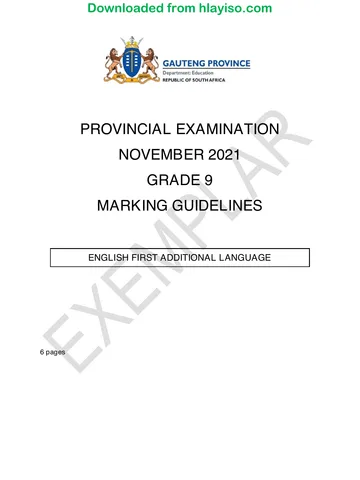
English FAL Grade 9 Gauteng November 2021 Memo
Memorandum
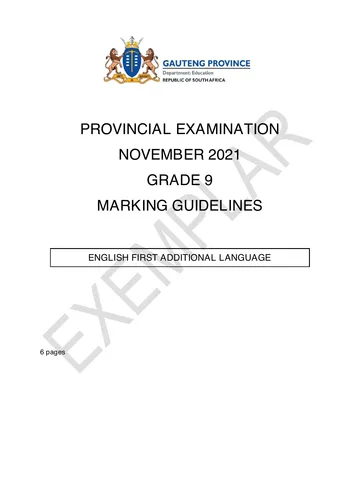
English FAL Grade 9 Gauteng November 2021 Memo
Question paper
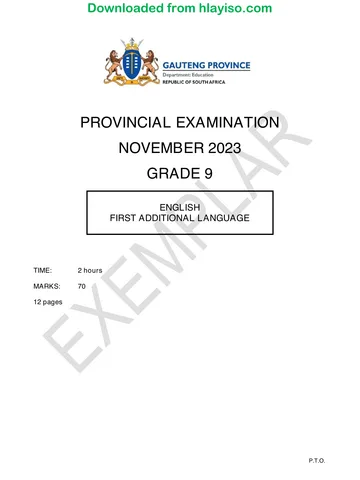
English FAL Grade 9 Gauteng November 2023 Question Paper
Question paper
English FAL Grade 9 Gauteng November 2023 Question Paper
Question paper
English FAL Grade 9 Gauteng November 2020 Question Paper
More from Grade 9 English FAL
CAPS document
CAPS SP FAL ENGLISH GR 7 9 WEB
Memorandum
English FAL Grade 9 Paper 1 November Mock 2026 Memo
Memorandum
English FAL Grade 9 Paper 2 November Mock 2026 Memo
Memorandum
English FAL Grade 9 Gauteng June 2024 Memo
Memorandum
English FAL Grade 9 Gauteng June 2024 Memo
Memorandum