
NATIONAL
SENIOR CERTIFICATE
GRADE 10
NOVEMBER 2018
AGRICULTURAL SCIENCES P1
MARKS: 150
TIME: 2½ hours
This question paper consists of 13 pages.
You're offline
Skip to contentQuestion paper 
View all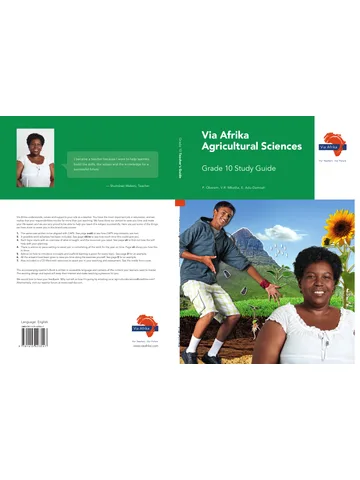
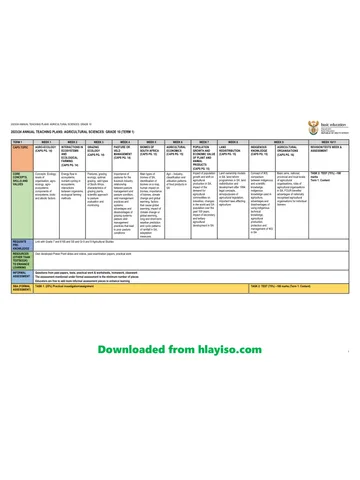
AGRIC SCIENCES P1 GR10 QP NOV2018 English
Agricultural Sciences · Grade 10 · National November Exam · 2018 · English. Question paper, 13 pages. Read online or download the PDF.
- Subject
- Agricultural Sciences
- Grade
- Grade 10
- Language
- English
- Document type
- Question paper
- Year
- 2018
- Exam period
- National November Exam
- Paper
- 1
- Pages
- 13
- File size
- 657.2 KB
Loading document…
Loading document…
1 of 13
Document textSearch extracted text and jump to a page.
2 AGRICULTURAL SCIENCES P1 (EC/NOVEMBER 2018)
INSTRUCTIONS AND INFORMATION
1. This question paper consists of TWO sections, namely SECTION A and
SECTION B.
2. Answer ALL the questions in the ANSWER BOOK.
3. Start EACH question on a NEW page.
4. Number the answers correctly according to the numbering system used
in this question paper.
5. You may use a non-programmable calculator.
6. Show ALL calculations, including formulae, where applicable.
7. Write neatly and legibly.
Copyright reserved Please turn over
(EC/NOVEMBER 2018) AGRICULTURAL SCIENCES P1 3
SECTION A
QUESTION 1
1.1 Various options are provided as possible answers to the following
questions. Choose the correct answer and write only the letter (A–D) next
to the question number (1.1.1–1.1.10) in the ANSWER BOOK, for example
1.1.11 D.
1.1.1 This farming involves the commercialisation of wildlife by private
land owners:
A Poultry farming
B Game farming
C Livestock breeding
D Conservation farming
1.1.2 The number of animals that can be allocated to a certain area for a
specific period:
A Animal ratio
B Stocking rate
C Grazing rate
D Selective grazing
1.1.3 When vapour changes back to liquid:
A Condensation
B Transpiration
C Evaporation
D Sublimation
1.1.4 Part of the earth where living organisms exist, including the upper
part of the soil, the water bodies and the lower parts of the air:
A Biome
B Ecosystem
C community
D Biosphere
1.1.5 This trophic level contains the most energy:
A First
B Second
C Third
D Fourth
Copyright reserved Please turn over
4 AGRICULTURAL SCIENCES P1 (EC/NOVEMBER 2018)
1.1.6 The process by which regional economies, societies, and cultures
have become integrated through communication, transportation,
and trade:
A Global demand
B Global warming
C Globalisation
D Urbanisation
1.1.7 The weather conditions prevailing in an area in general or over a
long period:
A Climate
B Weather
C Rain
D Sunlight
1.1.8 The laws of a country, as determined by the law-making sector
part of government, such as parliament:
A Green paper
B White paper
C Legislation
D Legal framework
1.1.9 This combination is an example of indigenous beef breeds:
(i) Afrikaner
(ii) Drakensberger
(iii) Brahman
(iv) Bonsmara
Choose the correct combination:
A (i), (ii) and (iii)
B (ii), (iii) and (iv)
C (i), (iii) and (iv)
D (i), (ii) and (iv)
1.1.10 These are examples of meat goat breeds except …
A Boer goat.
B Saanen.
C Savanna.
D Kalahari. (10 x 2) (20)
Copyright reserved Please turn over
(EC/NOVEMBER 2018) AGRICULTURAL SCIENCES P1 5
1.2 Indicate whether each of the descriptions in COLUMN B applies to A
ONLY, B ONLY, BOTH A AND B or NONE of the items in COLUMN A.
Write A only, B only, both A and B or none next to the question number
(1.2.1–1.2.5) in the ANSWER BOOK, for example 1.2.6 B only.
COLUMN A COLUMN B
A: Land reform Returning land to people who were
1.2.1
B: Land restitution forcibly removed
A: State land Private land ownership
1.2.2
B: Communal land
A: El Niño Sea surface temperatures in the
1.2.3 B: La Niña equatorial Pacific become cooler than
normal
A: Large white Examples of bacon breeds
1.2.4
B: Land race
A: Livestock Biotic factors
1.2.5
B: Vegetation
(5 x 2) (10)
1.3 Give ONE word/term for each of the following descriptions. Write only the
word/term next to the question number (1.3.1–1.3.5) in the ANSWER
BOOK.
1.3.1 The total value of all goods and services produced by a country
in a year
1.3.2 The process that involves bringing food from the stomach back
to the mouth for chewing and swallowing again
1.3.3 Measure of an animal’s efficiency to convert food mass into
body mass.
1.3.4 Breeds that are mainly kept for wool, meat or both.
1.3.5 A diagram that shows the trophic levels in an ecosystem
(5 x 2) (10)
Copyright reserved Please turn over
6 AGRICULTURAL SCIENCES P1 (EC/NOVEMBER 2018)
1.4 Change the UNDERLINED WORD/S in each of the following sentences to
make them TRUE. Write only the answer next to the question number
(1.4.1–1.4.5) in the ANSWER BOOK.
1.4.1 The variety of life in the world or in a particular habitat or
ecosystem is called biosphere.
1.4.2 Income is the wealth and resources of a country or region,
especially in terms of production and consumption of goods and
services.
1.4.3 The form of land ownership where people, groups or private
companies own a piece of land, is known as lease hold.
1.4.4 The National Water Act, Act no. 36 of 1998, is an example of
land law.
1.4.5 Browsers are animals that eat grass and other low lying
vegetation. (5 x 1) (5)
TOTAL SECTION A: 45
Copyright reserved Please turn over
(EC/NOVEMBER 2018) AGRICULTURAL SCIENCES P1 7
SECTION B
QUESTION 2: AGRO-ECOLOGY
Start this question on a NEW page.
2.1 Study the diagram below and answer the questions that follow.
2.1.1 Supply a suitable heading for the diagram in QUESTION 2.1. (1)
2.1.2 Indicate a LETTER representing:
(a) Primary consumers (1)
(b) Predators (1)
2.1.3 Briefly describe the changes that will take place in the ecosystem if
organism C is removed. (2)
2.1.4 Mention any TWO biotic factors in the diagram in QUESTION 2.1. (2)
2.2 Forest biome is the smallest biome in South Africa and covers only 0,37%
of the land. South Africa has only temperate forests. They are the Knysna
forest, the Tsitsikama forest and those in Kwazulu-Natal. The remaining
forest patches in South Africa face a range of general threats such as
farming (clearing of forest) and spread of invasive alien species.
2.2.1 Identify ONE threat to the forest biome from the scenario in
QUESTION 2.2. (1)
2.2.2 Suggest TWO other threats that are not mentioned in the scenario
in QUESTION 2.2. (2)
2.2.3 Give TWO reasons for the importance of the forest biome in
agriculture. (2)
2.2.4 State THREE other biomes of South Africa. (3)
Copyright reserved Please turn over
8 AGRICULTURAL SCIENCES P1 (EC/NOVEMBER 2018)
2.3 The schematic representation below illustrates nutrient recycling.
2.3.1 Identify the type of nutrient cycle in the diagram in QUESTION 2.3. (1)
2.3.2 Mention the main source of carbon. (1)
2.3.3 Provide labels for the processes numbered 1 and 6. (2)
2.3.4 Deduce THREE ways in which carbon dioxide is returned to the
atmosphere. (3)
2.4 Study the illustrations of two famers’ veld management practices and
answer the questions that follow.
FARM A FARM B
2.4.1 Identify the grazing systems represented by FARM A and FARM B. (2)
2.4.2 Indicate the farm with minimum management input. (1)
2.4.3 Deduce the farm with a low stocking rate. Motivate your answer. (2)
2.4.4 Give THREE practices that lead to poor veld condition. (3)
Copyright reserved Please turn over
(EC/NOVEMBER 2018) AGRICULTURAL SCIENCES P1 9
2.5 The earth’s average temperature has already risen by about 0,74 °C since
1906. Scientists predict that it will continue to rise by 0,2 °C each decade
for the next two decades. After that global warming will depend on the
amount of greenhouse gases we continue to release. Increased
temperatures are predicted to cause rises in sea level, more extreme
weather and changes in ecosystems.
2.5.1 Explain the underlined term in the scenario above (2)
2.5.2 Identify TWO disadvantages of climate change in the scenario
above. (2)
2.5.3 Give any agricultural adaptation measure farmers have to take to
reduce the impact of climate change. (1)
[35]
Copyright reserved Please turn over
10 AGRICULTURAL SCIENCES P1 (EC/NOVEMBER 2018)
QUESTION 3: AGRI-INDUSTRY
Start this question on a NEW page.
3.1 The diagrams below illustrate the classification and utilisation patterns of
food products in South Africa.
A B C
3.1.1 Classify the foods in diagram A, B and C according to utilisation
patterns. (3)
3.1.2 Supply THREE advantages of the type of food labelled C. (3)
3.1.3 Indicate the letter that best fits the following descriptions:
(a) Normally not too expensive (1)
(b) Raw fresh produce is transformed into other forms that
can be consumed by humans and animals (1)
(c) Food that farmers harvest and then sell just as they are (1)
(d) Supply most of the energy needs (1)
3.2 South Africa is rich in indigenous plants. Many of these plants have
traditional medicinal value and can also be used to treat livestock.
Sustainable farmers make use of these plants as remedies to treat
animals, because they are cheap and easy to collect. Unfortunately,
many of these plants can become extinct if they are not used in a
sustainable manner. With an increase in demand for these indigenous
plants, protective measures must be put in place.
The legume-forming herb called Sutherlandia frutescens (cancer bush) is
also becoming well-known as the ‘Aids bush’. This bush was used
historically by the Nama and Khoi to make creams from powdered pastes
to heal infections. It has been used to treat cancer for hundreds of years,
and is administered by drawing a tea extract from the leaves. With recent
advances in technology, the powdered leaves are now sold in chemists in
pill form.
Copyright reserved Please turn over
(EC/NOVEMBER 2018) AGRICULTURAL SCIENCES P1 11
3.2.1 Identify THREE different forms in which the cancer bush can be
used. (3)
3.2.2 Name the regions where this plant grows naturally according to the
information given in the scenario in QUESTION 3.2. (2)
3.2.3 Deduce the common vegetable that is family of this plant. (1)
3.2.4 Give TWO characteristics of indigenous knowledge. (2)
3.2.5 Do you think that this bush has a marketing value? Give a reason
for your answer. (2)
3.3 The CSIR was founded in 1945. It is one of the leading scientific and
technology research, development and implementation organisations in
Africa and is represented in parliament by the Minister of Science and
Technology. It strives to provide science-based solutions to the challenging
environmental and natural resource issues that face the population at
present and in the future. It also improves competition in the global market.
3.3.1 Give the name of the underlined abbreviation in full. (1)
3.3.2 Identify TWO aims of the CSIR from the scenario above. (2)
3.3.3 Provide THREE benefits of nationally recognised agricultural
organisations for individual farmers. (3)
3.4 Communal is land in the previously called ‘native reserves’ and occupies
about 17% of the total farming area in Africa. The land is not owned by and
individual, but rather by an extended family or village community.
3.4.1 Suggest TWO uses of communal land. (2)
3.4.2 Give THREE problems associated with communal land. (3)
3.4.3 Distinguish between state land and private land ownership. (4)
[35]
Copyright reserved Please turn over
12 AGRICULTURAL SCIENCES P1 (EC/NOVEMBER 2018)
QUESTION 4: ANIMAL STUDIES
Start this question on a NEW page.
4.1 The diagram below indicates some of the economic importance of
domestic animals.
4.1.1 Indicate THREE examples of the economic importance of animals
from the picture in QUESTION 4.1. (3)
4.1.2 State TWO traditional examples of the importance of cattle in
South Africa that are NOT in the diagram above. (2)
4.2 Sheep breeds can be classified based on their utilisation or uses to the
farmer and the consumer.
4.2.1 Classify the following sheep breeds into meat, pelt and wool
breeds:
(a) Karakul (1)
(b) Merino (1)
(c) Dorper (1)
4.2.2 Tabulate THREE differences between mohair and wool fibres. (6)
Copyright reserved Please turn over
(EC/NOVEMBER 2018) AGRICULTURAL SCIENCES P1 13
4.3 Supply the correct terminology for the animal species in the table below.
Write the question number and the answer in your ANSWER BOOK.
Species Adult Castrated Adult Young Young
male male female female
Cattle 4.3.1 4.3.2
Sheep 4.3.3
Chicken 4.3.4
Pig 4.3.5
Goat 4.3.6
(6 x 1) (6)
4.4 A mule is the offspring of crossing two different species.
4.4.1 Give the TWO parents of a mule. (2)
4.4.2 Provide THREE main characteristics of mules. (3)
4.5 The following table shows the average milk production of dairy breeds
Milk (𝓵) Butter fat %
Dairy breed
2000 2004 2008 2000 2004 2008
Friesland 9 200 8 700 12 400 7,16 6,80 5,90
Jersey 7 800 7 500 7 900 9,45 9,10 8,75
Brown Swiss 8 100 8 100 9 800 8,85 6,29 6,29
Simmentaler 8 400 8 400 8 888 7,38 6,51 8,55
4.5.1 Plot a bar graph showing the average milk production of dairy
breeds in 2008. (6)
4.5.2 Identify the dairy breed that produced the second highest volume of
milk over the three production seasons. (1)
4.5.3 Indicate the dairy breed has the highest production of milk but the
lowest percentage butterfat. (1)
4.5.4 State the breed that you would recommend to produce cream for a
butter factory. Motivate your answer. (2)
[35]
TOTAL SECTION B: 105
GRAND TOTAL: 150
Copyright reserved Please turn over
Verified matching documents
The question paper, memo or addendum that belongs with this document.
Recommended for this subject
Published documents with matching subject and grade metadata.
Question paper
GR10 AGRICULTURAL SCIENCES QP P1 ENG
Question paper
GR10 AGRICULTURAL SCIENCES QP P2 NW
Question paper
AGR SCIENCES P1 GR10 QP NOV2020 English hlayiso.com
Question paper
AGRSC P2 GR10 QP NOV2020 English hlayiso.com
Question paper
AGR SCIENCES P1 GR10 QP NOV2020 English hlayiso.com
Question paper
AGRSC P2 GR10 QP NOV2020 English hlayiso.com
Related documents
Matched using subject, grade, language, document type and exam metadata.
Question paper
AGR SCIENCES P2 GR10 QP NOV2018 English
Question paper
AGRIC SCIENCES P1 GR10 QP NOV2018 English hlayiso.com
Memorandum
AGR SCIENCES P2 GR10 MEMO NOV2018 English
Memorandum
AGRIC SCIENCES P1 GR10 MEMO NOV2018 English hlayiso.com
Memorandum
AGR SCIENCES P1 GR10 MEMO NOV2019 English.
Memorandum
AGRIC SCIENCES P1 GR10 MEMO English
More from Grade 10 Agricultural Sciences
Explore more published documents in this catalogue.
Study guide
Gr10 Agricultural Sciences SG LR hlayiso.com
Annual teaching plan
Gr 10 Agric Sci ATP 2023 24
Memorandum
AGR SCIENCES P1 GR10 MEMO NOV2020 English hlayiso.com
Memorandum
AGRSC P2 GR10 MEMO NOV2020 English hlayiso.com
Memorandum
AGR SCIENCES P1 GR10 MEMO NOV2020 English hlayiso.com
Memorandum