
Copyright reserved
Please turn over
Mock
hlayiso mock exams
Practice Series:
Grade 8 Exam Preparation
WWW.HLAYISO.COM
SENIOR PHASE
END-OF-YEAR EXAMINATION
GRADE 8
NATURAL SCIENCES
NOVEMBER 2026 (MOCK)
MARKS: 100
TIME: 2 hours
This question paper consists of 12 pages.
Skip to contentQuestion paper 
View all
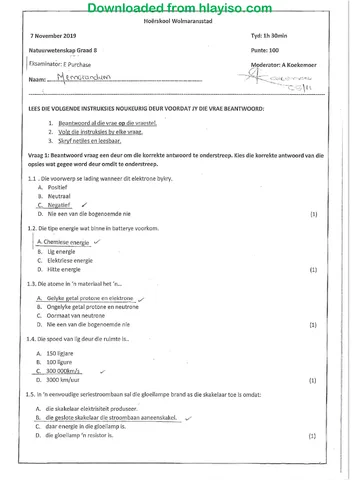
Natural Sciences Grade 8 P1 November Mock 2026 Question Paper
Grade 8 Natural Sciences Paper 1 question paper from the November Mock Exam 2026, 12 pages. Read online or get the free PDF download, memo linked when available.
Publisher: Hlayiso
Natural Sciences · Grade 8 · November Mock Exam · 2026. Question paper, 12 pages. Read online or download the PDF.
- Subject
- Natural Sciences
- Grade
- Grade 8
- Document type
- Question paper
- Year
- 2026
- Exam period
- November Mock Exam
- Paper
- 1
- Publisher
- Hlayiso
- Curriculum
- CAPS
- Pages
- 12
- File size
- 161.8 KB
Loading document…
Loading document…
1 of 12
Document textSearch extracted text and jump to a page.
Natural Sciences
2
Senior Phase Mock
Hlayiso/Mock 2026
INSTRUCTIONS AND INFORMATION
Read the following instructions carefully before answering the questions.
1.
This question paper consists of NINE questions in TWO sections:
SECTION A: QUESTIONS 1 to 3
(20 marks)
SECTION B: QUESTIONS 4 to 9
(80 marks)
2.
The paper examines the Term 3 work (ENERGY AND CHANGE) and the Term 4 work
(PLANET EARTH AND BEYOND).
3.
Answer ALL the questions in the ANSWER BOOK.
4.
Number the answers correctly according to the numbering system used in this question
paper.
5.
Leave a line open between subquestions, for example between QUESTION 4.1 and
QUESTION 4.2.
6.
You may use a non-programmable calculator.
7.
Show ALL calculations, including formulae and units.
8.
ALL drawings must be done in pencil and labelled in blue or black ink. Use the correct
circuit symbols when you draw circuit diagrams.
9.
Diagrams are NOT necessarily drawn to scale.
10.
Write neatly and legibly.
Copyright reserved
Please turn over
Natural Sciences
3
Senior Phase Mock
Hlayiso/Mock 2026
SECTION A
QUESTION 1: MULTIPLE-CHOICE QUESTIONS
Various options are provided as possible answers to the following questions. Choose the
answer and write only the letter (A–D) next to the question numbers (1.1 to 1.10) in the
ANSWER BOOK, e.g. 1.11 D.
1.1
A glass rod is rubbed with a silk cloth and becomes POSITIVELY charged.
This happens because the glass rod …
A
lost electrons to the silk cloth.
B
gained protons from the silk cloth.
C
gained electrons from the silk cloth.
D
lost protons to the silk cloth.
(1)
1.2
Which ONE of the following devices works mainly because of the MAGNETIC
effect of an electric current?
A
Toaster
B
Electric kettle
C
Electric doorbell
D
Electric heater
(1)
1.3
More identical cells are connected in SERIES to a circuit that contains ONE
light bulb. The bulb …
A
gets brighter.
B
gets dimmer.
C
stays the same.
D
goes out.
(1)
1.4
A fuse is connected in a circuit because it …
A
melts and breaks the circuit when the current becomes too high.
B
increases the current so that the appliance works better.
C
stores electrical energy for when the power fails.
D
changes electrical energy into light energy.
(1)
1.5
Which colour of visible light has the SHORTEST wavelength?
A
Red
B
Yellow
C
Green
D
Violet
(1)
Copyright reserved
Please turn over
Natural Sciences
4
Senior Phase Mock
Hlayiso/Mock 2026
1.6
A leaf looks green in sunlight because the leaf …
A
absorbs green light and reflects all the other colours.
B
reflects green light and absorbs most of the other colours.
C
gives off its own green light.
D
refracts green light into the eye.
(1)
1.7
Light travels from a source in …
A
straight lines.
B
curved lines.
C
circles.
D
zigzag lines.
(1)
1.8
Which ONE of the following planets is a GAS GIANT?
A
Mercury
B
Venus
C
Mars
D
Saturn
(1)
1.9
The star that is CLOSEST to the Earth is …
A
Sirius.
B
the Sun.
C
Betelgeuse.
D
Polaris.
(1)
1.10
We can see the Moon at night because it …
A
gives off its own light.
B
reflects light from the Sun.
C
reflects light from the Earth.
D
is very hot.
(1)
[10]
QUESTION 2: TERMINOLOGY
Give the correct scientific term for each of the following descriptions. Write only the term next
to the question numbers (2.1 to 2.5) in the ANSWER BOOK.
2.1
A giant electric spark in the sky caused by the sudden discharge of static
electricity from a cloud
(1)
Copyright reserved
Please turn over
Natural Sciences
5
Senior Phase Mock
Hlayiso/Mock 2026
2.2
A coil of wire around an iron core that becomes a magnet only while a current
flows through the wire
(1)
2.3
The bending of light when it passes at an angle from one transparent medium
into another
(1)
2.4
A group of stars that, seen from the Earth, forms a pattern or shape in the
night sky
(1)
2.5
A huge group of billions of stars, gas and dust that is held together by gravity
(1)
[5]
QUESTION 3: MATCHING ITEMS
Choose a term from COLUMN B that matches a description in COLUMN A. Write only the
letter (A–I) next to the question numbers (3.1 to 3.5) in the ANSWER BOOK, e.g. 3.6 J.
COLUMN A
COLUMN B
3.1
A material, such as frosted glass, that lets some
light through but scatters it, so that objects behind it
cannot be seen clearly
A
Opaque
3.2
An object that gives off its own light
B
Translucent
3.3
The breaking down of a compound into simpler
substances by passing an electric current through
its solution
C
Luminous
3.4
A material that does NOT allow an electric current
to flow through it easily
D
Electrolysis
3.5
The largest object that orbits the Sun between Mars
and Jupiter; it is classified as a dwarf planet
E
Conductor
F
Insulator
G
Pluto
H
Ceres
I
Transparent
[5]
TOTAL SECTION A:
20
Copyright reserved
Please turn over
Natural Sciences
6
Senior Phase Mock
Hlayiso/Mock 2026
SECTION B
QUESTION 4: STATIC ELECTRICITY
Thandi rubs a plastic comb with a woollen cloth. The comb becomes NEGATIVELY charged.
She then holds the comb close to small pieces of tissue paper on a table. The pieces of paper
jump up towards the comb.
−
−
−
−
−
comb
pieces of tissue paper
4.1
What was the charge on the comb BEFORE it was rubbed? Give a reason
for your answer.
(2)
4.2
Refer to the movement of electrons and explain how the comb became
negatively charged.
(2)
4.3
What is the charge on the woollen cloth AFTER the rubbing?
(1)
4.4
Redraw the comb and ONE piece of tissue paper in your ANSWER BOOK.
Show how the charges in the piece of paper are arranged when the charged
comb is held close to it.
(2)
4.5
Thandi rubs a second plastic comb with the same cloth and hangs the two
combs on threads close to each other. Will the combs ATTRACT or REPEL
each other?
(1)
[8]
QUESTION 5: ENERGY TRANSFER IN ELECTRICAL SYSTEMS
5.1
Electric current has three effects: a HEATING effect, a MAGNETIC effect and
a CHEMICAL effect. Which effect is used in each of the following?
5.1.1
A crane in a scrapyard lifts old cars with a large electromagnet.
5.1.2
A thin layer of silver is coated onto a spoon (electroplating).
5.1.3
A hairdryer blows warm air.
(3)
5.2
Learners wind an insulated copper wire 20 times around an iron nail and
connect it to a battery of two cells and a switch. When the switch is closed,
the nail picks up 6 steel paper clips.
battery
switch
paper clips
insulated copper wire
iron nail
5.2.1
The nail drops the paper clips when the switch is opened. What does
this tell you about the type of magnet that was formed?
(1)
Copyright reserved
Please turn over
Natural Sciences
7
Senior Phase Mock
Hlayiso/Mock 2026
5.2.2
Suggest TWO practical changes that will make the electromagnet
pick up MORE paper clips.
(2)
5.2.3
Explain
why
the
electromagnet
cannot
pick
up
aluminium
cooldrink-can rings.
(1)
5.3
The diagram shows apparatus used to pass an electric current through a
blue copper chloride solution. After a few minutes, gas bubbles that smell
like swimming-pool water form at the positive electrode, and a reddish-brown
layer forms on the negative electrode.
+
−
positive
electrode
negative
electrode
copper chloride
solution
5.3.1
Complete the following word equation for the reaction in the
ANSWER BOOK:
copper chloride −→……… + ………
(2)
5.3.2
Which effect of an electric current is shown in this experiment?
(1)
5.3.3
Write down the main energy conversion that takes place in the
solution.
(2)
5.4
State why a fuse in a circuit must have a LOWER current rating than the
maximum current that the wires can safely carry.
(1)
[13]
Copyright reserved
Please turn over
Natural Sciences
8
Senior Phase Mock
Hlayiso/Mock 2026
QUESTION 6: SERIES AND PARALLEL CIRCUITS
6.1
Grade 8 learners investigate how the number of light bulbs connected in
SERIES affects the current in a circuit. They use the same battery, ammeter
and IDENTICAL bulbs for circuits A, B and C.
Circuit A
A
Circuit B
A
Circuit C
A
Circuit
A
B
C
Number of bulbs in series
1
2
3
Ammeter reading (A)
0,60
0,30
0,20
6.1.1
Write down an investigative question for this investigation.
(2)
6.1.2
Identify the INDEPENDENT variable.
(1)
6.1.3
Name ONE variable that was kept constant (controlled).
(1)
6.1.4
Write down a conclusion for this investigation, and use the idea of
RESISTANCE to explain the results.
(2)
6.2
In the circuit below, two DIFFERENT light bulbs, P and Q, are connected in
parallel. Ammeter A1 measures the total current and ammeter A2 measures
the current through bulb P.
A1
A2
P
Q
A1 reads 1,2 A
A2 reads 0,5 A
6.2.1
Calculate the current through bulb Q.
(2)
6.2.2
Bulb Q blows (burns out). Will bulb P still glow? Write only YES or
NO.
(1)
6.2.3
A third bulb is now connected in parallel with P and Q. Will the
TOTAL resistance of the circuit INCREASE, DECREASE or STAY
THE SAME?
(1)
6.2.4
Give ONE reason why the lights in a house are connected in parallel
and not in series.
(1)
Copyright reserved
Please turn over
Natural Sciences
9
Senior Phase Mock
Hlayiso/Mock 2026
6.3
Draw a circuit diagram of a circuit that consists of THREE cells connected in
series, a CLOSED switch, a FUSE in series with the battery and TWO light
bulbs connected in PARALLEL.
(4)
[15]
QUESTION 7: VISIBLE LIGHT
7.1
A narrow beam of white light shines onto a triangular glass prism. The light
splits into seven colours on a white screen. X and Y are the colours at the two
ends of the band of colours.
white light
X
Y
screen
glass prism
7.1.1
What is the band of seven colours on the screen called?
(1)
7.1.2
Name the colours X and Y.
(2)
7.1.3
Which ONE of the seven colours is refracted (bent) the MOST by
the prism?
(1)
7.2
A ray of light strikes a plane mirror. The incident ray makes an angle of 40°
with the SURFACE of the mirror. The dashed line is the normal.
mirror
normal
incident ray
40°
7.2.1
Calculate the angle of incidence.
(2)
7.2.2
Write down the size of the angle of reflection.
(1)
7.2.3
State the law of reflection.
(1)
7.3
A ray of light passes from air into a rectangular glass block at an angle, as
shown.
ray of light
normal
glass block
air
Copyright reserved
Please turn over
Natural Sciences
10
Senior Phase Mock
Hlayiso/Mock 2026
7.3.1
Name the phenomenon that takes place when the ray enters the
glass block at an angle.
(1)
7.3.2
Will the ray bend TOWARDS or AWAY FROM the normal when it
enters the glass? Give a reason for your answer.
(2)
7.4
A learner’s soccer kit has a RED shirt and WHITE shorts. On a school stage,
only BLUE light shines on the learner.
7.4.1
What colour will the red shirt appear to be in the blue light?
(1)
7.4.2
Refer to the ABSORPTION and REFLECTION of light and explain
your answer to QUESTION 7.4.1.
(2)
7.5
Which ONE of the following will cast the darkest, clearest shadow when light
shines on it: a clear glass window, a sheet of frosted glass or a wooden door?
(1)
[15]
Copyright reserved
Please turn over
Natural Sciences
11
Senior Phase Mock
Hlayiso/Mock 2026
QUESTION 8: THE SOLAR SYSTEM
8.1
The diagram shows the Sun, the eight planets (A to H), the asteroid belt and
a dwarf planet (X).
Sun
A
B
C
D
E
F
G
H
asteroid
belt
X
8.1.1
The Sun is a star, but the planets are not. Give ONE reason why the
Sun is called a star.
(1)
8.1.2
Name the nuclear reaction that produces the Sun’s energy, and the
gas that forms in this reaction.
(2)
8.1.3
Write down the NAMES of planet D (the “red planet”) and planet E
(the largest planet).
(2)
8.1.4
Give the NAME of the dwarf planet X.
(1)
8.1.5
Planet C is the only planet known to support life. Name and explain
ONE condition on planet C that makes life possible.
(2)
8.1.6
State ONE other condition on planet C that supports life (name only).
(1)
8.2
The table gives information about six planets.
Planet
Diameter (km)
Average distance
from the Sun (million
km)
Time for one orbit
(Earth years)
Mercury
4 879
58
0,24
Venus
12 104
108
0,62
Earth
12 756
150
1,00
Mars
6 792
228
1,88
Jupiter
142 984
779
11,86
Saturn
120 536
1 432
29,46
[Values rounded from published planetary data.]
8.2.1
Which planet in the table is the SMALLEST?
(1)
8.2.2
Use the table to describe the relationship between a planet’s
distance from the Sun and the time it takes to complete one orbit.
(2)
8.2.3
Name the force that keeps all the planets in their orbits around the
Sun.
(1)
Copyright reserved
Please turn over
Natural Sciences
12
Senior Phase Mock
Hlayiso/Mock 2026
8.3
Give THREE differences between an asteroid and a comet. Tabulate your
answer.
(3)
[16]
QUESTION 9: BEYOND THE SOLAR SYSTEM AND LOOKING INTO SPACE
9.1
The sketch shows a well-known group of stars and its two pointer stars, as
seen in the southern night sky.
Pointer 2
Pointer 1
Pointer 1 is the brighter pointer. It is part of the star system that is closest to
our solar system.
9.1.1
Name the group of four bright stars on the right of the sketch.
(1)
9.1.2
Name the star system of which Pointer 1 is part.
(1)
9.1.3
Explain what a LIGHT YEAR is.
(2)
9.1.4
Why do astronomers measure the distances to stars in light years
and not in kilometres?
(1)
9.1.5
Light from the Sun takes about 500 seconds to reach the Earth. Light
travels at 300 000 km per second. Calculate the distance between
the Sun and the Earth in kilometres.
(2)
9.2
Our solar system is part of the Milky Way galaxy.
9.2.1
Describe the SHAPE of the Milky Way galaxy.
(1)
9.2.2
Why is our galaxy called the “Milky Way”?
(1)
9.3
South Africa hosts the Southern African Large Telescope (SALT) near
Sutherland and the MeerKAT telescope near Carnarvon, both in the Northern
Cape.
9.3.1
Is MeerKAT an OPTICAL telescope or a RADIO telescope?
(1)
9.3.2
Give TWO reasons why the area around Sutherland is a good place
for an optical telescope such as SALT.
(2)
9.3.3
Give ONE advantage of a radio telescope over an optical telescope.
(1)
[13]
TOTAL SECTION B:
80
TOTAL:
100
Copyright reserved
Study this subject
Revise the topics in this paper, then practise them question by question.
Recommended for this subject
More papers and memos for this grade and subject.
Question paper
Natural Sciences Grade 8 June 2019 Question Paper
Question paper
Natural Sciences Grade 8 November 2019 Question Paper
Question paper
Natural Sciences Grade 8 November 2019 Question Paper
Question paper
Natural Sciences Grade 8 June 2018 Question Paper
Question paper
Natural Sciences Grade 8 March 2018 Question Paper
Question paper
Natural Sciences Grade 8 NSC November 2018 Question Paper
Related documents
Addendum
Natural Sciences Grade 8 Paper 1 November Mock 2026 Addendum
Memorandum
Natural Sciences Grade 8 Paper 1 November Mock 2026 Memo
Question paper
Natural Sciences Grade 8 NSC Prelim 2018 Question Paper
Question paper
Natural Sciences Grade 8 Sept 2018 Question Paper
Question paper
Natural Sciences Grade 8 NSC November 2017 Question Paper
Question paper
Natural Sciences Grade 8 March 2016 Question Paper
More from Grade 8 Natural Sciences
CAPS document
CAPS SP NATURAL SCIENCES GR 7 9 WEB
Memorandum
Natural Sciences Grade 8 June 2020 Memo
Memorandum
Natural Sciences Grade 8 November 2020 Memo
Memorandum
Natural Sciences Grade 8 November 2019 Memo
Memorandum
Natural Sciences Grade 8 NSC November 2017 Memo
Question paper