
Downloaded from hlayiso.com
TEACHERS WITHOUT BORDERS
PROGRAMME
BROUGHT TO YOU BY
With grateful thanks to our associate partners, The National Department of Basic Education, The Independent
Examinations Board, Siyavula Education, Smarticks, Noteshare, Lemonlicious, datacentrix, and most of all, to
the schools and teachers from both the public and private education sectors who as founder contributors,
have lent content to the Teachers without Borders programme, for the benefit of all South Africa's learners.
In Bill Gates words, at the Mandela Day ‘Living Together’ address: “Maintaining the quality of this country’s
higher education system while expanding access to more students will not be easy. But it’s critical to
South Africa’s future” – working together, we can help achieve this."
Contributing schools to date:
Clifton School Milnerton High Rustenburg Girls’ High St Peter's
Durban Girls' Northwood High St Anne's DC St Stithians
Fairmont High Roedean St John's DSG Wynberg Boys' High
Herzlia High Rondebosch Boys’ St Mary's DSG Kloof Wynberg Secondary
Skip to contentQuestion paper 
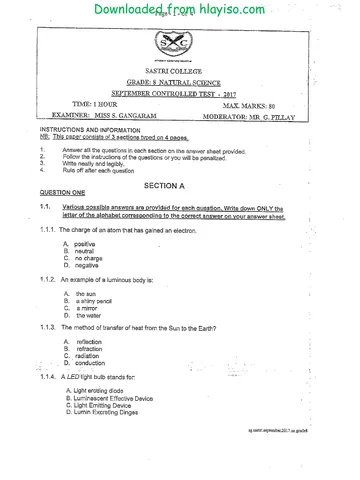
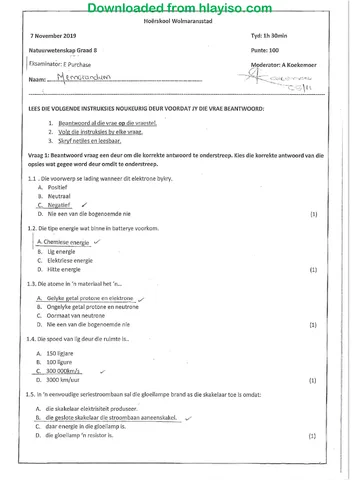
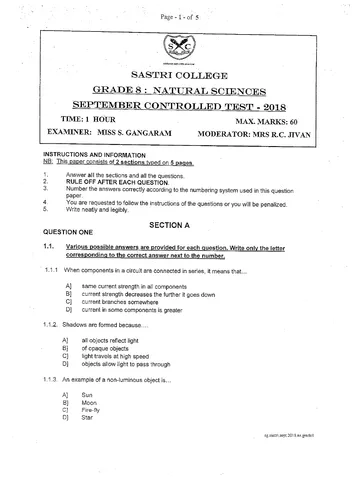

View all
Natural Sciences Grade 8 June 2019 Question Paper
Grade 8 Natural Sciences question paper from the June 2019, 14 pages. Read online or get the free PDF download, memo linked when available.
Natural Sciences · Grade 8 · June · 2019. Question paper, 14 pages. Read online or download the PDF.
- Subject
- Natural Sciences
- Grade
- Grade 8
- Document type
- Question paper
- Year
- 2019
- Exam period
- June
- Curriculum
- CAPS
- Pages
- 14
- File size
- 1.3 MB
Loading document…
Loading document…
1 of 14
Document textSearch extracted text and jump to a page.
Downloaded from hlayiso.com
GRADE 8 NATURAL SCIENCES EXAMINATION JUNE 2019
TIME: 2 HOURS MARKS____/120
NAME:
INSTRUCTIONS:
1. This paper consists of 13 pages. Please check that all pages are present.
2. Use the periodic table to answer the questions in this examination
3. Answer question 1 in the spaces provided on the question paper.
4. Answer questions 2 – 4 on the lined paper provided.
QUESTION 1
1.1. Various possible answers are provided for each question.
Choose the best answer and write only the LETTER in the box provided.
1.1.1. 1.1.2. 1.1.3. 1.1.4. 1.1.5. 1.1.6. 1.1.7. 1.1.8. 1.1.9. 1.1.10.
1.1.1. The following bin was observed in a local
Pietermaritzburg hospital. The symbol on the lid of
the bin indicates that the waste inside is
A. a biohazard
B. an environmental hazard
C. a radioactive substance
D. a corrosive substance
(1)
1.1.2. The safety symbol alongside illustrates a:
A. biohazard
B. corrosive substance
C. harmful substance
D. environmental hazard
(1)
Page 1 of 13
Downloaded from hlayiso.com
1.1.3. Which of the following safety symbols is to warn people that the material is
flammable?
A. B. C. D.
(1)
1.1.4. Which of these elements does not react with any other elements?
A. Al
B. As
C. Ar
(1)
D. At
1.1.5. Uranium is an element which is
A. Radioactive and manmade
B. Radioactive and solid at room temperature
C. Radioactive and liquid at room temperature
(1)
D. Manmade and solid at room temperature
1.1.6. Which statements about a phosphorus atom are correct?
1. The nucleon number is 16.
2. The number of outer electrons is 5.
3. The proton number is 15.
A. 1, 2 and 3
B. 1 and 2 only
C. 1 and 3 only (1)
D. 2 and 3 only
Questions 1.1.7. and 1.1.8. refer to the following piece of glass apparatus.
1.1.7. The apparatus shown alongside is
A. a measuring cylinder
B. a burette
C. a pipette
D. a conical flask (1)
Page 2 of 13
Downloaded from hlayiso.com
1.1.8. The reading on the apparatus is
A. 16.6 cm3
B. 15.4 cm3
C. 15.3 cm3
D. 16.7 cm3 (1)
Questions 1.1.9. and 1.1.10. refer to the pie charts below that show the different
sources used for electricity generation in 2004 and 2014.
other other
1%
2004 2% 2014
Hydro
Hydro 16%
23%
Coal Coal
40% 40% Nuclear
Nuclear
16%
2%
Gas
13% Oil Gas
Oil 19%
7%
21%
1.1.9. Which forms of electricity generation have increased between 2004 & 2014?
A. Gas and nuclear only
B. Gas and oil
C. Gas & other & nuclear
D. Gas and coal
(1)
1.1.10. If the World’s total electricity generation was 500 000 units, how many units
were produced by coal in 2004?
A. 199 000 units
B. 250 000 units
C. 1000 000 units
(1)
D. 200 000 units
[10]
1.2. Write the chemical formula for four molecules of a compound consisting of lithium,
carbon and oxygen in the ratio of 2:1:3.
[4]
___________________________________________________________
Page 3 of 13
Downloaded from hlayiso.com
1.3. The following diagram shows an outline of the Periodic Table.
The letters (A – F) shown are NOT the chemical symbols of the elements.
1.
3
.
1
.
Give all the letters (A – F) of the elements that represent metals
____________________________________________ (1)
1.3.2. Write the letter (A to F) of a noble gas _____________
State the group number _______ and period number _____of this noble gas. (3)
1.3.3. Write letter (A to F) of the element that is a metalloid ____________
State the chemical name _______________and chemical symbol _______of this
metalloid. (3)
1.3.4. Write the letter (A – F) of the element that is an alkaline earth metal_______
How many electrons are found in the outer energy level of this element?_____(2)
[9]
1.4. Answer the following questions about laboratory apparatus.
1.4.1. What is a boss head clamp used for in the laboratory?
(2)
_______________________________________________________________
_______________________________________________________________
Page 4 of 13
Downloaded from hlayiso.com
1.4.2. What piece of apparatus would you use to place a small amount of a powder
into a test tube?
______________________________________________________________
(1)
1.4.3. Label the TWO pieces of apparatus in the diagram below:
(2)
1.4.4. You use a 25 ml pipette to transfer 25 ml of water into a
beaker.
You then use a 50 ml pipette to transfer 50 ml of water
into the same 100 ml beaker.
Draw the meniscus on the diagram of
50
the beaker to indicate the total amount
of water in the beaker.
(2)
1.4.5. Name ONE other piece of apparatus that you could have used to transfer this
amount of water to the beaker.
(1)
_____________________________________________________
[8]
1.5. The following equations represent four reactions that took place when elements
reacted with one another.
Name the compound that will form at A, B and C.
e.g. Na + O2 sodium oxide
Si + Cl2 A
Ca + N2 B
K + Br2 C
[3]
Page 5 of 13
Downloaded from hlayiso.com
1.6. The structure of an atom is shown below:
1.6.1. Complete the key and complete the diagram below. (5)
proton
5
(2)
1.6.2. Write a suitable heading above the diagram.
[7]
1.7. Copper is a metal.
Which TWO properties of metals are useful when making a copper bottom of a
frying pan?
_______________________________________________________________
_______________________________________________________________ [2]
Page 6 of 13
Downloaded from hlayiso.com
1.8. The pie chart shows the composition of recyclable waste from a family in
Pietermaritzburg.
PIE CHART
other
20% organic
matter
30%
glass and
tins
10%
paper
15% plastic
25%
Draw a bar graph to show the data in the pie graph. [11]
Page 7 of 13
Downloaded from hlayiso.com
1.9. The diagrams below show the arrangement of atoms or molecules in five different
substances A, B, C, D and E.
1.9.1 Give the LETTER of the diagram which represents:
(i) An element _______ (1)
(ii) A mixture of elements _______ (1)
(iii) A compound _______ (1)
(iv) A mixture of compounds _______ (1)
(v) A mixture of an element and a compound _______ (1)
1.9.2 Using the same symbols as given in the diagrams above, draw a diagram of
a mixture of a diatomic element and a compound. (2)
[7]
Page 8 of 13
Downloaded from hlayiso.com
1.10. Use the following article and the periodic table to answer the questions below:
https://iupac.org/ Elements 113, 115, 117, and 118 are now formally named
Research Triangle Park, NC: On 28 November 2016, the International Union of Pure and Applied
Chemistry (IUPAC) approved the name and symbols for element 113, 115, 117, and 118.
Keeping with tradition, the newly discovered elements have been named after a place or
geographical region, or a scientist.
The name nihonium with the symbol Nh for element 113, was proposed by the discoverers at
RIKEN Nishina Center (Japan); the name came from Nihon which is one of the two ways to say
“Japan” in Japanese, and means “the Land of Rising Sun”.
Moscovium with the symbol Mc for element 115, and tennessine with the symbol Ts for element
117, were proposed by the discoverers at various research laboratories in Russia and USA.
Moscovium is in recognition of the Moscow region. Tennessine is in recognition of the
contribution of the Tennessee region of the United States to superheavy element research.
Lastly, the name oganesson and symbol Og for element 118, was proposed by the teams of
discoverers at the various laboratories, and recognizes Professor Yuri Oganessian for his
pioneering contributions to the discovery of superheavy elements.
Comments from the general public were many. However, these suggestions could not be
accepted, given the fact that under the current guidelines, only the discoverers have the right to
propose names and symbols.
1.10.1. What is the temporary placeholder name of element 113?
_______________________________________________________ (1)
1.10.2. What is the official name of element 117? _________________________ (1)
1.10.3. Identify the element that combines with calcium to form element 115
__________________________________________________________ (1)
1.10.4. What is the official name of the element that was named for a person?
__________________________________________________________ (1)
1.10.5. How many protons in element 117 atoms? ________________________ (1)
1.10.6. How many neutrons in element 118 atoms? _______________________ (1)
1.10.7. How many nucleons in element 115 atoms? ______________________ (1)
1.10.8. In which period is element 113 found? ____________________________ (1)
1.10.9. Write the correct nuclear notation for element 115. (2)
[10]
Page 9 of 13
Downloaded from hlayiso.com
ANSWER THE FOLLOWING QUESTIONS ON THE LINED PAPER PROVIDED.
QUESTION 2
2.1. Study the following diagram showing zinc reacting with hydrochloric acid to produce
hydrogen gas and zinc chloride.
A B
C
2.1.1. Name the THREE types of glass apparatus labelled A, B and C. (3)
2.1.2. Name the reactants in this experiment. (2)
2.1.3. Write the chemical formula for hydrogen gas. (2)
[7]
2.2. Record the measurements shown on the thermometer below.
(4)
[4]
Fahrenheit - Celsius
Page 10 of 13
Downloaded from hlayiso.com
2.3. Study the diagram below.
2.3.1. Name the apparatus shown above. (1)
2.3.2. What is the purpose of the above apparatus? (1)
2.3.3. What other apparatus can be used for the same purpose? (1)
2.3.4. Record the measurement shown on the apparatus above. (2)
[5]
QUESTION 3
3.1. Study the image below which shows some elements. Draw a table to show the
elements that are gases, liquids and solids at room temperature in separate columns.
Br Na Xe
Be Ne Hg
[7]
Page 11 of 13
Downloaded from hlayiso.com
3.2. Air is mostly made up of the gases, nitrogen and oxygen. Carbon dioxide makes
up only a very small percentage of the air. Air also contains water that has
evaporated. This gas is called water vapour.
78% Nitrogen
0,97% argon,
water vapour and
other gases
0,03%
21% Oxygen carbon
dioxide
The text boxes show the different amounts of the main gases in the air in the
balloon.
3.2.1 Is air a mixture, an element or a compound? (1)
3.2.2 Give a reason for your answer in 3.2.1. (1)
3.2.3 Is carbon dioxide an element or a compound? (1)
3.2.4 Explain the reason for your answer in 3.2.3 (1)
3.2.5 Is oxygen an atom or a molecule? (1)
3.2.6 Explain the reason for your answer in 3.2.5 (1)
[6]
Page 12 of 13
Downloaded from hlayiso.com
QUESTION 4
4.1. Observe the following diagram showing the reaction in which sulphur burns in
the presence of oxygen to produce sulphur dioxide.
Sulphur dioxide
sulphur
4.1.1. Is this reaction endothermic or exothermic? Give a reason for your (2)
answer.
4.1.2. Make ONE observation about the reaction occurring in this experiment. (1)
4.1.3. The chemical equation for the above reaction is S + O2 SO2
Write a word equation for the reaction.
(3)
4.1.4. Use the following key to draw four molecules of sulphur dioxide
(3)
Oxygen Hydrogen Sulphur
4.1.5. State TWO ways in which the girl is correctly following lab safety
procedures.
In EACH case, explain what she is doing safely and why it is important. (4)
[13]
4.2. Write the chemical formula for the following diagrams.
KEY A. B.
Carbon
Hydrogen
C. D. [7]
Oxygen
TOTAL 120
Page 13 of 13
Powered by TCPDF (www.tcpdf.org)
Study this subject
Revise the topics in this paper, then practise them question by question.
Recommended for this subject
More papers and memos for this grade and subject.
Question paper
Natural Sciences Grade 8 P1 November Mock 2026 Question Paper
Question paper
Natural Sciences Grade 8 November 2019 Question Paper
Question paper
Natural Sciences Grade 8 November 2019 Question Paper
Question paper
Natural Sciences Grade 8 June 2018 Question Paper
Question paper
Natural Sciences Grade 8 March 2018 Question Paper
Question paper
Natural Sciences Grade 8 NSC November 2018 Question Paper
Related documents
Memorandum
Natural Sciences Grade 8 November 2019 Memo
Question paper
Natural Sciences Grade 8 NSC Prelim 2018 Question Paper
Question paper
Natural Sciences Grade 8 Sept 2018 Question Paper
Question paper
Natural Sciences Grade 8 NSC November 2017 Question Paper
Question paper
Natural Sciences Grade 8 March 2016 Question Paper
Question paper
Natural Sciences Grade 8 March 2014 Question Paper
More from Grade 8 Natural Sciences
CAPS document
CAPS SP NATURAL SCIENCES GR 7 9 WEB
Addendum
Natural Sciences Grade 8 Paper 1 November Mock 2026 Addendum
Memorandum
Natural Sciences Grade 8 Paper 1 November Mock 2026 Memo
Memorandum
Natural Sciences Grade 8 June 2020 Memo
Memorandum
Natural Sciences Grade 8 November 2020 Memo
Memorandum