
Downloaded from hlayiso.com
testpapers.co.za
Skip to content

View all
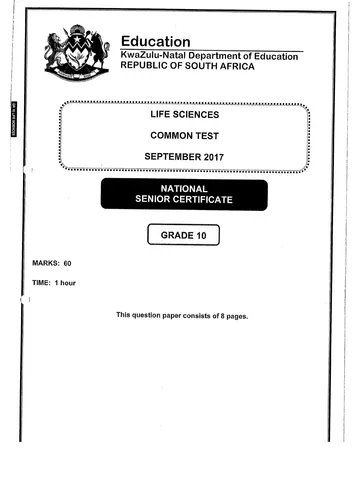
Life Sciences Grade 10 September Test 2017 Paper & Memo
Grade 10 Life Sciences question paper and memo from the September Test 2017, 10 pages. Read online or get the free PDF download.
Life Sciences · Grade 10 · September Test · 2017. Question paper and memorandum, 10 pages. Read online or download the PDF.
- Subject
- Life Sciences
- Grade
- Grade 10
- Document type
- Question paper and memo
- Year
- 2017
- Exam period
- September Test
- Curriculum
- CAPS
- Pages
- 10
- File size
- 516.3 KB
Free to read online, no sign-up needed
Loading document…
Loading document…
1 of 10
Document textSearch extracted text and jump to a page.
Ltescerees DOWNIlOaded frem hlayisSO. Ges 2017 common Test
Grade 10
INSTRUCTIONS AND INFORMATION
Read the following instructions carefully before answering the questions.
1. Answer ALL. the questions.
2. Write ALL the answers in the ANSWER BOOK.
3. Start the answers to EACH question at the top of a NEW page.
4, Number the answers correctly according to the numbering system used in
this question paper.
5. Present your answers according to the instructions of each question.
6. Do ALL drawings in pencil and label them in blue or black ink.
7. Draw diagrams, tables or flow charts only when asked to do so,
8. The diagrams in this question paper are NOT necessarily drawn to scale.
9. Do NOT use graph paper.
10.
1
1, | Write neatly and legibly.
Copyright Reserved
Please Turn Over
You must use a non-programmable calculator, protractor and a compass, where necessary.
2
g
ma
Hy
3
fd
g
6
R
3
Life Sciences
Downloaded from hlayiso.com
September 2017 Common Test
Grade 10
SECTION A
QUESTION 1
1.1 Various options are provided as possible answers to the following questions.
Choose the correct answer and write only the letter (A to D) next to the question
number (1.1.1 to 1.1.5) in your ANSWER BOOK, for example 1.1.6 D.
1.1.1
1.1.3
Copyright Reserved
Which ONE of the following is part of the Earth and its atmosphere where
living organisms are found?
A Ecosystem
B Ecology
Cc Biosphere
D Biome
Study the characteristics listed below.
(i) Simple, single-celled
(ii) | Complex, multicellular
(iii) Prokaryotic
(iv) Eukaryotic
Which ONE of the following combinations is characteristic of the kingdom
Animalia?
A (i) and (iii) only
B (ii) and (iii) only
Cc (i) and (iv) only
D (ii) and (iv) only
Which consumer feeds on other animals only?
A Carnivores
B Herbivores
Cc Omnivores
D Decomposers
Which ONE of the following is a physiographic factor?
A Altitude
B pH of the soil
Cc Light intensity
D Temperature
Please Turn Over
Life Sciences
1.1.5
Copyright Reserved
Downloaded from hlayiso.com
September 2017 Common Test
Grade 10
The graph below shows the effect of temperature on the yleld of
tomatoes.
J :
Yield of tomatoes per plant (kg)
0 5 10 15 20 25 30 35 40
Temperature °C
A reasonable conclusion that can be made from this graph is that ...
A
B
Cc
D
an increase in temperature increases the yield of tomatoes.
a decrease in temperature increases the yield of tomatoes.
an increase in temperature to about 23 °C increases the yield
of tomatoes.
an increase in the yield of tomatoes increases the temperature.
(x2) ()
TOTAL SECTION A: 10
Please Turn Over
{
)
Downloaded from hlayiso.com
Life Sciences 5 September 2017 Common Test
Grade 10
SECTION B
QUESTION 2
2.1 Study the diagram below showing one of the cycles in nature.
Plants make their own food
Process A N
Gas given off B Gas released D
Plants and animals use gas B
Process C
2.1.1 Identify gas:
(a) B
(b) D
2.1.2 Write down the LETTER and the NAME of the process that decreases
the amount of oxygen in the atmosphere.
2.2 Describe the role of bacteria in the nitrogen cycle during the breaking down of dead
plants and animals.
Copyright Reserved
(1)
(2)
(4)
(4)
Please Turn Over
Life Sciences
Downloaded from hlayiso.com
September 2017 Common Test
Grade 10
2.3 An investigation was carried out to determine the air content of different soil types.
The procedure was as follows:
* Three identical beakers were used,
* Beakers A, B and C were filled with an equal volume of different soil types.
* An
equal amount of water was added to each beaker.
* The air content of each soil type was determined by observing the amount
of air bubbles released from the soil.
The results of the investigation are shown in the diagram below.
Water
Air
bubble
Soil
2.3.1
2.3.2
2.3.3 %
2.3.4.
2.3.5
Copyright Reserved
Identify the:
(a) Dependent variable
(b) Independent variable
Write down the LETTER of the beaker that contains clay soil.
Give ONE visible reason for your answer in QUESTION 2.3.2.
State TWO factors that were kept constant during the investigation.
State ONE way in which the reliability of the results can be increased,
Please Turn Over
f
(1)
(1)
(2)
(1)
(7)
(15)
Lfescenee DOWnloaded from hlayiso.com vor Connon re
Grade 10
QUESTION 3
3.1 The table below shows the number of each endemic species in South Africa.
ORGANISM NUMBER OF ENDEMIC SPECIES
Marine fish 97
Mammals 35
Birds 16
Amphibians 52
Reptiles 124
Vertebrates 44
Total 362
3.1.1 Define endemic.
3.1.2 Which organism has the lowest number of endemic species in South
Africa?
3.1.3 Calculate the percentage of endemic species in South Africa which
are reptiles. Show ALL working.
3.1.4 Suggest TWO reasons why humans need to conserve endemic
species.
3.2 Study the diagram of a food chain below.
3.2.1
3.2.2
3.2.3
Copyright Reserved
Write down the LETTER only of the organism that represents a/an:
(a) Secondary consumer
(b) — Autotroph
Describe the role of decomposers in the ecosystem where the above
food chain occurs.
Explain what would happen if ail of organism B died in an ecosystem
with limited biodiversity.
TOTAL SECTION B:
Please Turn Over
(2)
(1)
(3)
(2)
(8)
(1)
(2)
(3)
(7)
[15]
(30)
Downloaded from hlayiso.com
Life Sciences September 2017 Common Test
Grade 10
SECTION C
QUESTION 4
Describe the negative impact that human activities may have on the environment and reasons
why humans should conserve wetlands. Also describe the effect of temperature (day/night and
seasons) on the movement and behavior of animals.
Content: (17)
Synthesis: (3)
(20)
NOTE: NO marks will be awarded for answers in the form of flowcharts
or diagrams.
TOTAL SECTION C: 20
(
GRAND TOTAL: 60
Copyright Reserved
4900 UN] BSEOjq Penasey WySukdoo JBAQ WN] BSEAIq paniasay jy uAdog
[sv]
(2)
(1) Auy AedAy [Os YoRs UUM si8yeaq Jo JequNu ayy eseesou -
suopebgsanul op jeeday - g'e%
(z) Auy 499209 YORE 0} pappe JeyeM JO JUNO ~
ASAdAj JOS JUBIBYIP JO BLUNJOA -
£ ssiayeaq eoquep| - yEZ
re) () sejqgng we ssaj sey/ pare Jo sjunowe |[eWs SpjoH- EET
we “soBed y Jo sysisuoo euyepind Guyysew siyy
oO (y) ro TET
{eo} 0) /Sedhy Jos juareyig — (q)
2 Q) syusyuos diy (8) Vez
> ez ———
& (py) Auy ssiuejd Aq paqiosge oue sayenin - . oF aqvas
cc ASSET OU! SSP LOAUOD -
Aeus}eg SPENIN - nein
£ ASOUMU OY oneuoen chan. ALVOILYADS YOINAS
Ze. HAN ~
ro} /APIUOWUWUE SB [OS Lp OJU! pesesjel S| U@HONIN- 7°, TWNOLLVN
i (a
to (2) puopeidsey AQ ZZ go RA BES BEE SSG ES SERBS SESS ESSE SES SES EEEESEEES,
3 (b) /AaPXolp uoqied —(q) : 2102 BAGWAL das :
1 “
CG () puaBAxQ (©) LEZ ™ isa. NOWWOS :
© Wz “ Fi
ro) ZNOUSaND Fi ANIMAdGINS OND :
—_ : rt
Sc g@ NOLLOAS “ SAONAIDS Ss! ”
-
s ny V NOLLOSS WLOL See ee eee eee eee
° (ol) (zx) SAO SEL
Q nan
LY EL
rAd ZL
PAO VEL VolIdsV HLNOS 40 OaNd3sy
VL uoneonpa jo Jueujiedag jeyey-njnzemy
}NOILSaND.
ous: uoneonpy
V NOLLOSS
uinpueowoyy _ “_
yS8| UOWWIOD 210z Joquiaydeg z . OL 8peid — seouaiog ay]
so?
Life Sciences — Grade 10 3 { 3mber 2017 Common Test
we Memorandum —
QUESTION 3
. 34
3.1.1. - Species found in a particular area or countryY”
- and nowhere elsev” (2)
3.1.2 Birdy’ . (1)
= 3.1.3 121 +362 100%
{o) = 33%Y1 33.4% (3)
oO 3.1.4. - For medicinal valuev
° .
- For ecotourism”
fe} - To prevent extinction of species”
” - Economic benefit for humansY Any (2)
—_ (Mark first TWO only)
> 8)
& 32
cx 321 (a) cy a)
£ (b) AY (1)
fe) 3.2.2 - They break organic compounds into simple nutrients”
- fo enrich the soilv Q)
KS
+ 3.2.3. - Frogs/€ population would decreaseY
ze} - causing the snake/D population to decreaseY
- due te shortage of food”
® - Population of A will increase”
we} - since there is nothing to feed upon it” Any (3)
_ M5]
Copyright Reserved Please tum over
Life Sciences — Grad” 4 September 2017 Common Test
‘ow! Memorandum
SECTION C
QUESTION 4
Negative impact of human activities on the environment
- Global warming” /air pollution/burning of fossil fuels
- speed up climate change”
- Natural habitats are destroyedY
- during cultivation of land~
- Natural vegetation is clearedY
- during city or town development”
- destroying the habitat of organisms”
- Human population growthY
- use more natural resources”
- Poachingy
- leads to the extinction of certain species” Any (8)
Importance of wetlands
- Provide water for people and domestic animals” |
- Provide a habitat and breeding place for plants and animals“
- Purify water naturally”
- Prevent flooding during heavy rainfall”
- Keeps rivers and streams flowing during dry seasons”
- Some wetlands attract tourists”
- thus creating jobs~ Any (4)
Effects of temperature
- Inwinter the temperature drops”
- Some animals migrate”
- Other animals hibernate~
- due to shortage of food”
- In summer the temperature risesY
- Other animals aestivatev/become dormant
~ to avoid the high temperatureY
- Some organism burrow”
- to avoid the heat of the dayv
- Some organisms are more active at nighiv/nociurnal
- when it is cooler” Any (5)
Content (17)
Synthesis (3)
[20]
ASSESSING THE PRESENTATION OF THE ESSAY.
Ideas arranged in a logical’ | Answered all aspects required by
relevant to the topic cause-elfect sequence the essay in sufficient detail
All information is relevant to: Correct sequence of events | At least the following points are
- Negative human impact for . included:
- Importance of wetlands ~ Negative human impact | - Negative human impact (5/8)
- The effect of temperature ~ Importance of wetlands - Importance of wetlands (2/4)
There is no irrelevant information |- The effect of temperature | - The effect of temperature (3/5)
mark Tmark mark
- TOTAL SECTION C:20
GRAND TOTAL: 60
Copyright Reserved
Study this subject
Recommended for this subject
Question paper and memo
Life Sciences Grade 10 KwaZulu Natal June 2017 Paper & Memo
Question paper and memo
Life Sciences Grade 10 March Test 2017 Paper & Memo
Question paper and memo
Life Sciences Grade 10 NSC Prelim 2017 Paper & Memo
Question paper and memo
Life Sciences Grade 10 September Test 2023 Paper & Memo
Question paper and memo
Life Sciences Grade 10 September Test 2019 Paper & Memo
Question paper and memo
Life Sciences Grade 10 September Test 2018 Paper & Memo
More from Grade 10 Life Sciences
Study guide
Gr10 Lewenswetenskappe OG studyguide LR
Study guide
Gr10 Life Sciences TG studyguide LR
Memorandum
Life Sciences Grade 10 P1 November Mock 2026 Memo (English)
Memorandum
Life Sciences Grade 10 P2 November Mock 2026 Memo (English)
Question paper
Life Sciences Grade 10 P1 November Mock 2026 QP (Eng)
Question paper