
Downloaded from hlayiso.com
GAUTENG DEPARTMENT OF EDUCATION
PREPARATORY EXAMINATION
2021
11091
TECHNICAL MATHEMATICS
PAPER 1
TIME: 3 hours
MARKS: 150
10 pages + 2 information sheets and 2 answer sheets
P.T.O.
Skip to contentAll 2021 papers 
View all
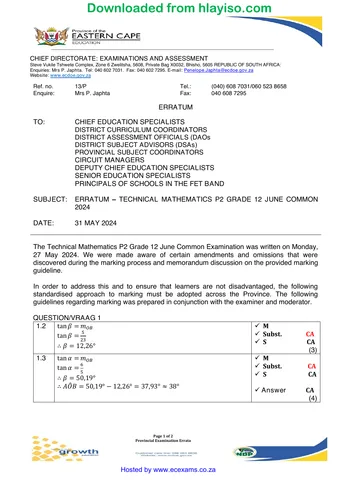
Technical Mathematics Grade 12 P1 GP Prelim 2021 QP (Eng)
Grade 12 Technical Mathematics Paper 1 question paper from the GP Prelim 2021 (English), 14 pages. Read online or download the free PDF.
Technical Mathematics · Grade 12 · GP Prelim · 2021 · English. Question paper, 14 pages. Read online or download the PDF.
- Subject
- Technical Mathematics
- Grade
- Grade 12
- Language
- English
- Document type
- Question paper
- Year
- 2021
- Exam period
- GP Prelim
- Paper
- 1
- Curriculum
- CAPS
- Pages
- 14
- File size
- 905.6 KB
Free to read online, no sign-up needed
Loading document…
Loading document…
1 of 14
This exam
GP Prelim 2021
- Paper 1Question paper
- Paper 2Question paper
Questions in this paper
Document textSearch extracted text and jump to a page.
Downloaded from hlayiso.com
TECHNICAL MATHEMATICS 2
(Paper 1) 11091/21
INSTRUCTIONS AND INFORMATION
1. Answer ALL the questions.
2. Answer QUESTION 4.2.3, QUESTION 4.2.6 and QUESTION 7.4 on the given
ANSWR SHEETS. Write your name in the space provided on the answer sheets and
hand them in with your ANSWER BOOK.
3. Number the answers correctly according to the numbering system used in this question
paper.
4. Clearly show ALL calculations, diagrams, graphs, etc. that you used in determining
your answers.
5. Answers only will not necessarily be awarded full marks.
6. You may use an approved scientific calculator (non-programmable and non-graphical),
unless stated otherwise.
7. If necessary, round-off answers to TWO decimal places, unless stated otherwise.
8. Diagrams are NOT necessarily drawn to scale.
9. Write neatly and legibly.
P.T.O.
Downloaded from hlayiso.com
TECHNICAL MATHEMATICS 3
(Paper 1) 11091/21
QUESTION 1
1.1 In order to support a solar collector (panel) at the correct angle, the roof trusses for a
building are designed as right-angled triangles as shown in the figure below.
A
x
B C
The rafter on the same side as the solar collector is 7 metres shorter than AC, the other
rafter. The base, BC, of the truss is 13 metres long.
1.1.1 If AB is 𝑥 metres, express AC in terms of 𝑥. (1)
1.1.2 Complete the following statement for the given right-angled triangle:
BC2 = AB2 + … (1)
1.1.3 Hence, determine the lengths of AB and AC. (5)
1.2 Solve for 𝑥 if:
(𝑥 − 4)(𝑥 + 3) ≤ 0 (2)
1.3 Solve for 𝑥 and 𝑦 if:
𝑥 + 𝑦 − 1 = 0 and 𝑥 2 + 𝑥𝑦 + 𝑦 2 = 3 (6)
P.T.O.
Downloaded from hlayiso.com
TECHNICAL MATHEMATICS 4
(Paper 1) 11091/21
1.4 Two metal spheres J and L are placed 0,2 m apart on a wooden stand. The charge on J
is + 3 × 10⁻⁶ 𝐶 (or 3 𝜇𝐶) and the charge on L is unknown. The symbol 𝜇 refers to
micro which refers to 10−6 .
The force that exists between the two spheres is given by:
𝑘𝑄1 𝑄2
𝐹= ;
𝑟2
where 𝑘 is Coulomb’s constant, 𝑄1 and 𝑄2 are the charges and 𝑟 is the distance between
the charges in metres.
1.4.1 Make 𝑄2 the subject of the formula. (2)
1.4.2 Calculate the magnitude of 𝑄2 if:
𝐹 = 1, 35 𝑁; 𝑘 = 9 × 10⁹ 𝑁. 𝑚2 . 𝐶 −2 ; 𝑄1 = 3 × 10⁻⁶ 𝐶 and 𝑟 = 0, 2 𝑚. (2)
1.5 Without the use of a calculator determine the integer equivalent value of the following
sum:
1110112 + 101002 (2)
[21]
QUESTION 2
3±√𝑘+4
2.1 Given: A =
2𝑘+1
2.1.1 For which value(s) of 𝑘 will A have real roots? (2)
2.1.2 For which value(s) of 𝑘 will A be undefined? (2)
2.2 For which value(s) of 𝑚 will the equation 3𝑥 2 + 2𝑥 − 𝑚 = 0 have non-real roots? (4)
[8]
P.T.O.
Downloaded from hlayiso.com
TECHNICAL MATHEMATICS 5
(Paper 1) 11091/21
QUESTION 3
3.1 Simplify the following without the use of a calculator:
√−8. √−12
3.1.1 (3)
√6
3.1.2 log 25 + 3 log 2 – log 20 (3)
3.1.3 3.2 a 4.2 a 2
2 a 2 a 1 (4)
3.2 Solve for x :
3.2.1 52 x1 0,008 (3)
3.2.2 𝑙𝑜𝑔(3𝑥 − 5) + 2 = 𝑙𝑜𝑔4𝑥 (5)
3.3 Solve for 𝑥 and 𝑦 if:
i
x yi
2i (4)
[22]
P.T.O.
Downloaded from hlayiso.com
TECHNICAL MATHEMATICS 6
(Paper 1) 11091/21
QUESTION 4
4.1 The sketch below shows a parabola defined by 𝑓(𝑥) = 𝑥 2 + 4 and a straight line
defined by 𝑔(𝑥) = 𝑚𝑥 + 𝑐. The points A (−2; 𝑘) and B are the points of intersection
of the parabola and straight line. C is the turning point of the parabola. EG//DB.
G (𝑥; 29) is a point on the parabola. The inclination of the straight line is 450 .
y
F
E G (x ; 29)
f
g
D
B
𝐴 (−2; 𝑘)
C
45°
x
Determine:
4.1.1 The value of 𝑘 (1)
4.1.2 The equation of the straight line through A and B in the form of 𝑦 = 𝑚𝑥 + 𝑐 (3)
4.1.3 The coordinates of B if g(x) = x + 10 (6)
4.1.4 The length of CD (1)
4.1.5 The length of EG, if the y-coordinate of G is 29 (3)
P.T.O.
Downloaded from hlayiso.com
TECHNICAL MATHEMATICS 7
(Paper 1) 11091/21
4.2 Given: 𝑓(𝑥) = 3. 2𝑥 − 3 and 𝑔(𝑥) = √9 − 𝑥 2
4.2.1 Write down the asymptote of 𝑓(𝑥). (1)
4.2.2 Calculate:
a) The 𝑥-intercepts of 𝑓(𝑥) (4)
b) The 𝑦-intercept of 𝑓(𝑥) (2)
4.2.3 Sketch the graphs of 𝑓(𝑥) and 𝑔(𝑥) on the same set of axes, indicating all the
intercepts with axes as well as the asymptotes. (6)
4.2.4 Is 𝑔(𝑥) a function or not a function? Give a reason for your answer. (2)
4.2.5 Write down the domain of 𝑔(𝑥). (2)
4.2.6 On your sketch for QUESTION 4.2.3, shade the area where 𝑓(𝑥) > 𝑔(𝑥). (1)
[32]
QUESTION 5
5.1 Thato invests R250 000 of her savings. She is quoted a nominal interest rate of 7,4% p.a.,
compounded monthly.
5.1.1 Calculate the equivalent effective annual interest rate, correct to TWO decimal
places. (3)
5.1.2 Calculate how long (in completed months) it will take Thato’s investment to
grow to at least R300 000. (4)
5.2 Alfred received R1 500 000 from his Provident Fund. He invested this lump sum for a
period of seven years with a local financial institution. Three years after the initial deposit,
he withdrew R300 000 to purchase a new car. During the first four years of the investment,
the interest was 12 % p.a., compounded monthly. Thereafter, the interest changed to
14 % p.a., compounded half-yearly.
Calculate the amount available in his account at the end of seven years. (5)
P.T.O.
Downloaded from hlayiso.com
TECHNICAL MATHEMATICS 8
(Paper 1) 11091/21
5.3 The exponential graph below shows the depreciating value of a new car over a period
of time (in years).
𝑦
(0; 450 000)
Value of the car (in Rand)
𝑥
0
Years
5.3.1 Use the information on the graph to determine the annual rate of depreciation. (3)
5.3.2 Calculate the value of V and interpret this value. (2)
[17]
QUESTION 6
6.1 Given: 𝑓(𝑥) = −6𝑥
Determine the derivative of 𝑓, from FIRST PRINCIPLES. (3)
6.2 Determine the average gradient of 𝑓(𝑥) = 𝑥 2 + 𝑥 between the points 𝑥 = 2 and
x = 5. (3)
6.3 Determine:
6.3.1 𝑓 ′ (𝑥) if 𝑓(𝑥) = 6𝑥 2 (3 − 𝑥) (3)
𝑑𝑦 3
6.3.2 if 𝑦 = 4√𝑥 + 𝑥 3 − 2𝑒𝑥 (Leave your answer with positive exponents.) (4)
𝑑𝑥
6.4 Determine the coordinate of the point P at which the gradient of the curve
𝑓(𝑥) = 𝑥 2 − 2𝑥 − 3 is −8. (5)
[18]
P.T.O.
Downloaded from hlayiso.com
TECHNICAL MATHEMATICS 9
(Paper 1) 11091/21
QUESTION 7
Given: 𝑓(𝑥) = − 𝑥 3 − 2𝑥 2 + 4𝑥 + 8
7.1 Determine:
7.1.1 The y-intercept of 𝑓(𝑥) (1)
7.1.2 The x-intercepts of 𝑓(𝑥) (3)
7.1.3 The turning point of 𝑓(𝑥) (4)
7.2 Sketch the graph of 𝑓(𝑥), show all intercepts and the turning points. (4)
[12]
QUESTION 8
The sketch below shows the curve defined by 𝑦 = 𝑥 2 . Rectangle PQRS is drawn with
vertices P (x ; x2); Q (x ; 0); R (3 ; 0) and S (3 ; x2).
y
P (x ; x2) S (3 ; x2)
x
Q (x; 0) R (3 ; 0)
8.1 Determine the area of the rectangle PQRS in terms of 𝑥. (2)
8.2 Determine the maximum area of the rectangle PQRS. (5)
[7]
P.T.O.
Downloaded from hlayiso.com
TECHNICAL MATHEMATICS 10
(Paper 1) 11091/21
QUESTION 9
Determine:
9.1 −3 ∫ 2 𝑑𝑥
(1)
9.2 ∫ 2(5𝑥 )𝑑𝑥
(2)
7 1
9.3 ∫ (√𝑥 5 + − + 𝜋) 𝑑𝑥
𝑥 3𝑥 4 (4)
[7]
QUESTION 10
10.1 The sketch below shows the graph of the function 𝑓(𝑥) = 𝑥 + 1.
𝑦
(𝑏; 𝑏 + 1)
𝑥
(−1; 0) (𝑏; 0)
Calculate the upper limit of the definite integral if the area bounded by the curve
(shaded area) is 8 units2 (6)
[6]
TOTAL: 150
END
Downloaded from hlayiso.com
TECHNICAL MATHEMATICS 11
(Paper 1) 11091/21
INFORMATION SHEET: TECHNICAL MATHEMATICS
b b 2 4ac 4ac b2
x x
b y
2a 2a 4a
𝑎 𝑥 = 𝑏 ⇔ 𝑥 = 𝑙𝑜𝑔𝑎 𝑏, 𝑎 > 0, 𝑎 ≠ 1 and 𝑏 > 0
A P(1 ni) A P(1 ni) A P(1 i) n A P(1 i) n
m
im
ieff 1 1
m
f x h f x xn 1
f / x lim x dx
n
C , n 1
h 0 h n 1
1 𝑎𝑥
∫ 𝑥 𝑑𝑥 = 𝑙𝑛( 𝑥) + 𝐶, 𝑥 > 0 ∫ 𝑎 𝑥 𝑑𝑥 = 𝑙𝑛 𝑎 + 𝐶, 𝑎 > 0
x x2 y1 y 2
d ( x2 x1 ) 2 ( y2 y1 ) 2 M 1 ;
2 2
y 2 y1
y mx c y y1 m( x x1 ) m m tan
x 2 x1
x2 y2
1
a2 b2
a b c
In ABC: a 2 b 2 c 2 2bc. cos A
sin A sin B sin C
1
Area of ΔABC = 2 𝑎𝑏 ⋅ sin C
sin2 θ + cos2 θ = 1 1 + tan2 θ = sec 2 θ cot 2 θ + 1 = cosec 2 𝜃
Downloaded from hlayiso.com
TECHNICAL MATHEMATICS 12
(Paper 1) 11091/21
rad 180
Angular velocity = 𝜔 = 2𝜋𝑛 = 3600 𝑛 where n = rotation frequency
Circumferential velocity = 𝜈 = 𝜋𝐷𝑛 where D = diameter and n = rotation frequency
s r where r = radius and = central angle in radians
𝑟𝑠 𝑟2𝜃
Area of 𝑎 sector = 2 = 2 where r = radius, s = arc length and
= central angle in radians
4ℎ2 − 4𝑑ℎ + 𝑥 2 = 0 where h = height of segment, d = diameter of circle and
x = length of chord
o o
A T a 1 n o2 o3 o4 . . . on 1 where a = equal parts, 𝑜𝑛 = 𝑛𝑡ℎ ordinate and
2
n = number of ordinates
OR
A T a m1 m2 m3 . . . mn where a = equal parts, m1 1
o o2
2
and n = number of ordinates
Downloaded from hlayiso.com
TECHNICAL MATHEMATICS 13
(Paper 1) 11091/21
Candidate’s Name: ____________________________________________________ Grade 12 ______
QUESTION 4.2.3 and QUESTION 4.2.6
𝑦
𝑥
Downloaded from hlayiso.com
TECHNICAL MATHEMATICS 14
(Paper 1) 11091/21
Candidate’s Name: ____________________________________________________ Grade 12 ______
QUESTION 7.4
y
x
Study this subject
Recommended for this subject
Question paper
Technical Mathematics Grade 12 P2 GP Prelim 2021 QP (Eng)
Question paper
Technical Mathematics Grade 12 P1 EC June 2021 QP (Eng)
Question paper
Technical Mathematics Grade 12 P2 EC June 2021 QP (Eng)
Question paper
Technical Mathematics Grade 12 P2 Gauteng Mock 2021 QP (Eng)
Question paper
Technical Mathematics Grade 12 P2 GP Prelim 2022 QP (Eng)
Question paper
Technical Mathematics Grade 12 P1 Eastern Cape June 2024 QP
More from Grade 12 Technical Mathematics
Memorandum
Technical Mathematics Grade 12 P2 2025 Memo
Memorandum
Technical Mathematics Grade 12 P2 2025 Memo
Question paper
Technical Mathematics Grade 12 P2 NW June 2025 QP (Eng)
Addendum
Technical Mathematics Grade 12 P2 2024 Addendum (Afr)
Addendum
Technical Mathematics Grade 12 P2 2024 Addendum
Errata