
Downloaded from hlayiso.com
NATIONAL SENIOR CERTIFICATE EXAMINATION
NOVEMBER 2019
TECHNICAL SCIENCES: PAPER I
Time: 3 hours 150 marks
PLEASE READ THE FOLLOWING INSTRUCTIONS CAREFULLY
1. This question paper consists of 14 pages and a Data Sheet of 2 pages (i–ii).
Please check that your question paper is complete.
2. This paper consists of ELEVEN questions. Answer ALL the questions in the
Answer Book.
3. Please start each question on a new page of your Answer Book.
4. Number your answers exactly as the questions are numbered in the question
paper.
5. Leave ONE line open between sub-questions, for example between
QUESTION 2.1 and QUESTION 2.2.
6. You may use a non-programmable calculator.
7. You may use appropriate mathematical instruments.
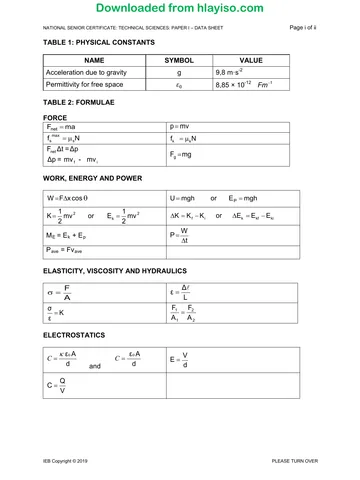
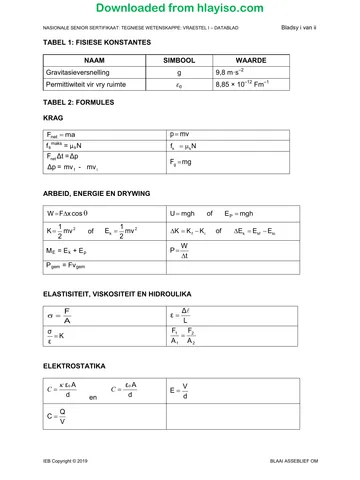
8. You are advised to use the attached DATA SHEETS.
9. Show ALL formulae and substitutions in ALL calculations.
10. Round off your final numerical answers to a MINIMUM of TWO decimal places.
11. Give brief motivations, discussions, etc. where required.
12. Read the questions carefully.
13. Do not write in the margin.
14. It is in your own interest to write legibly and to present your work neatly.
IEB Copyright © 2019 PLEASE TURN OVER
Skip to contentQuestion paper 
Technical Sciences Grade 12 IEB Paper 1 2019 Question Paper
IEB Grade 12 Technical Sciences Paper 1 question paper from the 2019, 14 pages. Read online or get the free PDF download, memo linked when available.
Publisher: IEB
Technical Sciences · Grade 12 · 2019. Question paper, 14 pages. Read online or download the PDF.
- Subject
- Technical Sciences
- Grade
- Grade 12
- Document type
- Question paper
- Year
- 2019
- Paper
- 1
- Publisher
- IEB
- Curriculum
- IEB
- Pages
- 14
- File size
- 415.3 KB
Loading document…
Loading document…
1 of 14
Document textSearch extracted text and jump to a page.
Downloaded from hlayiso.com
NATIONAL SENIOR CERTIFICATE: TECHNICAL SCIENCES: PAPER I Page 2 of 14
QUESTION 1 MULTIPLE-CHOICE QUESTIONS
Various options are provided as possible answers to the following questions.
Choose the answer and write only the letter (A–D) next to the question number
(1.1–1.10) in the ANSWER BOOK, for example 1.11 D.
1.1 Frictional force …
A is opposite the direction of motion of an object and acts
perpendicular to the surface the object is in contact with.
B is in the same direction as the motion of an object and acts parallel
to the surface the object is in contact with.
C is in the same direction as gravitational force.
D opposes the motion of an object and acts parallel to the surface the
object is in contact with. (2)
1.2 If the resultant (net) force acting on an object is zero, the object …
A slows down.
B accelerates uniformly.
C changes its direction of motion.
D continues moving with constant velocity. (2)
1.3 A boy sits on a chair. According to Newton's Third Law, the reaction force
on the boy's weight is ...
A the force of the boy on the chair.
B the force of the chair on the boy.
C the force of the Earth on the boy.
D the force of the boy on the Earth. (2)
1.4 A piece of silicon that is doped with elements of group III becomes a …
A P-Type semiconductor.
B N-Type semiconductor.
C III-Type semiconductor.
D superconductor. (2)
1.5 An example of an intrinsic semiconductor is?
A Tin
B Phosphorus
C Boron
D Magnesium (2)
IEB Copyright © 2019
Downloaded from hlayiso.com
NATIONAL SENIOR CERTIFICATE: TECHNICAL SCIENCES: PAPER I Page 3 of 14
1.6 Which one of the following graphs correctly represents the relationship
between potential difference (V) and current (I) for an ohmic conductor?
A V
I
B V
I
C V
I
D V
I
(2)
1.7 When a potential difference of 220 V is maintained across a capacitor
with a capacitance of 50 F, the capacitor will store … coulomb of charge.
A 4400
B 11 000
C 0,227
D 270 (2)
IEB Copyright © 2019 PLEASE TURN OVER
Downloaded from hlayiso.com
NATIONAL SENIOR CERTIFICATE: TECHNICAL SCIENCES: PAPER I Page 4 of 14
1.8 A battery with negligible internal resistance is connected to two resistors as
shown in the diagram below. The switch S is OPEN.
V1
S
● ●
V2
Switch S is now CLOSED.
How will the readings on voltmeters V1 and V2 change?
READING ON V1 READING ON V2
A Increases Increases
B Decreases Increases
C Increases Decreases
D Decreases Decreases
(2)
1.9 Which ONE of the following combinations represents the component(s)
present AS WELL AS the energy conversion in a direct current (DC) motor?
Component Energy Transfer
A Split ring commutator Electrical to mechanical energy
B Slip rings Mechanical to electrical energy
C Slip rings Electrical to mechanical energy
D Split ring commutator Mechanical to electrical energy
(2)
IEB Copyright © 2019
Downloaded from hlayiso.com
NATIONAL SENIOR CERTIFICATE: TECHNICAL SCIENCES: PAPER I Page 5 of 14
1.10 A conducting wire, XY, moves between two magnets as shown below.
Which ONE of the following actions can lead to an increased induced
current in wire XY?
Move the wire …
A quickly and parallel to the magnetic field.
B slowly and parallel to the magnetic field.
C quickly and perpendicular to the magnetic field.
D slowly and perpendicular to the magnetic field. (2)
[20]
IEB Copyright © 2019 PLEASE TURN OVER
Downloaded from hlayiso.com
NATIONAL SENIOR CERTIFICATE: TECHNICAL SCIENCES: PAPER I Page 6 of 14
QUESTION 2
A boy is pulling two trolleys with masses 5 kg and 10 kg, with a force of 50 N at an
angle of 30o to the horizontal, over a frictionless surface, as shown in the following
diagram.
m = 10 kg
m = 5 kg
30°
2.1 Draw a labelled free body diagram for the 5 kg trolley. Indicate all the forces
acting on the trolley. (4)
2.2 State Newton's Second Law of Motion in words. (2)
2.3 Apply Newton's Second Law of Motion to calculate the acceleration of the
system. (6)
2.4 Determine the tension in the rope between trolley A and B. (2)
2.5 Define acceleration. (2)
2.6 How will the acceleration change if friction was accounted for? Use
Newton's Second Law of Motion to explain your answer. (2)
[18]
IEB Copyright © 2019
Downloaded from hlayiso.com
NATIONAL SENIOR CERTIFICATE: TECHNICAL SCIENCES: PAPER I Page 7 of 14
QUESTION 3
Trolley X with a mass 250 g is placed against trolley Y with mass 750 g, as shown
in the diagram below. A compressed spring between the two trolleys releases in
0,3 s and the trolleys move in opposite directions. Trolley X moves west and hits a
barrier after time t.
Barrier Cushion N
Y W E
X
S
The table below gives the position of trolley X for time intervals of 0,3 seconds:
Position (m) 0 1,38 2,88 4,38 5,88 7,38 7,38 7,38
Time (s) 0 0,3 0,6 0,9 1,2 1,5 1,8 2,1
3.1 At which time t does the trolley X hit the barrier? (1)
3.2 Explain, with reference to the values in the table, why trolley X moves with a
constant speed between t = 0,3 s and t = 1,5 s. (2)
3.3 State the principle of conservation of linear momentum in words. (2)
3.4 Calculate the speed of trolley Y after the spring is released. (5)
3.5 Define impulse. (2)
3.6 Calculate the force that is exerted on trolley Y. (4)
Trolley Y collides with the cushion and bounces back at a speed of 3,25 m∙s-1 .
3.7 Define the following:
3.7.1 An elastic collision (2)
3.7.2 An inelastic collision (2)
[20]
IEB Copyright © 2019 PLEASE TURN OVER
Downloaded from hlayiso.com
NATIONAL SENIOR CERTIFICATE: TECHNICAL SCIENCES: PAPER I Page 8 of 14
QUESTION 4
A block of mass 8 kg moves over a rough horizontal surface from point A to B as
shown in the following diagram.
10 m∙s-1
8 kg
A 6m B
4.1 Define the term energy. (2)
4.2 Calculate the kinetic energy of the block at point A. (3)
The coefficient of kinetic friction (μk) between the block and the surface AB is 0,15.
4.3 Calculate the magnitude of the kinetic frictional force on the block while
moving from point A to B. (3)
4.4 Calculate the work done by the kinetic frictional force from point A to point
B. (3)
[11]
IEB Copyright © 2019
Downloaded from hlayiso.com
NATIONAL SENIOR CERTIFICATE: TECHNICAL SCIENCES: PAPER I Page 9 of 14
QUESTION 5
The following diagram shows a wrecking ball with mass 1,5 tons hanging from a
crane on a cable. The crane winds up the cable so that the ball moves upwards at
a constant velocity of 2 m⋅s–1.
After 3 seconds the crane stops winding the cable. The ball stops and reaches a
height of 6 m above the ground.
5.1 Define power. (2)
5.2 Calculate the weight of the ball. (3)
5.3 Calculate the power of the crane motor as it winds up the cable. (4)
5.4 Convert your answer in Question 5.3 to horsepower. (2)
A strong wind starts to blow and the ball starts to swing in the direction of B, as
indicated in the diagram below.
B
A
The ball reaches a maximum height at point B of 7,5 m above the ground.
5.5 Calculate the gravitational potential energy of the ball at point B. (3)
5.6 State the principle of conservation of mechanical energy in words. (2)
5.7 Calculate the speed of the ball at point A when it swings back. (4)
[20]
IEB Copyright © 2019 PLEASE TURN OVER
Downloaded from hlayiso.com
NATIONAL SENIOR CERTIFICATE: TECHNICAL SCIENCES: PAPER I Page 10 of 14
QUESTION 6
When a tensile stress of 5 × 10⁶ Pa is applied to the ends of a round bar, it is
desired that the strain is about 5 × 10⁻⁴. The length of the round bar is 120 cm.
Type of material Young's modulus
Rubber 3 × 10⁷ Pa
Wood 1 × 10¹⁰ Pa
Brass 1 × 10¹¹ Pa
Iron 1 × 10¹² Pa
Make use of the table above to answer the following.
6.1 State Hooke's Law in words. (2)
6.2 What would be the most appropriate material to use for this bar?
(Make use of a calculation to determine your answer.) (4)
6.3 Calculate the change in length of the bar. (4)
6.4 Define stress. (2)
6.5 If a force of 9800 N is applied to obtain this tensile stress, what is the cross
section area of the bar? (3)
[15]
QUESTION 7
During an experiment, five motor oils with different gradings are used to indicate
the difference in viscosity of motor oils. The experiment is set up as indicated in
the diagram below. The experiment is performed at –20 °C.
0W–30 5W–30 10W–30 15W–30 20W–30
7.1 Give a complete definition for viscosity. (2)
7.2 Which oil has the highest viscosity? (1)
7.3 What is the meaning of the SAE value 10W–30. (3)
[6]
IEB Copyright © 2019
Downloaded from hlayiso.com
NATIONAL SENIOR CERTIFICATE: TECHNICAL SCIENCES: PAPER I Page 11 of 14
QUESTION 8
A hydraulic press for compacting powdered samples has a large cylinder which
has a diameter of 11,8 cm, and a small cylinder with an area of 3,02 × 10⁻⁴ m2. A
lever is attached to the small cylinder as shown. The sample which is placed on
the large cylinder, has a cross sectional area of 4,09 cm2.
8.1 State Pascal's Law in words. (2)
8.2 Calculate the area of the large cylinder in m2. (3)
8.3 A force of 319 N is applied on the lever. Calculate the output force exerted
in the larger piston. (4)
[9]
IEB Copyright © 2019 PLEASE TURN OVER
Downloaded from hlayiso.com
NATIONAL SENIOR CERTIFICATE: TECHNICAL SCIENCES: PAPER I Page 12 of 14
QUESTION 9
A capacitor is a component used in an electric circuit to store electrical charge.
9.1 Define the term capacitance of a capacitor. (2)
9.2 Name the three factors that influence the capacitance of a capacitor. (3)
9.3 A capacitor consists of two square metal plates, of length 2 cm, that are
separated by an air gap of 3 mm.
Calculate the potential difference across the capacitor plates if each plate
can store 6 × 10-11 C of charge. (5)
[10]
IEB Copyright © 2019
Downloaded from hlayiso.com
NATIONAL SENIOR CERTIFICATE: TECHNICAL SCIENCES: PAPER I Page 13 of 14
QUESTION 10
A cell with an emf (ε) of 4,5 V is connected in a circuit as shown in the diagram below.
V1
● ● 6Ω
S1
1Ω 2Ω
4,5 V
A
10.1 Which device in the circuit diagram measures the rate of flow of charge?
Write down only VOLTMETER or AMMETER. (1)
10.2 State Ohm's Law in words. (2)
Switch S1 is now closed.
10.3 What is the reading on Voltmeter V1. (1)
10.4 Calculate the current strength through the 6 Ω resistor. (3)
10.5 Define power as it pertains to electrical circuits. (2)
10.6 Calculate the energy conversion that takes place in the 6 Ω resistor. (3)
[12]
IEB Copyright © 2019 PLEASE TURN OVER
Downloaded from hlayiso.com
NATIONAL SENIOR CERTIFICATE: TECHNICAL SCIENCES: PAPER I Page 14 of 14
QUESTION 11
11.1 The diagram below represents a simplified drawing of an electric device
that is connected to a light bulb.
X
Brushes
11.1.1 What is this type of electric device called? (1)
11.1.2 Write down the principle on which the device operates. (1)
11.1.3 Write down ONE method to increase the brightness of the bulb. (1)
11.1.4 Identify component X in the diagram. (1)
11.2 The following diagram represents the basic structure of a transformer.
11.2.1 To which contact points, AB or CD, must the input voltage be
connected so that the transformer can function as a step-up
transformer. (1)
11.2.2 A cellphone requires a 4,5 V output voltage. The cellphone charger
is connected to a 240 V alternating current source. Calculate the
number of windings on the secondary coil if the primary coil has
1000 windings. (4)
[9]
Total: 150 marks
IEB Copyright © 2019
Study this subject
Revise the topics in this paper, then practise them question by question.
- Grade 12 Technical Sciences notes
CAPS revision notes with worked examples.
- Technical Sciences questions by topic
Past exam questions sorted by CAPS topic, with memos where available.
- Grade 12 Technical Sciences quizzes
Short topic quizzes with instant feedback.
- All Grade 12 Technical Sciences past papers
Past papers by year, with memos where available.
- Grade 12 IEB past papers
More Technical Sciences and other subjects in this collection.
Recommended for this subject
More papers and memos for this grade and subject.
Question paperIEB
Technical Sciences Grade 12 IEB Paper 2 2019 Question Paper
Question paperIEB
Technical Sciences Grade 12 IEB P1 2019 Question Paper (Afr)
Question paperIEB
Technical Sciences Grade 12 IEB P2 2019 Question Paper (Afr)
Question paperIEB
Technical Sciences Grade 12 IEB P2 2019 Question Paper (Afr)
Data sheetIEB
Technical Sciences Grade 12 IEB Paper 1 2019 Data Sheet
Data sheetIEB
Technical Sciences Grade 12 IEB P1 2019 Data Sheet (Afrikaans)
Related documents
MemorandumIEB
Technical Sciences Grade 12 IEB Paper 1 2019 Memo
MemorandumIEB
Technical Sciences Grade 12 IEB Paper 1 2019 Memo (Afrikaans)
Data sheetIEB
Technical Sciences Grade 12 IEB Paper 2 2019 Data Sheet
Data sheetIEB
Technical Sciences Grade 12 IEB P2 2019 Data Sheet (Afrikaans)
MemorandumIEB