
Downloaded from hlayiso.com
NATIONAL SENIOR CERTIFICATE EXAMINATION
NOVEMBER 2019
TECHNICAL SCIENCES: PAPER II
Time: 3 hours 150 marks
PLEASE READ THE FOLLOWING INSTRUCTIONS CAREFULLY
1. This question paper consists of 12 pages and a Data Sheet of 4 pages (i–iv).
Please check that your question paper is complete.
2. This paper consists of TEN questions. Answer ALL the questions in the Answer
Book.
3. Please start each question on a new page of your Answer Book.
4. Number your answers exactly as the questions are numbered in the question
paper.
5. Leave ONE line open between sub-questions, for example between
QUESTION 2.2 and QUESTION 2.3.
6. You may use a non-programmable calculator.
7. You may use appropriate mathematical instruments.
8. You are advised to use the attached DATA SHEET.
9. Show ALL formulae and substitutions in ALL calculations.
10. Round off your final numerical answers to a MINIMUM of TWO decimal places.
11. Give brief motivations, discussions, etc. where required.
12. Read the questions carefully.
13. Do not write in the margin.
14. It is in your own interest to write legibly and to present your work neatly.
IEB Copyright © 2019 PLEASE TURN OVER
Skip to contentQuestion paper 
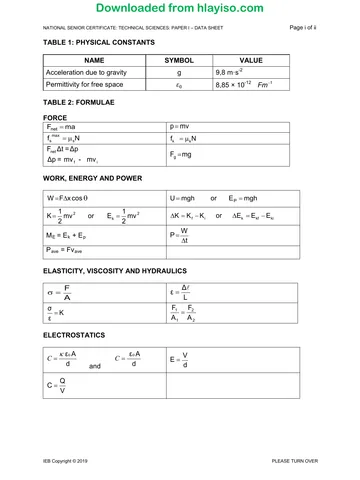
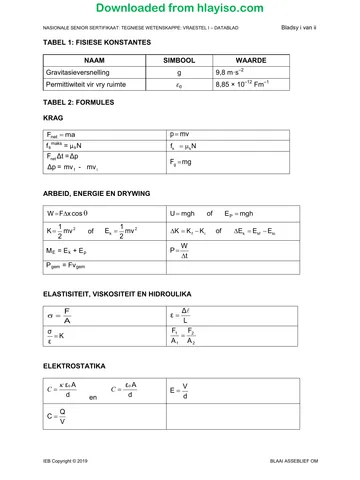
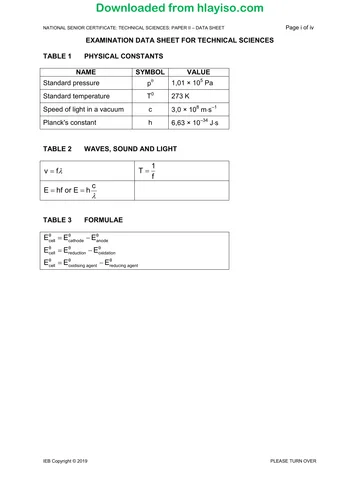
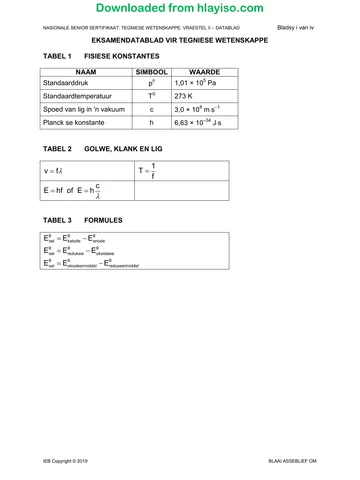
Technical Sciences Grade 12 IEB Paper 2 2019 Question Paper
IEB Grade 12 Technical Sciences Paper 2 question paper from the 2019, 12 pages. Read online or get the free PDF download, memo linked when available.
Publisher: IEB
Technical Sciences · Grade 12 · 2019. Question paper, 12 pages. Read online or download the PDF.
- Subject
- Technical Sciences
- Grade
- Grade 12
- Document type
- Question paper
- Year
- 2019
- Paper
- 2
- Publisher
- IEB
- Curriculum
- IEB
- Pages
- 12
- File size
- 241.9 KB
Loading document…
Loading document…
1 of 12
Document textSearch extracted text and jump to a page.
Downloaded from hlayiso.com
NATIONAL SENIOR CERTIFICATE: TECHNICAL SCIENCES: PAPER II Page 2 of 12
QUESTION 1
Four options are given as possible answers to the following questions. Each
question has only ONE correct answer. Choose the correct answer and only write
A, B, C or D next to the question number (1.1–1.10) in your Answer Book.
1.1 The IUPAC name for
CH3-CH-CH2-CH2-CH3
I
CH3
A 2-ethylbutane
B 2-methylbutane
C 2-methylpentane
D 3-ethylbutane
1.2 Which one of the following compounds has the molecular formula C4H10O?
A 2-methylpropanone
B 1,1-dimethylethanol
C 2-butanol
D 2-methylpropanal
1.3 Which one of the following belongs to the same homologous series as C3H8?
A C2H2
B C3H6
C C3H4
D C4H10
1.4 The following ester is produced by which substances?
H O
I II
H–C–O–C–H
I
H
A Methanal and methanoic acid
B Methanol and methanone
C Methanol and methanoic acid
D Methanal and methanone
IEB Copyright © 2019
Downloaded from hlayiso.com
NATIONAL SENIOR CERTIFICATE: TECHNICAL SCIENCES: PAPER II Page 3 of 12
1.5 The property of light where it changes direction when passing from a dense
medium to a denser medium at an angle is ...
A reflection.
B diffraction.
C refraction.
D dispersion.
1.6 Two waves pass from one medium to another, they enter the second,
denser medium at an angle. Wave A has a wavelength of 4,5 nm and wave
B has a wavelength of 3,2 μm.
A A will be refracted more than B
B A and B will be equally refracted
C B will be refracted more than A
D Neither A nor B will be refracted
1.7 Light consists of photons, which are ...
A packets of light.
B packets of energy.
C packets of ultraviolet rays.
D packets of infrared rays.
1.8 A student sets up a Zn/Cu galvanic cell. The cathode ...
A is the negative electrode.
B is made out of copper.
C attracts anions from the solution.
D undergoes a mass decrease over time.
1.9 A student sets up a silver/zinc electrochemical cell. The most suitable
solution for the salt bridge would be:
A NaCl
B KCl
C NaNO3
D CCl4
1.10 In the following cell
Al / Al3+ // Fe2+ /Fe
the oxidizing agent is:
A Al
B Al3+
C Fe2+
D Fe
[20]
IEB Copyright © 2019 PLEASE TURN OVER
Downloaded from hlayiso.com
NATIONAL SENIOR CERTIFICATE: TECHNICAL SCIENCES: PAPER II Page 4 of 12
QUESTION 2
The letters A to F in the table below represent six organic compounds. Use these
compounds to answer the questions that follow.
A H B H H H H H
I I I I I I
H H O H H H–C=C–C=C–C–H
I I I I I I
H–C–C– C –C–C–H H
I I I I I
H H H H H
C 2,3-dichloropentane D H H H O
I I I II
H–C–C–C–C–O–H
I I I
H H H
E 2-Methylbutanal F C3H6
2.1 Define the term homologous series. (2)
2.2 Write down the letters of the two compounds that belong to the same
homologous series. (2)
2.3 Draw the structural formula for the compound:
2.3.1 C (2)
2.3.2 E (2)
2.4 Write the IUPAC name of:
2.4.1 D (2)
2.4.2 F (2)
2.5 Write down the letter that represents an aldehyde. (2)
2.6 Define the term positional isomer. (2)
2.7 Draw a positional isomer for compound A and give the IUPAC name. (4)
[20]
IEB Copyright © 2019
Downloaded from hlayiso.com
NATIONAL SENIOR CERTIFICATE: TECHNICAL SCIENCES: PAPER II Page 5 of 12
QUESTION 3
Study the flow chart below and use it to answer the following questions.
3.1 Is ethene a saturated or an unsaturated compound? (1)
3.2 Name a substance that can be used in reaction A. (1)
3.3 What type of addition reaction takes place at A? (1)
3.4 A hydration reaction takes place at B. Name two reaction conditions for this
type of reaction to take place. (2)
3.5 Give the name or formula of the substance that must be added at reaction
C to produce ethanol from a haloalkane. (1)
3.6 What type of reaction takes place at C? (1)
3.7 Write down a balanced equation for the reaction at C, using structural
formulae for organic reagents. (3)
[10]
QUESTION 4
4.1 Define monomer. (2)
4.2
What process is depicted in the diagram above? (1)
4.3 Ethene can be used to make High-Density Polythene (HDPE) or Low-
Density Polythene (LDP). Give two uses of HDPE in everyday situations. (2)
[5]
IEB Copyright © 2019 PLEASE TURN OVER
Downloaded from hlayiso.com
NATIONAL SENIOR CERTIFICATE: TECHNICAL SCIENCES: PAPER II Page 6 of 12
QUESTION 5
The following boiling points were recorded while doing an experiment.
Molecule Boiling Point (°C)
Butane -0,4
Butanone 79,64
Butene -6,3
Butanol 117,7
Propanol 97
5.1 Define the term boiling point. (2)
5.2 Explain why the boiling point of butanol is higher than the boiling point of
propanol. (2)
5.3 Name the intermolecular forces in:
5.3.1 butane (1)
5.3.2 butanone (1)
5.3.3 butanol (1)
5.4 What is the melting point of a substance? (1)
5.5 Which of the following should have the highest melting point, butanol or
butanone? (1)
5.6 Explain your answer in Question 5.5. (2)
5.7 Which one of the substances in the table will have the lowest viscosity?
Explain your answer by referring to intermolecular forces. (2)
[13]
IEB Copyright © 2019
Downloaded from hlayiso.com
NATIONAL SENIOR CERTIFICATE: TECHNICAL SCIENCES: PAPER II Page 7 of 12
QUESTION 6
In industry, silver plating is done for a variety of reasons. It holds up well against
chemicals and acids and it protects against corrosion. It is an excellent conductor
of electricity and heat. It adds to the visual impact of the product.
Consider the following electrochemical cell. AgNO3 is in solution and two graphite
rods are used as electrodes.
6.1 Give the definition of an electrolytical cell. (2)
6.2 What will you see at electrode A when the current has been flowing for a
few minutes? (2)
6.3 What energy change takes place in this cell? (1)
6.4 At which electrode (A or B) does ... take place?
6.4.1 oxidation (1)
6.4.2 reduction (1)
6.5 Write down the half reaction which takes place at electrode A. (2)
6.6 Explain how electrolysis can be used for silver plating in the industry. (2)
[11]
IEB Copyright © 2019 PLEASE TURN OVER
Downloaded from hlayiso.com
NATIONAL SENIOR CERTIFICATE: TECHNICAL SCIENCES: PAPER II Page 8 of 12
QUESTION 7
7.1 Consider the diagram below of a galvanic cell constructed under standard
conditions.
7.1.1 Will any current flow in the external circuit? Explain your answer. (2)
7.1.2 What energy conversion takes place in this galvanic cell? (1)
7.1.3 In which direction will the current flow in the external circuit? Zn to
Cu or Cu to Zn? (1)
7.1.4 At which electrode does reduction take place? (1)
7.1.5 Write down the reduction half-reaction. (2)
7.1.6 Write down the net cell reaction when the cell delivers current. (3)
7.1.7 Give the standard cell notation for this cell. (3)
7.2 Two reactions take place:
A: Fe + 2Ag+ → Fe2+ + 2Ag
B: Hg + Mg2+ → Hg2+ + Mg
7.2.1 Define oxidation. (2)
7.2.2 Use the redox table and calculate the EMF of reaction A and B. (5)
7.2.3 Use your answers in Question 7.2.2 to determine and explain which
reaction will take place spontaneously. (2)
7.3 Eskom has announced a 9,3% increase in electricity tariffs for this year.
Due to high electricity costs, people are looking for alternative sources of
electricity.
Two types of cells have been developed, a fuel cell and a photovoltaic cell.
7.3.1 Name an advantage of photovoltaic cells. (1)
7.3.2 Where can we use photovoltaic cells? (1)
[24]
IEB Copyright © 2019
Downloaded from hlayiso.com
NATIONAL SENIOR CERTIFICATE: TECHNICAL SCIENCES: PAPER II Page 9 of 12
QUESTION 8
8.1 Light moves through a semi-circular glass prism as indicated below.
8.1.1 Identify the phenomena taking place in Figure 2. (1)
8.1.2 Explain why this phenomena takes place. (2)
8.1.3 What do we call angle i in Figure 3? (1)
8.2 In a submarine the captain uses a periscope to observe any movement
above the water.
8.2.1 Name the phenomenon of light that is used in a periscope which
makes this possible. (1)
8.2.2 Give two conditions for this phenomenon to occur. (2)
8.2.3 Give two more applications where this phenomenon is used in
optical equipment. (2)
IEB Copyright © 2019 PLEASE TURN OVER
Downloaded from hlayiso.com
NATIONAL SENIOR CERTIFICATE: TECHNICAL SCIENCES: PAPER II Page 10 of 12
8.3 Consider the following diagram of reflection on a flat plane to answer the
following questions.
8.3.1 Define the normal. (2)
8.3.2 Name lines A and B. (2)
8.3.3 If the magnitude of ϴr is 40°, what is the magnitude of ϴi? (1)
8.3.4 A flower, 7 cm high, is placed 27 cm from the flat mirror.
(a) How high is the image formed? (1)
(b) How far is the image formed from the mirror? (1)
(c) Is the image upright? (1)
[17]
IEB Copyright © 2019
Downloaded from hlayiso.com
NATIONAL SENIOR CERTIFICATE: TECHNICAL SCIENCES: PAPER II Page 11 of 12
QUESTION 9
9.1 The ray diagram below depicts an image placed at a distance of 2F from
the focal point.
9.1.1 What type of lens is used? (1)
9.1.2 Choose words from the box below to describe the image that is
formed.
upright virtual inverted smaller bigger same size real (3)
9.1.3 When will you use a lens in this position? (1)
9.2 9.2.1 Use a sketch to show the movement of light through a concave lens. (3)
9.2.2 Describe the image that is formed when light shines through a
concave lens. (3)
9.3 When it rains, a rainbow is formed when the sun breaks through the clouds.
9.3.1 What do we call this phenomenon? (1)
9.3.2 Give a definition for this phenomenon. (2)
9.3.3 A rainbow has seven colours. Which colour is refracted the most? (1)
9.3.4 Use different wavelengths to explain your answer to Question 9.3.3. (2)
[17]
IEB Copyright © 2019 PLEASE TURN OVER
Downloaded from hlayiso.com
NATIONAL SENIOR CERTIFICATE: TECHNICAL SCIENCES: PAPER II Page 12 of 12
QUESTION 10
Electromagnetic radiation is a form of energy that is all around us. It takes many
forms; sunlight is also a form of electromagnetic radiation.
10.1 Define electromagnetic waves. (2)
10.2 What is the difference between sound waves and electromagnetic waves? (2)
10.3 Arrange the following electromagnetic waves in ascending order of
wavelength.
(4)
10.4 Identify the electromagnetic waves that would be used in the following
situations:
10.4.1 Used in security systems to detect hidden weapons. (1)
10.4.2 Used to sterilise medical equipment. (1)
10.5 Calculate the energy of a photon of an electromagnetic wave with a
wavelength of 456 nm. (3)
[13]
Total: 150 marks
IEB Copyright © 2019
Study this subject
Revise the topics in this paper, then practise them question by question.
- Grade 12 Technical Sciences notes
CAPS revision notes with worked examples.
- Technical Sciences questions by topic
Past exam questions sorted by CAPS topic, with memos where available.
- Grade 12 Technical Sciences quizzes
Short topic quizzes with instant feedback.
- All Grade 12 Technical Sciences past papers
Past papers by year, with memos where available.
- Grade 12 IEB past papers
More Technical Sciences and other subjects in this collection.
Recommended for this subject
More papers and memos for this grade and subject.
Question paperIEB
Technical Sciences Grade 12 IEB Paper 1 2019 Question Paper
Question paperIEB
Technical Sciences Grade 12 IEB P1 2019 Question Paper (Afr)
Question paperIEB
Technical Sciences Grade 12 IEB P2 2019 Question Paper (Afr)
Question paperIEB
Technical Sciences Grade 12 IEB P2 2019 Question Paper (Afr)
Data sheetIEB
Technical Sciences Grade 12 IEB Paper 1 2019 Data Sheet
Data sheetIEB
Technical Sciences Grade 12 IEB P1 2019 Data Sheet (Afrikaans)
Related documents
Data sheetIEB
Technical Sciences Grade 12 IEB Paper 2 2019 Data Sheet
Data sheetIEB
Technical Sciences Grade 12 IEB P2 2019 Data Sheet (Afrikaans)
MemorandumIEB
Technical Sciences Grade 12 IEB Paper 2 2019 Memo
MemorandumIEB
Technical Sciences Grade 12 IEB Paper 1 2019 Memo
MemorandumIEB