
Downloaded from hlayiso.com
NATIONAL SENIOR CERTIFICATE EXAMINATION
NOVEMBER 2019
TECHNICAL SCIENCES: PAPER II
MARKING GUIDELINES
Time: 3 hours 150 marks
These marking guidelines are prepared for use by examiners and sub-examiners,
all of whom are required to attend a standardisation meeting to ensure that the
guidelines are consistently interpreted and applied in the marking of candidates'
scripts.
The IEB will not enter into any discussions or correspondence about any marking
guidelines. It is acknowledged that there may be different views about some
matters of emphasis or detail in the guidelines. It is also recognised that,
without the benefit of attendance at a standardisation meeting, there may be
different interpretations of the application of the marking guidelines.
IEB Copyright © 2019 PLEASE TURN OVER
Skip to contentMemorandum 
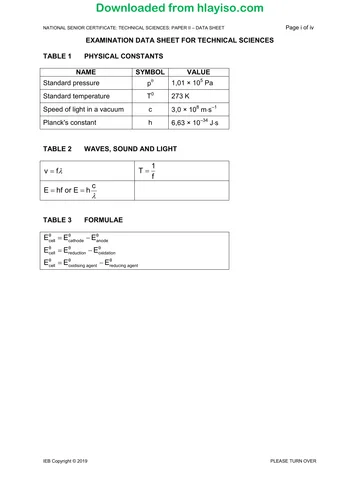
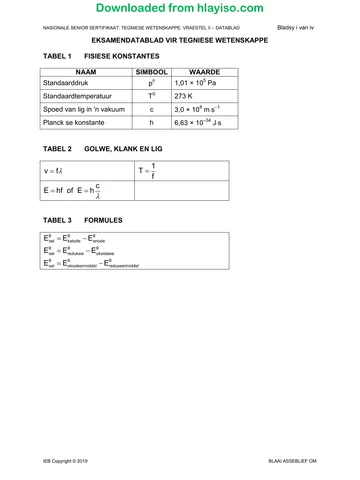
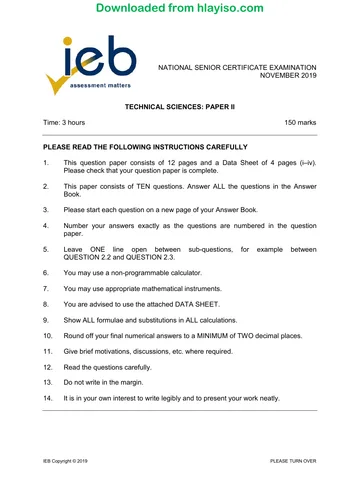
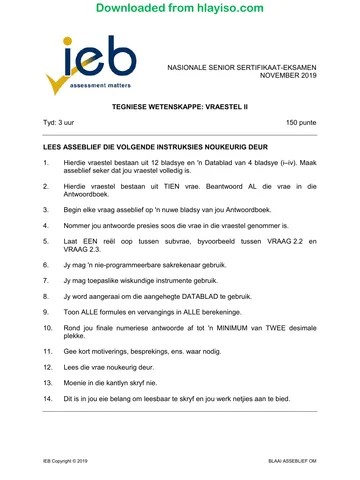
Technical Sciences Grade 12 IEB Paper 2 2019 Memo
IEB Grade 12 Technical Sciences Paper 2 memorandum from the 2019, 8 pages. Read online or get the free PDF download, question paper linked when available.
Publisher: IEB
Technical Sciences · Grade 12 · 2019. Memorandum, 8 pages. Read online or download the PDF.
- Subject
- Technical Sciences
- Grade
- Grade 12
- Document type
- Memorandum
- Year
- 2019
- Paper
- 2
- Publisher
- IEB
- Curriculum
- IEB
- Pages
- 8
- File size
- 224.7 KB
Loading document…
Loading document…
1 of 8
Document textSearch extracted text and jump to a page.
Downloaded from hlayiso.com
NATIONAL SENIOR CERTIFICATE: TECHNICAL SCIENCES: PAPER II – MARKING GUIDELINES Page 2 of 8
QUESTION 1
1.1 C
1.2 C
1.3 D
1.4 C
1.5 C
1.6 A
1.7 B
1.8 B
1.9 C
1.10 C
[20]
QUESTION 2
2.1 A series of organic compounds that can be described by the same general
formula where the one member is separated from the following by a CH 2 -
group.
2.2 B and F
2.3 2.3.1
5 carbons
2 chlorides
2.3.2
Aldehyde group
Methyl group
2.4 2.4.1 Butanoic acid
2.4.2 Propene
2.5 E
2.6 Positional isomers have the same molecular formula, but different positions
of the side chain, substitutions or functional groups.
2.7
IEB Copyright © 2019 PLEASE TURN OVER
Downloaded from hlayiso.com
NATIONAL SENIOR CERTIFICATE: TECHNICAL SCIENCES: PAPER II – MARKING GUIDELINES Page 3 of 8
QUESTION 3
3.1 Unsaturated
3.2 Hydrochloric acid
3.3 Hidro-halogenation
3.4 Acid catalyst must be used
Excess of water (H 2 O)
3.5 Sodium hydroxide (NaOH)
3.6 Substitution/Hydrolysis
3.7
QUESTION 4
4.1 Monomer is the basic structural unit (a small molecule) from which a
polymer (macro molecule) is made. /Small organic molecule that can be
covalently bonded to each other in a repeating pattern.
4.2 Polymerisation
4.3 Electrical insulation
Milk and fruit juice bottles, butter and margarine containers
Detergent containers
Re-usable bottles
Recycling bins
Stadium seats
Traffic barrier cones
Water & drain pipes
Toys
(Any two)
IEB Copyright © 2019 PLEASE TURN OVER
Downloaded from hlayiso.com
NATIONAL SENIOR CERTIFICATE: TECHNICAL SCIENCES: PAPER II – MARKING GUIDELINES Page 4 of 8
QUESTION 5
5.1 The temperature at which the vapour pressure of the liquid is equal to the
atmospheric pressure of the liquid.
5.2 Butanol has a longer chain length than propanol, therefore it has a larger
contact surface area and it has stronger London forces than propanol. More
(heat) energy is needed for higher kinetic energy to overcome the
intermolecular forces and therefore it has higher boiling point.
5.3 5.3.1 London forces
5.3.2 Dipole-dipole forces
5.3.3 Hydrogen forces
5.4 The temperature at which the solid and liquid phases of a substance are at
equilibrium.
5.5 Butanol
5.6 Butanone has dipole-dipole forces between the molecules. Butanol has
strong hydrogen forces between the molecules. Butanol needs more energy
to break the hydrogen bonds between the molecules and therefore the
melting point will be higher.
5.7 Butene
It has the weakest intermolecular forces which gives it the lowest viscosity
as the layers can move over each other easily.
QUESTION 6
6.1 It is an electrochemical cell where electrical energy is converted into
chemical energy.
6.2 A silver layer forms.
6.3 Electrical energy → Chemical energy
6.4 6.4.1 B
6.4.2 A
6.5 Ag+(aq) + 1e–→ Ag(s)
6.6 Instead of using a carbon electrode, the object that is to be silver plated can
be connected to the negative pole of the cell and placed in a AgNO 3
solution and silver will be deposited on the object.
IEB Copyright © 2019 PLEASE TURN OVER
Downloaded from hlayiso.com
NATIONAL SENIOR CERTIFICATE: TECHNICAL SCIENCES: PAPER II – MARKING GUIDELINES Page 5 of 8
QUESTION 7
7.1 7.1.1 No, there is no salt bridge to connect the two containers OR The
circuit is not completed.
7.1.2 Chemical energy → Electrical energy
7.1.3 Zn to Cu
7.1.4 Cu-electrode
7.1.5 Cu2+ + 2e–→ Cu
7.1.6 Zn + Cu2+ → Zn2+ + Cu + Bal
7.1.7 Zn(s)/Zn2+ (aq)(1mol.dm–3) //Cu2+(aq)(1mol.dm-3)/Cu(s)
7.2 7.2.1 Loss of electrons
7.2.2 Emf A = E°(reduction) – E°(oxidation)
= 0,8 – (–0,44)
=1,24V
Emf B = E°(reduction) – E(oxidation)
= –2,36 – (0,85)
= –3,21 V
7.2.3 Reaction A will be spontaneous as the EMF has a positive value.
7.3 7.3.1 PV systems do not emit any harmful air or water pollution.
Photovoltaic cells are quiet and no visual disturbance.
Small solar plants can be put on roofs of existing buildings.
PV cells operate for a long time with little maintenance.
Solar energy is a local renewable source of energy.
A PV system can be made to any energy requirements.
A PV system can be enlarged or moved as the energy requirements
change.
(Correct answer)
7.3.2 It can be used in isolated areas or in the middle of cities and towns
to generate electricity which is used for, for example, pumping
water, lights, activating switches, charging batteries, supplying the
electric grid.
IEB Copyright © 2019 PLEASE TURN OVER
Downloaded from hlayiso.com
NATIONAL SENIOR CERTIFICATE: TECHNICAL SCIENCES: PAPER II – MARKING GUIDELINES Page 6 of 8
QUESTION 8
8.1 8.1.1 Refraction
8.1.2 The light ray is moving from a dense to a less dense medium. The
speed of the wave changes in a different medium and the wave is
refracted.
8.1.3 Critical angle
8.2 8.2.1 Total internal reflection
8.2.2 Angle of incidence must be bigger than the critical angle.
The light wave must move from a dense to a less dense medium.
8.2.3 Telescope
Binoculars
8.3 8.3.1 Normal is a line which is perpendicular to the surface of the
reflective object.
8.3.2 Line of incidence
Reflected ray
8.3.3 40°
8.3.4 (a) 7 cm
(b) 27 cm
(c) Yes
IEB Copyright © 2019 PLEASE TURN OVER
Downloaded from hlayiso.com
NATIONAL SENIOR CERTIFICATE: TECHNICAL SCIENCES: PAPER II – MARKING GUIDELINES Page 7 of 8
QUESTION 9
9.1 9.1.1 Convex
9.1.2 Real
Inverted
Same size
9.1.3 When an exact copy of an object is needed.
9.2 9.2.1
9.2.2 Upright, virtual, smaller than object.
9.3 9.3.1 Dispersion
9.3.2 The phenomena whereby white light breaks up into its component
colours.
9.3.3 Violet
9.3.4 Violet has the shortest wavelength and is therefore refracted most.
IEB Copyright © 2019 PLEASE TURN OVER
Downloaded from hlayiso.com
NATIONAL SENIOR CERTIFICATE: TECHNICAL SCIENCES: PAPER II – MARKING GUIDELINES Page 8 of 8
QUESTION 10
10.1 Self propagating, changing magnetic and electric fields that are mutually
perpendicular to each other and perpendicular to the direction of
propagation of the wave.
10.2 Sound waves need a medium for propagation and electromagnetic waves
do not.
10.3 Gamma, X-rays, Ultraviolet, Visible light, Infrared, Microwaves, Radio
waves.
10.4 10.4.1 X-rays
10.4.2 Ultra violet rays
hc
10.5 E=
λ
6,63 × 10 −34 × 3 × 108
=
456 × 10 −9
= 4,36 × 10 −19 J
Total: 150 marks
IEB Copyright © 2019
Study this subject
Revise the topics in this paper, then practise them question by question.
- Grade 12 Technical Sciences notes
CAPS revision notes with worked examples.
- Technical Sciences questions by topic
Past exam questions sorted by CAPS topic, with memos where available.
- Grade 12 Technical Sciences quizzes
Short topic quizzes with instant feedback.
- All Grade 12 Technical Sciences past papers
Past papers by year, with memos where available.
- Grade 12 IEB past papers
More Technical Sciences and other subjects in this collection.
Recommended for this subject
More papers and memos for this grade and subject.
MemorandumIEB
Technical Sciences Grade 12 IEB Paper 1 2019 Memo
MemorandumIEB
Technical Sciences Grade 12 IEB Paper 1 2019 Memo (Afrikaans)
Data sheetIEB
Technical Sciences Grade 12 IEB Paper 1 2019 Data Sheet
Data sheetIEB
Technical Sciences Grade 12 IEB P1 2019 Data Sheet (Afrikaans)
Data sheetIEB
Technical Sciences Grade 12 IEB Paper 2 2019 Data Sheet
Data sheetIEB
Technical Sciences Grade 12 IEB P2 2019 Data Sheet (Afrikaans)
Related documents
Question paperIEB
Technical Sciences Grade 12 IEB Paper 2 2019 Question Paper
Question paperIEB
Technical Sciences Grade 12 IEB P2 2019 Question Paper (Afr)
Question paperIEB
Technical Sciences Grade 12 IEB P2 2019 Question Paper (Afr)
Question paperIEB
Technical Sciences Grade 12 IEB Paper 1 2019 Question Paper
Question paperIEB