
Downloaded from hlayiso.com
PREPARATORY EXAMINATION
2023
11101
TECHNICAL SCIENCES
(PAPER 1)
TIME: 3 hours
MARKS: 150
13 pages + 3 data sheets
P.T.O.
Skip to contentAll 2023 papers 
View all

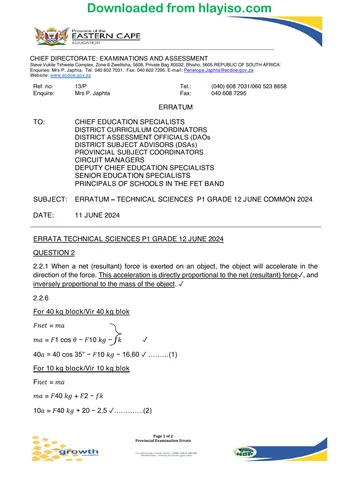

Technical Sciences Grade 12 P1 GP Prelim 2023 QP (Eng)
Grade 12 Technical Sciences Paper 1 question paper from the GP Prelim 2023 (English), 16 pages. Read online or download the free PDF.
Technical Sciences · Grade 12 · GP Prelim · 2023 · English. Question paper, 16 pages. Read online or download the PDF.
- Subject
- Technical Sciences
- Grade
- Grade 12
- Language
- English
- Document type
- Question paper
- Year
- 2023
- Exam period
- GP Prelim
- Paper
- 1
- Curriculum
- CAPS
- Pages
- 16
- File size
- 1.2 MB
Free to read online, no sign-up needed
Loading document…
Loading document…
1 of 16
This exam
GP Prelim 2023
- Paper 1Question paperMemo
- Paper 2Question paperMemo
Questions in this paper
Document textSearch extracted text and jump to a page.
Downloaded from hlayiso.com
TECHNICAL SCIENCES
2
(PAPER 1) 11101/23
INSTRUCTIONS AND INFORMATION
1. Write your name in the ANSWER BOOK.
2. This question paper consists of TEN questions. Answer ALL the questions in the
ANSWER BOOK.
3. Start EACH question on a NEW page in the ANSWER BOOK.
4. Number the answers correctly according to the numbering system used in this
question paper.
5. Leave ONE line between two subsections, e.g. between QUESTION 2.1 and
QUESTION 2.2.
6. You may use a non-programmable calculator.
7. You may use appropriate mathematical instruments.
8. You are advised to use the attached DATA SHEETS.
9. Show ALL formulae and substitutions in ALL calculations.
10. Round-off your FINAL numerical answers to a minimum of TWO decimal places.
11. Give brief motivations, discussions, et cetera where required.
12. Write neatly and legibly.
P.T.O.
Downloaded from hlayiso.com
TECHNICAL SCIENCES
3
(PAPER 1) 11101/23
QUESTION 1: MULTIPLE-CHOICE QUESTIONS
Four options are provided as possible answers to the following questions. Each question
has only ONE correct answer. Choose the answer and write down only the letter (A – D)
next to the question numbers (1.1 to 1.10) in your ANSWER BOOK.
1.1 The force that the Earth exerts on any object on or near its surface is called ...
A normal force.
B applied force.
C gravitational force.
D tension force. (2)
1.2 When a car moves at a constant velocity, the resultant force acting on the body is
zero. This phenomenon is best explained by ...
A Newton’s First Law.
B Newton’s Second Law.
C Newton’s Third Law.
D gravitational acceleration. (2)
1.3 The net force exerted on an object is equal to the ...
A rate of change in velocity.
B rate of change in momentum.
C impulse exerted on the object.
D change in momentum of the object. (2)
1.4 Which of the following is the unit of impulse?
A Ampere (A)
B Coulomb (C)
C Newton-second (Nꞏs)
D Newton (N) (2)
P.T.O.
Downloaded from hlayiso.com
TECHNICAL SCIENCES
4
(PAPER 1) 11101/23
1.5 An object is dropped from a height, h, above ground level. Ignore the effects of
air resistance.
Which of the following graphs BEST represents the relationship between its kinetic
energy, K and its height, h above ground level?
(2)
1.6 Which term BEST describes a force that is equal and opposite to the deforming
force?
A Strain
B Stress
C Applied force
D Restoring force (2)
1.7 The device that can convert electrical energy to mechanical energy is called a ...
A dynamo.
B alternator.
C electric motor.
D generator. (2)
P.T.O.
Downloaded from hlayiso.com
TECHNICAL SCIENCES
5
(PAPER 1) 11101/23
1.8 Consider the following four variables:
(i) Current between plates
(ii) Distance between plates
(iii) Type of dielectric material
(iv) Total surface area of plates
Which of these factors affects the capacitance of a capacitor?
A (iii), (ii) & (i)
B (iv), (iii) & (ii)
C (iv), (ii) & (i)
D (iv), (iii) & (i) (2)
1.9 Which of the following terms BEST explains why a pencil in a glass of water
appears to be cut in half?
A Reflection
B Interference
C Diffraction
D Refraction (2)
1.10 The period of a wave is the:
A Number of completed waves that passes a point in one second
B Time it takes for one wave to travel past a point
C Distance the wave travels in one second
D Number of times the wave is repeated in one second (2)
[20]
P.T.O.
Downloaded from hlayiso.com
TECHNICAL SCIENCES
6
(PAPER 1) 11101/23
QUESTION 2: MATCHING ITEMS
Match the terms in COLUMN B with the descriptions in COLUMN A. Write only the
letter (A – H) next to the question numbers (2.1 to 2.8) in the ANSWER BOOK, e.g.
2.9 I
COLUMN A COLUMN B
2.1 The perpendicular force exerted by a surface on A Kinetic energy
an object that lies on that surface
2.2 The product of the mass of an object and its B Dielectrics
velocity
2.3 The energy of an object due to its motion C Focal point
2.4 A body that does not show a tendency to regain D Normal force
its original shape and size when the deforming
force is removed
2.5 The capacitor comprises two plates separated E Electromagnetic induction
by material
2.6 The rate of flow of charge F Perfectly plastic body
2.7 The point in space where parallel light rays meet G Current
after passing through the lense
2.8 The production of an electromotive force (emf) or H Momentum
voltage across an electrical conductor due to
relative motion between the conductor and
magnetic field
(8 x 1) [8]
P.T.O.
Downloaded from hlayiso.com
TECHNICAL SCIENCES
7
(PAPER 1) 11101/23
QUESTION 3 (Start on the new page.)
3.1 In the diagram below a learner is pushing the car of 960 kg mass, with force F on
a rough surface with the acceleration of 2 mꞏs-2. The frictional force between the
car’s tyres and the surface is 750 N.
3.1.1 Define the term frictional force. (2)
3.1.2 Draw the free-body diagram of ALL the forces acting on the car. (4)
3.1.3 Calculate the applied force exerted by the learner on the car. (4)
3.1.4 Calculate the weight of the car. (2)
3.2 Two learners are helping each other to move a big box of 70 kg mass from one
corner of the room to the other corner. One of the learners is pushing the box with
force FH of 120 N and the other learner is pulling the same box with a diagonal force
FD of 180 N at an angle of 15° to the horizontal surface. The box experiences the
kinetic frictional force of 100 N across the flow.
3.2.1 State Newton's Second Law of Motion in words. (2)
3.2.2 From the diagram above, how many forces are acting on the object in total? (1)
3.2.3 Calculate the acceleration of the box. (4)
3.2.4 If the angle of the force FD increases, what will happen to the kinetic
frictional force? Write only INCREASES, DECREASES OR REMAINS
THE SAME. (1)
[20]
P.T.O.
Downloaded from hlayiso.com
TECHNICAL SCIENCES
8
(PAPER 1) 11101/23
QUESTION 4 (Start on the new page.)
4.1 A ball of mass 150 g is thrown against a wall at a velocity of 50 mꞏs-1. The ball
bounces back towards the hand of the thrower at a velocity of 32 mꞏs-1 as
illustrated in the diagram below.
4.1.1 Define the term impulse. (2)
4.1.2 Convert the mass of the ball from grams to kilograms (kg). (2)
4.1.3 Will the net force exerted by the ball on the wall INCREASE, DECREASE
or REMAIN THE SAME if the time of contact between the ball and the
wall increases? (1)
4.1.4 Calculate the net force exerted by the wall on the ball if the contact time
between the wall and the ball is 0,012 s. (4)
4.2 Modern vehicles use airbags as a protection system to reduce the risk of death or
injury during a collision. These airbags inflate at the moment of collision to reduce
the risk of death or injury.
4.2.1 Use momentum principles to explain how airbags serve as a protection
system against injuries. (2)
4.2.2 How will the increased change in velocity of the car affect the impulse of
the car? (2)
[13]
P.T.O.
Downloaded from hlayiso.com
TECHNICAL SCIENCES
9
(PAPER 1) 11101/23
QUESTION 5 (Start on the new page.)
A 2 kg crate is at rest on a frictionless horizontal surface. The crate is then pushed by a
constant force F of magnitude 5 N to the right. The crate moves at a constant velocity of
1,5 mꞏs-1 on the horizontal surface to cover the distance of 3 m from point A to point B.
When the force is removed at point B, the crate slides down the slope from a height of
0,5 m to point C at the ground. Ignore the effects of friction. Consider the diagram below
and answer the questions that follow.
5.1 Define the term work. (2)
5.2 Calculate the net work done on the crate as it moves from point A to point B. (3)
5.3 Consider the motion from point B to point C on the ground.
5.3.1 State the principle of conservation of mechanical energy in words. (2)
5.3.2 Calculate the kinetic energy of the crate at point B. (3)
5.3.3 Calculate the gravitational potential energy of the crate at point B. (3)
5.3.4 Use the principle of conservation of mechanical energy to calculate the
speed at which the crate hits the ground. (5)
[18]
P.T.O.
Downloaded from hlayiso.com
TECHNICAL SCIENCES
10
(PAPER 1) 11101/23
QUESTION 6 (Start on a new page.)
6.1 A minicar and an SUV are connected to each other with a solid steel rod. The
solid steel rod is 3 m long and has a radius of 0,03 m. The SUV pulls with a force
of 6 000 N to stretch the solid steel rod by 0,01 m to the right.
6.1.1 Define the term deforming force. (2)
6.1.2 Calculate the cross circle area of the solid steel rod. (3)
6.1.3 Calculate the stress experienced by the solid steel rod. (3)
6.1.4 Calculate the strain experienced by the solid steel rod. (3)
6.1.5 State Hooke’s Law in words. (2)
6.1.6 Calculate the Young's modulus of elasticity for the solid steel rod. (4)
6.2 When the temperature of a fluid increases, its viscosity decreases. Liquids that
are used as lubricating fluids and for several other applications must be selected
correctly in relation to operating temperatures. The diagram below shows two
different engine oils of different grades.
6.2.1 Define the term viscocity. (2)
P.T.O.
Downloaded from hlayiso.com
TECHNICAL SCIENCES
11
(PAPER 1) 11101/23
6.2.2 Which of the two oils shown in the diagram above will thicken more in
cold weather? (1)
6.2.3 Give a reason for your answer in QUESTION 6.2.2. (1)
6.2.4 Which oil can be used during winter, and for cars in cooler regions to
keep the engine functioning optimally? (1)
6.2.5 State ONE function of motor oil. (1)
[23]
QUESTION 7 (Start on a new page.)
The graph below represents the results of an experiment that was conducted by a
learner using a capacitor. The learner measures the charge stored in the different
potential differences.
Graph of charge vs potential difference
30
25
20
Charge (C)
15
10
5
0
0 2 4 6 8 10 12
Potential difference (V)
7.1 Define the term capacitance. (2)
7.2 Use the results on the graph to calculate the capacitance of the capacitor in this
experiment. (3)
7.3 What is the relationship between the charge and the potential difference in this
experiment? (2)
7.4 Give TWO examples of capacitors that are used in technology. (2)
[9]
P.T.O.
Downloaded from hlayiso.com
TECHNICAL SCIENCES
12
(PAPER 1) 11101/23
QUESTION 8 (Start on a new page.)
In the circuit diagram below, the battery has an emf of 12 V. Ignore the internal
resistance of the battery.
8.1 State Ohm’s Law in words. (2)
8.2 Calculate the:
8.2.1 Total resistance of the circuit (4)
8.2.2 The reading on the ammeter (3)
8.2.3 The reading on the voltmeter (3)
8.2.4 The power in the 3 Ω resistor (4)
8.3 Will the ammeter reading INCREASE, DECREASE or REMAIN THE SAME if
the 3 Ω resistor is removed? Give a reason for your answer. (2)
[18]
P.T.O.
Downloaded from hlayiso.com
TECHNICAL SCIENCES
13
(PAPER 1) 11101/23
QUESTION 9 (Start on a new page.)
When a surface is shiny and smooth, like a mirror, light will be reflected.
9.1 Draw a ray diagram and indicate the following labels:
Angle of incidence
Angle of reflection
Normal
Incident ray
Reflection ray
Mirror (5)
9.2 Define the term critical angle. (2)
9.3 Define the term dispersion. (2)
9.4 How are the wavelength, frequency and speed of light affected as light travels
from air to water? (3)
[12]
QUESTION 10 (Start on a new page.)
In Physics, electromagnetic radiation refers to the waves of the electromagnetic field
propagating through space-time carrying electromagnetic radiant energy.
10.1 Define an electromagnetic wave. (2)
10.2 Name FOUR properties of electromagnetic waves. (4)
10.3 Explain where in the medical world we use electromagnetic waves. (1)
10.4 Explain the use of the waves as mentioned in QUESTION 10.3. (2)
[9]
TOTAL: 150
END
Downloaded from hlayiso.com
TECHNICAL SCIENCES
14
(PAPER 1) 11101/23
DATA FOR TECHNICAL SCIENCES GRADE 12 PAPER 1
GEGEWENS VIR TEGNIESE WETENSKAPPE GRAAD 12 VRAESTEL 1
TABLE 1: PHYSICAL CONSTANTS/TABEL 1: FISIESE KONSTANTES
NAME/NAAM SYMBOL/SIMBOOL VALUE/WAARDE
Acceleration due to gravity
g 9,8 mꞏs-2
Swaartekragversnelling
Universal gravitational constant
G 6,67 x 10⁻¹¹ Nꞏm2ꞏkg-2
Universele gravitasie konstante
Speed of light in a vacuum
c 3,0 x 10⁸ mꞏs-1
Spoed van lig in ʼn vakuum
Planck's constant
h 6,63 x 10⁻³⁴ Jꞏs
Planck se konstante
Coulomb's constant
k 9,0 x 10⁹ Nꞏm2ꞏC-2
Coulomb se konstante
Charge on electron
e -1,6 x 10⁻¹⁹ C
Lading op elektron
Electron mass
me 9,11 x 10⁻³¹ kg
Elektronmassa
Mass of Earth
M 5,98 x 1024 kg
Massa van Aarde
Radius of Earth
RE 6,38 x 10³ km
Radius van Aarde
Downloaded from hlayiso.com
TECHNICAL SCIENCES
15
(PAPER 1) 11101/23
TABLE 2: FORMULAE/TABEL 2: FORMULES
MOTION/BEWEGING
Δx v i Δt 21 a t 2 or/of
v f v i a t
Δy v i Δt 21 at 2
v vf v vf
2 2 2
v f v i 2ax or/of v f v i 2a y
2
Δx i Δt or/of Δy i Δt
2 2
FORCE/KRAG
Fnet ma p mv
f fs /
x
a
m
s
k
a
m
k k μs
(
N )
N
Fnet t p
w mg
p mv f mv i
Gm1m2 Gm
F g
r2 r2
WORK, ENERGY AND POWER/ARBEID, ENERGIE EN DRYWING
W Fx cos U mgh or/of E P mgh
1 1 Wnet K or/of Wnet Ek
K mv 2 or/of Ek mv2
2 2
K K f K i or/of Ek Ekf Eki
Wnc = ∆K + ∆U or/of Wnc = ∆Ek + ∆Ep Pav Fv av Pgemid Fv gemid
/
W
P
t
WAVES, SOUND AND LIGHT/GOLWE, KLANK EN LIG
1
vf T
f
E hf
v vL v vL
fL fs or/of fL fb c
v vs v vb E h
E Wo K max/maks E Wo E k ( where/waar
s
/
k
x
a
a
m
m
or/of )
1 / s
E hf and/en W0 hf0 and/en Ek (
k
mv 2
s x
or/of
/
x
a k
a a
m a
m
m m
) ........
2
1 / s
k
mv 2
/ s x a
K(
x
a k
a a
m m
m m
)
2
Downloaded from hlayiso.com
TECHNICAL SCIENCES
16
(PAPER 1) 11101/23
ELECTROSTATICS/ELEKTROSTATIKA
kQ 1Q 2 kQ
F 2
E 2
r r
F W
E V
q q
Q Q
n= n=
e or/of qe
ELECTRIC CIRCUITS/ELEKTRIESE STROOMBANE
V emf ( ε ) = I(R + r)
R
I
R s R1 R 2 ...
1 1 1 qI t
...
R p R1 R 2
W = Vq W
P
Δt
W = VI t
P = VI
W= I2R t
2
P = I 2R
V Δt
W= V2
R P
R
ALTERNATING CURRENT/WISSELSTROOM
I
I rms max/maks /
2 Paverage Vrms I rms / Pgemiddeld Vwgk I wgk
s
I
/
x
a k
a
m m
I wgk
2 P I2 R Pgemiddeld I 2wgk R
average rms /
Vmax/maks
Vrms / 2
Vrms 2
Vwgk
2 Paverage / Pgemiddeld
Vmax/maks R R
Vwgk
2
Study this subject
Recommended for this subject
Question paper
Technical Sciences Grade 12 P2 GP Prelim 2023 QP (Eng)
Question paper
Technical Sciences Grade 12 P1 Eastern Cape June 2023 QP
Question paper
Technical Sciences Grade 12 P1 Eastern Cape Mock 2023 QP
Question paper
Technical Sciences Grade 12 P1 GP Prelim 2021 QP (Eng)
Memorandum
Technical Sciences Grade 12 P2 GP Prelim 2023 Memo (English)
Memorandum
Technical Sciences Grade 12 P1 Eastern Cape June 2023 Memo
More from Grade 12 Technical Sciences
Memorandum
Technical Sciences Grade 12 P1 NSC November Mock 2026 Memo
Annual teaching plan
Gr 12 Tech Sci ATP 2023 24
Memorandum
Technical Sciences Grade 12 P1 Eastern Cape Mock 2025 Memo
Memorandum
Technical Sciences Grade 12 P2 Eastern Cape Mock 2025 Memo
Errata
Technical Sciences Grade 12 P1 Eastern Cape June 2024 Errata
Memorandum