
Downloaded from hlayiso.com
Province of the
EASTERN CAPE
EDUCATION
NATIONAL
SENIOR CERTIFICATE
GRADE 11
NOVEMBER 2012
DRAMATIC ARTS
MARKS: 150
TIME: 3 hours
This question paper consists of 9 pages.
Skip to contentAll 2012 papers 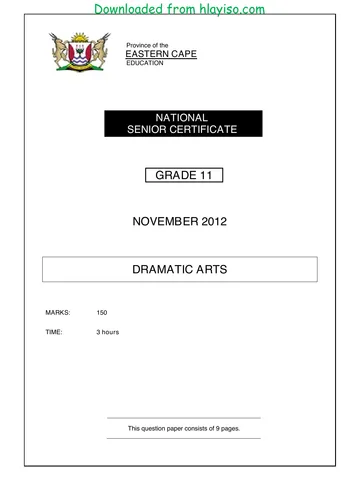
View all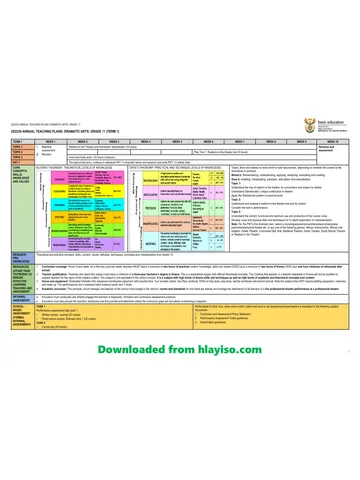
Dramatic Arts Grade 11 Eastern Cape November 2012 QP (Eng)
Grade 11 Dramatic Arts question paper from the Eastern Cape November 2012 (English), 8 pages. Read online or download the free PDF.
Dramatic Arts · Grade 11 · Eastern Cape November · 2012. Question paper, 8 pages. Read online or download the PDF.
- Subject
- Dramatic Arts
- Grade
- Grade 11
- Document type
- Question paper
- Year
- 2012
- Exam period
- Eastern Cape November
- Curriculum
- CAPS
- Pages
- 8
- File size
- 845.3 KB
Free to read online, no sign-up needed
Loading document…
Loading document…
1 of 8
This exam
Eastern Cape November 2012
- Other filesQuestion paperQuestion paper (2)MemoMemo (2)
Document textSearch extracted text and jump to a page.
Downloaded from hlayiso.com
2 DRAMATIC ARTS (NOVEMBER 2012)
INSTRUCTIONS AND INFORMATION
1. Answer ONLY the questions on the drama texts that you studied.
2. Reading time of 15 minutes has been allocated before the start of the examination.
3. This question paper consists of THREE sections:
SECTION A: 30 marks
SECTION B: 60 marks
SECTION C: 60 marks
4. SECTION A: QUESTION 1 is compulsory: Realism
5. SECTION B consists of THREE questions. Answer only TWO of the THREE
questions.
QUESTION 2: SOUTH AFRICAN THEATRE (30)
QUESTION 3: ELIZABETHAN THEATRE (30)
QUESTION 4: AMERICAN THEATRE (30)
6. SECTION C consists of FIVE questions. QUESTIONS 5 and 6 are
COMPULSORY. In QUESTION 7, 8 and 9 there is a choice between three
questions. Answer ONE of the three.
7. Number the answers correctly according to the numbering system used in this
question paper.
8. Pay attention to the number of marks awarded to each question in order to
determine the length of your answers.
9. Use your classroom knowledge, as well as independent and creative thought, to
answer the questions.
10. Write neatly and legibly.
Downloaded from hlayiso.com
(NOVEMBER 2012) DRAMATIC ARTS 3
SECTION A: COMPULSORY
QUESTION 1: REALISM
“In response to changing society, new forms of theatre began to emerge in the
middle of the 1800s. The first such form, Realism, was led by Eugene Scribe
(1791 – 1861). What mattered most to Scribe was the plot. He devised a
structure that was to become known as the „well-made play‟, a step-by-step
formula for creating a play of any genre-comedy, melodrama, farce, or serious
drama. Realism demanded specific conventions (guidelines or rules).”
[Source: OBE FET Dramatic Arts Grade 11]
Write an essay in which you analyse and discuss the Realistic play you have
studied. Refer to the following:
Conventions
Examples from your play
Explain and motivate the application of these conventions
TOTAL SECTION A: 30
Downloaded from hlayiso.com
4 DRAMATIC ARTS (NOVEMBER 2012)
SECTION B
This section consists of three questions. Answer only TWO of the THREE
questions.
QUESTION 2: SOUTH AFRICAN THEATRE (30)
QUESTION 3: ELIZABETHIAN THEATRE (30)
QUESTION 4: AMERICAN THEATRE (30)
QUESTION 2: SOUTH AFRICAN THEATRE
2.1 Name the play and author of the South African play you have studied. (2)
2.2 South African Theatre transcends over various theatre genres, like Black
Theatre Protest etc. What genre is the play that you have studied?
Motivate your answer with examples (references) from the play. (6)
2.3 Referring to a specific scene in the play you have mentioned in
QUESTION 2.1, create a set design using either a sketch with notation or
give a description. (5)
2.4 Name where the specific scene fits in the play and why you have decided
on the design in QUESTION 2.3. (5)
2.5 Explain the term, „Community Theatre‟. (2)
2.6 Explain the process of workshop as is commonly used in South African
Theatre to create a new production or play. (10)
[30]
AND/OR
QUESTION 3: ELIZABETHAN THEATRE
3.1 Name the play and author of the play that you have studied. (2)
3.2 Name the THREE main theatre genres of Elizabethan times and give an
example of each. (6)
3.3 3.3.1 Refer to a specific scene in the play mentioned in QUESTION 3.1
and create a costume design for ONE of the characters by using a
sketch with notation or a written description. (5)
3.3.2 Name the character in QUESTION 3.3.1 and motivate your design
for that specific costume. (5)
3.4 What is the name of the famous theatre in London that was built in 1598? (2)
3.5 In Elizabethan times actors where required to have certain skills when
performing. Discuss these skills and how you applied them to the
Shakespearean performance that you have done. (10)
[30]
Downloaded from hlayiso.com
(NOVEMBER 2012) DRAMATIC ARTS 5
AND/OR
QUESTION 4: AMERICAN THEATRE
4.1 Name the play and author of the play that you have studied. (2)
4.2 Explain the, “American Dream” and how it influenced theatrical realism. (6)
4.3 4.3.1 Refer to a specific character in the play that you have studied and
create a make-up design using a sketch with notation or give a
written description. This should apply to a specific scene. (5)
4.3.2 Name the character and describe the scene of QUESTION 4.3.1
and motivate your make-up design. (5)
4.4 Explain the term, “Traditional American Musical”. (2)
4.5 Stanislavski had a big influence on American Theatre and the Actors
Studio with Lee Strasberg and method acting. How would you apply these
techniques to create your character in the American Play that you have
studied? (10)
[30]
TOTAL SECTION B: 30
Downloaded from hlayiso.com
6 DRAMATIC ARTS (NOVEMBER 2012)
SECTION C
This section consists of FIVE questions. QUESTIONS 5 and 6 are
COMPULSORY. In QUESTION 7, 8 and 9 there is a choice between three
questions. Answer ONE of the three.
QUESTION 5: COMPULSORY
Read the extract and answer the questions that follow.
Steel Magnolias
Robert Harling
1. M‟lynn For dessert they served an original creation called “Dago” pie. I think that says it
all. Jackson is from a good old Southern Family with good old Southern values.
You either shoot it, stuff it, or marry it.
2. Shelby They are simply outdoorsy, that‟s all.
3. Truvy Did you all do anything especially romantic?
4. Shelby We drove down to Frenchman‟s point and went parking.
5. M‟lynn Shelby, really.
6. Truvy Oh, boy. The romantic part. This is what really melts my butter.
7. Shelby Then we went skinny-dipping and did things that frightened the fish.
8. M‟lynn Shelby.
9. Clairee It‟s been a long time since we‟ve had a youngster in this place, hasn‟t it?
10. Shelby We talked, and talked, and talked ...
11. Truvy I love those kinds of talks ... in the arms of the man you love.
12. Shelby Actually we fought most of the time.
13. Truvy What?
14. Shelby Because I told him I couldn‟t marry him. (Shock all around)
15. M‟lynn What?
16. Clairee Why would you go and do a thing like that?
17. Shelby It‟s O.K. now. We worked it all out.
18. Truvy It was just one of those last minute jitter things.
5.1 What is the main characteristic of Truvy in this extract? (2)
5.2 Describe the relationship between Shelby and Truvy. (5)
5.3 How would Shelby say: “We talked, and talked, and talked ...”in speech 10. (3)
5.4 In speech 1, M‟lynn describes. How would she phrase the speech?
Indicate the pauses that she would use with a slash. (5)
[15]
Downloaded from hlayiso.com
(NOVEMBER 2012) DRAMATIC ARTS 7
QUESTION 6: COMPULSORY
Refer to the source below and answer the questions that follow.
6.1 Pick the relevant theatre genre that suites the above source:
A Protest Theatre
B Dance Drama.
C Physical Theatre (2)
6.2 Do you consider this photograph to be a typical movement performance?
Motivate your answer. (5)
6.3 Study the photo carefully and create a short story line that would explain it
(50 – 100 words). (5)
6.4 As a director would you use the wheelchair and the bathtub as props or part
of the storyline? Motivate your answer. (3)
6.5 If you had to create a movement performance how would you go about
developing it?
Use the following concepts and explain: music/sound and movements. (5)
Downloaded from hlayiso.com
8 DRAMATIC ARTS (NOVEMBER 2012)
6.6 Write notes that would describe the aspects that you have to work on your
personal problems/shortcomings/developmental needs as a
performer/actor. Provide indications of corrective developmental
techniques or exercises. (10)
[30]
In QUESTIONS 7, 8 and 9 there is a choice between three questions. Answer
ONE of the three.
QUESTION 7: LIVE PERFORMANCE (CHOICE QUESTION)
“All actions have circumstances surrounding them. We need to ask what, where,
why, and when?”
[Source: OBE FET Dramatic Arts Grade 11]
In a paragraph, discuss how you applied this quote in performing your
monologue. Use references from your monologue. [15]
OR/AND
QUESTION 8: MEDIA STUDIES (CHOICE QUESTION)
“Actors working in film need to prepare themselves in much the same way as in
theatre.”
[Source: OBE FET Dramatic Arts Grade 11]
In a paragraph discuss the differences in acting on stage and film. [15]
OR/AND
QUESTION 9: CULTURAL PERFORMANCES (CHOICE QUESTION)
“The political history of South Africa resided in separation and isolation of people.
Today theatre needs to speak across language and cultural barriers.”
[Source: OBE FET Dramatic Arts Grade 11]
In a paragraph, discuss whether theatre in South Africa today succeeds in
validating this quote. Use references of the plays you have studied. [15]
TOTAL SECTION C: 60
GRAND TOTAL: 150
Study this subject
Recommended for this subject
Question paper
Dramatic Arts Grade 11 Eastern Cape November 2012 QP (Eng)
Memorandum
Dramatic Arts Grade 11 Eastern Cape November 2012 Memo
Memorandum
Dramatic Arts Grade 11 Eastern Cape November 2012 Memo
Question paper
Dramatic Arts Grade 11 Eastern Cape November 2016 QP (Afr)
Question paper
Dramatic Arts Grade 11 Eastern Cape November 2016 QP (Eng)
Question paper
Dramatic Arts Grade 11 Eastern Cape November 2015 QP (Eng)
More from Grade 11 Dramatic Arts
Annual teaching plan
Gr 11 Dram Art ATP 2023 24
Memorandum
Dramatic Arts Grade 11 Eastern Cape November 2018 Memo (Afr)
Memorandum
Dramatic Arts Grade 11 Eastern Cape November 2018 Memo (Eng)
Memorandum
Dramatic Arts Grade 11 Eastern Cape November 2017 Memo (Afr)
Memorandum
Dramatic Arts Grade 11 Eastern Cape November 2017 Memo (Eng)
Memorandum