
Downloaded from hlayiso.com
GRAAD 12
NATIONAL
SENIOR CERTIFICATE
GRADE 10
ELECTRICAL TECHNOLOGY
EXEMPLAR 2016
MARKS: 200
TIME: 3 hours
This question paper consists of 13 pages and a 2-page formula sheet.
Copyright reserved Please turn over
Skip to contentAll 2016 papers 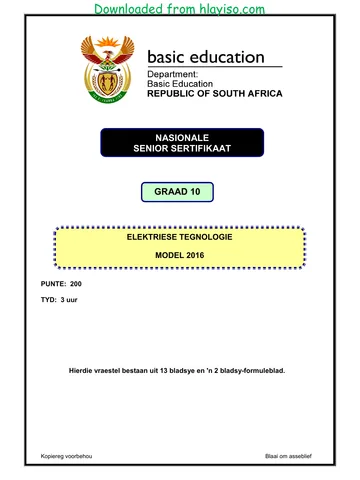
Electrical Technology Grade 10 National November 2016 QP
Grade 10 Electrical Technology question paper from the National November 2016 (English), 15 pages. Read online or download the free PDF.
Electrical Technology · Grade 10 · National November · 2016. Question paper, 15 pages. Read online or download the PDF.
- Subject
- Electrical Technology
- Grade
- Grade 10
- Document type
- Question paper
- Year
- 2016
- Exam period
- National November
- Curriculum
- CAPS
- Pages
- 15
- File size
- 722.7 KB
Free to read online, no sign-up needed
Loading document…
Loading document…
1 of 15
This exam
National November 2016
Document textSearch extracted text and jump to a page.
Downloaded from hlayiso.com
Electrical Technology 2 DBE/2016
CAPS – Grade 10 Exemplar
INSTRUCTIONS AND INFORMATION
1. This question paper consists of THREE sections. SECTION A is
COMPULSORY for ALL learners.
2. Learners offering Electrical must answer SECTION A and SECTION B.
3. Learners offering Electronics must answer SECTION A and SECTION C.
4. Learners offering Digital Systems must answer SECTION A and SECTION C.
5. Sketches and diagrams must be large, neat and fully labelled.
6. Show ALL calculations and round off answers correctly to TWO decimal
places. Show the units for ALL answers of calculations.
7. Number the answers correctly according to the numbering system used in this
question paper.
8. You may use a non-programmable calculator.
9. A formula sheet is provided at the end of this question paper.
10. Write neatly and legibly.
Copyright reserved Please turn over
Downloaded from hlayiso.com
Electrical Technology 3 DBE/2016
CAPS – Grade 10 Exemplar
SECTION A: GENERIC SECTION (COMPULSORY)
QUESTION 1: OCCUPATIONAL HEALTH AND SAFETY
1.1 Define an accident. (2)
1.2 Define the term good housekeeping. (3)
1.3 Name the following signs:
1.3.1
(1)
1.3.2
(1)
1.3.3
(1)
1.4 State TWO unsafe conditions that may result in an injury. (2)
1.5 Define the term unsafe action. (2)
[12]
Copyright reserved Please turn over
Downloaded from hlayiso.com
Electrical Technology 4 DBE/2016
CAPS – Grade 10 Exemplar
QUESTION 2: TOOLS AND MEASURING INSTRUMENTS
2.1 Explain the function of the following tools:
2.1.1 Combination pliers (2)
2.1.2 Solder sucker (2)
2.2 FIGURE 2.2 below shows a hacksaw. Identify parts 2.2.1 to 2.2.4.
2.2.1
2.2.2
2.2.3
2.2.4
FIGURE 2.2: HACKSAW (4)
2.3 Explain why the handles of electrical tools are insulated. (2)
2.4 Explain why is it important to adjust the tension of a hacksaw blade when
working with a hacksaw. (2)
2.5 State TWO maintenance considerations related to screw drivers. (2)
2.6 State ONE safety precaution to be observed when using an ammeter to
measure current in an electrical circuit. (2)
2.7 Explain how a voltmeter must be connected in an electrical circuit to measure
voltage. (2)
2.8 Explain why it is important to calibrate an oscilloscope before use. (2)
[20]
Copyright reserved Please turn over
Downloaded from hlayiso.com
Electrical Technology 5 DBE/2016
CAPS – Grade 10 Exemplar
QUESTION 3: BASIC PRINCIPLES OF ELECTRICITY
3.1 Define the following terms:
3.1.1 Insulator (2)
3.1.2 Negative temperature coefficient (2)
3.2 State ONE characteristic of copper. (1)
3.3 Define the term tolerance of a resistor. (2)
3.4 Determine the resistance value of a carbon resistor with the following colour
band:
Brown, green, orange and gold (2)
3.5 State Ohm's law in words. (3)
3.6 Calculate the resistance of a soldering iron heating element that draws
a current of 2 A when connected across a 220 V supply. (3)
3.7 Study FIGURE 3.7 below and answer the questions that follow.
R1 = 220 Ω
I1
R3 = 470 Ω
R2
I2
IT = 21,2 mA
12 V
FIGURE 3.7: CIRCUIT
Given:
R 1 = 220 Ω
R 3 = 470 Ω
I t = 21,2 mA
V t = 12 V
Copyright reserved Please turn over
Downloaded from hlayiso.com
Electrical Technology 6 DBE/2016
CAPS – Grade 10 Exemplar
Calculate:
3.7.1 The voltage drop across R 3 (3)
3.7.2 The voltage drop across R 1 (3)
3.7.3 The current through R 1 (3)
3.7.4 The current through R 2 (3)
3.7.5 The value of R 2 (3)
3.8 Explain what will happen to the total current in FIGURE 3.7 if R 3 is removed. (2)
[32]
QUESTION 4: POWER SOURCES
4.1 Define the term energy. (3)
4.2 State ONE primary source of energy. (1)
4.3 Draw a labelled diagram of a voltaic cell. (5)
4.4 Explain the difference between a secondary cell and a primary cell. (2)
4.5 Explain the difference between potential difference and electromotive force
with reference to a battery. (4)
4.6 Study FIGURE 4.6 below and answer the question that follows.
R = 100 Ω
I = 14,9 mA
E = 1,5 V
FIGURE 4.6: ELECTRIC CIRCUIT
Given:
E = 1,5 V
I = 14,9 mA
R = 100 Ω
Calculate the internal resistance of the cell. (3)
4.7 Draw the symbol of a photovoltaic cell. (2)
[20]
Copyright reserved Please turn over
Downloaded from hlayiso.com
Electrical Technology 7 DBE/2016
CAPS – Grade 10 Exemplar
QUESTION 5: ELECTRONIC COMPONENTS
5.1 Draw the symbols of the following switches:
5.1.1 SPDT switch (2)
5.1.2 DPST switch (2)
5.1.3 Rotary switch (2)
5.2 Explain the purpose of a capacitor. (2)
5.3 Draw the graph of voltage and current versus time for a charging capacitor. (4)
5.4 Two capacitors each have a capacitance of 2 200 µF.
Given:
C 1 = 2 200 µF
C 2 = 2 200 µF
Calculate the capacitance of the TWO capacitors when connected as follows:
5.4.1 In parallel (3)
5.4.2 In series (3)
5.5 A 100 µF capacitor is connected in series with a 50 kΩ resistor. The two
components are now connected across a 12 V supply.
Given:
C = 100 µF
R = 50 kΩ
V = 12 V
Calculate the total charging time of the capacitor. (5)
5.6 Explain the term forward biasing of a diode. (1)
5.7 State the purpose of a series resistor connected with a LED. (2)
[26]
Copyright reserved Please turn over
Downloaded from hlayiso.com
Electrical Technology 8 DBE/2016
CAPS – Grade 10 Exemplar
QUESTION 6: MAGNETISM
6.1 Describe the following terms:
6.1.1 Electromagnet (2)
6.1.2 Mutual inductance (3)
6.2 Explain the difference between magnetic flux and flux density. (4)
6.3 State TWO types of inductor cores. (2)
6.4 Describe what an inductor is. (2)
6.5 Calculate the total inductance of the inductors in FIGURE 6.5 below.
L1 120 mH L2 100 mH L3 90 mH
FIGURE 6.5: INDUCTORS (3)
6.6 Describe the operation of a relay. (4)
6.7 Label parts 6.7.1 to 6.7.4 in FIGURE 6.7 below.
6.7.1
6.7.4
6.7.2
6.7.3
FIGURE 6.7: SECTIONAL VIEW OF A DC MOTOR (4)
6.8 Explain the purpose of the brushes in a DC machine. (2)
[26]
TOTAL SECTION A: 136
Copyright reserved Please turn over
Downloaded from hlayiso.com
Electrical Technology 9 DBE/2016
CAPS – Grade 10 Exemplar
SECTION B: ELECTRICAL
QUESTION 7: DOMESTIC INSTALLATIONS
7.1 Define the term domestic installation. (2)
7.2 State the standard value of the following items in South Africa with reference
to a domestic installation:
7.2.1 Frequency (1)
7.2.2 Mains voltage (1)
7.3 Draw a block diagram that shows the sequence of electrical connection from
supplier to consumer. Label the diagram. (4)
7.4 What does the abbreviation SANS stand for? (4)
7.5 Describe the aim of SANS. (4)
7.6 State TWO conditions under which an electrical installation must activate
protection to protect devices. (2)
7.7 Safety principles are important in electrical installations. Describe what
principles must be adhered to with reference to the following:
7.7.1 Live parts (3)
7.7.2 Temperature (3)
7.8 Answer the following questions with reference to a distribution board.
7.8.1 Define the term distribution board. (3)
7.8.2 Name ONE place where a distribution board may NOT be mounted. (1)
7.8.3 Describe how the size of a busbar is determined in a distribution
board. (2)
Copyright reserved Please turn over
Downloaded from hlayiso.com
Electrical Technology 10 DBE/2016
CAPS – Grade 10 Exemplar
7.9 Answer the following questions with reference to miniature circuit breakers.
7.9.1 Describe the function of a miniature circuit breaker. (3)
7.9.2 Describe the operation of the electromagnetic miniature circuit
breaker shown in FIGURE 7.9 below.
Circuit breaker
Contact
Pivot
Current from
external
Live
power supply
Spring wire
Current into
household
or business
FIGURE 7.1: ELECTROMAGNETIC MINIATURE
CIRCUIT BREAKER (5)
7.9.3 Give the current rating of a miniature circuit breaker used to protect
a lighting circuit. (1)
7.9.4 Describe TWO methods used to rate miniature circuit breakers. (4)
7.9.5 The thermal-type miniature circuit breaker operates with the use of
a bimetal strip. Describe how a bimetal strip works. (4)
7.10 Answer the following questions with reference to earth leakage devices.
7.10.1 State the THREE functions of an earth-leakage device. (3)
7.10.2 Give ONE practical example of an earth fault that may occur in
a domestic installation. (3)
7.11 Answer the following questions with reference to the earthing of electrical
systems.
7.11.1 Define the term earthing. (2)
7.11.2 State the purpose of earthing. (2)
7.11.3 Describe what type of resistive value an earthing system should
have. (4)
7.11.4 Explain the term earth spike. (3)
TOTAL SECTION B: 64
Copyright reserved Please turn over
Downloaded from hlayiso.com
Electrical Technology 11 DBE/2016
CAPS – Grade 10 Exemplar
SECTION C: ELECTRONICS AND DIGITAL ELECTRONICS
QUESTION 8: LOGIC
8.1 Study FIGURE 8.1a and FIGURE 8.1b below that shows two clocks and
answer the questions that follow.
FIGURE 8.1a: CLOCK
FIGURE 8.1b: CLOCK
8.1.1 Name the system used in the clock in FIGURE 8.1a. (1)
8.1.2 Name the system used in the clock in FIGURE 8.1b. (1)
8.2 Name any TWO number systems used commonly in digital circuits. (2)
8.3 Convert 19 10 to a binary number. (5)
8.4 Convert 1001 2 to a decimal number. (4)
8.5 Find the sum of 011 2 and 100 2 . (3)
8.6 Subtract 0111 2 from 1100 2 . (3)
Copyright reserved Please turn over
Downloaded from hlayiso.com
Electrical Technology 12 DBE/2016
CAPS – Grade 10 Exemplar
8.7 Do the following with reference to a two-input AND gate:
8.7.1 Draw the symbol of the gate. (2)
8.7.2 Write out the Boolean expression for the gate. (2)
8.7.3 Draw the truth table for the gate. (4)
8.8 Draw a neat logic circuit for the following Boolean expression:
X = AC + AB + BC (5)
[32]
QUESTION 9: COMMUNICATION
9.1 Describe the purpose of communication systems. (3)
9.2 Define radio wave propagation in communication systems. (3)
9.3 State THREE types of radio-wave propagation. (3)
9.4 Define the term frequency with reference to radio waves. (3)
9.5 Label part 9.5.1 and part 9.5.2 in FIGURE 9.5 below.
FIGURE 9.5: WAVE FORM (2)
9.6 Describe the function of an antenna in communication systems. (3)
9.7 Name TWO types of antennas used in communication systems. (2)
9.8 Describe what is meant by commercial broadcasting. (4)
Copyright reserved Please turn over
Downloaded from hlayiso.com
Electrical Technology 13 DBE/2016
CAPS – Grade 10 Exemplar
9.9 Label parts 9.9.1 to 9.9.4 in FIGURE 9.9 below.
FIGURE 9.9: COAXIAL CABLE (4)
9.10 Describe why cellphones have become the most popular choice in
communication. (5)
[32]
TOTAL SECTION C: 64
GRAND TOTAL: 200
Copyright reserved
Downloaded from hlayiso.com
Electrical Technology DBE/2016
CAPS – Grade 10 Exemplar
FORMULA SHEET
PRINCIPLES OF ELECTRICITY
Charge
Q = I× t (C)
Specific resistance
ρxl
R= (Ω)
A
Ohm's law
V
R= (Ω )
I
Resistors in series
R T = R1 + R 2 + ... + R n (Ω)
IT = I1 = I2 = ... + In (A)
Resistors in parallel
1 1 1 1
= + + ... + (Ω)
R T R1 R 2 Rn
IT = I1 + I 2 + ... + I n (A)
Kirchhoff's law (voltage divider)
VT = V1 + V2 + ... + Vn (V)
Kirchhoff's Law (current divider)
IT = I1 + I 2 + ... + I n (A)
Power
P = V×I (W)
Energy = P × t (kW.h)
Light-emitting diode (LED)
V − VLED
R series = T (Ω)
I LED
POWER SOURCES
Potential difference
E
V= (V)
Q
Copyright reserved Please turn over
Downloaded from hlayiso.com
Electrical Technology DBE/2016
CAPS – Grade 10 Exemplar
Electromotive force (emf)
Vemf = Vpd + Vr (V)
or
Vemf = I (R + r) (V)
Capacity and power rating
Battery capacity = Icharge × Tcharge (A.h)
ELECTRONIC COMPONENTS
Electrostatic charge
Q = CV (C)
Time constant
τ = RC (s)
T = 5RC (s)
Charging rate
Vcapasitor = Vsupply × 0,623 (V)
Icapasitor = I max × 0,364 (A)
Capacitors in series
1 1 1 1
= + + ... + (F)
CT C1 C2 Cn
Capacitors in parallel
CT = C1 + C2 + .... + C (F)
PRINCIPLES OF MAGNETISM
Coils in series
LT = L1 + L 2 + L3 + ... + L n (H)
Coils in parallel
1 1 1 1 1
= + + + ... + (H)
LT L1 L 2 L3 Ln
Copyright reserved
Study this subject
Recommended for this subject
Question paper
Electrical Technology Grade 10 National November 2016 QP
Annual teaching plan
Gr 10 Elec Tech Pow Sys ATP 2023 24
Annual teaching plan
Gr 10 Dig Elec ATP 2023 24
Annual teaching plan
Gr 10 Elec Tech Elec ATP 2023 24
Memorandum
Electrical Technology Grade 10 National November 2016 Memo
Memorandum