Downloaded from hlayiso.com
NATIONAL SENIOR CERTIFICATE EXAMINATION
NOVEMBER 2018
EQUINE STUDIES
Time: 3 hours 200 marks
PLEASE READ THE FOLLOWING INSTRUCTIONS CAREFULLY
1. This question paper consists of 14 pages and 3 sections. Please check that your
question paper is complete.
2. You are required to answer all the questions.
3. All answers must be written in the Answer Book provided.
4. Answers must be numbered exactly as the questions are numbered.
5. Read the questions carefully.
6. It is recommended that you spend approximately 1 hour on each section.
7. It is in your own interest to write legibly and to present your work neatly.
IEB Copyright © 2018 PLEASE TURN OVER
You're offline
Skip to contentQuestion paper
Equine Studies 2018 hlayiso.com
Equine Studies · Grade 12 · 2018. Question paper, 14 pages. Read online or download the PDF.
- Subject
- Equine Studies
- Grade
- Grade 12
- Document type
- Question paper
- Year
- 2018
- Publisher
- IEB
- Pages
- 14
- File size
- 1.3 MB
Loading document…
Loading document…
1 of 14
Document textSearch extracted text and jump to a page.
Downloaded from hlayiso.com
NATIONAL SENIOR CERTIFICATE: EQUINE STUDIES Page 2 of 14
SECTION A
QUESTION 1
1.1 Give the correct term for the description below:
1.1.1 The duct joining the ovary to the uterine horn.
1.1.2 A supplement that encourages good bacterial growth in the hindgut
of the horse.
1.1.3 Tooth adapted for grinding.
1.1.4 Hormone secreted by the uterus, causing the corpus luteum to stop
working so that a mare comes back into season.
1.1.5 Swollen leg caused by the lymphatic system becoming infected
after a minor cut. (5)
1.2 Give a definition for the following:
1.2.1 Virus
1.2.2 Epistaxis
1.2.3 Carbohydrate
1.2.4 Amino acid
1.2.5 Capillary vessel (10)
1.3 State whether the following are true or false. If false, correct the statement
to make the statement true.
1.3.1 Thrush produces cheesy white discharge from the frog Sulci.
1.3.2 White line disease is when a bacterial or fungal infection gets into
the area between the hoof wall and sole of the foot.
1.3.3 Laminitis is known as founder when the pedal bone rotates and
drops in the hoof capsule.
1.3.4 Navicular disease is a condition of the proximal sesamoid bones.
1.3.5 Sheared heels is when the two bulbs of the heel become narrow
and closer together.
1.3.6 Side bone is usually seen in young, light-breed horses. (12)
[27]
IEB Copyright © 2018
Downloaded from hlayiso.com
NATIONAL SENIOR CERTIFICATE: EQUINE STUDIES Page 3 of 14
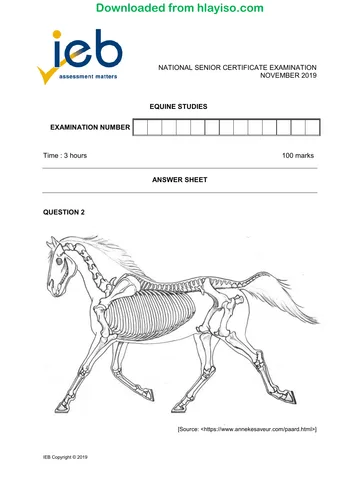
QUESTION 2
2.1 2.1.1 Match the picture of the muscle in column B to the muscle name in
column A.
A B
1. Trapezius muscle A
2. Latissimus dorsi muscle B
3. Longissimus dorsi muscle C
4. Splenius muscle D
5. Triceps muscle E
6. Gluteal muscle F
7. Brachiocephalic muscle G
H
I
(7)
IEB Copyright © 2018 PLEASE TURN OVER
Downloaded from hlayiso.com
NATIONAL SENIOR CERTIFICATE: EQUINE STUDIES Page 4 of 14
2.1.2 Name two conditions of muscles that may be seen in the
thoroughbred race horse. (2)
2.2 2.2.1 Name the ligament and two tendons that run down the back of the
cannon bone. Write them in order from deep to superficial in
anatomical position. (4)
2.2.2 Why, after a tendon injury, is stable rest first prescribed and then
walking in hand? (4)
2.3 Name the bursal enlargements caused by stress and strain found at the
anatomical areas indicated by numbers 1 to 6 in Figure 1.
[Source: The Athletic Horse: Carol Foster, pg 116]
Figure 1
(6)
[23]
IEB Copyright © 2018
Downloaded from hlayiso.com
NATIONAL SENIOR CERTIFICATE: EQUINE STUDIES Page 5 of 14
QUESTION 3
3.1 Study Figure 2 below and answer the questions that follow.
[Source: <https://socratic.org>]
Figure 2
3.1.1 Give a descriptive label of the biological process shown in Figure 2. (3)
3.1.2 Give the name of cell A. (1)
3.1.3 What gives cell A its red colour? (1)
3.1.4 Give one other function of this red pigment found in cell A. (1)
3.1.5 What gas is moving at B? (1)
3.1.6 What gas is moving at C? (1)
3.1.7 Explain what drives the movement of gases B and C as shown in
the diagram. (2)
3.1.8 When a horse is exercising, the movement of gases across the
membranes needs to increase. Give three ways in which this can
happen. (6)
3.1.9 Name D. (1)
3.1.10 Name E. (1)
3.1.11 What about the anatomy of structures D and E is important to allow
movement of gas to take place easily and quickly? (2)
[20]
70 marks
IEB Copyright © 2018 PLEASE TURN OVER
Downloaded from hlayiso.com
NATIONAL SENIOR CERTIFICATE: EQUINE STUDIES Page 6 of 14
SECTION B
QUESTION 4
4.1 Study Figure 3 below showing endocrine control of reproduction and answer
the questions that follow.
Figure 3 Endocrine control of reproduction.
4.1.1 Where would you find Sertoli and Leydig cells respectively? (2)
4.1.2 Besides having a positive feedback on the hypothalamus and
pituitary gland, list 4 characteristics testosterone is responsible for. (4)
4.1.3 Give the full name of FSH. (1)
4.1.4 Name the functions of LH in the mare. (2)
IEB Copyright © 2018
Downloaded from hlayiso.com
NATIONAL SENIOR CERTIFICATE: EQUINE STUDIES Page 7 of 14
4.2 Study Figure 4 below and answer the questions that follow.
Figure 4 Schematic representation of plasma testosterone
concentration (dotted line) and total volume of
ejaculate, for stallions in the northern hemisphere,
throughout the year.
4.2.1 Why is it important to state that this information is for the northern
hemisphere? (2)
4.2.2 Why do testosterone levels reach a peak before the total sperm
volume reaches its peak? (2)
4.2.3 During which months would you breed with these stallions? Justify
your answer. (3)
[16]
IEB Copyright © 2018 PLEASE TURN OVER
Downloaded from hlayiso.com
NATIONAL SENIOR CERTIFICATE: EQUINE STUDIES Page 8 of 14
QUESTION 5
Use the feed label in Figure 5 below to answer the questions that follow.
Figure 5
5.1 What does the 12 stand for in "Cool 'n Perform 12"? (1)
5.2 Do you think this feed is really suitable to "keep all types of horses in peak
condition" as stated on the label? Explain your answer in terms of type,
age, condition, and workload of the horse. (10)
5.3 If a horse was fed 2 kg of this feed twice a day, how much protein in grams
would it be getting daily? (3)
5.4 If the Ca : P ratio was imbalanced and the phosphorus was too high,
5.4.1 how would you easily correct this ratio? (2)
5.4.2 what would happen if you left this imbalanced? (1)
5.5 Why is it important that the label states "free of raw maize"? (4)
IEB Copyright © 2018
Downloaded from hlayiso.com
NATIONAL SENIOR CERTIFICATE: EQUINE STUDIES Page 9 of 14
5.6 How is micronised maize different to raw maize in its preparation,
appearance and use by the horse? (3)
5.7 There is 50 g/kg of fat in this feed. Why is fat good in this type of feed? (3)
5.8 What are anti-oxidants useful for? (2)
5.9 Salt is included in this feed. Why is salt supplementation so important in
horses? (3)
5.10 A horse on this feed needs box rest. How would you adjust its feeding? (2)
5.11 Why is it important that a horse on box rest still gets sufficient balanced
nutrients? (2)
5.12 If a horse on this feed was in foal, how would you change this horse's diet? (5)
5.13 Your horse bolts its morning feed. Give three preventative measures you
can take to eliminate this behaviour. (3)
[44]
IEB Copyright © 2018 PLEASE TURN OVER
Downloaded from hlayiso.com
NATIONAL SENIOR CERTIFICATE: EQUINE STUDIES Page 10 of 14
QUESTION 6
Study the source in Figure 6 below and use it to answer the questions that follow.
[Source: <http://www.africanhorsesickness.co.za>]
Figure 6
6.1 What is African Horse Sickness (AHS)? (2)
6.2 Name the four zones currently in place as shown on the map. (4)
6.3 Must horses be vaccinated in all of these zones? Explain your answer. (4)
6.4 Why do we need such strict regulations within these zones? (3)
6.5 What are the new AHS vaccination requirements? (2)
6.6 Why were these new vaccination requirements made? (3)
6.7 If you had to truck horses from Durban to a show in Malmesbury, what
requirements would you need in place to do this? (4)
6.8 If this trip is a 14-hour drive, explain how you would care for the horse on
this trip (pre-travel, feed, water, stops, dress). (5)
6.9 If you were taking one horse in a two-berth box, on which side would you
load the horse? Justify your answer with sound reasoning. (2)
IEB Copyright © 2018
Downloaded from hlayiso.com
NATIONAL SENIOR CERTIFICATE: EQUINE STUDIES Page 11 of 14
6.10 You are worried about travel sickness. Give five signs or symptoms you
would be looking for. (5)
6.11 Respiratory distress is often seen in AHS and other respiratory-related
conditions. Describe what a horse in respiratory distress would look like. (3)
6.12 A horse with AHS often has fluid in the lungs. How would this affect
gaseous exchange in the lungs? (3)
[40]
100 marks
IEB Copyright © 2018 PLEASE TURN OVER
Downloaded from hlayiso.com
NATIONAL SENIOR CERTIFICATE: EQUINE STUDIES Page 12 of 14
SECTION C
QUESTION 7
Read the information below and answer the questions that follow.
GASTRODISCUS AEGYPTIACUS
Gastrodiscus aegyptiacus is a parasitic fluke or parasitic worm belonging to the class of worms
known as Trematodes.
Gastrodiscus aegyptiacus is a fluke species that has horses, swine and related wild animals
(zebras, warthogs, etc.) as final hosts. It is found mainly in Africa as well as in India and other
Asiatic countries. Little is known about the prevalence and incidence of these flukes. In a study in
Egypt, it was found that 22% of 156 donkeys and 15% of 40 horses investigated shed eggs of this
parasite.
These flukes do not affect cattle, sheep, goats, dogs or cats and there is no evidence that these
flukes can infect humans.
Figure 7.1 Egg of fluke Figure 7.2 Intermediate host –
freshwater snail
Predilection sites of Gastrodiscus aegyptiacus are the small intestine, caecum and the colon.
Adult Gastrodiscus aegyptiacus are about 1,5 cm long and 0,5 cm–0,7 cm broad. They have the
flat body and the oval shape typical for most flukes, but their body is divided in a small, conical
anterior part and a wider posterior part with numerous papillae arranged in transverse rows.
As with other flukes, they have no external signs of segmentation. The mouth ends in the
pharynx, a muscular tube that allows sucking. The digestive system is blind (i.e. without anus: the
only opening is the mouth) and not linear, as in most animals, but branched, ending in several
blind ducts (called coeca). Like most flukes, Gastrodiscus are simultaneous hermaphrodites, i.e.
they have both male and female reproductive organs.
The eggs have an oval shape and are rather large (~110 micrometer × 180 micrometer), thin-
shelled and have a brownish colour.
Gastrodiscus aegyptiacus has an indirect life cycle with freshwater snails as intermediate hosts,
mainly of the genera Bulinus and Cleopatra.
Cont.
IEB Copyright © 2018
Downloaded from hlayiso.com
NATIONAL SENIOR CERTIFICATE: EQUINE STUDIES Page 13 of 14
The eggs shed by adult flukes are expelled with faeces. Once outside the host, the larvae called
miracidia hatch out of the eggs in a few days. These larvae can survive for weeks without a host
provided there is enough humidity. They die quickly in a dry environment. Miracidia can swim and
penetrate actively into the snails where they develop successively to sporocysts, rediae and
cercariae, the usual larval stages of most fluke species.
Mature cercariae leave the snail, attach to the vegetation and produce cysts, the so-called
metacercariae, which are infective for the final host. Horses become infected when grazing on
contaminated pastures.
Once a final host ingests metacercariae while grazing, they migrate to their predilection sites.
Most infections with Gastrodiscus aegyptiacus are benign and show no clinical signs. But in case
of heavy infestations severe health problems with diarrhoea, blood loss, swelling, weight loss, and
poor condition can follow.
Diagnosis is done by detection of eggs or immature flukes in the faeces or by identification of the
adult flukes after necropsy. A history of grazing in marshy pastures together with such clinical
symptoms may suggest infection with Gastrodiscus aegyptiacus.
Most flukicides are approved only for ruminants (cattle, sheep, goats) and not for horses or swine,
simply because they are seldom a problem for equine or porcine hosts. They may be used on
horses or swine under the supervision of a veterinary doctor.
Neither Ivermectin, Moxidectin nor Levamisole, nor most other benzimidazoles are effective
against Gastrodiscus aegyptiacus. There are so far no vaccines against Gastrodiscus aegyptiacus.
There are currently no reports on resistance of Gastrodiscus aegyptiacus to flukicides.
Figure 7.3 Horse with fluke infestation
[Sources: <http://fourwaysequine.co.za> and <http://parasitipedia.net>]
IEB Copyright © 2018 PLEASE TURN OVER
Downloaded from hlayiso.com
NATIONAL SENIOR CERTIFICATE: EQUINE STUDIES Page 14 of 14
7.1 Accurately draw a fluke from the description on the previous page. (4)
7.2 Differentiate between the term anterior and posterior used to describe the
fluke. (2)
7.3 Describe or draw the lifecycle of this fluke. Include the names of all the
stages. You may add simple drawings to assist you. (10)
7.4 Give the scientific term for blood loss or low blood count referred to in the
text. (1)
7.5 Explain, in your own words, how these worms are diagnosed. (2)
7.6 Humans cannot contract this fluke. What term is used to describe diseases
that humans can contract from animals? (1)
7.7 The text states that there is no resistance to the flukicide. Give 3 reasons
why a horse might not improve after being treated for this fluke. (3)
7.8 Give 5 ways you could prevent infestation of this fluke. (5)
7.9 There is resistance to dewormers in other equine worms. How are the
horse community and vets trying to stop resistance? (2)
30 marks
Total: 200 marks
IEB Copyright © 2018
Recommended for this subject
Published documents with matching subject and grade metadata.
Related documents
Matched using subject, grade, language, document type and exam metadata.