Downloaded from hlayiso.com
NATIONAL SENIOR CERTIFICATE EXAMINATION
NOVEMBER 2019
EQUINE STUDIES
MARKING GUIDELINES
Time: 3 hours 200 marks
These marking guidelines are prepared for use by examiners and sub-examiners,
all of whom are required to attend a standardisation meeting to ensure that the
guidelines are consistently interpreted and applied in the marking of candidates'
scripts.
The IEB will not enter into any discussions or correspondence about any marking
guidelines. It is acknowledged that there may be different views about some
matters of emphasis or detail in the guidelines. It is also recognised that,
without the benefit of attendance at a standardisation meeting, there may be
different interpretations of the application of the marking guidelines.
IEB Copyright © 2019 PLEASE TURN OVER
You're offline
Skip to contentMemorandum
Equine Studies Memo 2019 hlayiso.com
Equine Studies · Grade 12 · 2019. Memorandum, 9 pages. Read online or download the PDF.
- Subject
- Equine Studies
- Grade
- Grade 12
- Document type
- Memorandum
- Year
- 2019
- Publisher
- IEB
- Pages
- 9
- File size
- 288.0 KB
Loading document…
Loading document…
1 of 9
Document textSearch extracted text and jump to a page.
Downloaded from hlayiso.com
NATIONAL SENIOR CERTIFICATE: EQUINE STUDIES – MARKING GUIDELINES Page 2 of 9
SECTION A
QUESTION 1
1.1 A–2
B–6
C–1
D–4
E – 3 or 7
1.2 1.2.1 Senecio – affects intestine, liver, nerves and skin, causing
diarrhoea, colic, weight loss, icterus, staggers, sun sensitivity
Datura – inhibits parasympathetic system, causing impaction colic,
dilated pupils, blindness, seizures, diaphragm paralysis, ataxia
Mienie-mienie bean – colic, bloody diarrhoea, fever, skin itching and
irritation
Monkey rope – ataxia, seizures, torticollis
Bracken fern – depression, ataxia, blindness, head and neck up and
backwards, convulsions, trembling
Blue green algae – diarrhoea, dehydration, colic, liver failure,
photosensitivity, seizures
Thorn apple – ileus, colic, ataxia, convulsion, blindness
(any two plants two marks each, only have to include two symptoms
to be awarded the marks)
1.2.2 Oil coats intestine to avoid absorption of toxic principle and purges
intestines of toxin so less contact time for absorption.
1.2.3 Large amount required to be effective, won't get in enough and
horse does not like taste, if force horse it may get it into the lung may
cause pneumonia.
1.3 1.3.1 Occupational Health and Safety
1.3.2 Pay as You Earn
1.3.3 Value added tax
1.3.4 Unemployment Insurance Fund
1.3.5 Compensation for Occupational Injuries and Diseases Act
IEB Copyright © 2019 PLEASE TURN OVER
Downloaded from hlayiso.com
NATIONAL SENIOR CERTIFICATE: EQUINE STUDIES – MARKING GUIDELINES Page 3 of 9
QUESTION 2
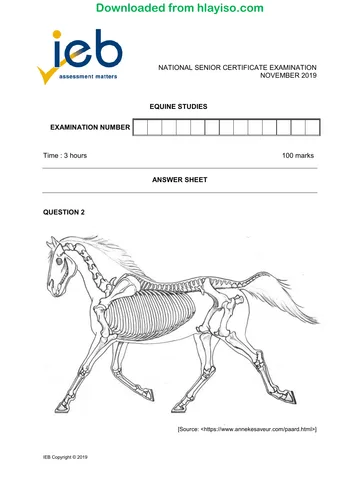
Gluteal
Trapezius
Longissimus dorsi
Brachio-
cephalic
Triceps
2.1 Each muscle given 3 marks: correct area and label, correct origin, correct
insertion.
2.2 Decreased hock action with little impulsion, working on the forehand and
will not track up (lack of collection)
2.3 trauma/pain, lack of use, nerve damage, incorrect riding/schooling
2.4 Hill work, pole work, collection (ride from behind) physiotherapy
QUESTION 3
3.1 Atlas C1; Axis C2
3.2 C1 or cervical
3.3 Skull Shows most lateral movement, cervical vertebrae lateral movement
increases till C6 where most lateral movement is seen of all vertebrae, it
then slowly decreases, least amount of lateral flexion over withers and
lumbar area mid thorax show small amount of lateral flexion.
3.4 A nodding "yes" movement up and down
3.5 cervical vertebrae
IEB Copyright © 2019 PLEASE TURN OVER
Downloaded from hlayiso.com
NATIONAL SENIOR CERTIFICATE: EQUINE STUDIES – MARKING GUIDELINES Page 4 of 9
3.6 Kissing spine usually seen between T 14 – 16. According to graph this
shows least movement of spine in this area, usually due to change in
direction of dorsal spinal process which is not represented in the graph.
3.7 Check saddle – may be causing back pain and lordosis if ill fitting, weight of
rider – too heavy causes lordosis and increased impingement of spine, no
rest/ keep in work keep muscles strong to work correctly, ride with back
rounded up supported by core and abdominal muscles to increase space
between spines.
IEB Copyright © 2019 PLEASE TURN OVER
Downloaded from hlayiso.com
NATIONAL SENIOR CERTIFICATE: EQUINE STUDIES – MARKING GUIDELINES Page 5 of 9
SECTION B
QUESTION 4
4.1 4.1.1 1st month: appetite loss as 31/36 (86%) horses improved
2nd month: BCL as 31/37 (84%) horses improved and appetite loss
was now 29/36 (80%)
Overall, dung softening improved in 10/11 horses (91%)
4.1.2 Needs longer than one month to show effect, colic due to reasons
other than ulcers, larger research group may have shown more
change.
4.1.3 Little access to pasture, most time in the stables means acid often in
contact with empty stomach wall causing erosions, high stress
environment stress releases cortisol predisposing horse to stomach
ulcers, high concentrate low roughage, partially empty stomach for
many hours per day concentrate quickly digested and makes for
more acidic environment, low roughage means low pH as no
buffering or protective fibrous matt takes place, gastric acid
production continuous, means acid often in contact with empty
stomach wall causing erosions, high intensity exercise on empty
stomach causing splashing of acid on lining of stomach.
4.1.4 (a) Saliva buffers acid especially on the top surface mat that
suppresses splashing of acid in the stomach.
(b) Saliva flow increases with molar pressure with eating
therefore increase the amount of hay fed as this requires the
most amount of molar pressure to chew.
4.1.5 pawing, rolling, grinding teeth, looking at stomach, sweating,
restless, anorexic, decreased little to no droppings passed,
increased heart rate, increased or decreased gut sounds. Moaning
or groaning (any 7
4.1.6 lack of water, poor teeth, poor quality hay, parasites, eating sand,
sudden change in diet (any 4)
4.2 4.2.1 hydrochloric acid is continually secreted from the stomach to
denature the proteins present in the feed. The enzyme pepsinogen is
excreted in an inactive form it is activated to pepsin by HCL and this
pepsin starts protein digestion.
4.2.2 Mechanical and bacterial digestion Mechanical is the physical
breakdown of feed into smaller particles that increase the surface
area for further enzymatic digestion. Bacterial digestion occurs in the
hind gut. Microbe in the caecum breaks down indigestible fibre by
fermentation into volatile fatty acids which are absorbed and used for
energy.
IEB Copyright © 2019 PLEASE TURN OVER
Downloaded from hlayiso.com
NATIONAL SENIOR CERTIFICATE: EQUINE STUDIES – MARKING GUIDELINES Page 6 of 9
QUESTION 5
5.1 5.1.1 Increased speed causes increased potential for vascular damage
therefore the body prepares itself to correct any potential bleeds.
5.1.2 Horses pre-empt racing day causing increased adrenalin and stress,
this may in itself increase platelet count, spleen contraction will
disperse stored blood which may increase platelet numbers.
5.1.3 Exercise induced pulmonary haemorrhage / bleeders / epistaxis
5.2 Gastric ulcers Colic Acute diarrhoea
Two signs Weight loss, change in Pawing, Watery stool, painful
behaviour, pain after looking at abdomen,
eating, grinding teeth, etc. flank, dehydration,
sweating, anorexic, etc.
restless,
anorexic, etc.
One cause High concentrate low Dehydration, Bacteria, virus, fresh
roughage, management, poor quality grass, etc.
stress, high work hay, change of
diet, worms,
etc.
Part of GIT stomach stomach, SI, SI, LI
LI
Impact on Damage to lining of Death of Inflammation of lining
part of GIT stomach, red lesions, tissue due to of small and/or large
painful when acid touched lack of blood intestine, decreased
thinned mucosa. supply, absorption of fluids or
impaction increased production
twisting, gas of fluids.
expansion,
etc.
Initial Call vet, Call vet, Call vet, keep horse
treatment Omeprazole/omeprocoat, remove and stable clean,
herbal ulcer remedies, diet concentrate, remove concentrates,
change painkillers ensure fresh clean
water available,
probiotics/prebiotics
Prevention Change management, Deworming, Keep utensils clean,
increase roughage, change feed pre/probiotics, limit
decrease training and slowly, ensure sudden increase in
stress fresh clean lush grazing, change
water food slowly, etc.
available,
good quality
roughage,
dental up to
date, etc.
IEB Copyright © 2019 PLEASE TURN OVER
Downloaded from hlayiso.com
NATIONAL SENIOR CERTIFICATE: EQUINE STUDIES – MARKING GUIDELINES Page 7 of 9
5.3 Palatability is the taste of the feed and how well the horse eats it.
Digestibility is how easily the feed is broken down in the intestine to release
energy by the horse.
5.4 salt / molasses
5.5 Must discuss a feeding board/chart, discuss named/numbered feed
bins/covers, transport to stables in wheelbarrow, etc. possible more than
one feed room, work in order, double check before sending out, field horses
fed apart and watched, remove problem horses or slow eaters, more than
one person to feed, wear hats, bring into stalls in shift, any other reasonable
answers.
5.6
A Introduce hand grazing for short periods, small amounts of wet hay
often, concentres only added slowly once eating hay well and passing
droppings, if on box rest not back to previous amounts pre/probiotics.
B Ad lib fresh clean water, needs increasing energy to produce milk as
foal grows and drinks more milk, change feed according to BCS
C High concentrate 14 – 16%, 550:50 concentrate to roughage ratio,
small meals often, best quality feed, ulcer medication.
D Depending on BCS just roughage and grazing otherwise good quality
protein to keep muscle mass up, not high percentage protein as can
put strain on kidney and liver. Check teeth, may need easily digestible
feed, oil, pre/probiotics.
E Should be on high roughage low concentrate, increase concentrate
amount and protein/energy% with workload, slowly, watch behaviour
and BCS.
F Restrict grazing with limited turnout or grazing muzzle, soak hay, low to
no concentrates, possibly balancing supplement if no concentrate.
5.7 Metabolism; example of a TB (hot blood) and a draft (cold blood) where the
draft is large but keeps on weight with a small amount of feed due to slow
metabolism, and the TB that is smaller but needs high amounts of feed to
keep weight on due to higher metabolism.
5.8 High concentration CO2 in muscles diffuses down concentration gradient to
low CO2 concentration in plasma, goes to lungs where high concentration in
plasma diffuses to low concentration in alveoli, breathed out.
IEB Copyright © 2019 PLEASE TURN OVER
Downloaded from hlayiso.com
NATIONAL SENIOR CERTIFICATE: EQUINE STUDIES – MARKING GUIDELINES Page 8 of 9
QUESTION 6
6.1 Retained placenta, increased green grass or grain intake, diarrhoea, drugs,
increased weigh bearing on one foot, increased concussion of foot (any
four)
6.2 Founder
6.3 WBC help fight infection by attacking and engulfing foreign bodies and
bacteria helping the body to localize and destroy any infection, reparexin
inhibits them moving into tissues and therefore the infection may spread
easier and become worse.
6.4 Increased toe length will put increased pressure on the laminae causing
stretching from the white line up causing inflammation and possibly
laminitis.
IEB Copyright © 2019 PLEASE TURN OVER
Downloaded from hlayiso.com
NATIONAL SENIOR CERTIFICATE: EQUINE STUDIES – MARKING GUIDELINES Page 9 of 9
SECTION C
QUESTION 7
7.1 African Horse Sickness is a viral disease that affects horses' vascular
system that is transmitted by the cullicoides midge.
7.2 7.2.1 Bacteria, yeast and eggs. In living systems.
7.2.2 Tobacco plants
7.2.3 Live but weakened virus
7.2.4 Virus like particles
7.2.5 possible signs of AHS/viraemic horse, cause outbreak
7.2.6 no effect just antibodies produced, no chance of outbreak
7.3 No, no vaccine in 100% effective, many horses are not vaccinated in rural
areas, zebra's endemically harbour the virus so there is always a pool of
circulating virus in Africa. There are 9 strains and this is only a vaccine for
one strain.
7.4 Once injected the vaccine causes the horse's immune system to respond to
the antigen that looks like/has the same protein markers as the live virus or
bacteria. The body produces antibodies that will work against the antigen.
Some antibodies are stored as memory cells so when the horse is exposed
to the real disease the body can quickly respond and attack the
virus/bacteria.
7.5 Must argue for and against and then form their own opinion e.g. unethical if
vaccine doesn't work and horse gets AHS, suffers and dies, if vaccine does
work however it will mean many more horses will survive AHS in the future.
If the horses used are treated with highest medical attention and care or
humanely euthenised to prevent suffering in the case where the horse
contacts AHS, I am for testing this vaccine. Etc.
7.6 Export will become easier, quarantine would be shorter and from many
stations around the country not just the cape. Other countries will be
happier to accept our horses as if there is an outbreak they can use the
vaccine without the possibility of an outbreak. Economically it would be
good for our race and endurance industry as well as for other competitors
who wish to compete overseas.
Total: 200 marks
IEB Copyright © 2019
Recommended for this subject
Published documents with matching subject and grade metadata.
Related documents
Matched using subject, grade, language, document type and exam metadata.