Downloaded from hlayiso.com
NATIONAL SENIOR CERTIFICATE EXAMINATION
NOVEMBER 2018
EQUINE STUDIES
MARKING GUIDELINES
Time: 3 hours 200 marks
These marking guidelines are prepared for use by examiners and sub-examiners,
all of whom are required to attend a standardisation meeting to ensure that the
guidelines are consistently interpreted and applied in the marking of candidates'
scripts.
The IEB will not enter into any discussions or correspondence about any marking
guidelines. It is acknowledged that there may be different views about some
matters of emphasis or detail in the guidelines. It is also recognised that,
without the benefit of attendance at a standardisation meeting, there may be
different interpretations of the application of the marking guidelines.
IEB Copyright © 2018 PLEASE TURN OVER
You're offline
Skip to contentMemorandum
Equine Studies Memo 2018 hlayiso.com
Equine Studies · Grade 12 · 2018. Memorandum, 7 pages. Read online or download the PDF.
- Subject
- Equine Studies
- Grade
- Grade 12
- Document type
- Memorandum
- Year
- 2018
- Publisher
- IEB
- Pages
- 7
- File size
- 240.4 KB
Loading document…
Loading document…
1 of 7
Document textSearch extracted text and jump to a page.
Downloaded from hlayiso.com
NATIONAL SENIOR CERTIFICATE: EQUINE STUDIES – MARKING GUIDELINES Page 2 of 7
SECTION A
QUESTION 1
1.1 Give term described below
1.1.1 Fallopian tube OR oviduct
1.1.2 Prebiotic
1.1.3 Molar
1.1.4 Prostaglandin
1.1.5 Lymphangitis
1.2 Give the definition of the following
1.2.1 Small living particle which infects and causes disease, not visible
with ordinary microscope.
1.2.2 Bleeding from nose
1.2.3 Sugar substance in food, simple and complex
1.2.4 Building block of protein.
1.2.5 Connect artery and vein, very small.
1.3 1.3.1 False. Thrush produces tarry black discharge from the frog Sulci
1.3.2 True
1.3.3 True
1.3.4 False. Navicular is a disease of the distal sesamoid bone
1.3.5 False. Sheared heels is when the bulbs of each heel move
independently of each other OR contracted heels.
1.3.6 False. Side bone is seen in older, heavy, draught-type horses.
IEB Copyright © 2018 PLEASE TURN OVER
Downloaded from hlayiso.com
NATIONAL SENIOR CERTIFICATE: EQUINE STUDIES – MARKING GUIDELINES Page 3 of 7
QUESTION 2
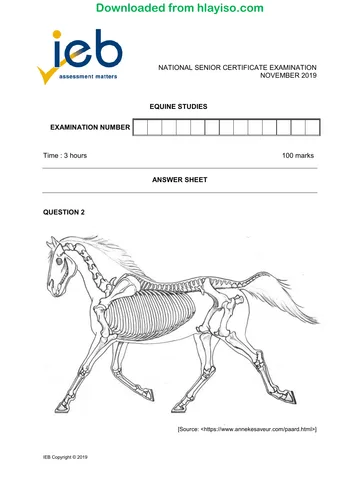
2.1 2.1.1 1. C
2. G
3. F
4. B
5. E
6. H
7. A
2.1.2 Tying up, muscle sprain/tear, muscle fatigue, atrophy. (any two)
2.2 2.2.1 Suspensory ligament, DDFT, SDFT (correct order)
2.2.2 Rest to reduce swelling to start healing process prevent any further
damage. Walk to start aligning tendon fibres so heal straight and
stronger. Increase blood flow for healing.
2.3 1. capped elbow
2. capped knee / carpitis
3. wind galls/wind puffs
4. bog spavin
5. capped hock
6. thoroughpin
QUESTION 3
3.1 3.1.1 Alveoli of the lung showing gaseous exchange
3.1.2 Red blood cell
3.1.3 Haemoglobin
3.1.4 Carry oxygen
3.1.5 Oxygen
3.1.6 Carbon dioxide
3.1.7 High concentration to a low concentration
3.1.8 Increased respiration to move more air, increased heart rate to
increase blood flow and therefore amount of oxygen to the muscles,
spleen contracts to release more RBC so more oxygen can be
transported
3.1.9 Alveolus wall
3.1.10 Capillary wall
3.1.11 They are only one cell thick and therefore make it easier for gases to
diffuse across a smaller distance.
IEB Copyright © 2018 PLEASE TURN OVER
Downloaded from hlayiso.com
NATIONAL SENIOR CERTIFICATE: EQUINE STUDIES – MARKING GUIDELINES Page 4 of 7
SECTION B
QUESTION 4
4.1 Looking at Figure 3 on endocrine control of reproduction
4.1.1 Sertoli – testicle interstitial tissue; Leydig – testical seminiferous
tubules
4.1.2 Libido, crest formation, deep voice, aggressive behaviour.
Spermatogenesis, increase in testicular size
4.1.3 Follicle-stimulating hormone
4.1.4 Luteinising hormone luteinises the corpus luteum. Triggers
ovulation
4.2 Looking at Figure 4
4.2.1 Seasons are different / opposite to ours in southern hemisphere
4.2.2 Testosterone is needed to stimulate sperm production.
4.2.3 April till August as sperm count is highest and mares in season as
it is summer time in northern hemisphere so highest chance of
getting mare pregnant.
IEB Copyright © 2018 PLEASE TURN OVER
Downloaded from hlayiso.com
NATIONAL SENIOR CERTIFICATE: EQUINE STUDIES – MARKING GUIDELINES Page 5 of 7
QUESTION 5
5.1 12% protein content
5.2 No one feed fits all, thriving and poorly underweight horses will require
higher-fat meal overweight horses will require restricted-energy feed with
higher roughage, horse may be lazy and need more energy as this food is
good for a hot horse, horse may be in hard work and require higher protein,
age of horse will affect protein and energy requirements young horse
requires more protein to grow than adult fully grown horse older horses
have specific requirements want to feed as little as possible may need to
feed large amounts to meet energy requirements.
5.3 120 g/kg × 4 = 480 g protein
5.4 5.4.1 Add lucerne as high in Ca or supplement with any Ca-containing
feed.
5.4.2 May get miller's disease.
5.5 Raw maize not easily digested, undigested starch spills into hind gut,
digested there into lactic acid causes horse to be hot, no longer "cool and
perform".
5.6 Micronised is infrared heated, therefore starch more easily digested and
available to horse, will not look like whole kernel, often flaked or in pellets
as tiny pieces.
5.7 Keeps horse calm and keeps weight on, slow-release energy for horse,
higher energy density therefore feed less.
5.8 Scavenging free radicals increase in immunity, prevents oxidation which
causes damage which causes ageing and inflammation
5.9 Salt forms part of electrolytes which are important for chemical reactions
and specific functions in horses; horses lose salt when sweating during
work, therefore need to replace. Nerve impulses, increases need to drink
water
5.10 Decrease concentrate increase roughage
5.11 Still needs to maintain body and extra to heal body – reason for box rest.
5.12 Only change in third trimester as this is when biggest growth of the foetus
occurs therefore higher protein or increased feed amount will be required,
give smaller feeds more often as foetus takes up room in abdomen putting
pressure on stomach, good-quality hay and grazing free access to fresh,
clean water
5.13 Move from bully horse, give hay first, feed on schedule, not late, large,
smooth rocks in feed, smaller amounts more often
IEB Copyright © 2018 PLEASE TURN OVER
Downloaded from hlayiso.com
NATIONAL SENIOR CERTIFICATE: EQUINE STUDIES – MARKING GUIDELINES Page 6 of 7
QUESTION 6
6.1 Viral infection that affects blood vessels and lungs
6.2 Infected, protection, surveillance and free
6.3 No, only vaccinated in infected and protection zone, horses in surveillance
zone can request permission to vaccinate, free zone. No vaccinations but
may request permission to vaccinate June October
6.4 Need to stay AHS free so export of horses possible, very important for
racing industry, financial implications
6.5 June to October, two injections, three weeks apart
6.6 Decrease chance of vaccine mutation and spread by midges as live
attenuated virus in vaccine can infect unvaccinated horses through midges
6.7 Vaccinations before movement, in a passport, health check by vet,
movement permit by local state vet, inform/prenotification Boland state vet,
possible quarantine stop over
6.8 Take temperature twice daily two days pre-trip and five days post-trip to check
for travel sickness change feed week before trip to increase water in gut
possibly with balanced bran, feed and water on trip, ad-lib hay as low as
possible, stop every 5 hours to rest and water horse, depend on weather if
blanket or sweat sheet used, poll guard and leg bandages more supportive
than boxing boots for long distance, overreach boots, tail guard. (pre-travel,
feed, water, stops, dress)
6.9 Right side due to camber of the road
6.10 Fever, anorexia, cough respiratory distress weight loss
6.11 Elbows turned out, head and neck extended and down, heaving or
abdominal component, possible wheezing audible respiration (any three)
6.12 Fluid in alveolar where exchange of oxygen takes place is filled with fluid,
inhibits oxygen and CO2 exchange leads to decreased O2 in blood
therefore increased respiratory rate to exchange where no fluid is
IEB Copyright © 2018 PLEASE TURN OVER
Downloaded from hlayiso.com
NATIONAL SENIOR CERTIFICATE: EQUINE STUDIES – MARKING GUIDELINES Page 7 of 7
SECTION C
QUESTION 7
7.1 Height accurate, width accurate, oval, small "mouth"
7.2 Anterior towards the head, posterior towards the tail
7.3 The eggs shed by adult flukes are expelled with the faeces. Once outside
the host, the larvae called miracidia hatch out of the eggs in a few days.
These larvae can survive for weeks without a host provided there is enough
humidity. They die quickly in a dry environment. Miracidia can swim and
penetrate actively into the snails where they develop successively to
sporocysts, rediae and cercariae, the usual larval stages of most fluke
species.
Mature cercariae leave the snail, attach to the vegetation and produce
cysts, the so-called metacercariae, which are infective for the final host.
Horses become infected when grazing on contaminated pastures.
Once a final host ingests metacercariae while grazing, they migrate to their
predilection sites.
7.4 Anaemia
7.5 Eggs seen in stool under microscope or adults seen in gut on post-mortem
7.6 Zoonosis
7.7 Wrong diagnosis, incorrect drug, incorrect amount of drug, re-infestation
(any three)
7.8 Remove from paddock with dam, fence dam, cut grass around dam,
eradicate snails with chemicals or biocontrol, drain dam/water.
7.9 Strategic deworming after faecal float only deworm horses with high egg
count.
Total: 200 marks
IEB Copyright © 2018
Recommended for this subject
Published documents with matching subject and grade metadata.
Related documents
Matched using subject, grade, language, document type and exam metadata.