Downloaded from hlayiso.com
NATIONAL SENIOR CERTIFICATE EXAMINATION
NOVEMBER 2019
EQUINE STUDIES
Time: 3 hours 200 marks
PLEASE READ THE FOLLOWING INSTRUCTIONS CAREFULLY
1. This question paper consists of 10 pages and an Answer Sheet of 1 page. Please
check that your question paper is complete.
2. You are required to answer all the questions.
3. All answers must be written in the Answer Book provided.
4. Answers must be numbered exactly as the questions are numbered.
5. Read the questions carefully.
6. It is recommended that you spend approximately 1 hour on each section.
7. It is in your own interest to write legibly and to present your work neatly.
IEB Copyright © 2019 PLEASE TURN OVER
You're offline
Skip to contentQuestion paper
Equine Studies 2019 hlayiso.com
Equine Studies · Grade 12 · 2019. Question paper, 10 pages. Read online or download the PDF.
- Subject
- Equine Studies
- Grade
- Grade 12
- Document type
- Question paper
- Year
- 2019
- Publisher
- IEB
- Pages
- 10
- File size
- 548.7 KB
Loading document…
Loading document…
1 of 10
Document textSearch extracted text and jump to a page.
Downloaded from hlayiso.com
NATIONAL SENIOR CERTIFICATE: EQUINE STUDIES Page 2 of 10
SECTION A
QUESTION 1
1.1 Match the correct name listed in Column B to the pictures of toxic plants shown in
Column A. Write only the letter and corresponding number in each case, e.g. F9.
Column A Column B
A Descriptor: green feathered leaves 1. Senecio
2. Bracken fern
3. Datura
4. Blue-green
[Source: <https://www.nrs.fs.fed.us/ef/marcell>]
algae
B Descriptor: red seeds with central black spot 5. Monkey rope
6. Mienie-mienie
bean
7. Thorn apple
[Source: <https://jumpic.com/hashtag.php?q=Erythrina_lysistemon>]
C Descriptor: yellow daisy like flowers
[Source: <https://wagwalking.com/horse/condition/>]
D Descriptor: covers water surface area
[Source: <https://esemag.com/water/>]
E Descriptor: white trumpet like flower, spikey seed pod
[Source: <http://www.flora.sa.gov.au>]
(5)
IEB Copyright © 2019
Downloaded from hlayiso.com
NATIONAL SENIOR CERTIFICATE: EQUINE STUDIES Page 3 of 10
1.2 Choose TWO of the toxic plants given in Question 1.1.
1.2.1 For each plant, describe the signs/symptoms you might see in a
horse if the plant was ingested. (4)
1.2.2 Horses that have recently ingested a toxic substance are often
drenched with oil through a naso-gastric tube directly into the
stomach. What is the reasoning behind this treatment? (2)
1.2.3 One litre of oil is required as a treatment. If your vet is not available
for drenching, why would you not attempt to do this with a syringe
into the horse's mouth? (2)
1.3 Give the full name of the following abbreviated legislation terms:
1.3.1 OHS
1.3.2 PAYE
1.3.3 VAT
1.3.4 UIF
1.3.5 COIDA (10)
[23]
QUESTION 2
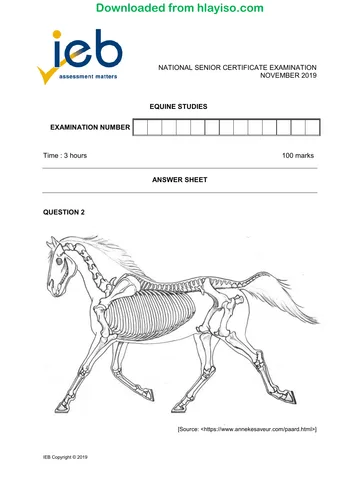
2.1 Sketch the following muscles in on the diagram of a skeleton provided on
your Answer Sheet and label them:
2.1.1 Trapezius muscle
2.1.2 Gluteal muscle
2.1.3 Brachiocephalic muscle
2.1.4 Triceps muscle
2.1.5 Longissimus dorsi muscle (15)
2.2 Describe how a horse would move if it had bilateral muscle atrophy of the
gluteal muscles. (4)
2.3 Give FOUR reasons why this atrophy of the gluteal muscles could have
occurred. (4)
2.4 What exercises could you use to correct this atrophy in a horse? (3)
[26]
IEB Copyright © 2019 PLEASE TURN OVER
Downloaded from hlayiso.com
NATIONAL SENIOR CERTIFICATE: EQUINE STUDIES Page 4 of 10
QUESTION 3
Refer to the graph below showing the range of motion between the vertebrae of a horse
and answer the questions that follow.
Range of lateral movement
Range of joint flexion and extension
Rotation
[Adapted from: Blignault, K., 2009. Equine Biomechanics for Riders.
1st ed. Great Britain: J.A Allen, Pg 43]
3.1 Give the common names for the first and second cervical vertebrae. (2)
3.2 From the graph, which vertebrae show the most rotational movement? (1)
3.3 Using the information in the graph, describe the lateral movement
throughout the horse's entire vertebral column. (4)
3.4 What would flexion and extension of the skull look like? (2)
3.5 In which section of vertebrae would Wobbler's disease occur? (1)
3.6 Does kissing spine have any correlation to movement of the spine? Justify
your answer with sound reasoning from the graph. (3)
3.7 Explain FOUR riding-related guidelines you would give to the owner of a
horse with kissing spine. (8)
[21]
70 marks
IEB Copyright © 2019
Downloaded from hlayiso.com
NATIONAL SENIOR CERTIFICATE: EQUINE STUDIES Page 5 of 10
SECTION B
QUESTION 4
4.1 FERMAID EASE is a natural feed ingredient to help maintain gastric health
in intensively managed horses at risk from gastric ulcers.
Forty horses at risk from gastric ulcers were treated with FERMAID EASE
at a veterinary clinic. The graph below shows the results of this treatment.
[Source: EQUINE HEALTH UPDATE, volume 20, issue 1 April 2018.]
4.1.1 Which clinical sign did Fermaid Ease have the most positive effect
on? Show your reasoning. (3)
4.1.2 Give THREE reasons why you suspect Fermaid Ease had no effect
on recurrent colics in these forty horses. (3)
4.1.3 Explain why intensively managed horses are at higher risk from
gastric ulcers. (8)
4.1.4 (a) Why is saliva important in preventing gastric ulcers? (2)
(b) How would you increase production of saliva in a horse? (2)
4.1.5 Colic can be a sign of gastric ulcers. List SEVEN signs of colic in
horses. (7)
4.1.6 Name FOUR causes of colic in an old retired horse. (4)
4.2 There are four types of digestion that occur in the horse.
4.2.1 Describe digestion by the acid and enzyme pathways in the horse's
stomach. (7)
4.2.2 Explain TWO other methods of digestion that occur in the horse. (8)
[44]
IEB Copyright © 2019 PLEASE TURN OVER
Downloaded from hlayiso.com
NATIONAL SENIOR CERTIFICATE: EQUINE STUDIES Page 6 of 10
QUESTION 5
5.1 Platelets are tiny blood cells that help the blood form clots to stop bleeding.
The graph below shows the effects of exercise on platelet numbers:
A: before exercise; B: after exercise.
Study the graph and answer the questions that follow.
[Source: Fig 5.1 Hinchcliff K, Geor R, Kaneps A;
2008;Equine Exercise Physiology,
the science of exercise in the athletic horse,
st
1 ed, China, Saunders Elsevier pg 403]
5.1.1 Why do the number of platelets increase much more after exercising
at racing speed than after a slow workout? (2)
5.1.2 Give TWO reasons why there is a higher platelet count before
exercise at racing speed than before exercise at a slow workout.
Explain your reasoning. (3)
5.1.3 Name ONE respiratory condition seen in racehorses that will
increase the use of platelets during a race. (1)
IEB Copyright © 2019
Downloaded from hlayiso.com
NATIONAL SENIOR CERTIFICATE: EQUINE STUDIES Page 7 of 10
5.2 A horse's digestive system can be affected by many conditions such as
gastric ulcers, colic and acute diarrhoea.
Select one of the conditions named above and write it down.
5.2.1 Describe TWO signs of the selected condition and suggest one
possible cause of the condition. (3)
5.2.2 Name the specific part of the digestive system that is affected by this
condition. (1)
5.2.3 Explain the impact this condition has on the part of the digestive
system where it occurs. (2)
5.2.4 Outline the appropriate initial treatment and how the condition can be
prevented in future. (4)
5.3 Explain the difference between palatability and digestibility of a feed. (2)
5.4 Which common food supplement is used to make the feed more palatable? (1)
5.5 The stable yard you work at has 50 stabled horses in five different rows and
20 field/live-out herd-kept horses that all need to be fed different rations.
Propose a procedure or system that would ensure each horse's ration is
mixed correctly and delivered correctly and safely to each horse. (6)
5.6 Most horses have special nutrient requirements. Select three of the
following horses and explain the special nutritional requirements for each
horse. Write just the letter of your selection and then the explanation.
A. A horse recovering from a severe bout of colic
B. A lactating broodmare
C. A stabled racehorse in hard work
D. A 25-year-old retired horse
E. A performance horse returning from an extended box rest due to
injury
F. An overweight pony prone to laminitis (12)
5.7 Give the term that describes the rate at which a horse's body uses energy
and how this would affect feeding in a cold-blooded breed and a hot-blooded
breed. (3)
5.8 Carbohydrates and fats are broken down to provide energy for muscle
contraction. During this process, carbon dioxide (CO 2 ) is produced.
Describe in detail how the CO 2 is excreted. (5)
[45]
IEB Copyright © 2019 PLEASE TURN OVER
Downloaded from hlayiso.com
NATIONAL SENIOR CERTIFICATE: EQUINE STUDIES Page 8 of 10
QUESTION 6
Reparixin is an experimental drug that prevents white blood cells from leaving the bloodstream
and invading and damaging tissue during acute inflammation. It might lend a hand in laminitis
cases because white blood cell movement into laminar tissue always takes place in equine acute
laminitis. This WBC movement may contribute to the detachment of the hoof wall from the
coffin bone. The drug is not commercially available and further studies are warranted.
[Adapted from: The study, "Reparixin, an antagonist of CXCR1/2, in experimental laminitis," was published
in the October 2013 issue of the Journal of Equine Veterinary Science.]
6.1 Name FOUR general causes of laminitis. (4)
6.2 What is the term used to describe the condition when the hoof wall
detaches from the coffin bone and you see rotation and sinking of the coffin
bone? (1)
6.3 Why would it not be good to give Reparixin to a horse with a large wound
on its leg? (2)
6.4 Break-over of the horse's foot can influence pressures on the toe and
dorsal hoof wall. Explain how toe length and break-over could affect the
occurrence of laminitis. (4)
[11]
100 marks
IEB Copyright © 2019
Downloaded from hlayiso.com
NATIONAL SENIOR CERTIFICATE: EQUINE STUDIES Page 9 of 10
SECTION C
QUESTION 7
New hope in fight against African Horse Sickness
BRU research group leaders in the greenhouse
They are (from left) Dr Ann Meyers, Prof Ed Rybicki and Assoc Prof Inga Hitzeroth
Vaccines and antibodies growing in plants? That's the revolutionary disruptive development that
a hydroponic farm in the Cape is pioneering. The traditional method of producing vaccines and
antibodies has always been in living systems – bacteria, yeast and eggs – now tobacco plants
have become the means for creating life-saving vaccines. It's a development so remarkable, that
it could help wipe out African Horse Sickness (AHS).
The need for an effective AHS vaccine is pressing. The disease is a devastating one, particularly in
Sub Saharan Africa, with up to 90% of infected horses dying in some outbreaks. AHS is a looming
threat, as a changing climate allows the midge that carries the virus to spread to new parts of
Europe and the United Kingdom.
Researchers at the University of Cape Town's (UCT) Biopharming Research Unit (BRU) in the
Department of Molecular and Cell Biology have created a promising new vaccine candidate to
help prevent the devastating effects of AHS – and they're producing it in tobacco plants.
The new tobacco-produced vaccine is extremely effective in creating immunity, and also
produces neutralising antibodies when administered to healthy horses. While the vaccine works
really well in initial tests, it must be tested against an actual outbreak of AHS before it can be
sold.
The current commercial vaccine is what is known as a live-attenuated vaccine, and while it
remains effective, it carries some risks. Live vaccines can and occasionally do cause outbreaks of
their own. This is why the currently available vaccine is not used in other parts of the world. The
BRU's plant-produced vaccine doesn't carry any of these risks, which makes it suitable for use
worldwide.
BRU has used tobacco plants to produce four different virus proteins that automatically
assemble to form a virus-like particle (VLP). It looks the same as the virus, just without any
genetic material, so it cannot replicate or infect horses with the disease.
This VLP is the vaccine which, when injected into an animal, prompts the immune system to
produce antibodies to the virus that will fend off the real thing, so protecting the animal from
disease. When they tested the plant-produced vaccine in healthy horses, they saw an immune
response at the same level as the live vaccine currently used.
When first testing vaccines in live animals, the most important thing is to show that the animal's
IEB Copyright © 2019 PLEASE TURN OVER
Downloaded from hlayiso.com
NATIONAL SENIOR CERTIFICATE: EQUINE STUDIES Page 10 of 10
health is not affected, and that the immune system
produces neutralising antibodies – the best indication that
the vaccine will work against the live virus. On both
counts, the BRU study has been a success.
This success builds on more than 10 years of work at the
BRU producing VLPs and other proteins in tobacco plants.
In particular, years of work on bluetongue virus, which is
related to the AHS virus, has contributed to this
breakthrough.
The next step is to test the protective power of the
vaccine in horses against a real outbreak of the virus to
see whether this promising vaccine can stand up against
Electron micrographs of African Horse the live virus.
Sickness virus-like particles, which
mimic the structure of the virus without If this does as well as the current commercial vaccine,
causing sickness. BRU researchers believe they will be well on their way to
a new global AHS vaccine.
[Adapted from: <https://www.news.uct.ac.za/article/-2018-11-26-new-hope-in-fight-against-african-horse-
sickness> <http://www.idm.uct.ac.za/news/new-vaccine-hope-african-horse-sickness-unlikely-source>
<https://www.facebook.com/carteblanchetv/posts/vaccines-and-antibodies-growing-in-plants-thats-the-
revolutionary>]
7.1 What is African Horse Sickness? (3)
7.2 Complete the following table by only writing down the number and your
answer in your Answer Book.
Current vaccine for AHS BRU developed vaccine
for AHS
Where the vaccine is 7.2.1 7.2.2
produced
The content of the vaccine 7.2.3 7.2.4
The effect of the vaccine 7.2.5 7.2.6
(6)
7.3 Is it reasonable to say that this new vaccine will wipe out AHS in Africa?
Justify your answer. (5)
7.4 Explain how a vaccine works. (5)
7.5 There are differing opinions on the ethics of testing "the protective power of
the vaccine in horses against a real outbreak of the virus". Explain why this
can be seen as both ethical and non-ethical. (6)
7.6 If this new vaccine works, predict how it will change the export regulations
of horses from South Africa and what impact this would have on the South
African Equine and Equestrian community. (5)
[30]
30 marks
Total: 200 marks
IEB Copyright © 2019
Recommended for this subject
Published documents with matching subject and grade metadata.
Related documents
Matched using subject, grade, language, document type and exam metadata.