
Downloaded from hlayiso.com
PROVINCIAL EXAMINATION
NOVEMBER 2022
GRADE 10
MATHEMATICS
(PAPER 2)
TIME: 1 hour
MARKS: 100
9 pages + 1 information sheet and a special answer book of 14 pages
P.T.O.
Skip to contentAll 2022 papers 
View all
Mathematics Grade 10 P2 Gauteng November 2022 QP (Eng)
Grade 10 Mathematics Paper 2 question paper from the Gauteng November 2022 (English), 10 pages. Read online or download the free PDF.
Mathematics · Grade 10 · Gauteng November · 2022 · English. Question paper, 10 pages. Read online or download the PDF.
- Subject
- Mathematics
- Grade
- Grade 10
- Language
- English
- Document type
- Question paper
- Year
- 2022
- Exam period
- Gauteng November
- Paper
- 2
- Curriculum
- CAPS
- Pages
- 10
- File size
- 395.4 KB
Free to read online, no sign-up needed
Loading document…
Loading document…
1 of 10
This exam
Gauteng November 2022
Questions in this paper
Document textSearch extracted text and jump to a page.
Downloaded from hlayiso.com
MATHEMATICS 2
(PAPER 2) GRADE 10
INSTRUCTIONS AND INFORMATION
Read the following instructions carefully before answering the questions.
1. This question paper consists of 10 questions.
2. Answer ALL the questions in the ANSWER BOOK provided.
3. Clearly show ALL calculations, diagrams, graphs, etc. that you have used to determine the
answers
4. Answers only will NOT necessarily be awarded full marks.
5. You may use an approved scientific calculator (non-programmable and
non-graphical), unless stated otherwise.
6. If necessary, round-off answers to TWO decimal places, unless otherwise stated.
7. Diagrams are NOT necessarily drawn to scale.
8. Write neatly and legibly.
P.T.O.
Downloaded from hlayiso.com
MATHEMATICS 3
(PAPER 2) GRADE 10
QUESTION 1
The heights of 18 grade 8 learners were recorded in cm as shown below. Use the data below to
answer the questions that follow.
147 131 142 133 152 125
128 162 129 165 151 130
143 162 110 129 139 153
1.1 Represent the data on a stem and leaf diagram. (4)
1.2 Determine the:
1.2.1 Median (2)
1.2.2 Mode (1)
1.2.3 Lower quartile and the upper quartile (2)
1.2.4 Mean (2)
[11]
QUESTION 2
The figures in the table below are the ages, to the nearest year, of a random sample of 30 people
negotiating a mortgage in a bank. Use the data below to answer the questions that follow.
29 26 31 42 38 45 35 37 38 38
36 39 49 40 32 32 34 27 56 29
33 31 33 52 44 32 30 38 42 33
2.1 Complete the frequency table on the diagram provided in your ANSWER BOOK. (4)
FREQUENCY TABLE
AGE INTERVALS TALLY FREQUENCY
25 x < 33
33 x < 41
41 x < 49
49 x < 57
2.2 Use the information from the frequency table to draw a histogram on the grid provided in
the SPECIAL ANSWER SHEET. (2)
2.3 Draw a frequency polygon on the grid provided in the SPECIAL ANSWER SHEET. (3)
[9]
P.T.O.
Downloaded from hlayiso.com
MATHEMATICS 4
(PAPER 2) GRADE 10
QUESTION 3
In the diagram below A (–3;7), B (–8;2) and C (4;6) are the vertices of triangle ABC.
AD is drawn such that D (–2;𝑘) is the midpoint of BC.
y
A(–3 ; 7)
C(4 ; 6)
D(–2 ; k)
B(–8 ; 2)
x
3.1 Determine the gradient of BC. (2)
3.2 Calculate the length of BC. (2)
3.3 Determine the value of 𝑘. (2)
3.4 Is AD ⊥ BC? Show all your calculations. (3)
[9]
QUESTION 4
4.1 If x = 66,4° and y = 114,7°, evaluate the following correct to TWO decimal places.
4.1.1 cos(x + y) (2)
4.1.2 2sin x (2)
4.1.3 cosec x (2)
P.T.O.
Downloaded from hlayiso.com
MATHEMATICS 5
(PAPER 2) GRADE 10
4.2 Determine the value of correct to ONE decimal place.
4.2.1 sin + 0,38 = 1 (2)
4.2.2 2cot 2 = 3 (3)
4.2.3 2cos(3 –60°) = 1,71 (4)
[15]
QUESTION 5
5.1 4
Given that sin 𝜃 = 5 and tan 𝜃 < 0. Determine with the aid of a diagram and WITHOUT
the use of a calculator:
5.1.1 tan θ (4)
5.1.2 2cos 2 𝜃 − 1 (2)
5.2 Simplify the following expression WITHOUT using a calculator.
cos 0° + sin2 60° + 2 . sec 45° (4)
5.3 In the diagram below, a person is standing at point A which is 30 m away from point B.
Point A and point B are on the same horizontal plane. The angle of elevation of a first
storey window at point C from point A is 15°. The angle of elevation of the second storey
window at point D from point A is 21°.
D
C
15° 21°
B A
30 m
Determine the distance between the two windows. (6)
[16]
P.T.O.
Downloaded from hlayiso.com
MATHEMATICS 6
(PAPER 2) GRADE 10
QUESTION 6
The graphs of f(x) = a sin x and g(x) cos x + 1 for x [0°; 360°].
6.1 Write down the value of a. (1)
6.2 Determine the range of g. (2)
6.3 Determine the amplitude of g. (1)
6.4 For which value(s) of x will f(x) g(x). (2)
6.5 For which value(s) of x will g(x) – f(x) = 2. (3)
6.6 The graph of f is reflected across the x-axis. Write down the equation of the new graph h. (1)
[10]
P.T.O.
Downloaded from hlayiso.com
MATHEMATICS 7
(PAPER 2) GRADE 10
QUESTION 7
7.1 The roof of a canvas tent is in the shape of a right pyramid having a perpendicular height
of 0,8 meters on a square base. The length of one side of the base is 3 metres.
7.1.1 Calculate the length of AH. (2)
7.1.2 Calculate the surface area of the roof. (2)
7.1.3 If the height of the walls of the tent is 2,1 metres, calculate the total amount of
canvas required to make the tent if the floor is excluded. (2)
7.2 A metal ball has a radius of 8 millimetres.
4 3
Volume of sphere = r
3
7.2. 1 Calculate the volume of metal used to make this ball. Give your answer correct to
TWO decimal places. (2)
7.2.2 If the radius of the ball is doubled, write down the ratio of the new volume : the
original volume. (2)
7.2.3 You would like this ball to be silver plated to a thickness of 1 millimetre. What is
the volume of silver required? Give your answer correct to TWO decimal places. (2)
[12]
P.T.O.
Downloaded from hlayiso.com
MATHEMATICS 8
(PAPER 2) GRADE 10
QUESTION 8
ˆ R . PW // ST and PT // WS.
ˆ S and SW bisects PS
In parallelogram PQRS, PW bisects QP
8.1 Prove that x + y = 90°. (4)
8.2 Prove that PWST is a rectangle. (4)
[8]
QUESTION 9
ABCD is a parallelogram with AD // BC and BA // CD.
Using the diagram above, prove the theorem that states that the opposite sides of a parallelogram
are equal.
[5]
P.T.O.
Downloaded from hlayiso.com
MATHEMATICS 9
(PAPER 2) GRADE 10
QUESTION 10
In the diagram below, D and E are midpoints of sides AB and BC of ∆𝐴𝐵𝐶. Point P is on BC
such that PA = PB. PB cuts DE at R.
Prove that RDB is isosceles.
[5]
TOTAL: 100
END
Downloaded from hlayiso.com
MATHEMATICS 10
(PAPER 2) GRADE 10
INFORMATION SHEET
− b b 2 − 4ac
x=
2a
A = P(1 + ni) A = P(1 − ni) A = P(1 − i ) n A = P(1 + i ) n
Tn = a + (n − 1)d Sn =
n
2a + (n − 1)d
2
Tn = ar n−1 Sn =
( )
a r n −1 ; r 1 S =
a
; −1 r 1
r −1 1− r
x [ (1 + i ) − 1] x [1 − (1 + i)−n ]
n
F= P=
i i
f ( x + h) − f ( x)
f ' ( x) = lim
h→ 0 h
x1 + x2 y1 + y 2
d = ( x2 − x1 ) 2 + ( y2 − y1 ) 2 M ;
2 2
y 2 − y1
y = mx + c y − y1 = m( x − x1 ) m= m = tan
x 2 − x1
(x − a)2 + ( y − b)2 = r 2
a b c
InABC: = =
sin A sin B sin C
a 2 = b 2 + c 2 − 2bc. cos A
1
area ABC = ab.sinC
2
sin ( + ) = sin .cos + cos .sin sin ( − ) = sin .cos − cos .sin
cos ( + ) = cos .cos − sin .sin cos ( − ) = cos .cos + sin .sin
cos2 − sin 2
cos 2 = 1 − 2 sin 2 sin 2 = 2 sin . cos
2 cos2 − 1
n 2
x (x − x )
i
x= = i =1
2
n n
n(A)
P(A) = P(A or B) = P(A) + P(B) – P(A and B)
n(S)
yˆ = a + bx b=
(x − x )( y − y )
(x − x) 2
Study this subject
Recommended for this subject
Question paper
Mathematics Grade 10 P1 Gauteng November 2022 QP (Eng)
Question paper
Mathematics Grade 10 P2 Gauteng November 2020 QP (Eng)
Question paper
Mathematics Grade 10 P1 Gauteng November 2020 QP (Eng)
Question paper
Mathematics Grade 10 P2 Eastern Cape November 2020 QP (Eng)
Question paper
Mathematics Grade 10 P2 Gauteng June 2019 QP (Eng)
Question paper
Mathematics Grade 10 P2 2019 QP (Eng)
More from Grade 10 Mathematics
Memorandum
Mathematics Grade 10 P2 November Mock 2026 Memo (English)
Annual teaching plan
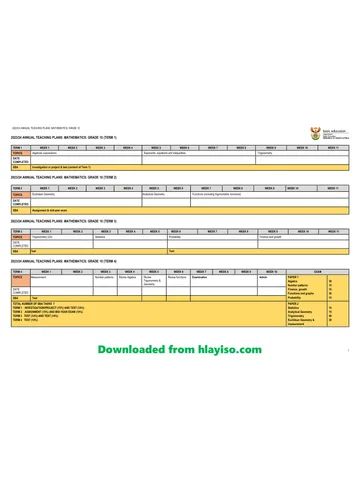
Gr 10 Maths ATP 2023 24
Question paper and memo
Mathematics Grade 10 Paper 1 KZN June 2025 Paper & Memo
Question paper and memo
Mathematics Grade 10 KZN March Test 2025 Paper & Memo
Question paper and memo
Mathematics Grade 10 Paper 1 KZN November 2025 Paper & Memo
Question paper and memo