
Copyright reserved
Please turn over
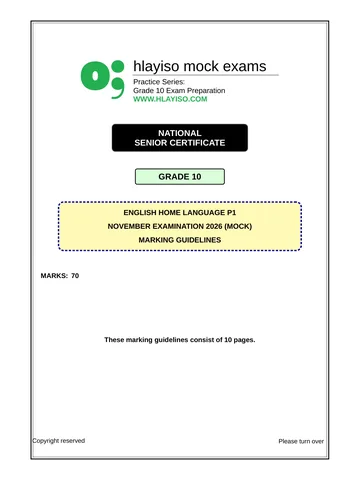
Mock
hlayiso mock exams
Practice Series:
Grade 10 Exam Preparation
WWW.HLAYISO.COM
NATIONAL
SENIOR CERTIFICATE
GRADE 10
ENGLISH HOME LANGUAGE P1
NOVEMBER EXAMINATION 2026 (MOCK)
MARKS: 70
TIME: 2 hours
This question paper consists of 12 pages.
Skip to contentQuestion paper 
View all
English HL Grade 10 P1 November Mock 2026 Question Paper (Eng)
Grade 10 English HL Paper 1 question paper from the November Mock Exam 2026 (English), 12 pages. Read online or get the free PDF download, memo linked when available.
Publisher: Hlayiso
English HL · Grade 10 · November Mock Exam · 2026. Question paper, 12 pages. Read online or download the PDF.
- Subject
- English HL
- Grade
- Grade 10
- Language
- English
- Document type
- Question paper
- Year
- 2026
- Exam period
- November Mock Exam
- Paper
- 1
- Publisher
- Hlayiso
- Curriculum
- CAPS
- Pages
- 12
- File size
- 457.7 KB
Loading document…
Loading document…
1 of 12
Document textSearch extracted text and jump to a page.
English Home Language/P1
2
NSC Mock
Hlayiso/Mock 2026
INSTRUCTIONS AND INFORMATION
1.
This question paper consists of THREE sections:
SECTION A: Comprehension
(30)
SECTION B: Summary
(10)
SECTION C: Language in context
(30)
2.
Read ALL the instructions carefully.
3.
Answer ALL the questions.
4.
Start EACH section on a NEW page.
5.
Rule off after each section.
6.
Number the answers correctly according to the numbering system used in this question
paper.
7.
Leave a line after each answer.
8.
Pay special attention to spelling and sentence construction.
9.
Suggested time allocation:
SECTION A:
50 minutes
SECTION B:
30 minutes
SECTION C:
40 minutes
10.
Write neatly and legibly.
Copyright reserved
Please turn over
English Home Language/P1
3
NSC Mock
Hlayiso/Mock 2026
SECTION A: COMPREHENSION
QUESTION 1: READING FOR MEANING AND UNDERSTANDING
Read TEXT A and TEXT B below and answer the questions set. Answer in your own words
as far as possible.
TEXT A
ROOTS ON THE ROOFTOP
1
Six storeys above the hooting taxis of the Johannesburg city centre, Lindiwe
Khoza*, seventeen, kneels between rows of spinach and pulls a weed from the
soil. Below her, the city roars. Up here, the loudest sound is the buzzing of bees.
'People don't believe me when I tell them I'm a farmer,' she laughs, brushing the
dirt from her school shoes. 'They think farms are only found in the countryside.'
5
2
Three years ago, the roof of the old office block where Lindiwe lives was a
wasteland of broken bottles, rusted pipes and pigeon droppings. Today it is home
to more than forty vegetable beds made from old bathtubs, car tyres and plastic
crates. The garden was started by a group of teenagers who were tired of, in
Lindiwe's words, 'just hanging around and waiting for life to happen'. With R2 000 10
raised at a car wash and seedlings donated by a local nursery, they began to dig.
3
The early days were not easy. The first crop of tomatoes was scorched by the sun;
the second was eaten by pigeons. 'We nearly gave up,' admits Sipho Ndlovu*,
sixteen, one of the founders. 'Then an old man from the third floor, who grew up
on a farm in KwaZulu-Natal, came upstairs and laughed at us. He said we were 15
planting like city people.' Under the guidance of the man they now call Mkhulu1,
the teenagers learnt to build shade nets from old curtains, to make compost from
kitchen scraps and to plant marigolds among the vegetables to keep insects away.
4
Today the harvest is impressive. Every week the rooftop produces spinach,
onions, beetroot, herbs and chillies. Some of it is shared with elderly residents in 20
the building; the rest is sold at a small stall at the entrance, and the profits pay
for seeds and tools. Last year the group earned enough to buy two second-hand
water tanks, which collect rainwater from the gutters.
Copyright reserved
Please turn over
English Home Language/P1
4
NSC Mock
Hlayiso/Mock 2026
5
Food is only part of the story. Small urban gardens like this one are appearing
on rooftops, in schoolyards and on empty plots in towns and cities. Supporters 25
point out that they bring a range of benefits: plants help to keep buildings cooler
in summer, soil absorbs rainwater that would otherwise rush into the streets,
and vegetables grown nearby are fresher and often cheaper than food that has
travelled hundreds of kilometres to reach the shops.
6
For the young gardeners, however, the greatest harvest cannot be weighed. 30
Sipho, who used to bunk school, now arrives early so that he can water the
seedlings before lessons begin. 'You can't lie to a plant,' he says. 'If you don't
look after it, it dies. It taught me that nothing grows without patience.' Lindiwe has
discovered a passion for science and hopes to study agriculture at university.
7
Not everyone was convinced at first. The caretaker of the building worried that the 35
soil would damage the roof, and some neighbours complained about the smell of
the compost. The teenagers responded by inviting them up for a tour – and a plate
of freshly cooked morogo2. Most of the critics went home with a bunch of spinach
and a changed opinion.
8
As the sun sets behind the Hillbrow Tower, Lindiwe packs away her tools. Far 40
below, the streets are filled with traffic and noise. Up here, a small green island is
growing quietly. 'Everyone says that young people are the future,' she says. 'But
we are not waiting for the future. We are planting it now.'
*not their real names
[Examiner's own text]
GLOSSARY:
1Mkhulu:
(isiZulu) grandfather; a respectful name for an old man
2morogo:
a traditional dish of cooked wild spinach or other leafy greens
AND
Copyright reserved
Please turn over
English Home Language/P1
5
NSC Mock
Hlayiso/Mock 2026
TEXT B
DON'T JUST EAT. GROW.
No garden? No problem.
All you need is a container, some soil, a few seeds and sunshine.
Join our FREE Saturday workshops for teens and learn how to:
• turn kitchen scraps into compost
• grow vegetables in old buckets, tyres and bottles
• save water with a simple drip system
Every Saturday in February • 09:00 – 12:00 • Community Hall
Small seeds. Big change.
JOZI GREEN ROOTS
[Examiner's own poster. Jozi Green Roots is a fictitious organisation.]
NOTE: The poster shows a large bucket standing on a rooftop. A healthy young seedling
grows out of the soil in the bucket. Smaller containers with plants stand beside it. Tall city
buildings fill the background.
The text in the poster reads as follows:
DON'T JUST EAT. GROW.
No garden? No problem.
All you need is a container, some soil, a few seeds and sunshine.
Join our FREE Saturday workshops for teens and learn how to:
turn kitchen scraps into compost; grow vegetables in old buckets, tyres and bottles; save
water with a simple drip system.
Every Saturday in February • 09:00 – 12:00 • Community Hall
Small seeds. Big change.
JOZI GREEN ROOTS
Copyright reserved
Please turn over
English Home Language/P1
6
NSC Mock
Hlayiso/Mock 2026
QUESTIONS: TEXT A
1.1
Refer to lines 4–5.
Why do people find it hard to believe that Lindiwe is a farmer?
(1)
1.2
Refer to line 6: 'a wasteland of broken bottles, rusted pipes and pigeon
droppings'.
What does the word 'wasteland' suggest about the roof before the garden was
started?
(1)
1.3
Refer to lines 6–9.
What does the choice of materials for the vegetable beds reveal about the
teenagers? Give a reason for your answer.
(2)
1.4
Refer to lines 14–16.
Explain what Mkhulu meant when he said that the teenagers were 'planting
like city people'.
(2)
1.5
Refer to paragraph 4 (lines 19–23).
Choose the correct answer from the options below.
As it is used in the passage, the word 'profits' refers to …
A
the vegetables that are given away.
B
the money that is left after costs have been paid.
C
the rainwater that is collected in the tanks.
D
the seeds that are donated by the nursery.
(1)
1.6
Refer to lines 24–29.
In your own words, state TWO benefits that urban gardens bring to a city.
(2)
1.7
Refer to line 30: 'For the young … cannot be weighed.'
Explain what the writer means by this statement.
(2)
1.8
Refer to lines 32–33: 'You can't lie … without patience.'
Discuss what Sipho has learnt from gardening and how this lesson could help
him in other areas of his life.
(3)
1.9
Refer to paragraph 7 (lines 35–39).
Do you think that the teenagers dealt wisely with their critics? Justify your
response.
(3)
1.10
Refer to line 41: 'Up here, a small green island is growing quietly.'
1.10.1
Identify the figure of speech used in this line.
(1)
1.10.2
Explain why this figure of speech is effective.
(2)
1.11
Refer to lines 42–43: 'But we are … it now.'
Comment on the effectiveness of these words as the conclusion to the article.
(2)
Copyright reserved
Please turn over
English Home Language/P1
7
NSC Mock
Hlayiso/Mock 2026
QUESTIONS: TEXT B
1.12
Refer to the headline: 'DON'T JUST EAT. GROW.'
Explain why this headline is effective.
(2)
1.13
Discuss how the picture of the seedling against the background of tall
buildings supports the slogan, 'Small seeds. Big change.'
(2)
QUESTION: TEXTS A AND B
1.14
Discuss how TEXT B supports the message of TEXT A. In your answer, refer
to BOTH texts and state which text you find more inspiring.
(4)
TOTAL SECTION A:
30
Copyright reserved
Please turn over
English Home Language/P1
8
NSC Mock
Hlayiso/Mock 2026
SECTION B: SUMMARY
QUESTION 2: SUMMARISING IN YOUR OWN WORDS
TEXT C gives advice to people who are planning to go hiking. Summarise, in your own words,
the steps that hikers should take to stay safe on a hiking trail.
NOTE:
1.
Your summary should include SEVEN points and NOT exceed 90 words.
2.
You must write a fluent paragraph.
3.
You are NOT required to include a title for the summary.
4.
Indicate your word count at the end of your summary.
TEXT C
BEFORE YOU HIT THE TRAIL
South Africa is a hiker's paradise. From the cliffs of the Drakensberg to the forests of the
Garden Route, there is a trail for every level of fitness. Every year, however, rescue teams
are called out to help hikers who are lost, injured or caught in bad weather. Most of these
emergencies could have been avoided with a little common sense.
Good hikes begin at home. Study a map of the route before you leave and make sure that
it suits the fitness of everyone in your group. Check the weather forecast, too: mountain
weather can change within minutes, and a sunny morning can turn into an afternoon of
mist and thunder.
Never set off without telling someone where you are going. Leave a copy of your route and
the time at which you expect to return with a friend or family member who is staying behind.
Better still, do not hike alone at all; in a group, there is always someone who can help or
fetch help.
What you carry matters. Pack more water than you think you will need, as well as snacks
that give you energy, such as nuts and dried fruit. Wear comfortable boots that support your
ankles, and take a warm, waterproof jacket, even in summer. A fully charged cellphone, a
torch and a small first-aid kit can make the difference between an uncomfortable night and
a disaster.
On the trail itself, stick to the marked paths. Short cuts may look tempting, but they are the
quickest way to get lost or to slip on loose rocks. Keep an eye on the time and the sky. If
the weather turns or you are running late, turn back. The mountain will still be there next
weekend.
Finally, remember that you are a visitor in the home of wild animals. Watch them from a
distance and never try to feed them.
A hike should leave you with tired legs and happy memories – not with a story about how
you were rescued.
[Examiner's own text]
TOTAL SECTION B:
10
Copyright reserved
Please turn over
English Home Language/P1
9
NSC Mock
Hlayiso/Mock 2026
SECTION C: LANGUAGE IN CONTEXT
QUESTION 3: ANALYSING ADVERTISING
Study the advertisement (TEXT D) below and answer the set questions.
TEXT D
ONE BOTTLE. ZERO REGRETS.
RiverStone
Every day, thousands of single-use plastic bottles wash up on our beaches.
The RiverStone steel bottle keeps water ice-cold for 24 hours
and tea hot for 12. One bottle, a lifetime* of refills.
Refill it. Reuse it. Love it for life.
RiverStone
Drink responsibly. Live lightly.
*Lifetime guarantee covers manufacturing defects only.
Terms and conditions apply.
[Examiner's own advertisement. RiverStone is a fictitious brand.]
NOTE: The advertisement shows a beach littered with empty plastic bottles. In the centre, a
large, shiny steel water bottle stands upright in the sand.
The text in the advertisement reads as follows:
ONE BOTTLE. ZERO REGRETS.
Every day, thousands of single-use plastic bottles wash up on our beaches. The
RiverStone steel bottle keeps water ice-cold for 24 hours and tea hot for 12. One bottle, a
lifetime* of refills.
Refill it. Reuse it. Love it for life.
RiverStone
Drink responsibly. Live lightly.
*Lifetime guarantee covers manufacturing defects only. Terms and conditions apply.
Copyright reserved
Please turn over
English Home Language/P1
10
NSC Mock
Hlayiso/Mock 2026
QUESTIONS: TEXT D
3.1
Identify the target audience of this advertisement. Give a reason for your
answer.
(2)
3.2
Refer to the headline: 'ONE BOTTLE. ZERO REGRETS.'
Explain how the headline tries to persuade readers to buy the product.
(2)
3.3
Discuss how the contrast between the plastic bottles and the steel bottle in
the picture supports the written message of the advertisement.
(3)
3.4
'Refill it. Reuse it. Love it for life.'
Identify the stylistic device used in the above line.
(1)
3.5
Refer to the slogan: 'Drink responsibly. Live lightly.'
Explain the play on words in the slogan.
(2)
[10]
QUESTION 4: UNDERSTANDING OTHER ASPECTS OF THE MEDIA
Study the cartoon (TEXT E) below and answer the set questions.
TEXT E: CARTOON
1
2
3
4
Don't worry, Gogo.
I'll teach you.
It's SO easy!
? ? ?
Which one is the 'send' button?
The little aeroplane?
05:02 Tuesday
GOGO (47 new
messages)
Gogo: [picture of
flowers]
Gogo: [picture of
flowers]
Gogo: GOOD
MORNING!!!
Two weeks
later …
Lerato! Why didn't you reply to my good-
morning flowers? I sent you FORTY-SEVEN!
[Examiner's own cartoon]
CHARACTERS:
Lerato (a teenager) and her grandmother (Gogo)
Copyright reserved
Please turn over
English Home Language/P1
11
NSC Mock
Hlayiso/Mock 2026
DESCRIPTION OF THE FRAMES:
FRAME 1:
Lerato, smiling confidently, holds up a cellphone and offers to teach Gogo how
to use it. Gogo smiles politely.
FRAME 2:
Gogo holds the phone and frowns. Three question marks float above her head.
Lerato points at the screen; drops of sweat fly from her head.
FRAME 3:
A close-up of Lerato's cellphone screen at 05:02 on a Tuesday morning, two
weeks later.
FRAME 4:
Gogo, beaming, holds up her phone. Lerato stands next to her, slumped, with
half-closed eyes and dark rings under them.
QUESTIONS: TEXT E
4.1
Refer to FRAME 1.
What do Lerato's words and facial expression reveal about her attitude
towards teaching Gogo?
(2)
4.2
Refer to FRAME 2.
Discuss how the cartoonist shows that Gogo finds the phone difficult to use.
(2)
4.3
Refer to FRAME 3.
Explain the significance of the time shown on the screen.
(1)
4.4
Refer to FRAMES 1 and 4.
Explain the irony in the cartoon.
(2)
4.5
Do you think that the cartoon gives a fair picture of the relationship between
older people and technology? Discuss your view.
(3)
[10]
Copyright reserved
Please turn over
English Home Language/P1
12
NSC Mock
Hlayiso/Mock 2026
QUESTION 5: USING LANGUAGE CORRECTLY
Read TEXT F, which contains some deliberate errors, and answer the set questions.
TEXT F
THE BICYCLE DOCTOR OF MAMELODI
1
Every afternoon, a queue of children forms outside a small tin garage in Mamelodi.
Some are pushing bicycles with flat tyres; others carries broken chains in their
hands.
2
The man they have come to see is Mr Peter Mahlangu*, a retired mechanic who
repairs bicycles for free. 'A bicycle is not a toy. It is a child's ticket to school,'
5
he explained when I visited him. He beleives that no child should miss lessons
because of a long walk.
3
Each bicycle that arrives has it's own story. Mr Mahlangu teaches the children to
fix their own bicycles, so that they can help their friends. Last year he repaired
more then three hundred bicycles.
10
4
Mr Mahlangu always goes the extra mile. When a girl arrived with a bicycle that
was too badly damaged to repair, he gave her one of his own. 'Her smile was my
payment,' he said proudly.
*not his real name
[Examiner's own text]
QUESTIONS: TEXT F
5.1
Correct the error of concord in paragraph 1.
(1)
5.2
Identify and correct the spelling error in paragraph 2.
(1)
5.3
'A bicycle is not a toy. It is a child's ticket to school,' he explained. (Line 5)
Rewrite the above sentence in reported speech.
Begin with: He explained that …
(2)
5.4
Correct the error in the use of the apostrophe in paragraph 3.
(1)
5.5
'Mr Mahlangu teaches the children to fix their own bicycles' (paragraph 3).
Rewrite the above clause in the passive voice. Begin with: The children …
(1)
5.6
Identify and correct the error in the use of a commonly confused word in
paragraph 3.
(1)
5.7
Explain the meaning of the idiom 'goes the extra mile' in paragraph 4.
(1)
5.8
Identify the part of speech of 'proudly' (paragraph 4).
(1)
5.9
Explain why the writer calls Mr Mahlangu a 'doctor' in the title.
(1)
[10]
TOTAL SECTION C:
30
GRAND TOTAL:
70
Copyright reserved
Matching paper and memo
The question paper, memo or addendum that belongs with this document.
Study this subject
Revise the topics in this paper, then practise them question by question.
Recommended for this subject
More papers and memos for this grade and subject.
Question paper
English HL Grade 10 P2 November Mock 2026 Question Paper (Eng)
Question paper
English HL Grade 10 P3 November Mock 2026 Question Paper (Eng)
Question paper
English HL Grade 10 P1 November Mock Exam 2 2026 QP (Eng)
Question paper
English HL Grade 10 P2 November Mock Exam 2 2026 QP (Eng)
Question paper
English HL Grade 10 P3 November Mock Exam 2 2026 QP (Eng)
Question paper
English Hl Grade 10 P1 North West June 2019 Question Paper (Eng)
Related documents
Memorandum
English HL Grade 10 Paper 2 November Mock 2026 Memo (English)
Memorandum
English HL Grade 10 Paper 3 November Mock 2026 Memo (English)
Memorandum
English HL Grade 10 P1 November Mock Exam 2 2026 Memo (English)
Question paper
English Hl Grade 10 P1 North West June 2018 Question Paper (Eng)
Memorandum
English HL Grade 10 P2 November Mock Exam 2 2026 Memo (English)
Memorandum
English HL Grade 10 P3 November Mock Exam 2 2026 Memo (English)
More from Grade 10 English HL
Annual teaching plan
Gr 10 English HL ATP 2023 24
Question paper and memo
English Hl Grade 10 March Test 2022 Paper & Memo
Memorandum
English Hl Grade 10 Paper 1 North West June 2019 Memo (English)
Question paper
English Hl Grade 10 March Test 2018 Question Paper
Memorandum
English Hl Grade 10 Paper 1 North West June 2018 Memo (English)
Question paper