
Mock
hlayiso mock exams
Practice Series:
Grade 11 Exam Preparation
WWW.HLAYISO.COM
NATIONAL
SENIOR CERTIFICATE
GRADE 11
TECHNICAL SCIENCES P1
NOVEMBER EXAMINATION 2026 (MOCK)
MARKING GUIDELINES
MARKS: 150
These marking guidelines consist of 11 pages.
Copyright reserved Please turn over
Skip to contentAll 2026 papers 

Technical Sciences Grade 11 P1 2026 Memo (Eng)
Grade 11 Technical Sciences Paper 1 memorandum from the November Mock Exam 2 2026 (English), 11 pages. Read online or download the free PDF.
Technical Sciences · Grade 11 · November Mock Exam 2 · 2026 · English. Memorandum, 11 pages. Read online or download the PDF.
- Subject
- Technical Sciences
- Grade
- Grade 11
- Language
- English
- Document type
- Memorandum
- Year
- 2026
- Exam period
- November Mock Exam 2
- Paper
- 1
- Publisher
- Hlayiso
- Curriculum
- CAPS
- Pages
- 11
- File size
- 158.0 KB
Free to read online, no sign-up needed
Loading document…
Loading document…
1 of 11
This exam
November Mock Exam 2 2026
- Paper 1Question paperMemo
- Paper 2Question paperMemo
Document textSearch extracted text and jump to a page.
Technical Sciences/P1 2 Hlayiso/Mock 2026
NSC – Marking Guidelines
GENERAL MARKING GUIDELINES
1. Calculations: Marks are awarded for the correct formula, correct substitution and the
correct final answer WITH the correct unit, as indicated by the ticks (✓). No mark is
awarded for a formula that is not followed by a substitution. If an incorrect formula is
used, no further marks are awarded for that calculation.
2. Units: The final-answer mark is only awarded if the correct unit is given. Penalise an
omitted or incorrect unit only ONCE per question.
3. Rounding: Accept final answers rounded to a minimum of TWO decimal places. Small
differences caused by rounding of intermediate values are accepted.
4. Positive marking: Where an incorrect answer from a previous question is used correctly
in a later calculation, full marks are awarded for the later calculation.
5. Negative marking: If a candidate must explain or motivate a choice (e.g. INCREASES
or DECREASES) and the choice is incorrect, no marks are awarded for the explanation.
6. Definitions/laws: Where key words are underlined, deduct 1 mark for EACH key word
or phrase that is omitted. Accept equivalent wording that conveys the same meaning.
7. Free-body diagrams: ONE mark for each force represented by an arrow with a correct
label. Penalise ONCE for: no arrows, gaps between the arrows and the dot, dotted lines,
or additional (non-applicable) forces.
8. Scale drawings: Accept answers within the stated range. No marks for the answer if
no scale drawing is shown.
9. Sign convention: Candidates may choose either direction as positive, provided it is
applied consistently.
Copyright reserved Please turn over
Technical Sciences/P1 3 Hlayiso/Mock 2026
NSC – Marking Guidelines
QUESTION 1
1.1 B ✓✓ (2)
1.2 C ✓✓ (2)
1.3 D ✓✓ (2)
1.4 A ✓✓ (2)
1.5 C ✓✓ (2)
1.6 B ✓✓ (2)
1.7 D ✓✓ (2)
1.8 A ✓✓ (2)
1.9 A ✓✓ (2)
1.10 C ✓✓ (2)
[20]
Copyright reserved Please turn over
Technical Sciences/P1 4 Hlayiso/Mock 2026
NSC – Marking Guidelines
QUESTION 2
2.1 A single force that, acting together with the other forces, produces equilibrium
/ is equal in magnitude but opposite in direction to the resultant. ✓✓ (2)
2.2.1 The angle between the (two) forces ✓ (1)
2.2.2 The magnitude of the resultant (force) ✓
Accept: reading on the third spring balance / equilibrant. (1)
2.3 R2 = F21 + F22 ✓
R2 = (40)2 + (25)2 ✓
X = R = 47,17 N ✓ (3)
2.4
R
25 N (50 mm)
120◦
40 N (80 mm)
Criteria:
Both forces drawn to the correct scale (80 mm and 50 mm) ✓
Correct angle between the directions of the forces (120◦ , i.e. 60◦ inside the
triangle) ✓
Resultant drawn from the tail of the first to the head of the last vector, with
arrow ✓
Y = 35 N (range 34 N – 36 N) ✓ (4)
2.5 As the angle between the forces INCREASES, the magnitude of the resultant
DECREASES. ✓✓
Accept the inverse statement. Accept: The resultant is a maximum at 0◦ and a
minimum at 180◦ (1 mark only). (2)
2.6 65 N ✓ (1)
[14]
Copyright reserved Please turn over
Technical Sciences/P1 5 Hlayiso/Mock 2026
NSC – Marking Guidelines
QUESTION 3
3.1 VECTOR ✓ (1)
3.2 (–5 ; 7) ✓✓ (1 mark for each correct coordinate)
Accept (–100 ; 140) (in metres). (2)
3.3 East–west component: 100 m (west) ✓
North–south component: 140 m (north) ✓
If grid units (5 and 7) are given without converting to metres: 1/2. (2)
3.4 POSITIVE MARKING FROM QUESTION 3.3
∆x2 = (100)2 + (140)2 ✓
∆x = 172,05 m ✓ (2)
100
3.5 tan θ = ✓
140
θ = 35,54◦ (west of north) ✓
Bearing = 360◦ – 35,54◦ = 324,46◦ ✓
OR: tan α = 140 ◦ ◦ ◦ ◦
100 ✓; α = 54,46 (north of west) ✓; bearing = 270 + 54,46 = 324,46 ✓.
100 or cos θ = 140 .
Accept sin θ = 172,05 172,05 (3)
[10]
Copyright reserved Please turn over
Technical Sciences/P1 6 Hlayiso/Mock 2026
NSC – Marking Guidelines
QUESTION 4
4.1 Static frictional force: The frictional force that acts on an object when it
is stationary (not moving) relative to the surface / opposes the tendency of
motion. ✓✓
Kinetic frictional force: The frictional force that acts on an object while it is
moving (sliding) over the surface. ✓✓ (4)
4.2.1 100 N ✓ to the left (opposite to the push) ✓ (2)
4.2.2 N = Fg = mg = (45)(9,8) = 441 N ✓
fmax
s = µs N ✓
max
fs = (0,40)(441) ✓
fmax
s = 176,40 N ✓
Minimum force needed = 176,40 N (horizontally, to the right)
Accept: (slightly) more than / greater than 176,40 N. (4)
4.3.1
N / FN / normal force ✓
F / FA / 180 N / tension ✓
fk / friction ✓
Fg / w / weight ✓
Do not penalise for relative lengths of arrows. Accept the components of F instead of
F only if F itself is not also drawn as an extra force. (4)
4.3.2 Fy = F sin θ = 180 sin 25◦ ✓
Fy = 76,07 N ✓
N + Fy = Fg OR N = Fg – Fy ✓
N = 441 – 76,07 ✓
N = 364,93 N (4)
4.3.3 fk = µk N ✓
fk = (0,28)(364,93) ✓
fk = 102,18 N ✓ (3)
4.4 DECREASES ✓
(A larger vertical component of F reduces the normal force.) (1)
[22]
Copyright reserved Please turn over
Technical Sciences/P1 7 Hlayiso/Mock 2026
NSC – Marking Guidelines
QUESTION 5
5.1 The distance between two successive (consecutive) points in phase (e.g. two
successive crests or troughs). ✓✓ (2)
5.2.1 Crest ✓ (1)
5.2.2 Trough ✓ (1)
5.3 Any ONE pair: P and S / P and U / S and U / Q and T ✓ (1)
1,6
5.4 A= ✓
2
A = 0,8 m ✓
If 1,6 m is given: 0/2. (2)
27
5.5 λ= ✓
3
λ =9m✓ (2)
50
5.6 T= =5s✓
10
1 1
f= = ✓
T 5
f = 0,2 Hz ✓
OR: f = numbertime
of waves = 10 ✓✓ = 0,2 Hz ✓
50 (3)
5.7 POSITIVE MARKING FROM QUESTIONS 5.5 AND 5.6
v = fλ ✓
v = (0,2)(9) ✓
v = 1,8 m·s–1 ✓ (3)
5.8 POSITIVE MARKING FROM QUESTION 5.7
∆x
v= ✓
∆t
150
1,8 = ✓
∆t
∆t = 83,33 s ✓ (3)
[18]
Copyright reserved Please turn over
Technical Sciences/P1 8 Hlayiso/Mock 2026
NSC – Marking Guidelines
QUESTION 6
6.1 The highness or lowness of a sound, which is determined by its frequency.
✓✓
Accept: The effect produced in the ear by a sound of a particular frequency. (2)
6.2.1 Q✓
Q shows MORE complete waves in the same time interval ✓ / shorter period,
so it has a HIGHER frequency (and pitch increases with frequency). ✓ (3)
6.2.2 P✓
P has the LARGER amplitude (loudness increases with amplitude). ✓ (2)
6.3.1 NO ✓
40 kHz is ABOVE the upper limit of the human hearing range (20 kHz) / it is
ultrasound. ✓ (2)
4,0 × 10⁻³
6.3.2 Time for the pulse to reach the wall: ∆t = = 2,0 × 10⁻³ s ✓
2
∆x
v= ✓
∆t
∆x
340 = ✓
2,0 × 10⁻³
∆x = 0,68 m ✓
OR: 2∆x = v∆t = (340)(4,0 × 10⁻³ ) = 1,36 m ✓✓✓; distance = 0,68 m ✓. If 1,36 m is
given as the distance: max 2/4. (4)
6.3.3 v = fλ ✓
340 = (40 × 103 )λ ✓
λ = 8,5 × 10⁻³ m (0,0085 m) ✓
If 40 is used instead of 40 000 Hz: max 2/3. (3)
6.4 Any ONE: Scanning a foetus (pre-natal scans) / imaging internal organs
/ breaking up kidney stones / physiotherapy (treating injured muscles) /
measuring blood flow ✓ (1)
[17]
Copyright reserved Please turn over
Technical Sciences/P1 9 Hlayiso/Mock 2026
NSC – Marking Guidelines
QUESTION 7
7.1 The region (in space) around a magnet in which another magnet or a
ferromagnetic material will experience a (magnetic) force. ✓✓ (2)
7.2.1 P: NORTH ✓ Q: SOUTH ✓
(Field lines point away from a north pole and towards a south pole.) (2)
7.2.2 ATTRACT ✓ (1)
7.2.3 X✓
The field lines are CLOSER TOGETHER (denser) at X. ✓ (2)
7.3 Charged particles (solar wind) from the Sun ✓ are deflected by the Earth’s
magnetic field and guided towards the (magnetic) poles. ✓
There they collide with gas atoms/molecules in the upper atmosphere, which
give off (emit) light. ✓ (3)
7.4 Any TWO: Electric motors / generators (dynamos) / loudspeakers and
microphones / MRI scanners / maglev trains / compasses / magnetic door
catches / hard drives and bank cards / electromagnets on scrap-yard cranes /
relays ✓✓ (2)
[12]
Copyright reserved Please turn over
Technical Sciences/P1 10 Hlayiso/Mock 2026
NSC – Marking Guidelines
QUESTION 8
8.1 The magnitude of the electrostatic force exerted by one point charge on
another is directly proportional to the product of their charges and inversely
proportional to the square of the distance between them. ✓✓ (2)
8.2
X Y
+ –
Criteria: Correct shape (lines from X curve towards Y) ✓; Direction of arrows
from X (positive) to Y (negative) ✓; Field lines start/end at the surfaces of the
spheres and do not cross ✓.
The outer lines may be omitted. (3)
kQ1 Q2
8.3 F= ✓
r2
(9 × 10⁹ )(4 × 10⁻⁹ )(6 × 10⁻⁹ )
6 × 10–5 = ✓✓
r2
r = 0,06 m ✓
1 mark for substitution of the charges and k; 1 mark for the force. Ignore the negative
sign if it is used. (4)
8.4 The (electrostatic) force experienced per unit positive charge placed at that
point. ✓✓ (2)
V
8.5.1 E= ✓
d
3 000
E= ✓
20 × 10–3
E = 1,5 × 10⁵ N·C–1 (V·m–1 ) ✓
If 20 m is used (no conversion): max 2/3. (3)
8.5.2 A✓ (the positive plate) (1)
[15]
Copyright reserved Please turn over
Technical Sciences/P1 11 Hlayiso/Mock 2026
NSC – Marking Guidelines
QUESTION 9
9.1 The potential difference across a conductor is directly proportional to the
current in the conductor at constant temperature. ✓✓ (2)
9.2 The maximum energy (work done) provided by a battery per coulomb (unit
charge) passing through it. ✓✓
Accept: The potential difference across the terminals of a battery when no current
flows (open circuit). (2)
V
9.3.1 R= ✓
I
24
RT = ✓
3
RT = 8 Ω ✓ (3)
V
9.3.2 R= ✓
I
V
4= 1 ✓
3
V1 = 12 V ✓ (3)
9.3.3 POSITIVE MARKING FROM QUESTION 9.3.1
Rp = RT – R1 = 8 – 4 = 4 Ω ✓
1 1 1
= + ✓
Rp R2 Rx
1 1 1
= + ✓
4 12 Rx
Rx = 6 Ω ✓
12 = 1 A ✓; I = 3 – 1 = 2 A ✓; R = 12 = 6 Ω ✓
OR: Vp = 24 – 12 = 12 V ✓; I2 = 12 x x 2 (4)
9.3.4 POSITIVE MARKING FROM QUESTION 9.3.2
V2 = ε – V1 = 24 – 12 ✓
V2 = 12 V ✓
OR: V2 = IRp = (3)(4) ✓ = 12 V ✓ (2)
9.4 DECREASES ✓ (1)
9.5 The total (equivalent) resistance of the circuit INCREASES (only Rx is left in
the parallel section). ✓
The emf stays the same, so the current decreases (I = RV ). ✓
(2)
9.6 POSITIVE MARKING FROM QUESTION 9.3.3
RT = R1 + Rx = 4 + 6 = 10 Ω ✓
V 24
I= = ✓
R 10
I = 2,4 A ✓ (3)
[22]
TOTAL: 150
Copyright reserved
Study this subject
Recommended for this subject
Question paper
Technical Sciences Grade 11 P2 November Mock Exam 2 2026 QP
Question paper
Technical Sciences Grade 11 P1 Eastern Cape November 2023 QP
Question paper
Technical Sciences Grade 11 P2 Eastern Cape November 2023 QP
Practical assessment task
Technical Sciences PAT GR 11 2017 Eng
Annual teaching plan
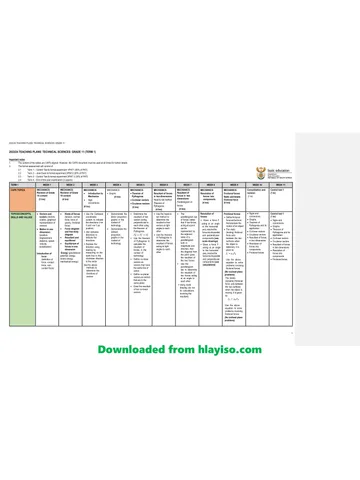
Gr 11 Tech Sci ATP 2023 24
Textbook