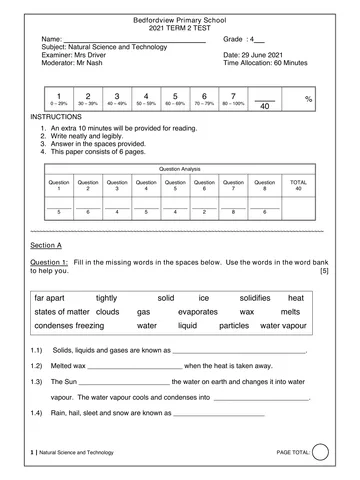
Bedfordview Primary School
Natural Science and Technology - MEMO
Grade 4 (Group 2) Term 3 Formal Assessment task
Examiner: Mrs P. Driver Moderator: Mr J. Nash
Time: 40 minutes Total: 40 marks
Name: ______________________________________Class: ____________
Teacher comment: _____________________________________________
Parent signature and comment____________________________________
1 2 3 4 5 6 7
(0-29%) (30-39%) (40-49%) (50-59%) (60-69%) (70-79%) (80-100%) _____
40
Mark Analysis
Section A Section B Section C
Lower order questions 50% Middle order questions 35% Higher order questions 15%
Q1 Q2 Q3 Q4 Q5 Q6 Q7 Q8
5 5 5 5 5 4 5 6
INSTRUCTIONS:
1. Read your questions carefully.
2. Answer all the questions.
3. Write neatly and legibly.
4. Good luck.
5. Check your work, read each question and answer again
Section A [20]
Question 1: Label the water cycle next to the numbers below :
2 1) __evaporation___√__________
3 2) __condensation__√_________
1 3) ___precipitation___√________
4) ___run off___√_____________
5) ___collection_√____________
5 4
(5)
1
You're offline
Skip to contentMemorandum View all
2020 Term 3 (grp2) FAT memo
Natural Sciences Tec · Grade 4 · Term 3 Test · 2021. Memorandum, 6 pages. Read online or download the PDF.
- Subject
- Natural Sciences Tec
- Grade
- Grade 4
- Document type
- Memorandum
- Year
- 2021
- Exam period
- Term 3 Test
- Pages
- 6
- File size
- 264.5 KB
Loading document…
Loading document…
1 of 6
Document textSearch extracted text and jump to a page.
Question 2: Fill in the missing words from the word bank to complete the
sentences.
solid gas invisible water vapour condensation melts
water solidification cools liquid evaporation
When water vapour is cooled it condenses and changes into __water √________. By
putting ice-cream in the sun it melts it turns into a __liquid √____________ .
__Evaporation √________ is when water is heated and water changes into water vapour.
This water vapour like all gases is ___invisible √______________________. When a
candle’s flame is blown out the liquid wax __solidifies √______ into a solid. (5)
Question 3: Fill in the missing raw or manufactured material.
Sand √ glass
wool jersey √
peanuts √ peanut butter
wood √ paper
clay mug, plate, pottery, ceramics, clay √
(5)
Question 4:
1) List 2 examples where struts are used to strengthen a structure.
_electricity pylon, skeleton, spider web , beams on a bridge, roof trusses any
acceptable answer. √√_______________________________________________
2) List the 3 shapes that struts / pillars can be.
_circular_√______ __square_√_________ __triangular__√____________ (5)
2
Section B [14]
Question 1: Properties of materials.
Use the list of properties in the block below to describe the items below. There is more
than one property to describe each item, but only write down one answer.
transparent strong flexible hard stiff
heavy soft light waterproof absorbent
1.1) Swimming towel: __absorbent; flexible; light; strong √_______
1.2) Elastic band: _flexible; strong; light √____________________
1.3) Water bottle: __waterproof; light; stiff; strong_√____________
1.4) Soccer ball:__strong: light; waterproof; stiff__√____________
1.5) Wood cupboard: __strong; hard; heavy; stiff; waterproof √___ (5)
Question 2: True or False
Write next to the sentences if they are true or false. If they are false write the correct
sentence.
2.1) Paper is can be strengthened by rolling or folding it.___True__√___________
___________________________________________________________________
___________________________________________________________________
2.2) The poles of an electricity pylon are an example of stuts. _True__√__________
___________________________________________________________________
___________________________________________________________________
2.3) A guy rope is a pillar/tube used to support structures. ___False, a guy rope is
a rope or cable pulled tight to support a structure OR a strut is a pillar/tube
used to support structures.___ √√_____________________________________
2.4) Struts are joined in a triangular shape to make the structure stronger.__True_√__
____________________________________________________________________
____________________________________________________________________
(5)
3
Question 3: Multiple choice
Circle the correct answer from the options below.
3.1) What is the definition of a raw material?
a) It had not yet been baked.
b) A pile of wood.
c) It is jersey made of wool.
d) Found in the environment, it is in its natural state.
3.2) What is the definition of a manufactured material?
a) It is a table and chairs
b) It is a raw material made into something useful.
c) It is a product found in nature.
d) It is used to make dresses.
3.3) What raw material is used to make the matjieshuis?
a) Sticks placed in an outline of a circle
b) Mud
c) The framework is covered by grass layers
d) Both a and b
3.4) What do the Xhosa people make their homes from?
a) Clay bricks and thatch roof
b) Metal struts
c) Tree branches covered with grass mats
d) Metal sheeting [4]
4
Section C: How glass is made: [6]
Please read the passage below carefully.
Sand is a raw material. Sand is used to make glass by mixing it with limestone and
soda ash. The sand mixture is heated to a very high temperature until it melts and
becomes a liquid. The sand becomes clear and changes into liquid glass. The
liquid glass is poured into different moulds to make different shapes and objects. As
the liquid glass cools it goes hard and solidifies. Glass is used to make products
such as window panes, bottles, drinking glasses and light bulbs. They are then
carefully packaged. The glass items are then transported to the shops to be sold.
Read the passage again. Use the information above to complete a flow diagram on
the process of how glass is made. Please watch the order of the flow diagram.
Please do your answers in pencil first, check your work, then write in pen.
1) A mixture of sand, 2) This mixture is heated to a
limestone and soda ash are high temperature till it melts to
used to make glass. √ a liquid. √
4) The liquid glass in the moulds 3) The liquid glass is poured
then hardens / solidifies. √ into mould to make different
shapes. √
5) Glass is used to make different 6) Glass items are transported to
products, they are then wrapped the shops to be sold. √
carefully. √
5
The Water Cycle
YKSSVFOSNCPR2GLET
Xx NAL_OKCLEORUEBQK C
yJsuwu J
IMENVPCEL
y uUsB
cOALON W
HUS DAH NLQ
FPGNODU
ROt.yY RK H PH C
QceEeceePMBREEPFOAOD
HX EC POFW BB
FRSEQY
OoOcT F YY EADATJSIAUN
LLr_ePWCBSTLQATTNS OZ
Ww Ac F
AQOnNTEV
VOOOosSWKEM OT R
oOU L_ MNS DRX E
DZaeTOAHEvVJSIODO
PTTFXKXWNPAS YN N AWMON O
UNBSJI SJ PJSI FS ZRMN T F
FEMCUEQOM™MMJS SF NJ ODS
ER2Z‘FT2ZHRXM PN F PH K X
K Jv
LPEuUHW2ZH t1tXxX* ARODK Y Y
Sun Water vapor
Ocean
Sleet
itation
Cloud
ipi
Prec
Condensation
Evaporation
Ice
in Runoff
Snow
Recommended for this subject
Published documents with matching subject and grade metadata.
Related documents
Matched using subject, grade, language, document type and exam metadata.
%20FAT--7aa9faa6-88ad-4398-b025-517f2fd7f2d4/v1-8525ee4cd34489ff1f1b/card.webp)
More from Grade 4 Natural Sciences Tec
Explore more published documents in this catalogue.