Downloaded from hlayiso.com
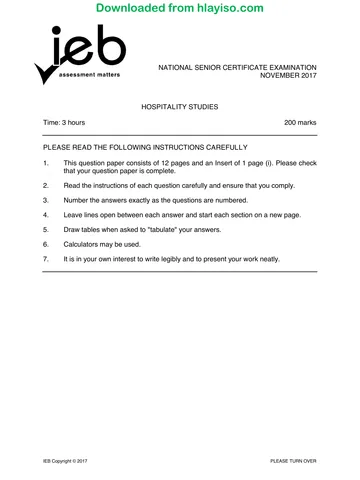
NATIONAL SENIOR CERTIFICATE EXAMINATION
NOVEMBER 2017
HOSPITALITY STUDIES
MARKING GUIDELINES
Time: 3 hours 200 marks
These marking guidelines are prepared for use by examiners and sub-examiners,
all of whom are required to attend a standardisation meeting to ensure that the
guidelines are consistently interpreted and applied in the marking of candidates'
scripts.
The IEB will not enter into any discussions or correspondence about any marking
guidelines. It is acknowledged that there may be different views about some
matters of emphasis or detail in the guidelines. It is also recognised that,
without the benefit of attendance at a standardisation meeting, there may be
different interpretations of the application of the marking guidelines.
IEB Copyright © 2017 PLEASE TURN OVER
Skip to contentMemorandum 
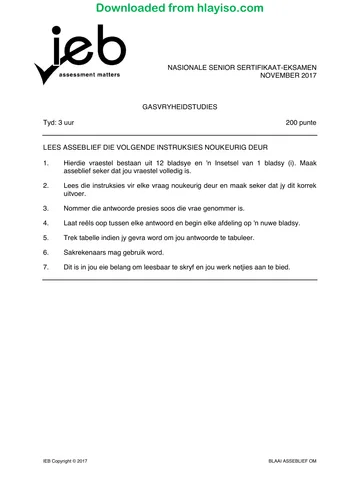
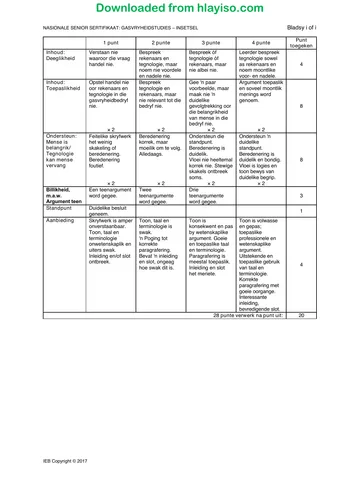
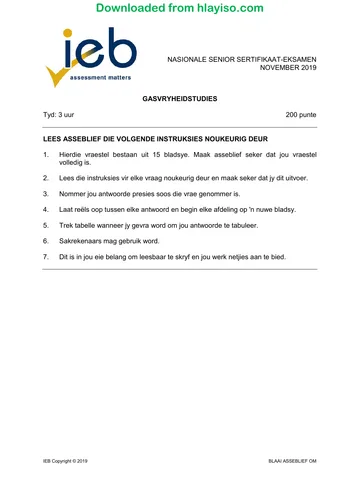
View all
Hospitality Studies Grade 12 IEB 2017 Memo
IEB Grade 12 Hospitality Studies memorandum from the 2017, 11 pages. Read online or get the free PDF download, question paper linked when available.
Publisher: IEB
Hospitality Studies · Grade 12 · 2017. Memorandum, 11 pages. Read online or download the PDF.
- Subject
- Hospitality Studies
- Grade
- Grade 12
- Document type
- Memorandum
- Year
- 2017
- Publisher
- IEB
- Curriculum
- IEB
- Pages
- 11
- File size
- 305.2 KB
Loading document…
Loading document…
1 of 11
Document textSearch extracted text and jump to a page.
Downloaded from hlayiso.com
NATIONAL SENIOR CERTIFICATE: HOSPITALITY STUDIES – MARKING GUIDELINES Page 2 of 11
SECTION A
QUESTION 1 MULTIPLE CHOICE
1.1 D Year
1.2 A Amenities
1.3 C Sustainable
1.4 B Eczema
1.5 A Gross
1.6 B Quotation
1.7 B Rumaki
1.8 A Sarcoplasm
1.9 C Collagen
1.10 C Soy
QUESTION 2 MATCH THE COLUMNS
Column A Column B Column C
Example of food Wine Type of glass
2.1 Trout in phyllo baskets E Chenin Blanc iii / iv
2.2 Chocolate mousse A Muscadel v
2.3 Oysters F Champagne i
2.4 Leg of lamb B Merlot iv / iii
2.5 Camembert and biscuits C Port ii
QUESTION 3
Choose the correct answer and write only the letters.
3.1 B It is cheaper than animal proteins.
C It is rich in complex carbohydrates.
E It has a very good shelf life.
G It has a low glycaemic index.
3.2 3.2.1 Agar-agar: Seaweed – others are animal based.
3.2.2 Deep-fat frying: Dry cooking method; the other two are combination
cooking methods; or Stir fry and Braising is a shallow frying method.
3.2.3 Slide shows: Audio visual marketing tool; others are electronic
marketing tools; other two is part of social media/internet.
IEB Copyright © 2017 PLEASE TURN OVER
Downloaded from hlayiso.com
NATIONAL SENIOR CERTIFICATE: HOSPITALITY STUDIES – MARKING GUIDELINES Page 3 of 11
SECTION B
QUESTION 4
4.1 4.1.1 • Must be in paragraph form.
• Explain that marketing manager organises all marketing activities
such as promotions or special events.
4.1.2 • Product – Explain what the cruise can offer a client.
• Promotion – Specials, like children under the age of 18 free.
• Price – Say for example why the price is high, what does it
include, Affordable.
• Place – Where does the cruise go to and what island can you
visit, etc.
• People – Mention who ... If it is for a matric vacation, matriculates
and their parents will be the target market.
• Presentation – The way the advertisement is presented to the
client.
4.2 • Contribute approximately 9.1% to the gross domestic product of the
economy of South Africa.
• Create jobs for local people.
• Supply products to the manufacturers.
• Skills development programmes increase their contribution to the
economy.
• Income-generated business contributes to development of the country's
infrastructure.
• Tourists bring valuable foreign currency into the country.
• Outsourcing will also contribute to the economy.
• Esteem and living standard of the community improves.
4.3 4.3.1 • Oversees all staff affairs such as employment, training, leave,
salaries and any problems experienced by staff.
• Draws up employment contracts, codes of conducts, procedures,
work schedules and rosters.
• Takes care of disciplinary actions and the evaluation of
performance in the workplace.
4.3.2 • Trains and/supervises new staff.
• Develop staff where needed.
4.4 Competitions, give-aways, lucky draws or any two possible ideas.
4.5 Revenue generated service.
IEB Copyright © 2017 PLEASE TURN OVER
Downloaded from hlayiso.com
NATIONAL SENIOR CERTIFICATE: HOSPITALITY STUDIES – MARKING GUIDELINES Page 4 of 11
QUESTION 5
5.1 5.1.1 Select the TWO dishes that need to change on the menu to
accommodate the guest:
Prawn tempura/Pumpkin fritters/Deep-fried potato/Spinach and
Cream/Chocolate mousse (Any two)
5.1.2 Give alternative dishes to replace them.
Prawn tempura → Prawn cocktail without the dough
Pumpkin fritters → Steamed pumpkin – no oil
Deep-fried potato → Mash potatoes – no oil
Spinach and Cream → Spinach without the cream
Chocolate mousse → Diabetes-friendly chocolate mousse
(Any two examples)
5.1.3 Explain why.
Avoid or restrict refined starch.
Limit sugar intake.
Decrease total fat, especially saturated fat and dietary cholesterol.
Avoid or restrict the intake of processed meats.
Control portion size.
(Any two examples)
5.2 • Each noun needs to start with a capital letter.
• Order of main course.
• Not dated.
• Nescafé coffee – not allowed to use brand names.
• Type of meal is not indicated.
• Amuse-bouche not needed on menu.
5.3 5.3.1 The inability of the body to fully digest or process certain foods. This
inability may be a result of the absence of enzymes of chemicals that
are necessary for digestion. It is genetic and is carried over to
children. The symptoms get worse with aging and appear later in life.
5.3.2 Spinach and cream or Chocolate mousse or
Cream, Pumpkin fitters with caramel sauce or Greek salad.
5.4 A small bite-sized hors d'œuvre(appetiser) that is served as a gift from
the chef; offered free of charge to all present at the table. Its purpose is to
stimulate the appetite and showcase the chef's skills.
5.5 • Prawn tempura – No shellfish
• Smoked pork fillet – No pork
• Spinach and cream – Dairy products not consumed with meat
• Chocolate mousse – Dairy products not consumed with meat
• Cream
• Caramel sauce
• Greek salad - Cheese
5.6 A menu where you can choose what you want to eat from a selection of
food.
IEB Copyright © 2017 PLEASE TURN OVER
Downloaded from hlayiso.com
NATIONAL SENIOR CERTIFICATE: HOSPITALITY STUDIES – MARKING GUIDELINES Page 5 of 11
QUESTION 6
6.1 Gastroenteritis
If people touch food and did not wash their hands properly after using the
toilet or touch their nose and did not wash hands properly.
If the food stands for a long time at the wrong temperatures.
If a food handler contracted gastroenteritis and worked with the food.
6.2 6.2.1 Cholera
6.2.2 • All liquids need to be chemically treated.
• Foods need to be cleaned and cooked properly – avoid raw and
undercooked foods.
• Thorough hand washing with antiseptic soap is important.
• Do not use uncooked fish or shellfish.
• Cover food to protect it from flies.
• Food handler who is infected with the illness must report to
manager and rather stay away from work.
• Only use food from reliable sources.
• Using treated water fir ice.
• Only use treated water to wash fruit and vegetables.
6.3 Absenteeism due to cholera adversely affects industrial output and leads to
a loss of trade and income.
6.4 • Complaints should always be handled positively and professionally.
• Control your emotions; be calm, polite and helpful.
• Maintain eye contact and positive body language.
• Show understanding and willingness to resolve the matter.
• Never argue with the customer.
• Listen and pay attention.
• Acknowledge.
• Apologise sincerely.
• Call the manager or get help from someone with more experience.
• Never offer something that you cannot provide.
• Never place the blame on yourself or somebody else.
(Any five)
QUESTION 7
7.1 7.1.1 • Feeding – good feeding guarantees good quality meat.
• Marbling– good feeding will result in marbling of muscles.
• Age – the meat of younger animals is tenderer and has less fat,
while meat of older animals is tastier and more flavoursome.
• Muscle activity – muscles that are not used often result in meat
that is more tender than muscles involved in lots of movement.
• Treatment – the animal should be kept as calm as possible as
stress prior to slaughtering can result in less tender meat.
7.1.2 After death, rigor mortis sets in as a result of the biochemical
changes taking place within the muscle fibre.
IEB Copyright © 2017 PLEASE TURN OVER
Downloaded from hlayiso.com
NATIONAL SENIOR CERTIFICATE: HOSPITALITY STUDIES – MARKING GUIDELINES Page 6 of 11
7.1.3 Greyish light red or greyish pink.
7.2 7.2.1 Aitchbone/Silverside/Top side/Bolo
7.2.2 Thick rib/Leg shank
7.3 • Mechanical – meat mallet or tenderising by the butcher.
• Chemical– meat tenderisers, acid, pineapple or pawpaw.(mark for any
explanation either mechanical or chemical)
7.4 7.4.1 America
7.4.2 Germany
7.4.3 Italy
7.5 Searing Sealing
A technique used when meat is • To begin: cook meat by sautéing
exposed to high temperaturesso it over a moderate heatuntil firm
that a caramelised colour is formed. but not brown.
QUESTION 8
8.1 • Should have a balanced intake of beans and grains to get the full
complement of essential amino acids.
• Some essential amino acids are missing from plant proteins and the
body is unable to make proper muscle and other tissue – this can result
in a loss of muscle and a gain in fat.
• Vegetarian food tends to be bulky and vegetables are high in water and
fibre content.
• To avoid deficiencies in the diet, vegetarians should follow diets rich in
Calcium, iron, zinc, Vit B12, Vit C, Vit D, Vit E.
• Vegetarians and vegans may need supplements to ensure that they are
getting all the essential nutrients.
• Vegetarian diet must include food from legumes, whole grains,
vegetables and fruit.
• Meat and meat alternatives and dairy products are excluded from the
diet, therefore vegetarian diet must be carefully planned to ensure that
all food groups are included.
• Depending on the type of vegetarian, the food pyramid will differ.
8.2 8.2.1 Include Exclude
Fish and other seafood Red meat
Milk and dairy products Poultry
Eggs
Vegetables and fruit as for vegan
8.2.2 Include Exclude
Eggs Meat and meat products, fish or
Vegetables and fruits seafood and milk and dairy
products
IEB Copyright © 2017 PLEASE TURN OVER
Downloaded from hlayiso.com
NATIONAL SENIOR CERTIFICATE: HOSPITALITY STUDIES – MARKING GUIDELINES Page 7 of 11
8.2.3 Include Exclude
People who claim to have eating Red meat is sometimes
habits that focus on vegetarian excluded/reduced as they are
foods but who occasionally eat transitioning into a semi-
meat in small quantities vegetarian lifestyle
8.3 • Smoking
• Natural preservatives (salt)
• Treating with additives; Chemicals (Benzoic acid)
• Drying
• Processing
• Canning
• Freezing
• Vacuum
• Pickling
(Any two)
8.4 • Salt
• Sugar
• Acid
(Any two)
8.5 Oven will remove all the moisture and give a crispy texture and better for
chips; the sun will also remove the moisture but will leave a soft-end
product.or with sun drying, discolouration will take place if not treated.
Oven dry is also a quicker process.
QUESTION 9
9.1 • Preparation
‒ Bite-sized.
‒ Attractive and colourful.
‒ Tasty and well-seasoned.
‒ Include a variety of flavours.
‒ Ingredients should be easily recognised.
‒ Properly prepared and made of high quality ingredients.
‒ Use fruit and vegetables that are in season.
‒ Use fresh ingredients.
‒ Time consuming.
‒ High form of hygiene.
(Any two)
• Presentation
‒ Do not put too much food onto platters.
‒ Place diagonally in neat evenly spread rows.
‒ Consider mixture of colours, tastes and textures.
‒ Provide enough space around tables.
‒ Pack out plates in logical order.
‒ Provide practicalities such as a place to discard toothpicks.
IEB Copyright © 2017 PLEASE TURN OVER
Downloaded from hlayiso.com
NATIONAL SENIOR CERTIFICATE: HOSPITALITY STUDIES – MARKING GUIDELINES Page 8 of 11
• Serving
‒ Make sure all trays are clean.
‒ Start with a selection of cold hors d'oeuvres and serve warm during
the evening.
‒ One or two sweet treats may be served towards the end of the
evening.
‒ Can be served plated, on a tray, trolley or table or according to
silver service.
9.2 Sausage Rolls Quiche
Non-laminated:
Laminated Fat is cut into the
layers take longer flour mixture.
9.2.1 Description
to make. Or Puff Quick and easy to
pastry make. Or Short
crust pastry
1:½
9.2.2 Proportion flour to fat 1:1
or 2 :1
1:½ 1:¼
9.2.3 Proportion flour to liquid
or 2 :1 or 4 :1
9.3 9.3.1 Flour gelatinises when cooked with the water and butter. If more flour
is added, the ungelatinised starch will cause the puffs to collapse
and no cavity will form.
Or if you change the consistency there will be no cavity.
9.3.2 The pastry dries out completely so that the cavity is encased in a
delicate crispy shell, while burning is prevented.
Puffs that are not completely cooked and still light in colour when
removed from the oven will collapse due to their high moisture
content.
9.4 The process that takes place when moist heat is applied to starch.
The starch granules soften and swell, thicken and become translucent.
A cooked taste develops and the starch becomes more digestible.
(Any two)
QUESTION 10
10.1 10.1.1 The dish was inspired by the Tour de France cycle tour.
Choux pasteis piped in a circle to symbolise a bicycle wheel.
Almond flakes are sprinkled on top and the baked ring is filled with
crème pâtissière.
10.1.2 Crêpes in an orange sauce that is flamed with brandy, i.e. flambé. or
thin flat pancakes.
10.1.3 Choux pastry-based fritters. Almost always dusted with sugar or
castor sugar. Or Deep fried choux pastry.
10.2 (Chef) Patissier/Pastry chef/Dessert chef
IEB Copyright © 2017 PLEASE TURN OVER
Downloaded from hlayiso.com
NATIONAL SENIOR CERTIFICATE: HOSPITALITY STUDIES – MARKING GUIDELINES Page 9 of 11
10.3 Italian Swiss
Beat egg whites till soft peaks form Combine egg whites and sugar and
heat mixture over Bain Marie
Slowly add hot sugar syrup while Heat until sugar dissolves
beating
Whip until cool and stiff peaks form Remove and whip until stiff peaks
form
10.4.1 • Chop or break chocolate into smaller pieces to melt.
• Melt indirectly with steam or microwave.
• If chocolate becomes too hot, it will become grainy and
scorch.
• Contact with water will cause chocolate to harden or
"seize" into a stiff grainy paste that won't melt.
• If chocolate becomes grainy ... add more warm liquid
and try to dissolve the paste.
• If you need to add water, cream or alcohol, you must add
it before melting, because the chocolate may seize if it is
added afterwards.
• Don't allow water to boil.
• Moderate heat/low heat.
(Any five)
10.4.2 Heat and cool chocolate to specific temperatures, making it more
resistant to melting and resulting in a smooth, hard, shiny finish.
Mixing constantly.
10.4.3 • Dark (bittersweet and semisweet) chocolate
• Milk chocolate
• White chocolate
QUESTION 11
11.1 11.1.1 • After the main course and before serving dessert.
• Hold plate on the flat of your left hand.
• Fold a service cloth and hold it in your right hand or between a
spoon and fork.
• Stand between two guests.
• Brush down halfway between both guests onto the plate.
• Pull down the handle of the piece of dessert cutlery facing you in
position.
• Clearing table of all glasses
11.1.2 • Give to the host from the left-hand side.
• Bill should be folded and placed on a side plate or in a billfold so
that the amount to be paid cannot be seen by the other guests.
• If there is no host, place the bill in the centre of the table.
• Allow enough time for the customer to place the correct amount
of money in the folder.
• Collect the folder with the money and the bill and take it to the
cashier.
IEB Copyright © 2017 PLEASE TURN OVER
Downloaded from hlayiso.com
NATIONAL SENIOR CERTIFICATE: HOSPITALITY STUDIES – MARKING GUIDELINES Page 10 of 11
11.2 • Formal food service
• Serve from the left hand side
• Serving equipment is a spoon and a fork
• Serve directly on the guest plate.
• Correct placement of food on the plate.
IEB Copyright © 2017 PLEASE TURN OVER
Downloaded from hlayiso.com
NATIONAL SENIOR CERTIFICATE: HOSPITALITY STUDIES – MARKING GUIDELINES Page 11 of 11
SECTION C
QUESTION 12
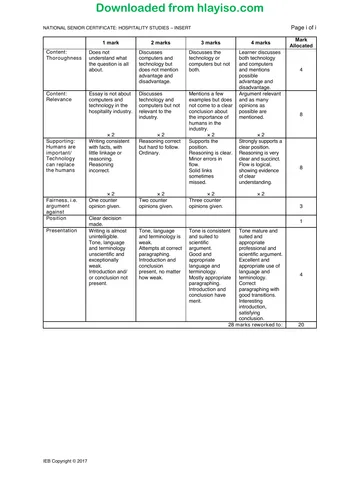
The article must:
• have an applicable heading and introduction.
• contain about 500 words and appropriate paragraphs.
• note a word count.
• come to a clear conclusion and opinion.
Marks will be allocated according to the rubric.
Mark
1 mark 2 marks 3 marks 4 marks
Allocated
Content: Does not Discusses Discusses the Learner discusses
Thoroughness understand what computers and technology or both technology
the question is all technology but computers but not and computers
about. does not mention both. and mentions 4
advantage and possible
disadvantage. advantage and
disadvantage.
Content: Essay is not about Discusses Mentions a few Argument relevant
Relevance computers and technology and examples but does and as many
technology in the computers but not not come to a clear opinions as
hospitality industry. relevant to the conclusion about possible are
8
industry. the importance of mentioned.
humans in the
industry.
×2 ×2 ×2 ×2
Supporting: Writing consistent Reasoning correct Supports the Strongly supports a
Humans are with facts, with but hard to follow. position. clear position.
important/ little linkage or Ordinary. Reasoning is clear. Reasoning is very
Technology reasoning. Minor errors in clear and succinct.
can replace Reasoning flow. Flow is logical, 8
the humans incorrect. Solid links showing evidence
sometimes of clear
missed. understanding.
×2 ×2 ×2 ×2
Fairness, i.e. One counter Two counter Three counter
Argument opinion given. opinions given. opinions given. 3
against
Position Clear decision
1
made.
Presentation Writing is almost Tone, language Tone is consistent Tone mature and
unintelligible. and terminology is and suited to suited and
Tone, language weak. scientific appropriate
and terminology Attempts at correct argument. professional and
unscientific and paragraphing. Good and scientific argument.
exceptionally Introduction and appropriate Excellent and
weak. conclusion language and appropriate use of
Introduction and/ present, no matter terminology. language and
4
or conclusion not how weak. Mostly appropriate terminology.
present. paragraphing. Correct
Introduction and paragraphing with
conclusion have good transitions.
merit. Interesting
introduction,
satisfying
conclusion.
28 marks reworked to: 20
Total: 200 marks
IEB Copyright © 2017
Study this subject
Revise the topics in this paper, then practise them question by question.
- Grade 12 Hospitality Studies notes
CAPS revision notes with worked examples.
- Hospitality Studies questions by topic
Past exam questions sorted by CAPS topic, with memos where available.
- All Grade 12 Hospitality Studies past papers
Past papers by year, with memos where available.
- Grade 12 IEB past papers
More Hospitality Studies and other subjects in this collection.
Recommended for this subject
More papers and memos for this grade and subject.
MemorandumIEB
Hospitality Studies Grade 12 IEB 2019 Memo
MemorandumIEB
Hospitality Studies Grade 12 IEB 2019 Memo (Afrikaans)
MemorandumIEB
Hospitality Studies Grade 12 IEB 2018 Memo
MemorandumIEB
Hospitality Studies Grade 12 IEB 2018 Memo (Afrikaans)
MemorandumIEB
Hospitality Studies Grade 12 IEB 2017 Memo (Afrikaans)
Question paperIEB
Hospitality Studies Grade 12 IEB 2019 Question Paper
Related documents
Question paperIEB
Hospitality Studies Grade 12 IEB 2017 Question Paper
Question paperIEB
Hospitality Studies Grade 12 IEB 2017 Question Paper (Afrikaans)
AddendumIEB
Hospitality Studies Grade 12 IEB 2017 Addendum
AddendumIEB
Hospitality Studies Grade 12 IEB 2017 Addendum (Afrikaans)
Question paperIEB
Hospitality Studies Grade 12 IEB 2019 Question Paper (Afrikaans)
Question paperIEB