Life Orientation:
Life Skills
NQF 2
Downloaded from hlayiso.com
Life Orientation NQF Level 2
Skip to contentStudy guide 








View all
L2 Life Orientation Module 6 Study Groups Timetables and Plans
Level 2 Life Orientation study guide, 23 pages. Read online or get the free PDF download.
Subject: Life OrientationMultiple grades23 pages
Life Orientation. Study guide, 23 pages. Read online or download the PDF.
- Subject
- Life Orientation
- Grade
- Multiple grades
- Document type
- Study guide
- Curriculum
- TVET
- Pages
- 23
- File size
- 1.5 MB
Loading document…
Loading document…
1 of 23
Document textSearch extracted text and jump to a page.
Develop a
study plan
Module 6
Downloaded from hlayiso.com
*see terms and conditions
Think about it…
• Does belonging to a study group help?
• How can I draw up a timetable for study
times?
• Does it help to study very hard the night
before an exam?
Downloaded from hlayiso.com
Unit 6.1
Study groups,
timetables & plans
Downloaded from hlayiso.com
Life Orientation NQF Level 2
What is a study group?
• Three or more
students meeting
regularly to study.
• Beneficial for
students,
especially those
who are: Figure 6.1: Some students learn better
Interpersonal. when discussing content with others
Linguistic.
Downloaded from hlayiso.com
Study groups: pros & cons
Table 6.1: Advantages and disadvantages of joining a study group
Advantages Disadvantages
• You have academic support to talk • The group may have the wrong
about content until you approaches, explanations or
understand & remember it. answers, & lead you astray.
• Discussing the work boosts your • The group may talk too much, or
speaking, reasoning, debating & chat about other things, & not get
negotiating skills. down to studying.
• You can learn from one another’s • The members’ weaknesses, poor
strengths & acquire new or better habits or different learning styles
study methods and habits. may be distracting.
• Being together in the same • Group members who rely too
situation at the college offers much on the support of the group
emotional support & you can might not study independently.
make new friends.
Downloaded from hlayiso.com
Study groups: pros & cons
Table 6.1: Advantages and disadvantages of joining a study group
Advantages Disadvantages
• The group holds you accountable • Some members may be unreliable
& you cannot postpone studying & not become a part of the team.
or not turn up.
• You can organise & complete • You may not learn best in a group
group projects easily because you setting & may need time to think
get to know each other better. things over quietly by yourself.
• A study group expands your • You may become exposed to the
perspectives & you learn more bad habits or wrong views of some
about other cultures & individual group members.
differences.
• It saves time, as you can divide a • Some may do their share of the
long reading list or research work work wrong or do the minimum so
among you. that you have to redo it.
Downloaded from hlayiso.com
Study groups: pros & cons
Table 6.1: Advantages and disadvantages of joining a study group
Advantages Disadvantages
• A study group improves your • A group member with a strong
teamwork & leadership skills, personality may dominate the
& builds self-confidence. others, or criticise them too much.
• If you form a new study group • Being in the same study group for
each term, you get to meet more the whole year may cause you to
people in class. not develop further.
Downloaded from hlayiso.com
Study timetables or study plans
• Time management tool (plan) for
managing your study time.
• Usually in table form with days/dates,
times of day, & what you’ll study when.
Downloaded from hlayiso.com
Guidelines for study timetables
• Draw tables in a logical way.
• Allocate time to subjects.
• Include time for breaks, sleeping,
eating & other activities.
• Include activities from your calendar &
to-do lists.
Downloaded from hlayiso.com
Guidelines for study timetables
• Study: 45 min, rest: 15 min.
• Divide subject content into available
weeks.
• Can use “rest” time to make copies, do
research & complete homework.
• Draw up short-term timetables for
specific projects, tests or exams.
Downloaded from hlayiso.com
Guidelines for study timetables
Table 6.3: Example of a study plan for the week before a test
Downloaded from hlayiso.com
Learning activity 6.1
Module 6
Test your knowledge of this unit – and draw up your own study timetable –
by completing Learning activity 6.1 in your Student’s Book.
Downloaded from hlayiso.com
Life Orientation NQF Level 2
Unit 6.2
Academic progress
& performance
Downloaded from hlayiso.com
Life Orientation NQF Level 2
What is academic progress?
• Moving forward in your formal studies.
• Can be measured:
Per subject.
In all subjects.
In your qualification.
Downloaded from hlayiso.com
Tracking academic progress
• Record your results.
• Compare with previous results.
• Use a table, spreadsheet or graph
(e.g. column or bar graph).
Downloaded from hlayiso.com
Creating a graph of your progress
Refer to Example 6.4
in your Student’s Book
to see how to use
Excel to create graphs
to track your academic
progress.
Downloaded from hlayiso.com
Action plan for
academic performance
• Set a clear, SMART goal.
• Choose a method to reach the goal.
• Break down the goal into subgoals.
Downloaded from hlayiso.com
Action plan for
academic performance
• Outline action steps for subgoals.
• Set a deadline for each step.
• Plan for obstacles.
• Identify the resources needed.
Downloaded from hlayiso.com
Action plan for
academic performance
Refer to Table 6.4:
Template for an action
plan in your Student’s
Book for more
information on how to
plan for academic
performance.
Downloaded from hlayiso.com
Learning activity 6.2
Module 6
Test your knowledge of this unit – and record your academic progress –
by completing Learning activity 6.2 in your Student’s Book.
Downloaded from hlayiso.com
Life Orientation NQF Level 2
Summative assessment
Module 6
Test your knowledge of this module by completing the Summative assessment of
Module 6 in your Student’s Book.
Downloaded from hlayiso.com
Life Orientation NQF Level 2
Mathematics NQF Level 2
Downloaded from hlayiso.com
Life Orientation (Life Skills) NQF Level 2
Study this subject
Notes, quizzes and topic questions for this subject.
Recommended for this subject
More papers and memos for this grade and subject.
Study guide
L2 Life Orientation Fire Safety Measures
Study guide
L2 Life Orientation Module 11 Human Rights Responsibilities
Study guide
L2 Life Orientation Module 12 Ethical Behaviour
Study guide
L2 Life Orientation Module 3 Time Management
Study guide
L2 Life Orientation Module 4 Positive Relationships
Study guide
L2 Life Orientation Module 5 How your brain works in terms of learning
Related documents
Study guide
L2 Life Orientation Module 7 Balanced Lifestyle
Study guide
L2 Life Orientation Module 8 Effects of substance abuse
Study guide
L2 Life Orientation Module 8 Substance Abuse
Study guide
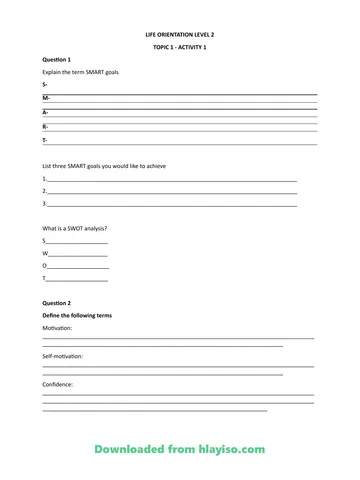
L2 Life Orientation Topic 1 Activity 1
Study guide
L2 Life Orientation Unit 3 .2
Study guide