Life Orientation:
Life Skills
NQF 3
Downloaded from hlayiso.com
Life Orientation NQF Level 3
Skip to contentStudy guide 
View all
L3 Life Orientation Module 10
Level 3 Life Orientation study guide, 34 pages. Read online or get the free PDF download.
Subject: Life OrientationMultiple grades34 pages
Life Orientation. Study guide, 34 pages. Read online or download the PDF.
- Subject
- Life Orientation
- Grade
- Multiple grades
- Document type
- Study guide
- Curriculum
- TVET
- Pages
- 34
- File size
- 2.3 MB
Loading document…
Loading document…
1 of 34
Document textSearch extracted text and jump to a page.
Explain
water safety
measures
Module 10
Downloaded from hlayiso.com
*see terms and conditions
Think about it…
• Can alcohol abuse also lead to water
accidents?
• What are the dangers of near-drowning?
• With regard to water, are there new
accidents or only new victims?
Downloaded from hlayiso.com
Unit 10.1
Water – risk situations
& safety measures
Downloaded from hlayiso.com
Life Orientation NQF Level 3
What is a water risk?
• Risk = danger of
being harmed or
injured
• Being in or near
water always has
risks.
Figure 10.1: Not only children, but also
hundreds of adults are injured or die
every year in water-related incidents
Downloaded from hlayiso.com
Potential risk situations
near or in water
• You could be at risk:
On your own, in a
group or near others
Near water
In water
In a vessel
Moving across
water. Figure 10.2: Freak waves can sweep
people off piers and rocks
Downloaded from hlayiso.com
Example of water risk:
Contaminated water
• Unsafe to drink, wash or swim in
• Can cause disease (e.g. bilharzia) or
death
• Chemicals (e.g. pool acid or industrial
waste) cause chemical contamination,
& can burn skin & poison water.
Downloaded from hlayiso.com
Example of water risk: Drowning
• Drowning = death from breathing in
water & not being able to absorb oxygen.
• Near-drowning = surviving drowning, but
may have lasting damage.
• Secondary drowning = water in lungs
causes complications & death (even days
after the incident).
• Refer to Table 10.1 in your Student’s
Book for more information.
Downloaded from hlayiso.com
Example of water risk: Drowning
• People most at risk of
drowning:
Can’t swim or are unfit
Under influence of alcohol
Have a medical condition
Lose consciousness after
knocking their head/neck
Have an accident in or
near water.
Downloaded from hlayiso.com
Example of water risk:
Health factors
• People who are unfit, weak or tired
• People with medical conditions (e.g.
asthma, heart disease, epilepsy)
• People who get cramps (making them
unable to swim).
Downloaded from hlayiso.com
Example of water risk:
Carelessness or misfortune
• People may ignore safety regulations.
• People may behave carelessly.
• An unexpected disaster may occur.
Downloaded from hlayiso.com
Learning activity 10.1
Module 10
Test your knowledge of this section by completing Learning activity 10.1 in your
Student’s Book.
Downloaded from hlayiso.com
Life Orientation NQF Level 3
Example of water risk:
Natural environment
• Dangerous animals:
In fresh water, e.g.
crocodiles & hippos
In sea water, e.g.
jellyfish & stingrays
Near water, e.g. lions
or leopards.
• Inhaling water Figure 10.6: Crocodiles in rivers and
dams may also cause drowning as they
• Corals & rocks. drag their live victims under the water
Downloaded from hlayiso.com
Example of water risk:
Hypothermia
• People may get too cold
in water or in wind after
getting out of the water.
• Body’s core temperature
drops.
• Causes shivering &
restricted blood flow
which can lead to
passing out & even
death.
Downloaded from hlayiso.com
Example of water risk:
Dehydration
• People stranded in
water may not have
fresh water to drink &
may be exposed to the
sun for a long time.
• People may over-
hydrate by swallowing
too much water when
trying to stay afloat or
get out of the water.
Downloaded from hlayiso.com
Learning activity 10.2
Module 10
Test your knowledge of this section by completing Learning activity 10.2 in your
Student’s Book.
Downloaded from hlayiso.com
Life Orientation NQF Level 3
What are safety measures?
• Safety measures =
rules, regulations &
common sense to
prevent injury or death
• Refer to Example 10.1
in your Student’s Book
for more information.
Downloaded from hlayiso.com
Learning activity 10.3
Module 10
Test your knowledge of this section by completing Learning activity 10.3 in your
Student’s Book.
Downloaded from hlayiso.com
Life Orientation NQF Level 3
Safety measures to avoid
accidents in or near water
• Take along clothing & gear
• Keep safe company
• Observe rules & warnings
• Use watercraft correctly
• Respect nature
• Use pools safely.
Downloaded from hlayiso.com
Learning activity 10.4
Module 10
Test your knowledge of this unit by completing Learning activity 10.4 in your
Student’s Book.
Downloaded from hlayiso.com
Life Orientation NQF Level 3
Unit 10.2
Basic first-aid skills
Downloaded from hlayiso.com
Life Orientation NQF Level 3
What is first aid?
• First aid = first
assistance/care for an
ill/injured person until
professional medical
treatment is given
• Aim of first aid = to
stabilise victims
• Focus on breathing,
heartbeat & blood
before other injuries.
Downloaded from hlayiso.com
First aid for water accidents
• Focus on ABC of first aid:
Airway
Breathing
Circulation
• Need oxygen for body to function &
to prevent permanent brain damage.
• May need to do different parts of
first aid at once.
Downloaded from hlayiso.com
A = clear the Airway
• Airway = nose, mouth, throat & lungs
• Clear:
Object stuck in throat
Water, vomit or chemicals inhaled.
• Note: Choking occurs when something
(food, water or a small item) is inhaled
accidentally.
• See Box 10.1 in your Student’s Book for
more information about dealing with
choking. Downloaded from hlayiso.com
B = get the Breathing going
• Unconscious = no response to talking,
pain or the situation
• If there is no pulse or heartbeat, need
to start CPR
• CPR = cardiopulmonary resuscitation;
getting oxygen to the heart (“cardio”) &
lungs (“pulmonary”).
Downloaded from hlayiso.com
How to give CPR
• Turn patient onto their back
• Check that the airway is clear
• Place heel of your hand on top of your other
hand
• Adults & older children: 30 compressions
(presses) on chest (between nipples)
• Young children: press to a depth of 4 cm only
• Babies: press with two fingers only
Downloaded from hlayiso.com
How to give CPR
• Gently tilt victim’s head back & pinch
nose shut
• Completely cover the victim’s mouth
with yours (or with a special inflatable
device)
• Blow hard enough for their chest to rise
(only a small breath for a baby)
• Give another two blows.
Downloaded from hlayiso.com
How to give CPR
• Continue to give
30 compressions
& two deep
breaths until
help arrives
• Don’t give up! If
necessary, swap
with someone or Figure 10.17: The rescuer on the left is
performing chest compressions, while
ask them to help. the one on the right is holding the
victim’s head back and administering air
Downloaded from hlayiso.com
C = restore the Circulation
• Cover the patient with a blanket, dry
towel or jacket to warm them
• Don’t give the patient anything to eat
or drink
• Try to stop any bleeding, but
don’t touch blood.
Downloaded from hlayiso.com
Recovery position
• Note: don’t move the patient if they
have a back/neck injury
• Once the patient is breathing & has a
pulse, they need to be in recovery
position
• Recovery position prevents choking &
makes breathing easier
• Refer to Box 10.4 in your Student’s Book
for guidelines on the recovery position.
Downloaded from hlayiso.com
Learning activity 10.5
Module 10
Test your knowledge of this unit – and think about your own safety – by
completing Learning activity 10.5 in your Student’s Book.
Downloaded from hlayiso.com
Life Orientation NQF Level 3
Summative assessment
Module 10
Test your knowledge of this module by completing the Summative assessment of
Module 10 in your Student’s Book.
Downloaded from hlayiso.com
Life Orientation NQF Level 3
Portfolio task 3
Module 10
Complete Portfolio task 3 in your Student’s Book. This is a formal practical
assignment.
Downloaded from hlayiso.com
Life Orientation NQF Level 3
Mathematics NQF Level 2
Downloaded from hlayiso.com
Life Orientation (Life Skills) NQF Level 3
Study this subject
Notes, quizzes and topic questions for this subject.
Recommended for this subject
More papers and memos for this grade and subject.
Study guide
L2 Life Orientation Fire Safety Measures
Study guide
L2 Life Orientation Module 11 Human Rights Responsibilities
Study guide
L2 Life Orientation Module 12 Ethical Behaviour
Study guide
L2 Life Orientation Module 3 Time Management
Study guide
L2 Life Orientation Module 4 Positive Relationships
Study guide
L2 Life Orientation Module 5 How your brain works in terms of learning
Related documents
Study guide
L2 Life Orientation Module 6 Study Groups Timetables and Plans
Study guide
L2 Life Orientation Module 7 Balanced Lifestyle
Study guide
L2 Life Orientation Module 8 Effects of substance abuse
Study guide
L2 Life Orientation Module 8 Substance Abuse
Study guide
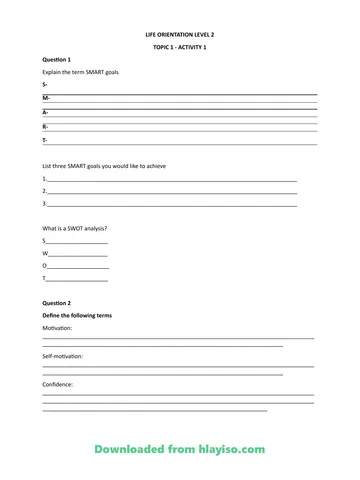
L2 Life Orientation Topic 1 Activity 1
Study guide