Life Orientation:
Life Skills
NQF 3
Downloaded from hlayiso.com
Life Orientation NQF Level 3
Skip to contentStudy guide 
View all
L3 Life Orientation Module 5
Level 3 Life Orientation study guide, 34 pages. Read online or get the free PDF download.
Subject: Life OrientationMultiple grades34 pages
Life Orientation. Study guide, 34 pages. Read online or download the PDF.
- Subject
- Life Orientation
- Grade
- Multiple grades
- Document type
- Study guide
- Curriculum
- TVET
- Pages
- 34
- File size
- 2.8 MB
Loading document…
Loading document…
1 of 34
Document textSearch extracted text and jump to a page.
Develop a
study method
Module 5
Downloaded from hlayiso.com
*see terms and conditions
Think about it…
• Do people have different ways in which
they prefer to learn?
• Will some study techniques work better
for certain people than for others?
• Can you draw up a plan to improve your
academic performance?
Downloaded from hlayiso.com
Unit 5.1
Brain dominance
& learning styles
Downloaded from hlayiso.com
Life Orientation NQF Level 3
The brain hemispheres
• The brain is a large organ in the head
that controls the nervous system.
• Each part of the brain is responsible
for different functions.
Downloaded from hlayiso.com
The brain is made up of:
• Cerebral cortex
(largest part) =
parietal, frontal,
occipital & temporal
lobes – has two
halves/hemispheres.
• Cerebellum (at base).
• Brainstem (also Figure 5.1: An illustration of the brain as seen
from the side, using colours to show the
forms spinal cord). different parts
Downloaded from hlayiso.com
Left & right hemispheres
• Some scientists say each side of the
brain controls different functions.
• Brain dominance = idea that the left
or right hemisphere is more important
in individuals and/or situations.
• In psychology, the terms ‘left-brain
dominant’ or ‘right-brain dominant’
are often used.
Downloaded from hlayiso.com
Left & right hemispheres
Figure 5.2: Illustration of the brain showing the cerebral cortex
from above (the left and right hemispheres of the brain are joined
on the inside by the corpus callosum, which is a bundle of neural
fibres that enables communication between the two hemispheres)
Downloaded from hlayiso.com
Left & right hemispheres
Table 5.1: Broad functions given to the left and right sides of the brain
Left hemisphere Right hemisphere
(logical, chronological, detailed) (intuitive, unsystematic, holistic)
• Strong verbal skills • Good at non-verbal expressions
• Good at language • Not strong in grammar or vocabulary
• Thinks in words • Has a strong imagination; daydreams
• Thinks analytically, systematically • Thinks more in terms of feelings &
& realistically impressions
• Thinks rationally (logically) • Thinks intuitively (instinctively)
• Very aware of detail when looking • Not so concerned with details, but
at things good at forming mental images &
more aware of the bigger picture
Downloaded from hlayiso.com
Left & right hemispheres
Table 5.1: Broad functions given to the left and right sides of the brain (continued)
Left hemisphere Right hemisphere
(logical, chronological, detailed) (intuitive, unsystematic, holistic)
• Likes to plan logically & in detail • Tends to be impulsive
• Finds it easy to arrange things in a • Tends to link things together randomly
certain order
• Good with numbers (maths), • Good at art, colours, music & writing
facts & science
• Tends to be more careful • Inclined to be adventurous
Downloaded from hlayiso.com
Learning activity 5.1
Module 5
Test your knowledge of this section by completing Learning activity 5.1 in your
Student’s Book.
Downloaded from hlayiso.com
Life Orientation NQF Level 3
Learning styles & preferences
• The way you approach
& best understand
information
• May use many styles,
but some are easier
for you
• Depends on your
personality, strengths,
weaknesses & the
situation.
Downloaded from hlayiso.com
Types of learning styles
• Visual (seeing)
• Auditory (hearing)
• Tactile (feeling)
• Kinaesthetic (moving)
• Gustatory (tasting)
• Olfactory (smelling).
Figure 5.6: Auditory learners are
able to repeat accurately
information they have heard
Downloaded from hlayiso.com
Types of learning styles
Table 5.2: Preferred learning styles
Learning Activities that enhance Type of tasks and tests
styles learning the most that are easiest
Visual Seeing; reading; drawing Written answers; charts;
diagrams & pictures; posters; comparisons; spelling;
underlining or highlighting memorisation; written reports;
words; writing outlines and lists; written comprehension tests
watching a demonstration or
video; taking notes; studying in a
quiet environment
Auditory Listening; speaking; reading Verbal instructions; oral
aloud; telling a story; talking to answers, summaries and
yourself; holding discussions; explanations; debates; dictation;
joining a study group vocabulary; oral reports
Downloaded from hlayiso.com
Types of learning styles
Table 5.2: Preferred learning styles (continued)
Learning Activities that enhance Type of tasks and tests
styles learning the most that are easiest
Tactile- Feeling; touching; handling; Physical activities; role-plays;
kinaesthetic writing; doing; exploring; doing experiments; demonstrations;
fieldwork; moving about building models; multiple-choice
questions
Gustatory Tasting Identifying and describing tastes
Olfactory Smelling Identifying and describing smells
Downloaded from hlayiso.com
Your own learning
styles & preferences
• Affect how you
learn
• Depend on the
situation
• Practise different
styles in risk-free
contexts
• Use best style for
the specific task. from hlayiso.com
Downloaded
Learning activity 5.2
Module 5
Test your knowledge of this section – and assess your own learning styles and
preferences – by completing Learning activity 5.2 in your Student’s Book.
Downloaded from hlayiso.com
Life Orientation NQF Level 3
Unit 5.2
Personal
study techniques
Downloaded from hlayiso.com
Life Orientation NQF Level 3
Different study techniques
• Study technique =
way to approach
content in order to
understand &
remember it
• Can be structured
or simple things
you do while
learning.
Downloaded from hlayiso.com
SQ3R method
• Survey = skim read for overview.
• Question = form questions from the chapter
title & headings.
• Read = read full text in sections.
• Recite = after each section recall main points.
• Review = quick read of text and underline
keywords.
Downloaded from hlayiso.com
Summarise
• Summary = most important facts
• No examples, stories or long sentences
• Short outline
• Underline keywords to use in your own full
sentences
• Use your own words.
Downloaded from hlayiso.com
Mind maps
• Diagrams that outline the topic
• Keyword/phrase in the middle
• Other words/phrases radiate from
the central point.
Downloaded from hlayiso.com
Mind maps
Represent ideas Show links,
visually to recall associations and
them easily connections
Aim of
mind maps
Break down See the overall
and arrange information structure of the way details
to make more sense to you fit together
Figure 5.11: A mind map showing the aim of mind maps
Downloaded from hlayiso.com
Comparative tables
• Compare similarities &
differences at a glance.
• First column/row lists
items being compared.
• Other headings indicate
different features.
• Refer to Example 5.3 in
your Student’s Book.
Downloaded from hlayiso.com
Flowcharts
A diagram to show one or more of the
following:
• Functions
• Sequence
• Hierarchy
• Causes & effects
• Questions & answers
• Stages of a process.
Downloaded from hlayiso.com
Learning activity 5.3
Module 5
Test your knowledge of this section by completing Learning activity 5.3 in your
Student’s Book.
Downloaded from hlayiso.com
Life Orientation NQF Level 3
Study techniques involving
movement and/or sound
• Move around while
learning
• Recite information
aloud
• Work in silence
• Work while Figure 5.17: Most people work and
study best when the light is good,
listening to music. the temperature is not too cool or
too warm, and there are few
distractions
Downloaded from hlayiso.com
Learning activity 5.4
Module 5
Test your knowledge of this section – and practise different study techniques –
by completing Learning activity 5.4 in your Student’s Book.
Downloaded from hlayiso.com
Life Orientation NQF Level 3
Unit 5.3
Academic progress
& performance
Downloaded from hlayiso.com
Life Orientation NQF Level 3
Tracking academic progress
• Record all marks & symbols in a table
or spreadsheet
• You can compare future results
• You can convert all ratings to
percentages:
• You can do more with spreadsheets.
Downloaded from hlayiso.com
An action plan for your
academic performance
• Identify steps to reach your goal
• Include final date, as well as steps &
dates for each goal
• See Table 5.5 in your Student’s Book.
Downloaded from hlayiso.com
Learning activity 5.5
Module 5
Test your knowledge of this unit – and start tracking your academic
performance – by completing Learning activity 5.5 in your Student’s Book.
Downloaded from hlayiso.com
Life Orientation NQF Level 3
Summative assessment
Module 5
Test your knowledge of this module by completing the Summative assessment of
Module 5 in your Student’s Book.
Downloaded from hlayiso.com
Life Orientation NQF Level 3
Mathematics NQF Level 2
Downloaded from hlayiso.com
Life Orientation (Life Skills) NQF Level 3
Study this subject
Notes, quizzes and topic questions for this subject.
Recommended for this subject
More papers and memos for this grade and subject.
Study guide
L2 Life Orientation Fire Safety Measures
Study guide
L2 Life Orientation Module 11 Human Rights Responsibilities
Study guide
L2 Life Orientation Module 12 Ethical Behaviour
Study guide
L2 Life Orientation Module 3 Time Management
Study guide
L2 Life Orientation Module 4 Positive Relationships
Study guide
L2 Life Orientation Module 5 How your brain works in terms of learning
Related documents
Study guide
L2 Life Orientation Module 6 Study Groups Timetables and Plans
Study guide
L2 Life Orientation Module 7 Balanced Lifestyle
Study guide
L2 Life Orientation Module 8 Effects of substance abuse
Study guide
L2 Life Orientation Module 8 Substance Abuse
Study guide
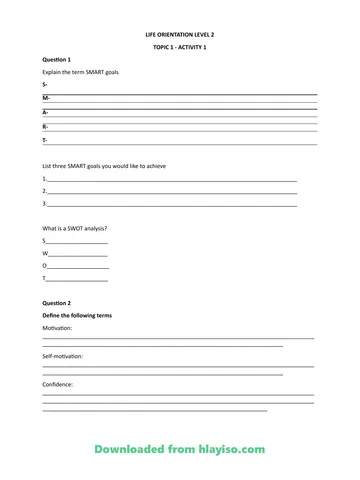
L2 Life Orientation Topic 1 Activity 1
Study guide