
NATIONAL
SENIOR CERTIFICATE
GRADE 12
JUNE 2024
TECHNICAL SCIENCES P1
MARKS: 150
TIME: 3 hours
This question paper consists of 14 pages, including 2 data sheets.
Skip to contentAll 2024 papers 
View all

Technical Sciences Grade 12 P1 Eastern Cape June 2024 QP
Grade 12 Technical Sciences Paper 1 question paper from the Eastern Cape June Exam 2024 (English), 14 pages. Read online or download the free PDF.
Technical Sciences · Grade 12 · Eastern Cape June Exam · 2024 · English. Question paper, 14 pages. Read online or download the PDF.
- Subject
- Technical Sciences
- Grade
- Grade 12
- Language
- English
- Document type
- Question paper
- Year
- 2024
- Exam period
- Eastern Cape June Exam
- Paper
- 1
- Curriculum
- CAPS
- Pages
- 14
- File size
- 880.2 KB
Free to read online, no sign-up needed
Loading document…
Loading document…
1 of 14
This exam
Eastern Cape June Exam 2024
Questions in this paper
Document textSearch extracted text and jump to a page.
2 TECHNICAL SCIENCES P1 (EC/JUNE 2024)
INSTRUCTIONS AND INFORMATION
Read the following instructions carefully before answering the questions.
1. Answer ALL the questions in the ANSWER BOOK.
2. Start EACH question on a NEW page.
3. You may use a non-programmable calculator.
4. You may use appropriate mathematical instruments.
5. Number the answers correctly according to the numbering system used in
this question paper.
6. Show ALL formulae and substitutions in ALL calculations.
7. Round off your FINAL numerical answers to a minimum of TWO decimal
places.
8. Give brief motivations, discussions et cetera where required.
9. You are advised to use the attached DATA SHEETS.
10. Write neatly and legibly.
Copyright reserved Please turn over
(EC/JUNE 2024) TECHNICAL SCIENCES P1 3
QUESTION 1: MULTIPLE-CHOICE QUESTIONS
Various options are provided as possible answers to the following questions. Choose
the answer and write only the letter (A–D) next to the question numbers (1.1 to 1.10)
in the ANSWER BOOK, for example 1.11 D.
1.1 Which ONE of the following is the best definition of acceleration?
A The rate of change of speed.
B The rate of change of velocity.
C The rate of change of position.
D The rate of change of distance. (2)
1.2 The inertia of a body can be defined as …
A the rate of change of its velocity.
B a force acting on a string or a rope.
C a force acting parallel to the surface and opposing motion.
D the property of a body to resist any change in its state of motion or rest. (2)
1.3 Block M is resting on a table. Force F is applied to the block as shown in the
diagram below and the block remains at rest.
F
θ
M
Which ONE of the following factors will NOT influence the magnitude of the
frictional force on block M?
A The angle θ between force F and the horizontal is decreased.
B The contact area of the block on the table is increased.
C The magnitude of force F is decreased.
D The mass of M is increased. (2)
Copyright reserved Please turn over
4 TECHNICAL SCIENCES P1 (EC/JUNE 2024)
1.4 The linear momentum of an object is a …
A vector quantity with the same direction as the velocity of the object.
B scalar quantity with the same direction as the velocity of the object.
C scalar quantity with a direction opposite to that of the velocity of the
object.
D vector quantity with a direction opposite to that of the velocity of the
object. (2)
1.5 The momentum of car A changes with time just before and just after a head-
on collision with car B. The masses of the two cars are the same. Assume that
the system is isolated. The velocity of car B DECREASES after the collision.
Which ONE of the following combinations about the momentum and kinetic
energy of the system is correct?
MOMENTUM KINETIC ENERGY
A Conserved Not conserved
B Not conserved Not conserved
C Conserved Conserved
D Not conserved Conserved (2)
1.6 Power is defined as the …
A ability to do work.
B rate at which work is done.
C product of mass and acceleration.
D product of force and displacement. (2)
1.7 A ball is thrown vertically upwards and returns to the ground. Work done by
the gravitational force on the ball is …
A positive on its way upwards and negative on its way downwards.
B negative on its way upwards and negative on its way downwards.
C negative on its way upwards and positive on its way downwards.
D positive on its way upwards and positive on its way downwards. (2)
Copyright reserved Please turn over
(EC/JUNE 2024) TECHNICAL SCIENCES P1 5
1.8 Which ONE of the following statements is correct?
If the stress applied to a body is more than the elastic limit of the body and is
then removed, the body …
A becomes hot.
B opposes the stress.
C cannot return to its original shape and size.
D returns to its original shape and size. (2)
1.9 The pressure at a point in a liquid DOES NOT depend on the ...
A area.
B depth.
C density.
D gravitational acceleration. (2)
1.10 A light ray is directed from water to air with an angle of incidence of 0°. Which
ONE of the following is true?
A The light ray is refracted along the normal.
B The light ray undergoes total internal reflection.
C The light ray is refracted towards the normal.
D The light ray is refracted away from the normal. (2)
[20]
Copyright reserved Please turn over
6 TECHNICAL SCIENCES P1 (EC/JUNE 2024)
QUESTION 2
2.1 Mpho is pulling a suitcase with a mass of 10 kg at a CONSTANT velocity. She
pulls the suitcase over a rough, horizontal surface with a force F of 50 N at an
angle of 60° to the horizontal.
60°
2.1.1 State Newton’s First Law of Motion in words. (2)
2.1.2 Name the non-contact force acting on the suitcase. (1)
2.1.3 Calculate the coefficient of friction of the frictional force on the suitcase. (5)
2.2 A force (F1) with a magnitude of 40 N is applied at an angle of 35° with the
horizontal on a 40 kg block standing on a ROUGH surface. The 40 kg block is
attached to a 10 kg block and a force (F2) of 20 N is applied, parallel to the
surface, on the 10 kg block. The frictional force between the 10 kg block and the
surface is 2,5 N and the frictional coefficient between the 40 kg block and the
surface is 0,04.
F1 = 40 N
35°˚
40 kg F2 = 20 N
10 kg
2.2.1 State Newton’s Second Law of Motion in words. (2)
2.2.2 Draw a labelled free body diagram to indicate ALL the forces acting on
the 10 kg block. (5)
2.2.3 Calculate the magnitude of the vertical component of F1. (2)
2.2.4 Calculate the magnitude of the normal force acting on the 40 kg block. (2)
2.2.5 Calculate the frictional force acting on the 40 kg block. (4)
2.2.6 Calculate the magnitude of the acceleration of the system. (5)
Copyright reserved Please turn over
(EC/JUNE 2024) TECHNICAL SCIENCES P1 7
2.2.7 What will the influence be on the acceleration of the system if F2 is
applied at an angle of 30˚ with the horizontal? Only write INCREASE,
DECREASE or REMAINS THE SAME. (2)
2.3 John with a mass of 70 kg, and Mary with a mass of 50 kg, are standing on an
ice rink as shown below. Then John pushes Mary away with a force of 50 N to
the right and they glide away from each other.
John
Mary
2.3.1 What is the direction and magnitude of the force experienced by John
while he is pushing against Mary? (2)
2.3.2 Explain in terms of inertia and other applicable concepts why John and
Mary would not cover equal distances from their starting points. (3)
[35]
Copyright reserved Please turn over
8 TECHNICAL SCIENCES P1 (EC/JUNE 2024)
QUESTION 3
3.1 A cricket ball, mass 175 g, is thrown directly towards a batsman at a horizontal
velocity of 12 m∙s-1. He hits it back in the opposite direction with a velocity of
30 m∙s-1. The ball is in contact with the bat for a period of 0,05 s.
3.1.1 Define the term impulse in words. (2)
3.1.2 Calculate the change in momentum of the ball in magnitude and
direction. (5)
3.1.3 Calculate the magnitude of the force exerted by the bat on the ball. (3)
3.1.4 Modern cars use crumple zones on the front and the sides as a safety
measure to reduce injuries during a collision.
Explain, by using the concept of impulse, how crumple zones reduce
injuries. (4)
3.2 Block X, mass 2 kg, slides at 3 m∙s-1 to the right and collides with a stationary
block Y, mass 3,5 kg. Block X rebounds at a velocity of 1 m∙s-1 to the left.
3.2.1 Write down the principle of conservation of linear momentum in
words. (2)
3.2.2 Calculate the velocity of block Y after the collision. (5)
[21]
Copyright reserved Please turn over
(EC/JUNE 2024) TECHNICAL SCIENCES P1 9
QUESTION 4
4.1 An applied force of 50 N acts on a block and it moves a distance of 10 m in a
straight line. The force of friction on the block during the motion is 20 N.
50 N
20 N
10 m
4.1.1 Define the term work in words. (2)
Calculate the:
4.1.2 Work done by the applied force (4)
4.1.3 Work done by friction (3)
4.1.4 Net work done on the block (3)
4.2 A motor mechanic stores an engine in a hole in the floor of his workshop. He
uses a crane to lift the engine out of the hole. The mass of the engine is
1 500 kg. From floor level to point X the engine moves to a height of 0,5 m at
CONSTANT velocity. The power dissipated by the crane during this distance is
7,35 kW. Ignore the mass of the cable and the effects of friction.
Crane
X
0,5 m
Engine
Floor
Hole in floor
4.2.1 Draw a free-body diagram to show all the forces acting on the engine
when moving between the floor and point X. (2)
Calculate the:
4.2.2 Speed at which the engine is lifted (4)
4.2.3 Work done by the applied force on the engine between the floor and
point X. (3)
4.2.4 Gravitational potential energy of the engine at point X with respect to
the floor. (3)
[24]
Copyright reserved Please turn over
10 TECHNICAL SCIENCES P1 (EC/JUNE 2024)
QUESTION 5
5.1 A wire, length 335 cm, with a cross-sectional area of 5 x 10⁻⁵ m2, is used to
suspend a 3,5 kN weight from a horizontal beam. The weight causes the length
of the wire to increase by 12 mm.
Beam
Cable
Weight
5.1 State Hooke’s law in words. (2)
5.2 Calculate the:
5.2.1 Stress (3)
5.2.2 Strain (3)
5.2.3 Modulus of elasticity (3)
5.3 Give TWO examples of perfect plastic bodies. (2)
[13]
Copyright reserved Please turn over
(EC/JUNE 2024) TECHNICAL SCIENCES P1 11
QUESTION 6
6.1 A 250 kg metal cylinder stands (vertically) upright on a workshop floor and the
cross-sectional area in touch with the floor is 3,15 x 104 mm2.
6.1.1 Define the term pressure. (2)
6.1.2 Calculate the pressure the cylinder exerts on the floor. (4)
6.2 A water tank has a height of 2,5 m and is filled with water. The density of the
water is 1 000 kg·m-3.
X 2 ,5 m
0 ,9 m
6.2.1 Calculate the pressure of the water at point X in the tank. Point X is
0,9 m from the bottom of the tank. (4)
6.2.2 The water is replaced with petrol, which has a lower density than water.
Will the fluid pressure in petrol at X be GREATER THAN, LESS THAN
or the SAME AS before? Explain your answer. (4)
6.3 In the hydraulic lift shown below, the large piston has a cross-sectional area
(A1) of 200 cm2 and the small piston has a cross-sectional area (A2) of 5 cm2.
A force of 250 N is applied to the small piston.
F2
A1 A2
F1
6.3.1 State Pascal’s law in words. (2)
6.3.2 Calculate the force F1 on the large piston. (4)
6.3.3 Give TWO reasons why liquids, and not gasses, are preferred for use
in hydraulic systems. (2)
[22]
Copyright reserved Please turn over
12 TECHNICAL SCIENCES P1 (EC/JUNE 2024)
QUESTION 7
The path of a ray of light which is directed from glass to air, is shown in the diagram
below. The critical angle of the glass is 55˚.
Glass Glass
Air Air
7.1 Define the term refraction. (2)
7.2 Label the following:
7.2.1 A (1)
7.2.2 D (1)
7.3 Define critical angle. (2)
7.4 What is the phenomenon called which occurs when the angle of incidence (i) is
greater than 55˚? (1)
7.5 Will the angle of refraction (r) be GREATER THAN, SMALLER THAN or EQUAL
TO the angle of incidence (i)? (1)
7.6 Give a reason for your answer to QUESTION 7.5. (2)
7.7 Draw a beam/ray diagram to determine the position and size of the image that
will be formed when the focal point distance F for a convex lens and an object
with a height of 3 cm is placed at a distance of 2F. (5)
[15]
TOTAL: 150
Copyright reserved Please turn over
(EC/JUNE 2024) TECHNICAL SCIENCES P1 13
DATA FOR TECHNICAL SCIENCES GRADE 12
PAPER 1
GEGEWENS VIR TEGNIESE WETENSKAPPE GRAAD 12
VRAESTEL 1
TABLE 1/TABEL 1
NAME/NAAM SYMBOL/SIMBOOL VALUE/WAARDE
Acceleration due to gravity g 9,8 m·s-2
Swaartekragversnelling
Speed of light in a vacuum
c 3,0 x 10⁸ m·s-1
Spoed van lig in ʼn vakuum
Planck's constant h 6,63 x 10⁻³⁴ J·s
Planck se konstante
Coulomb's constant k 9,0 x 10⁹ N·m2·C-2
Coulomb se konstante
Charge on electron -e -1,6 x 10⁻¹⁹ C
Lading op elektron
Electron mass me 9,11 x 10⁻³¹ kg
Elektronmassa
TABLE 2: FORMULAE/TABEL 2: FORMULES
FORCE/KRAG
Fnet = ma p = mv
fs max = μsN fk = μ k N
Fnet Δt = Δp
Fg = mg
Δp = mv f - mv i
L e
Torque = F x r˔ MA = E = I
Copyright reserved Please turn over
14 TECHNICAL SCIENCES P1 (EC/JUNE 2024)
WORK, ENERGY AND POWER/ARBEID, ENERGIE EN DRYWING
W = Fx cos U= mgh or/of EP = mgh
Wnet = K Wnet = Ek
or/of
1 1
K= mv 2 Ek = mv 2
2 or/of 2
K = K f − K i or/of Ek = Ekf − Eki
Wnc = Ek + Ep W
Wnc = K + U or/of P=
t
Pave = Fvave / Pgemid = Fvgemid M E = Ek + E p
WAVES, SOUND AND LIGHT/GOLWE, KLANK EN LIG
Speed/Spoed c=fλ
Energy/Energie E = hf
or/of
hc
E=
λ
ELASTICITY, VISCOSITY AND HYDRAULICS/ELASTISITEIT, VISKOSITEIT EN
HIDROULIKA
F
= Δ
A ε=
L
σ F1 F
=K = 2
ε A1 A 2
Copyright reserved Please turn over
Study this subject
Recommended for this subject
Question paper
Technical Sciences Grade 12 P2 Eastern Cape June 2024 QP
Question paper
Technical Sciences Grade 12 P1 Eastern Cape Prelim 2024 QP
Question paper
Technical Sciences Grade 12 P1 Gauteng Prelim 2024 QP (Eng)
Memorandum
Technical Sciences Grade 12 P1 Eastern Cape Prelim 2024 Memo
Memorandum
Technical Sciences Grade 12 P1 Gauteng Prelim 2024 Memo
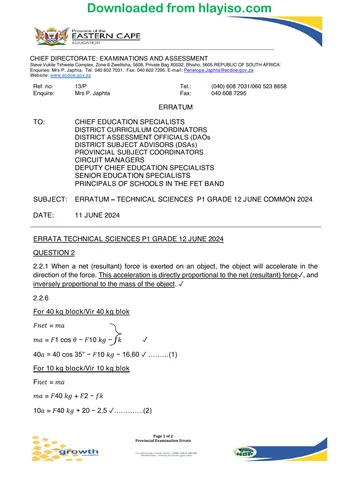
Errata
Technical Sciences Grade 12 P1 Eastern Cape June 2024 Errata
More from Grade 12 Technical Sciences
Memorandum
Technical Sciences Grade 12 P1 NSC November Mock 2026 Memo
Annual teaching plan
Gr 12 Tech Sci ATP 2023 24
Memorandum
Technical Sciences Grade 12 P1 Eastern Cape Mock 2025 Memo
Memorandum
Technical Sciences Grade 12 P2 Eastern Cape Mock 2025 Memo
Memorandum
Technical Sciences Grade 12 P2 Eastern Cape Prelim 2024 Memo
Memorandum