
Downloaded from hlayiso.com
METRO SOUTH EDUCATION DISTRICT
GRADE 12
PHYSICAL SCIENCES: PHYSICS (P1)
SEPTEMBER 2015
MARKS: 150
TIME: 3 hours
This question paper consists of 14 pages and 3 data sheets.
Skip to contentAll 2015 papers 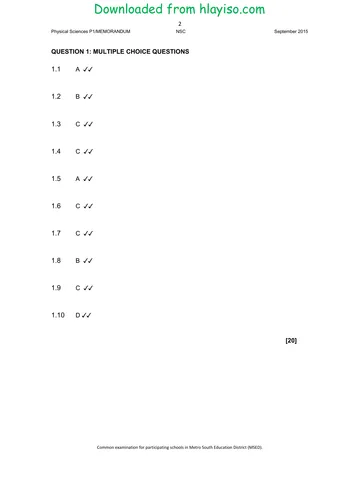

View all





Physical Sciences Grade 12 P1 Western Cape Mock 2015 QP
Grade 12 Physical Sciences Paper 1 question paper from the Western Cape Mock Exam 2015, 17 pages. Read online or download the free PDF.
Physical Sciences · Grade 12 · Western Cape Mock Exam · 2015. Question paper, 17 pages. Read online or download the PDF.
- Subject
- Physical Sciences
- Grade
- Grade 12
- Document type
- Question paper
- Year
- 2015
- Exam period
- Western Cape Mock Exam
- Paper
- 1
- Curriculum
- CAPS
- Pages
- 17
- File size
- 622.3 KB
Free to read online, no sign-up needed
Loading document…
Loading document…
1 of 17
This exam
Western Cape Mock Exam 2015
Questions in this paper
Document textSearch extracted text and jump to a page.
Downloaded from hlayiso.com
Physical Sciences/P1 2 September 2015
NSC
INSTRUCTIONS AND INFORMATION
1. Write your centre number and examination number in the appropriate spaces
on the ANSWER BOOK.
2. This question paper consists of ELEVEN questions. Answer ALL the
questions in the ANSWER BOOK.
3. Start EACH question on a NEW page in the ANSWER BOOK.
4. Number the answers correctly according to the numbering system used in this
question paper.
5. Leave ONE line between two subquestions, for example between
QUESTION 2.1 and QUESTION 2.2.
6. You may use a non-programmable calculator.
7. You may use appropriate mathematical instruments.
8. You are advised to use the attached DATA SHEETS.
9. Show ALL formulae and substitutions in ALL calculations.
10. Round off your final numerical answers to a minimum of TWO decimal places.
11. Give brief motivations, discussions, et cetera where required.
12. Write neatly and legibly.
Common examination for participating schools in Metro South Education District (MSED).
Downloaded from hlayiso.com
3
Physical Sciences P1 NSC September 2015
QUESTION 1 (MULTIPLE CHOICE QUESTIONS)
Four options are provided as possible answers to the following questions. Each
question has only ONE correct answer. Write only the letter (A-D) next to the
question number (1.1–1.10) in your answer book.
1.1 A constant net force, F, is applied to a crate which moves along a
frictionless horizontal surface. Which ONE the following quantities remains
constant while force F acts on the crate?
A the rate of change of velocity
B the change in momentum
C the work done on the crate
D the change in kinetic energy (2)
1.2 A satellite experiences a gravitational force of magnitude F on the surface of
the earth. The radius of the earth is R. The satellite now circles the earth at
an unknown height above the surface of the earth and experiences a
gravitational force of magnitude ¼ F. This unknown height above the
surface of the earth is ….
A R
B 2R
C 3R
D 4R (2)
1.3 When a light wave from a distant star is analysed it is found that this wave
is “red-shifted”. This confirms that the wave experienced a…
A decrease in wavelength and increase in frequency.
B decrease in wavelength and decrease in frequency.
C increase in wavelength and decrease in frequency.
D increase in wavelength and increase in frequency. (2)
Common examination for participating schools in Metro South Education District (MSED).
Downloaded from hlayiso.com
4
Physical Sciences P1 NSC September 2015
1.4 A boy, mass 2m, and a girl, mass m, standing on skateboards are facing
each other. They push off against one another. The boy exerts a force on
the girl and the boy experiences a change in momentum to the left.
Ignore the effects of friction. Which ONE of the following best describes
the magnitudes of the force exerted by the girl and her change in
momentum?
Force exerted by girl Change in momentum of girl
less than the force exerted by less than the change in momentum
A
the boy of the boy
less than the force exerted by equal to the change in momentum
B
the boy the boy
equal to the force exerted by equal to the change in momentum
C
the boy of the boy
equal to the force exerted by less than the change in momentum
D
the boy of the boy
(2)
1.5 The electric field pattern of two small charged objects are shown below.
Which one of the following diagrams correctly shows the force experienced
by a positive test charge placed at a point in the field?
F F
A B
C D
F F
(2)
Common examination for participating schools in Metro South Education District (MSED).
Downloaded from hlayiso.com
5
Physical Sciences P1 NSC September 2015
1.6 Consider the following electric circuit, with switch S open.
V
A
R1
S
R2
The resistors R1 and R2 are identical. The internal resistance of the battery
in the circuit is not negligible. When switch S is closed, which ONE of the
following gives the correct readings on the ammeter (A) and voltmeter (V)?
READING ON AMMETER READING ON VOLTMETER
A decreases remains the same
B decreases increases
C increases decreases
D increases remains the same
(2)
1.7 Two strong bar magnets are arranged with their poles O and Q facing each
as shown in the diagram below. A current – carrying conductor carries
conventional current into the plane of the paper when placed between the
poles of two magnets.
magnet R magnet
O ⊗ Q
P
If the force on the conductor is towards R then :-
A O and Q are both north poles.
B Q and O are both south poles.
C Q is a north pole and O is a south pole.
D O is a north pole and Q is a south pole. (2)
Common examination for participating schools in Metro South Education District (MSED).
Downloaded from hlayiso.com
6
Physical Sciences P1 NSC September 2015
1.8 The diagram shows the variation in emf produced by a generator.
emf
+10
0,05 0,1 0,15 0,2 time
-10
If the armature of the generator is rotated at twice the speed how will the
emf and the period shown by the graph change?
Emf Period
A Greater than 10 V 0,2 s
B Greater than 10 V 0,1 s
C Equal to 10 V 0,1 s
D Less than 10 V 0,4 s (2)
1.9 Which ONE of the following provides evidence that light behaves as
particles?
A Light can be diffracted.
B Light is refracted by a triangular prism.
C Light ejects electrons from a metal surface.
D The speed of light decreases when it travels from air
to glass. (2)
1.10 Which ONE of the following descriptions best explains the formation of a
line emission spectrum?
A line emission spectrum is formed when …
A white light passes through a cold gas.
B white light passes through a triangular prism.
C electrons in the ground state move to a higher energy level.
D electrons in the excited state move to a lower energy level.
(2)
[20]
Common examination for participating schools in Metro South Education District (MSED).
Downloaded from hlayiso.com
7
Physical Sciences P1 NSC September 2015
QUESTION 2 (Start on a new page)
Ball X of mass 3 kg is attached to trolley Y of mass 4 kg by a light string which
passes over a frictionless pulley as shown in the diagram. Initially the trolley is at
rest on a slope AB, which makes an angle of 30o with the horizontal. When the
ball is released it falls to the ground and the trolley moves 2 m up the slope
accelerating at 0,43 m.s-2.
The coefficient of kinetic friction along slope AB is µk = 0,2. (Ignore the rotation
effects of the wheels and air friction.)
Pulley
X
3 kg
A
T
2m Y
4 kg
30o
B
2.1 Draw a labelled free body diagram to show ALL the forces acting on the
trolley as it moves up the slope. (4)
2.2 Show that a friction force of 6,79 N acts on the trolley as it moves up the
slope. (3)
2.3 State Newton’s Second Law of motion in words. (2)
2.5 Calculate the tension T in the string. (5)
2.6 Calculate the speed with which the 3 kg ball strikes the ground. (4)
[18]
Common examination for participating schools in Metro South Education District (MSED).
Downloaded from hlayiso.com
8
Physical Sciences P1 NSC September 2015
QUESTION 3 (Start on a new page)
The position-time graph is given for a ball which is thrown down from a vertical
height of 1,8 m and bounces once on reaching the ground. The contact time
between the ball and the floor can be ignored.
1,8
Position (m)
0,9
time (s)
0,5 t
3.1 Calculate the initial velocity with which the ball was thrown. (3)
3.2 At what speed does the ball strike the ground? (3)
3.3 At what speed did the ball leave the ground after bouncing? (3)
3.4 Calculate the value of time t. (4)
3.5 Sketch a velocity-time graph to represent the motion of the ball. Indicate
the following values on the graph:
• The initial velocity at which the object was thrown.
• The velocity at which the ball strikes the ground.
• The velocity at which the ball bounces off the ground.
• The time at which the ball strikes the ground for the first time.
• The time, t, when the ball strikes the ground after the first bounce. (6)
[19]
Common examination for participating schools in Metro South Education District (MSED).
Downloaded from hlayiso.com
9
Physical Sciences P1 NSC September 2015
QUESTION 4 (Start on a new page)
A wooden block of mass 2 kg, moving at a velocity of 5 m.s-1, collides with a crate
of mass 9 kg resting on a flat horizontal surface as shown in the diagram below.
After the collision, the crate moves to the right at 1 m.s-1. Ignore the effects of
friction.
BEFORE COLLISION AFTER COLLISION
1 m.s-1
5 m.s-1
2 kg 9 kg 2 kg 9 kg
4.1 Write down the principle of conservation of linear momentum
in words. (2)
4.2 Calculate the magnitude of the velocity of the wooden block
immediately after the collision. (4)
4.3 If the collision lasts 0,6 seconds, calculate the force the wooden
block exerts on the crate during the collision. (4)
[10]
QUESTION 5 (Start on a new page)
A worker applies a constant force of 45 N on a crate of mass 25 kg, at an angle of
30° with the horizontal. When the crate reaches point P, its velocity is 12 m.s-1 and
3,5 m further it reaches point Q at a velocity of 10,8 m.s-1.
45 N
30°
25 kg
P Q
3,5 m
5.1 Draw a labelled free-body diagram to show the horizontal forces
acting on the crate during its motion. The length of the vectors
should be an indication of their relative magnitudes. (3)
5.2 Write down the NAME of the non-conservative force that opposes
the forward motion of the crate. (1)
5.3 State the Work-Energy theorem in words. (2)
5.4 Use ENERGY PRINCIPLES to calculate the magnitude of
the non-conservative force mentioned in QUESTION 5.2. (6)
[12]
Common examination for participating schools in Metro South Education District (MSED).
Downloaded from hlayiso.com
10
Physical Sciences P1 NSC September 2015
QUESTION 6 (Start on a new page)
The diagram shows a moving source of sound
wave in air.
It illustrates the Doppler Effect, a phenomenon
named after the German scientist,
Christian Doppler.
6.1 Explain in words, what is meant by the
Doppler Effect. (2)
6.2 In which direction is the source moving,
to the left or to the right? (1)
6.3 What happens to the observed frequency of the waves as the
source is moving? (1)
6.4 The sound source is moving towards a stationary observer.
Answer the following question by stating whether the pitch
INCREASES, DECREASES or REAMINS THE SAME. What
will the observer hear as the sound source…
6.4.1 moves towards the observer,
6.4.2 moves away from the observer,
6.4.3 slows down and stops. (3)
6.5 A submarine is lying motionless under water in the sea. It detects a sound
coming from a moving ship. The frequency detected is 1,003 times greater
than the actual frequency of the sound emitted by the ship. The speed of
sound in salt water is 1 470 m.s-1. Ignore the effects of any friction.
Calculate the velocity of the ship. (4)
[11]
Common examination for participating schools in Metro South Education District (MSED).
Downloaded from hlayiso.com
11
Physical Sciences P1 NSC September 2015
QUESTION 7 (Start on a new page)
7.1 The diagram shows two point charges which are 20mm apart. A carries a
charge of + 3nC and B carries a charge of – 5 nC. X is a point which is
situated 10mm to the right of B.
A B
+ 3nC − 5nC
X
20 mm 10 mm
7.1.1 Define the electric field at a point. (2)
7.1.2 Calculate the magnitude and direction of the net electric field
at point X due to the presence of both A and B. (6)
7.2 Two small charged spheres, X and Y, on insulated stands are placed
10 cm apart. The charge on X is –4 nC and the charge on Y is +6 nC.
–4 nC +6 nC
10 cm
X Y
7.2.1 Draw the electric field pattern around charges X and Y. (3)
7.2.2 Calculate the magnitude of the force that X exerts on Y. (4)
7.2.3 The charged spheres are now brought into contact with each
other and then separated. Calculate the charge on each sphere
after separation. (2)
[17]
Common examination for participating schools in Metro South Education District (MSED).
Downloaded from hlayiso.com
12
Physical Sciences P1 NSC September 2015
QUESTION 8 (Start on a new page)
In the circuit represented below, voltmeter V1 reads 12 V when the switch is open
and 10,8 V when the switch is closed. The internal resistance of the battery, r,
and the resistance of resistor R4 are unknown. When the switch S is closed, the
power dissipated in resistor R2 is 2 W.
The voltmeters have a very high resistance and the resistance of the ammeter is
so small that it can be disregarded.
R1 2,9 Ω R2 8Ω
V1 V2 R4 R3 2Ω
r
S
A
8.1 Calculate:-
8.1.1 The reading on the ammeter. (3)
8.1.2 The reading on voltmeter V2. (3)
8.1.3 The current which flows through the battery. (4)
8.1.4 The internal resistance of the battery. (3)
8.2 R4 is replaced by a conductor with negligible resistance. How will this
affect the power of R2? Write down INCREASE, DECREASE, BECOME
ZERO or REMAIN CONSTANT and give a reason for answer. (2)
[15]
Common examination for participating schools in Metro South Education District (MSED).
Downloaded from hlayiso.com
13
Physical Sciences P1 NSC September 2015
QUESTION 9 (Start on a new page)
In a simple generator a coil is rotated anti-clockwise in a uniform magnetic field.
The diagram below shows the position at the instant the coil lies parallel to the
magnetic field.
rotation
Y
N S
X
P
9.1 Name the law on which a generator operates. (1)
9.2 Name component P. (1)
9.3 What is the function of component P? (1)
9.4 Determine the direction of the current in segment XY when the
coil is in the position shown above. Only write down X to Y
OR Y to X. (1)
9.5 Is the induced potential difference in the coil illustrated above
about to increase or to decrease? Explain your answer by
referring to the change in magnetic flux as the loop rotates from
the horizontal to the vertical position. (3)
9.6 Draw a sketch graph of emf in the external circuit against time
for one complete rotation of the armature coil, starting with the
coil in the position shown. (2)
[9]
QUESTION 10 (Start on a new page)
A certain municipality implements a power decrease in the town. As a result
of the power decrease the rms voltage drops from 230 Vrms to 210 Vrms.
10.1 Calculate the peak voltage during the power decrease. (3)
10.2 A certain electrical appliance dissipates 1 800 W when it is
operated at 230 Vrms. Calculate the power at which
it will operate during the power decrease. (4)
[7]
Common examination for participating schools in Metro South Education District (MSED).
Downloaded from hlayiso.com
14
Physical Sciences P1 NSC September 2015
QUESTION 11 (Start on a new page)
In the diagram below, photons of ultraviolet light with energy 5,6 x 10⁻¹⁹ J is
incident on the cathode of a photo cell and causes photo-electrons to be emitted
from the metal surface.
The threshold (cut-off) frequency of the cathode of the photocell is 7,2 x 10¹⁴Hz.
11.1 Which property of light is illustrated by the photo-electric effect (1)
11.2 Define the term threshold (cut-off) frequency in words. (2)
11.3 Calculate the maximum kinetic energy of the emitted
photo-electrons. (3)
11.4 The brightness of the ultraviolet light is now increased. How will this
change affect each following? Only write down INCREASES,
DECREASES or REMAINS THE SAME.
11.4.1 The kinetic energy of the emitted photoelectrons. (1)
11.4.2 The reading on the ammeter. (1)
11.5 The ultraviolet light source is now replaced with a light source
of wavelength 622 nm. Will this light source be able to eject
photo-electrons from the cathode of the photo-cell?
Support your answer with a calculation. (4)
[12]
Total: 150 marks
Common examination for participating schools in Metro South Education District (MSED).
Downloaded from hlayiso.com
Physical Sciences/P1 15 September 2015
NSC
DATA FOR PHYSICAL SCIENCES GRADE 12
PAPER 1 (PHYSICS)
GEGEWENS VIR FISIESE WETENSKAPPE GRAAD 12
VRAESTEL 1 (FISIKA)
TABLE 1: PHYSICAL CONSTANTS/TABEL 1: FISIESE KONSTANTES
NAME/NAAM SYMBOL/SIMBOOL VALUE/WAARDE
Acceleration due to gravity
g 9,8 m·s-2
Swaartekragversnelling
Universal gravitational constant
G 6,67 x 10⁻¹¹ N·m2·kg-2
Universele gravitasiekonstant
Speed of light in a vacuum
c 3,0 x 10⁸ m·s-1
Spoed van lig in 'n vakuum
Planck's constant
h 6,63 x 10⁻³⁴ J·s
Planck se konstante
Coulomb's constant
k 9,0 x 10⁹ N·m2·C-2
Coulomb se konstante
Charge on electron
e- -1,6 x 10⁻¹⁹ C
Lading op elektron
Electron mass
me 9,11 x 10⁻³¹ kg
Elektronmassa
Mass of Earth
M 5,98 x 1024 kg
Massa van Aarde
Radius of Earth
RE 6,38 x 10³ km
Straal van Aarde
Common examination for participating schools in Metro South Education District (MSED).
Downloaded from hlayiso.com
Physical Sciences/P1 16 September 2015
NSC
TABLE 2: FORMULAE/TABEL 2: FORMULES
MOTION/BEWEGING
v f = vi + a ∆t Δx = v i Δt + 21 a∆t 2 or/of Δy = v i Δt + 21 a∆t 2
v + vf v + vf
2 2 2
v f = v i + 2a∆x or/of v f = v i + 2a∆y
2
Δx = i Δt or/of Δy = i Δt
2 2
FORCE/KRAG
Fnet = ma p = mv
f s max = μ sN fk = μk N
Fnet Δt = Δp
w = mg
Δp = mv f - mv i
m1m 2 m1m 2 M M
F=G or/of F=G g =G or/of g =G 2
d2 r2 d2 r
WORK, ENERGY AND POWER/ARBEID, ENERGIE EN DRYWING
W = F∆x cos θ U = mgh or/of E P = mgh
Wnet = ∆K or/of Wnet = ∆Ek
1 1
K = mv 2 or/of E k = mv 2
2 2
∆K = K f − K i or/of ∆Ek = Ekf − Eki
W
Wnc = ∆K + ∆U or/of Wnc = ∆Ek + ∆Ep P=
∆t
P av = Fv av / P gemid = Fv gemid
WAVES, SOUND AND LIGHT/GOLWE, KLANK EN LIG
1
v=fλ T=
f
v ± vL v ± vL c
fL = fs fL = fb E = hf or /of E= h
v ± vs v ± vb λ
E = Wo + E k(max) or/of E = Wo + K max where/waar
1 1
E = hf and/en W0 = hf0 and/en E k (max) = mv max
2
or/of K max = mv max
2
2 2
Common examination for participating schools in Metro South Education District (MSED).
Downloaded from hlayiso.com
Physical Sciences/P1 17 September 2015
NSC
ELECTROSTATICS/ELEKTROSTATIKA
kQ 1Q 2 kQ
F= E=
r2 r2
W F
V= E=
q q
Q Q
n= or / of n=
e qe
ELECTRIC CIRCUITS/ELEKTRIESE STROOMBANE
emf ε = I(R + r)
V
R=
I
emk ε = I(R + r)
R s = R1 + R 2 + ...
1 1 1 q = I ∆t
= + + ...
R p R1 R 2
W = Vq W
P=
Δt
W = VI ∆ t
P = VI
W = I2R ∆ t
2
P = I 2R
V Δt
W= V2
R P=
R
ALTERNATING CURRENT/WISSELSTROOM
Pav = Vrms I rms / Pgemiddeld = Vwgk I wgk
I max I
I rms = / I wgk = maks
2 2 2
Pav = I rms R / Pgemiddeld = I 2wgk R
Vmax Vmaks
Vrms = / Vwgk = 2
Vrms 2
Vwgk
2 2 Pav = / Pgemiddeld =
R R
Common examination for participating schools in Metro South Education District (MSED).
Study this subject
Recommended for this subject
Memorandum
Physical Sciences Grade 12 P1 Western Cape Mock 2015 Memo
Memorandum
Physical Sciences Grade 12 P1 Western Cape Mock 2015 Memo
Question paper
Physical Sciences Grade 12 P2 Western Cape Mock 2015 QP
Question paper
Physical Sciences Grade 12 P1 Western Cape Mock 2018 QP
Memorandum
Physical Sciences Grade 12 P1 Mpumalanga November 2015 Memo
Memorandum
Physical Sciences Grade 12 Paper 1 NSC November 2015 Memo
More from Grade 12 Physical Sciences
Memorandum
Physical Sciences Grade 12 P2 Eastern Cape June 2025 Memo
Memorandum
Physical Sciences Grade 12 P1 Eastern Cape Mock 2025 Memo
Memorandum
Physical Sciences Grade 12 Paper 1 Limpopo June 2025 Memo
Memorandum
Physical Sciences Grade 12 Paper 2 Limpopo June 2025 Memo
Memorandum
Physical Sciences Grade 12 Paper 1 Limpopo Mock 2025 Memo
Question paper