
Downloaded from hlayiso.com
NATIONAL SENIOR CERTIFICATE EXAMINATION
GRADE 12
PHYSICAL SCIENCES: PHYSICS (P1)
SEPTEMBER 2015
MEMORANDUM
MARKS/PUNTE: 150
This memorandum consists of 15 pages
Hierdie memorandum bestaan uit 15 bladsye
Skip to contentAll 2015 papers 
View all





Physical Sciences Grade 12 P1 Mpumalanga November 2015 Memo
Grade 12 Physical Sciences Paper 1 memorandum from the Mpumalanga November 2015, 15 pages. Read online or download the free PDF.
Physical Sciences · Grade 12 · Mpumalanga November · 2015. Memorandum, 15 pages. Read online or download the PDF.
- Subject
- Physical Sciences
- Grade
- Grade 12
- Document type
- Memorandum
- Year
- 2015
- Exam period
- Mpumalanga November
- Paper
- 1
- Curriculum
- CAPS
- Pages
- 15
- File size
- 492.5 KB
Free to read online, no sign-up needed
Loading document…
Loading document…
1 of 15
This exam
Mpumalanga November 2015
- Paper 1Question paperMemo
- Paper 2Question paperMemo
Questions in this paper
Document textSearch extracted text and jump to a page.
Downloaded from hlayiso.com
Physical Sciences P1/Fisiese Wetenskappe V1 2 September 2015
NSC/
NSS
GENERAL GUIDELINES
1. CALCULATIONS
1.1 Marks will be awarded for: correct formula, correct substitution, correct
answer with unit.
Punte sal toegeken word vir: korrekte formule, korrekte substitusie, korrekte
antwoord met eenheid.
1.2 No marks will be awarded if an incorrect or inappropriate formula is used,
even though there may be relevant symbols and applicable substitutions.
Geen punte sal toegeken word waar 'n verkeerde of ontoepaslike formule
gebruik word nie, selfs al is daar relevante simbole en relevante substitusies.
1.3 When an error is made during substitution into a correct formula, a mark
will be awarded for the correct formula and for the correct substitutions, but
no further marks will be given.
Wanneer 'n fout gedurende substitusie in 'n korrekte formule begaan word, sal
'n punt vir die korrekte formule en vir korrekte substitusies toegeken word, maar
geen verdere punte sal toegeken word nie.
1.4 If no formula is given, but all substitutions are correct, a candidate will
forfeit one mark.
Indien geen formule gegee is nie, maar al die substitusies is korrek, verloor die
kandidaat een punt.
1.5 No penalisation if zero substitutions are omitted in calculations where
formula/principle is given correctly.
Geen penalisering indien nulwaardes nie getoon word nie in berekeninge waar
die formule/beginsel korrek gegee is nie.
1.6 Mathematical manipulations and change of subject of appropriate formulae
carry no marks, but if a candidate starts off with the correct formula and then
changes the subject of the formula incorrectly, marks will be awarded for the
formula and the correct substitutions. The mark for the incorrect numerical
answer is forfeited.
Wiskundige manipulasies en verandering van die onderwerp van toepaslike
formules tel geen punte nie, maar indien 'n kandidaat met die korrekte formule
begin en dan die onderwerp van die formule verkeerd verander, sal punte vir die
formule en korrekte substitusies toegeken word. Die punt vir die verkeerde
numeriese antwoord word verbeur.
1.7 Marks are only awarded for a formula if a calculation had been attempted.
i.e. substitutions have been made or a numerical answer given.
Punte word slegs vir 'n formule toegeken indien 'n poging tot 'n berekening
aangewend is, d.w.s. substitusies is gedoen of 'n numeriese antwoord is gegee.
1.8 Marks can only be allocated for substitutions when values are substituted into
formulae and not when listed before a calculation starts.
Punte kan slegs toegeken word vir substitusies wanneer waardes in formule
ingestel is en nie vir waardes wat voor 'n berekening genoem is nie.
Downloaded from hlayiso.com
Physical Sciences P1/Fisiese Wetenskappe V1 3 September 2015
NSC/
NSS
1.9 All calculations, when not specified in the question, must be done to two
decimal places.
Alle berekenings, wanneer nie in die vraag gespesifiseer word nie, moet tot twee
desimale plekke gedoen word.
1.10 If a final answer to a calculation is correct, full marks will not automatically be
awarded. Markers will always ensure that the correct/appropriate formula is
used and that workings, including substitutions, are correct.
Indien 'n finale antwoord tot 'n berekening korrek is, sal volpunte nie outomaties
toegeken word nie. Nasieners sal altyd verseker dat die korrekte/toepaslike
formule gebruik word en dat bewerkings, insluitende substitusies korrek is.
1.11 Questions where a series of calculations have to be made (e.g. a circuit
diagram question) do not necessarily always have to follow the same order.
FULL MARKS will be awarded provided it is a valid solution to the problem.
However, any calculation that will not bring the candidate closer to the answer
than the original data, will not count any marks.
Vrae waar 'n reeks berekenings gedoen moet word (bv. 'n stroomdiagramvraag)
hoef nie noodwendig dieselfde volgorde te hê nie. VOLPUNTE sal toegeken word
op voorwaarde dat dit 'n geldige oplossing vir die probleem is. Enige berekening
wat egter nie die kandidaat nader aan die antwoord as die oorspronklike data bring
nie, sal geen punte tel nie.
2. UNITS/EENHEDE
2.1 Candidates will only be penalised once for the repeated use of an incorrect
unit within a question or subquestion.
'n Kandidate sal slegs een keer gepenaliseer word vir die herhaaldelike gebruik
van 'n verkeerde eenheid in 'n vraag of subvraag.
2.2 Units are only required in the final answer to a calculation.
Eenhede word slegs in die finale antwoord tot 'n vraag verlang.
2.3 Marks are only awarded for an answer, and not for a unit per se. Candidates
will therefore forfeit the mark allocated for the answer in each of the following
situations:
- Correct answer + wrong unit
- Wrong answer + correct unit
- Correct answer + no unit
Punte word slegs vir 'n antwoord en nie vir 'n eenheid per se toegeken nie.
Kandidate sal derhalwe die punt vir die antwoord in die volgende gevalle verbeur:
- Korrekte antwoord + verkeerde eenheid
- Verkeerde antwoord + korrekte eenheid
- Korrekte antwoord + geen eenheid
2.4 SI units must be used except in certain cases, e.g. V·m -1 instead of N·C-1, and
cm·s-1 or km·h-1 instead of m·s-1 where the question warrants this.
SI-eenhede moet gebruik word, behalwe in sekere gevalle, bv. V∙m -1 in plaas van
N∙C-1, en cm∙s-1 of km∙h-1 in plaas van m∙s-1 waar die vraag dit regverdig.
Downloaded from hlayiso.com
Physical Sciences P1/Fisiese Wetenskappe V1 4 September 2015
NSC/
NSS
3. GENERAL/ALGEMEEN
3.1 If one answer or calculation is required, but two given by the candidate, only
the first one will be marked, irrespective of which one is correct. If two
answers are required, only the first two will be marked, etc.
Indien een antwoord of berekening verlang word, maar twee word deur die
kandidaat gegee, sal slegs die eerste een nagesien word, ongeag watter een
korrek is. Indien twee antwoorde verlang word, sal slegs die eerste twee nagesien
word, ens.
3.2 For marking purposes, alternative symbols (s,u,t, etc.) will also be accepted.
Vir nasiendoeleindes sal alternatiewe simbole (s, u, t, ens.) ook aanvaar word.
3.3 Separate compound units with a multiplication dot, not a full stop, for
example, m·s-1. For marking purposes m.s-1 and m/s will also be accepted.
Skei saamgestelde eenhede met 'n vermenigvuldigpunt en nie met 'n punt nie,
byvoorbeeld, m·s-1. Vir nasiendoeleindes sal m.s-1 em m/s ook aanvaar word.
4. POSITIVE MARKING/POSITIEWE NASIEN
Positive marking regarding calculations will be followed in the following cases:
Positiewe nasien met betrekking tot berekenings sal in die volgende gevalle geld:
4.1 Subquestion to subquestion: When a certain variable is calculated in one
subquestion (e.g. 3.1) and needs to be substituted in another (3.2 or 3.3), e.g.
if the answer for 3.1 is incorrect and is substituted correctly in 3.2 or 3.3, full
marks are to be awarded for the subsequent subquestions.
Subvraag na subvraag: Wanneer 'n sekere veranderlike in een subvraag (bv.
3.1) bereken word en dan in 'n ander vervang moet word (3.2 of 3.3), bv. indien die
antwoord vir 3.1 verkeerd is en korrek in 3.2 of 3.3 vervang word, word volpunte
aan die daaropvolgende subvraag toegeken.
4.2 A multistep question in a subquestion: If the candidate has to calculate, for
example, current in the first step and gets it wrong due to a substitution error,
the mark for the substitution and the final answer will be forfeited.
'n Vraag met veelvuldige stappe in 'n subvraag: Indien 'n kandidaat
byvoorbeeld, die stroom verkeerd bereken in 'n eerste stap as gevolg van 'n
substitusiefout, verbeur die kandidaat die punt vir die substitusie sowel as die finale
antwoord.
5. NEGATIVE MARKING/NEGATIEWE NASIEN
Normally an incorrect answer cannot be correctly motivated if based on a
conceptual mistake. If the candidate is therefore required to motivate in
question 3.2 the answer given to question 3.1, and 3.1 is incorrect, no marks
can be awarded for question 3.2. However, if the answer for e.g. 3.1. is based
on a calculation, the motivation for the incorrect answer in 3.2 could be
considered.
'n Verkeerde antwoord, indien dit op 'n konsepsuele fout gebaseer is, kan
normaalweg nie korrek gemotiveer word nie. Indien 'n kandidaat gevra word om in
vraag 3.2 die antwoord op vraag 3.1 te motiveer en 3.1 is verkeerd, kan geen
punte vir vraag 3.2 toegeken word nie. Indien die antwoord op bv. 3.1 egter op 'n
berekening gebaseer is, kan die motivering vir die verkeerde antwoord in 3.2
oorweeg word.
Downloaded from hlayiso.com
Physical Sciences P1/Fisiese Wetenskappe V1 5 September 2015
NSC/
NSS
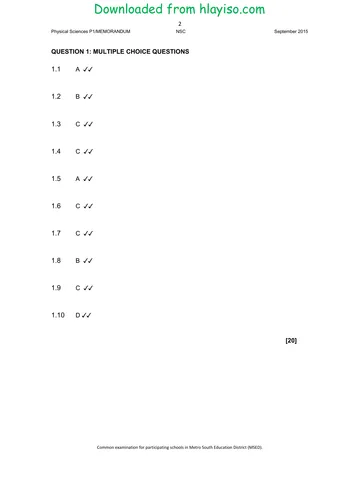
QUESTION 1 / VRAAG 1
1.1 C
1.2 B
1.3 C
1.4 A
1.5 B
1.6 C
1.7 B
1.8 B
1.9 D
1.10 C
[20]
QUESTION 2 / VRAAG 2
2.1 The force that opposes the motion of a moving object relative to a surface
Die krag wat die beweging van 'n bewegende voorwerp relatief tot 'n oppervlak
teenwerk (2)
2.2 Accepted labels / Aanvaarde benoemings
w Fg / Fw/force of earth on block/weight / 19,6 N / mg / gravitational force
fk f/friction/
T Tension /
F Fapp / FT / FToegepas /
N Normal force / FN / Force of surface on block
N
T F
fk
w
(5)
Notes/Aantekeninge:
Any additional forces: max 4⁄5
No arrows: 0⁄5
Force(s) not touching object: max 4⁄5
Downloaded from hlayiso.com
Physical Sciences P1/Fisiese Wetenskappe V1 6 September 2015
NSC/
NSS
2.3 For either
For 2 kg block: 2a or 1,5a For 1,5 kg block:
Fnet = ma Fnet = ma
F – T – f = 2a T – 1,5(9,8) = 1,5a
20 – T – 3,1 =2a T – 14,7 = 1,5a
16,9 – T =2a T = 1,5a + 14,7
T = 16,9 – 2a
∴16,9 – 2a = 1,5a +14,7
2,2 = 3,5a
a = 0,63 m·s-2
OR
T = 16,9 – 2a
T = 1,5a + 14,7
0 = 2,2 – 3,5a (subtract)
a = 0,63 m·s-2 (6)
[13]
QUESTION 3 / VRAAG 3
3.1 9,8 m·s-2 downwards (2)
3.2 Yes. Only force of gravity acts on the ball / Ball is moving under the influence of
its weight / weight is the only force acting on the ball (2)
3.3 Downwards positive: Upwards positive:
vf2 = vi2 + 2aΔy vf2 = vi2 + 2aΔy
= 82 + 2(9,8)(1,8) = (-8)2 + 2(-9,8)(-1,8)
vf = 9,96 m·s-1 vf = 9,96 m·s-1
OPTION 2 OPTION 3
(mgh + ½mv2)top = (mgh + ½mv2)floor Δy = viΔt + ½aΔt2
m(9,8)(1,8)+ ½m(8)2 = 0 + ½mv2 1,8 = 8Δt + ½(9,8)Δt2
17,64 + ½(64) = ½v2 Δt = 0,2 s Both
v = 9,96 m·s-1 Formulae
vf = vi + aΔt
= 8 + (9,8)(0,2)
vf = 9,96 m·s-1 (4)
Downloaded from hlayiso.com
Physical Sciences P1/Fisiese Wetenskappe V1 7 September 2015
NSC/
NSS
3.4 POSITIVE MARKING FROM Q3.3
OPTION 1 OPTION 2
Downwards positive: Downwards positive:
v v
vf = vi + aΔt Δy = f+2 i Δt
9,96 = 8 + 9,8Δt 9,96+8
Δt = 0,2 s 1,8 = 2 Δt
Δt = 0,2 s
Upwards positive:
vf = vi + aΔt Upwards positive:
v v
-9,96 = -8 + (-9,8)Δt Δy = f+2 i Δt
Δt = 0,2 s −9,96+(−8)
-1,8 = Δt
2
Δt = 0,2 s
OPTION 3
Downwards positive:
Δy = viΔt + ½aΔt2
1,8 = 8∆t + ½(9,8)∆t2
∆t = 0,2 s
Upwnwards positive:
Δy = viΔt + ½aΔt2
-1,8 = (-8)∆t + ½(-9,8)∆t2
∆t = 0,2 s (3)
3.5 POSITIVE MARKING FROM Q3.3 POSITIVE MARKING FROM Q3.3
OPTION 1 OPTION 2
80% of 9,96 = 7,97 m·s-1 80% of 9,96 = 7,97 m·s-1
Upwards positive: Upwards positive
vf2 = vi2 + 2aΔy vf = vi + aΔt
02 = (7,97)2 + 2(-9,8)Δy 0 = 7,97 + (-9,8)Δt
Δy = 3,24 m ∆t = 0,81 s
No, ball won’t reach the ceiling ∆y = vi∆t + ½a∆t2
= (7,97)(0,81) + ½ (-9,8)(0,81)2
Downwards positive: = 3,24 m
vf2 = vi2 + 2aΔy No, ball won’t reach the ceiling
02 = (-7,97)2 + 2(9,8)Δy
Δy = -3,24 m Downwards positive
Δy = 3,24 m vf = vi + aΔt
No, ball won’t reach the ceiling 0 = -7,97 + (9,8)Δt
∆t = 0,81 s
∆y = vi∆t + ½a∆t2
= (-7,97)(0,81) + ½ (9,8)(0,81)2
= -3,24 m
= 3,24 m
No, ball won’t reach the ceiling
Downloaded from hlayiso.com
Physical Sciences P1/Fisiese Wetenskappe V1 8 September 2015
NSC/
NSS
OPTION 3
80% of 9,96 = 7,97 m·s-1
Downwards positive
Upwards positive vf = vi + aΔt
vf = vi + aΔt 0 = -7,97 + (9,8)Δt
0 = 7,97 + (-9,8)Δt ∆t = 0,81 s
∆t = 0,81 s
v v
Δy = f+2 i Δt
vf+ vi
Δy = Δt 0+(−7,97)
2 = (0,81)
0+(7,97) 2
= (0,81)
2
= -3,23
= 3,23 m = 3,23 m
No, ball won’t reach the ceiling No, ball won’t reach the ceiling (5)
3.6
7,97 9,96
v
(m·s-1) 8
0,2 v
(m·s-1) 0,21
0,21 t (s)
0,2 t (s)
-8
-9,96 7,97
Criteria / Kriteria Marks
y-intercept at 8 m·s-1 / -8 m·s-1
POSITIVE MARKING FROM Q3.3 & Q3.4
Time and velocity shown with which ball hits the floor
(0,2 ; -9,96) or (0,2 ; 9,96)
POSITIVE MARKING FROM Q3.3 and Q3.4
Time and velocity shown with which ball leaves the floor
(0,21 ; 7,97) or (0,21 ; -7,97)
Note: time = answer of Q3.3 + 0,01
Shape/Vorm: 2 Straight parallel lines ending at v=0 (4)
[20]
Downloaded from hlayiso.com
Physical Sciences P1/Fisiese Wetenskappe V1 9 September 2015
NSC/
NSS
QUESTION 4
4.1 Σpi = Σpf
(mvi)1 + (mvi)2 = (mvf)1 + (mvf)2
0= 1,6(0,26) + 0,8vf
vf = -0,52
vf = 0,52 m·s-1 (4)
4.2 - F / Experiences the same force in magnitude, but in opposite direction
Newtons Third Law. (3)
4.3 External forces present / friction present (1)
4.4 f = μk·N
= (0,12)(1,6×9,8×Cos 30°)
= 1,63 N
4.5 POSITIVE MARKING FROM Q4.4
OPTION 1/OPSIE 1
Wnet = ΔEk
W w// + Wf = ½mvf2 – ½mvi2
(1,6×9,8×Sin 30°)(0,5)Cos 0° + (1,63)(0,5)Cos 180° = ½(1,6)vf2 – ½(1,6)(0,2)2
vf = 1,98 m·s-1
(5)
OPTION 2/OPSIE 2
Wnet = ΔEk
W w + Wf = ½mvf2 – ½mvi2
(1,6×9,8)(0,5)Cos 60° + (1,63)(0,5)Cos 180° = ½(1,6)vf2 – ½(1,6)(0,2)2
vf = 1,98 m·s-1
(5)
OPTION 3/OPSIE 3 0,5
Wnet = ΔEk 0,25
30°
W w + Wf = ½mvf2 – ½mvi2
(1,6×9,8)(0,25)Cos 0° + (1,63)(0,5)Cos 180° = ½(1,6)vf2 – ½(1,6)(0,2)2
vf = 1,98 m·s-1
(5)
OPTION 4/OPSIE 4
Wnet = ΔEk
Fnet·∆x·CosΘ = ½mvf2 – ½mvi2
(1,6×9,8×Sin30° - 1,63) (0,5)Cos0° = ½(1,6)vf2 – ½(1,6)(0,2)2
vf = 1,98 m·s-1
(5)
OPTION 5/OPSIE 5
Wnc = ΔEk + ΔEp
f·Δx·Cosθ = (½mvf2 – ½mvi2) + (mghf - mghi)
(1,63)(0,5)Cos180º= [½(1,6)(vf)2 – ½(1,6)(0,2)2] + [0 - (1,6)(9,8)(0,25)]
vf = 1,98 m·s-1
(5)
Downloaded from hlayiso.com
Physical Sciences P1/Fisiese Wetenskappe V1 10 September 2015
NSC/
NSS
QUESTION 5
5.1 A force for which the work done in moving an object between two points is
independent of the path taken. (2 or 0)
'n Krag waarvoor die arbeid verrig om 'n voorwerp tussen twee punte te beweeg,
onafhanklik is van die roete wat gevolg word. (2)
Wnc ∆Ek +∆Ep
5.2 P= =
∆t ∆t
Any one
1 1
( mv2f - mv2i )+(mghf -mghi )
2 2
= ∆t
1
[ (87)(2,1)2 -0]+[(87)(9,8)(35)-0]
2
= 60
= 500,55 W (5)
[7]
QUESTION 6
6.1 10×10-4 s / 1×10⁻³ s / 0,001 s (1)
6.2 POSITIVE MARKING FROM Q 6.1
1 𝑛𝑢𝑚𝑏𝑒𝑟 𝑜𝑓 𝑤𝑎𝑣𝑒𝑠
T=𝑓 OR f= 𝑡𝑖𝑚𝑒
1 0,25
f = 0,001 = 2,5×10−4
= 1000 Hz = 1000 Hz
(3)
6.3 The change in frequency (or pitch) of the sound detected by a listener because
the sound source and the listener have different velocities relative to the medium
of sound propagation.
Die verandering in frekwensie (of toonhoogte) van die klank waargeneem deur 'n
luisteraar omdat die klankbron en die luisteraar verskillende snelhede relatief tot
die medium waarin die klank voortgeplant word, het.
(2)
Downloaded from hlayiso.com
Physical Sciences P1/Fisiese Wetenskappe V1 11 September 2015
NSC/
NSS
6.4 POSITIVE MARKING FROM 6.2
𝑣±𝑣
𝑓𝐿 = 𝑣±𝑣𝐿 𝑓𝑆
𝑆
340
1000 = 340−𝑣 (800)
𝑠
vs = 68 m·s-1 (5)
1
6.5 Decreases. 𝑓 ∝ 𝜆 , if velocity stays constant (v = fλ) (3)
[14]
QUESTION 7
7.1 Don’t penalise if drawn horizontally
-
+ ̶
+
Criteria for sketch: Marks
Shape of electric field
Correct direction of field lines
No field lines crossing each other /
No field lines inside the sferes
(3)
7.2 The magnitude of the electrostatic force exerted by one point charge (Q1) on
another point charge (Q2) is directly proportional to the product of the magnitudes
of the charges and inversely proportional to the square of the distance (r)
between them
Die grootte van die elektrostatiese krag wat een puntlading (Q1) op 'n ander
puntlading (Q2) uitoefen, is direk eweredig aan die produk van die groottes van die
ladings en omgekeerd eweredig aan die kwadraat van die afstand (r) tussen
hulle. (2)
Downloaded from hlayiso.com
Physical Sciences P1/Fisiese Wetenskappe V1 12 September 2015
NSC/
NSS
7.3 T = force of string / scale
T
Fg = gravitational force /w / mg
FQ = electrostatic force
Fg
FQ
(3)
7.4 19,3 N (1)
7.5 POSITIVE MARKING FROM Q7.4
Fnet = 0
T – mg – FQ = 0
19,3 – (0,5)(9,8) = FQ
FQ = 14,4N
𝑘𝑄1 𝑄2
𝐹=
𝑟2
(9×10⁹ )(4×10⁻⁶ )(4×10⁻⁶ )
14,4 =
𝑟2
r = 0,1 m (6)
QUESTION 8
8.1 The resistance of a battery that opposes the flow of charge through the battery.
OR
The resistance of a battery that causes a drop in the reading on a voltmeter
connected over the battery (p.d) if the switch is closed. (2)
8.2
V Voltmeter in parallel over battery
and ammeter in series
Rest of components connected
• so that circuit will work
• A
(2)
8.3 EMF / ε
Downloaded from hlayiso.com
Physical Sciences P1/Fisiese Wetenskappe V1 13 September 2015
NSC/
NSS
8.4 If I increases then Vi will increase (Vi= Ir)
As ε will remain constant
Therefor Ve (= V1) will decrease (ε = Vi + Ve) (3)
8.5 Group 1.
The gradient represents the internal resistance and the gradient is steeper. (2)
[10]
QUESTION 9
9.1 P = I2 R
8,1 = (1,5)2 R
R = 3,6 Ω
9.2 POSITIVE MARKING FROM Q9.1
OPTION 1 OPTION 2
ε = I(R+r) P = VI
8,4 = 1,5 (R// + 3,6 + 0,4) 8,1 = V(1,5)
R// = 1,6 Ω V = 5,4 V
1 1 1 Vlost = Ir = (1,5)(0,4) = 0,6 V
=𝑟 +𝑟
𝑅 1 2
1 1 1
=𝑟 +8 V|| = 8,4 – 5,4 – 0,6 V = 2,4 V
1,6 1
R=2Ω
I8Ω = V/R = 2,4/8 = 0,3 A
Irheostat = 1,5 – 0,3 = 1,2 A
R = V/I = 2,4/1,2 = 2 Ω
(6)
9.3.1 Increases
9.3.2 Remains the same
9.3.3 Increases (3)
[12]
Downloaded from hlayiso.com
Physical Sciences P1/Fisiese Wetenskappe V1 14 September 2015
NSC/
NSS
QUESTION 10
10.1 Mechanical energy to electrical energy
Meganiese energie na elektriese energie
OR/OF
Kinetic energy to electrical energy
Kinetiese energie na elektriese energie
(1)
2
10.2 𝑃𝑎𝑣𝑔 = 𝐼𝑟𝑚𝑠 𝑅
2
80 = 𝐼𝑟𝑚𝑠 (2)
Irms = 6,32 A
𝐼
Irms = 𝑚𝑎𝑥
√2
𝐼
6,32 = 𝑚𝑎𝑥
√2
𝐼𝑚𝑎𝑥 = 8,94 A (5)
10.3 Cost = kWh × tariff
= (1,2 × 142)×R1,25
= R213 (2)
[8]
QUESTION 11
11.1 The process whereby electrons are ejected from a metal surface when light of
suitable frequency is incident on that surface.
Die proses waardeur elektrone uit 'n metaaloppervlak vrygestel word wanneer lig
van geskikte frekwensie invallend op die oppervlak is.
(2)
Downloaded from hlayiso.com
Physical Sciences P1/Fisiese Wetenskappe V1 15 September 2015
NSC/
NSS
11.2 Criteria for investigative question/Kriteria vir ondersoekende vraag:
Dependent and independent variables correctly identified.
Afhanklike en onafhanklike veranderlikes korrek geïdentifiseer.
Question about the relationship between the independent and dependent
variables correctly formulated.
Vraag oor die verwantskap tussen die afhanklike en onafhanklike
veranderlikes korrek geformuleer.
Dependent variable/Afhanklike veranderlike:
Ejection of the photoelectrons from the metal
Independent variable/Onafhanklike veranderlike:
Wavelength
Example/Voorbeeld:
What is the relationship between the wavelength of light incident on the surface of
the metal and the ejection of photo-electrons? / Wat is die verband tussen die
golflengte van lig wat op die oppervlak van ‘n metaal geskyn word en die vrystelling
van elektrone daaruit?
Notes/Aantekeninge:
A question that results in a ‘yes’ / ‘no’ answer: max 1⁄2
‘n Vraag wat ‘n ‘ja’ of ‘nee’ as antwoord het: maks 1⁄2
(2)
11.3 Frequency of light A is higher than the threshold frequency of the metal (f A>f0).
Frequency of light B is lower than the threshold frequency of the metal (fB<f0).
OR
Wavelength of light source A is less than wavelength of light source B
(2)
hc
11.4 E= λ
(6,63×10⁻³⁴ )(3×10⁸ )
=
(570×10−9 )
= 3,49×10⁻¹⁹ J (3)
11.5 POSITIVE MARKING FROM Q11.4
E = W o + Ek(max)
hc
= 3,49×10⁻¹⁹ + ½mv2
λ
(6,63×10⁻³⁴ )(3×10⁸ )
= 3,49×10⁻¹⁹ + ½(9,11×10⁻³¹)v2
(480×10−9 )
vmax = 37 8845,09 m·s-1 / 3,79×10⁵ m·s-1
(5)
11.6 Green (1)
[15]
TOTAL/TOTAAL: 150
Study this subject
Recommended for this subject
Memorandum
Physical Sciences Grade 12 Paper 1 NSC November 2015 Memo
Memorandum
Physical Sciences Grade 12 P1 NSC Supplementary 2015 Memo
Memorandum
Physical Sciences Grade 12 P1 Western Cape Mock 2015 Memo
Memorandum
Physical Sciences Grade 12 P1 Western Cape Mock 2015 Memo
Question paper
Physical Sciences Grade 12 P2 Mpumalanga November 2015 QP
Question paper
Physical Sciences Grade 12 P1 Western Cape Mock 2015 QP
More from Grade 12 Physical Sciences
Question paper
Physical Sciences Grade 12 P1 Eastern Cape June 2025 QP
Question paper
Physical Sciences Grade 12 P2 Eastern Cape Mock 2025 QP
Question paper
Physical Sciences Grade 12 P2 Gauteng Mock 2025 QP
Question paper
Physical Sciences Grade 12 P1 KZN Mock 2025 Question Paper
Question paper
Physical Sciences Grade 12 Limpopo March Test 2025 QP
Question paper