
(GRYSS GAUTENG PROVINCE
EDUCA
REPUBLIC OF SOUTH AFRICA
PREPARATORY EXAMINATION
2025
10842
PHYSICAL SCIENCES: CHEMISTRY
(PAPER 2)
PHYSICAL SCIENCES: Paper 2 MESS hours
ANIMA MARKS: 150
10842E
15 pages + 4 data sheets
MMI
P.T.O.
You're offline
Skip to contentQuestion paper 
%20SEP%202022%20Possible%20Answers_hlayiso.com_--4d5542c1-6f3c-4307-b28a-61585b180bda/v1-693e87048b67d083f3de/card.webp)
View all
Physics-Grade-12-NSC-P2-QP-September-2025-Gauteng.pdf
Physical Sciences · Grade 12 · Gauteng Mock Exam · 2025. Question paper, 19 pages. Read online or download the PDF.
- Subject
- Physical Sciences
- Grade
- Grade 12
- Document type
- Question paper
- Year
- 2025
- Exam period
- Gauteng Mock Exam
- Paper
- 2
- Pages
- 19
- File size
- 3.8 MB
Loading document…
Loading document…
1 of 19
Document textSearch extracted text and jump to a page.
CHEMISTRY
(PAPER 2) 10842/25
INSTRUCTIONS AND INFORMATION
1. Write your name in the appropriate space on the ANSWER BOOK.
2. This question paper consists of NINE questions. Answer ALL the questions in
the ANSWER BOOK.
3. Start EACH question on a NEW page.
4. Number the answers correctly according to the numbering system used in this
question paper.
5) Leave ONE line between subquestions, for example, between QUESTION 2.1 and
QUESTION 2.2.
6. You may use a non-programmable calculator.
%G You may use appropriate mathematical instruments.
8. Round-off your final numerical answers to a minimum of TWO decimal places.
9. Show ALL formulae and substitutions in ALL calculations.
10. You are advised to use the attached DATA SHEETS.
11. Give brief motivations, discussions, etc. where required.
12. Write neatly and legibly.
P.T.O.
(PAPER 2)
CHEMISTRY
10842/25
QUESTION 1: MULTIPLE-CHOICE QUESTIONS
Four options are provided as possible answers to the following questions. Each question has
only ONE correct answer. Choose the answer and write only the letter (A — D) next to the
question numbers (1.1 to 1.10) in the ANSWER BOOK, e.g. 1.11 E.
1.1
12
1.3
Which of the following compounds has a formyl group as its functional group?
A _ Propan-1-ol
B Propanoic acid
C_ ~Prop-1-ene
D_~Propanal
The correct IUPAC name for the structure shown below is:
CH,
H HH bu,
wt ton,
ts i bt, Ct
1,4-dichloro-4-ethyl-3-methylpentane
2,4-dichloro-2-ethyl-3-methylpentane
3,6-dichloro-3,4-dimethylhexane
1,4-dichloro-3,4-dimethythexane
00>
Consider the following reaction:
Step 1: CHsCHCHCH3 + HBr -> compound P
Step 2: Compound P + NaOH(aq) > compound X + NaBr
The IUPAC name for compound X is:
Butan-2-ol
But-2-ene
2-bromobut-2-ene
2-bromobutane
when
(2)
(2)
(2)
P.T.O.
14
1.5
(PAPER 2)
CHEMISTRY
10842/25
Consider the organic compound propanal.
Which of the following is CORRECT for the homologous series and intermolecular
forces between the molecules of the compound?
HOMOLOGOUS SERIES | INTERMOLECULAR FORCES
A Aldehyde Hydrogen bonds
B Ketone Dipole-dipole forces
cm Aldehyde Dipole-dipole forces
D Alcohol Hydrogen bonds
(2)
The graphs below illustrate the distribution of the same amount of four different O2
gas samples. Each sample is at a different temperature.
Which gas is at the highest temperature?
A ” B ”
2 £
= |
oO Oo
2 2
° °
iS E
ran rr
) ro) 1
o Oo '
a 2 '
— — I
] L =} 1
ie zi
Temperature Temperature
Cc di D Bs
2 o
= =)
°o Qo
2 g&
° 3
= £
x) i) 1
i _
oO 1 ® I
2 \ 2 a
— I 5 \
2 =
Temperature Temperature
(2)
P.T.O.
1.6
17
CHEMISTRY | 5
(PAPER 2) 10842/25
Consider the chemical reaction shown below:
2NO(g) + O2(g) = 2NO2(g) AH = - 62 kJ-mol*
A change was applied to the equilibrium of the gas mixture. The mixture returned to
equilibrium and a second change was applied. The following graph shows the
effects of the two changes.
Concentration
(mol.dm*)
Temperature change Concentration change Time
Identify the applied changes that best account for the shape of the graph.
TEMPERATURE CHANGE | CONCENTRATION CHANGE
A decreased O2 increased
B decreased NO decreased
Cc increased O2 increased
D increased NO decreased (2)
Which of the following statements about water is TRUE?
(i) It is a weak electrolyte that undergoes auto-ionisation.
(ii) | The equilibrium constant for the ionisation of water at room temperature
is 1x 1074.
(iii) It ionises completely at room temperature, hence [H30*] = [OH].
(iv) The ionisation of water produces twice as many hydronium ions as
compared to hydroxide ions.
A __ iandiionly
B ii and iii only
C _ iii and iv only
D i, ii, iii and iv (2)
P.T.O.
1.8
1.9
1.10
(PAPER 2)
CHEMISTRY
10842/25
A laboratory assistant prepares solutions of nitrous acid and hydrogen cyanide
acid, both at the same concentration.
The Ka values of these acidic solutions are:
e nitrous acid (HNO2z) = 4,6 x 10%
e hydrogen cyanide acid (HCN) = 6,17 x 10°1°
Which of these two acids is the stronger acid, and which has the higher pH?
STRONGER ACID | HIGHER pH
A HNOz HNOz
B HNOz HCN
C HCN HCN
D HCN HNOz2 (2)
Calcium metal reacts quickly with hot water to produce calcium hydroxide and
hydrogen:
Ca(s) + HOt) >
Ca(OH)2(aq)
+ Ha(g)
Identify the oxidising and reducing agents in this reaction:
OXIDISING AGENT
REDUCING AGENT
H20
He
Ca
H20
H20
Ca
OlO|wa|>
Ca(OH)
Ca
(2)
The following half-reactions show some predicted standard reduction potentials for
the oxides of a hypothetical element X.
2XOa(s) + 2H*(aq) + Ze’ = X20s(s) + H20(2) E° =-0,46V
X20s(s) + 2H*(aq) + 2e = 2XOr(s)+H2O(t) E° =+0,11V
XO2(s) + 4H*(aq)+ & == -X3*(aq) +2H2O (2) E® =-1,34V
The strongest reducing agent is:
A XOs
B X20s
C XOz
D
x3
(2)
[20]
P.T.O.
CHEMISTRY 7
(PAPER 2) 10842/25
QUESTION 2 (Start on a new page.)
The letters A to F in the table below represent six organic compounds.
ie)
A I| B | CH3CH(CH3)CH2CHs
iq Ce 4%
|
C | H,c—CcH,—CH—cH D CHsCOOH
l
CHs |
na
E | Ethyne F a an ie
H H H H
2.1. Name the homologous series to which each of the following compounds belong:
2.1.1 A (1)
aia ¢ (1)
2.2 Write down the IUPAC name of compound C. (3)
2.3. Write down the letter for the compound that has a carbonyl group. (1)
2.4 Write down the structural formula for the:
2.4.1 Functional isomer of compound A (2)
2.4.2 Ester with the same molecular formula as compound D (2)
2.4.3 Tertiary alcohol of compound F (2)
2.5. Explain why compound A is not an unsaturated hydrocarbon. (2)
2.6 | Which letter in the table above represents:
2.6.1 An unsaturated hydrocarbon (1)
2.6.2 |The compound with the general formula CnaH2nO (1)
2.7. Using molecular formulae, write down a balanced chemical equation for the
combustion of compound B in excess oxygen. (3)
P.T.O.
CHEMISTRY |
(PAPER 2) 10842/25
2.8 | Acompound is analysed and found to have an empirical formula of CH20. The
molar mass of the compound is found to be 150 g-mol".
What is the molecular formula of the compound? (2)
[21]
QUESTION 3 (Start on a new page.)
During an investigation, a table of data was collected for four organic compounds A, B,
C and D. The compounds have different functional groups.
COMPOUND MOLAR MASS | BOILING POINT (’C)
A CHsCH2CH2CH2CHs3 72 36,1
B CH3sCH2CH2CHO 72 74,8
Cc CH3sCOCH2CH3 72 79,64
D CHsCH2COOH 74 163,5
3.1. Define the term boiling point. (2)
3.2 In the investigation above, name the independent variable. (1)
3.3. Explain the trend in the boiling points among A, B, and C as shown in the table
above. (4)
3.4. Which compound, C or D, would have the lowest vapour pressure?
Give a reason for the answer. (2)
3.5 Write down the following:
3.5.1. The phase of compound A at room temperature (1)
3.5.2. The structural formula of the functional group of B (1)
3.5.3. The IUPAC name of compound C (1)
[12]
P.T.O.
CHEMISTRY 9
(PAPER 2) 10842/25
QUESTION 4 (Start on a new page.)
Four bottles containing organic compounds are found in the laboratory. The chemicals
are used in various reactions.
Jf
. Propanoi
BottleA BottleB Bottlec Bottle D
4.1 Identify the type of reaction that occurs when each of the following reactants
are used:
4.1.1 Bottle A and bottle D (1)
4.1.2 Bromine water and bottle C (1)
4.1.3 Bottle B and concentrated sulphuric acid (1)
4.2 Give the structural formula of the alcohol in bottle B if the alcohol has a prefix
of hex. (2)
4.3 Use structural formulae to represent the chemical equation for the formation of
the ester called butyl propanoate while using the primary alcohol in bottle A.
Include the IUPAC names for the reactants. (6)
44 Concentrated sulphuric acid is added to the reaction in QUESTION 4.3.
What is the function of the acid? (1)
4.5 Give the name of the functional group for bottle B. (1)
4.6 Bottle C is used to produce an alcohol.
4.6.1 Name the reaction conditions required. (1)
4.6.2 Give the structural formula of the major product that forms. (2)
4.6.3 Name the type of addition reaction that occurs. (1)
P.T.O.
CHEMISTRY | 49
(PAPER 2) 10842/25
4.6.4 Two products are formed during this reaction. The products can be
separated through distillation.
Which property of the compounds allows this separation? (1)
[18]
QUESTION 5 (Start on a new page.)
5.1
5.2
Define the term heat of reaction. (2)
The reaction between sodium thiosulfate and hydrochloric acid is investigated. A
conical flask is placed over a cross on a piece of paper. The time is measured
from the moment the acid is added to the sodium thiosulfate until the cross
disappears.
The equation of the reaction is given:
Na2S20s(aq) + 2HCf(aq) > 2NaCf(aq) + H2O0(t) + SO2(g) + S(s) AH>0O
The reaction is carried out with solutions of different concentrations of sodium
thiosulfate.
The table below shows the data collected.
CONCENTRATION OF | TIME TAKEN UNTIL THE CROSS COULD
Na2S203 NOT BE SEEN (IN SECONDS)
(mol-dm*) TRIAL 1 | TRIAL 2 | TRIAL 3 | AVERAGE
0,040 71 67 69 69
0,060 42 45 45 44
0,080 31 Al 33 Xx
5.2.1 Identify the independent variable. (1)
D2. Calculate the average rate of reaction, in mol-dm*-s"', for the highest
concentration used. (3)
§.2.3 Give the reason for the disappearance of the cross. (1)
5.2.4 Use the collision theory and explain the trend observed in this
experiment. (3)
P.T.O.
5.3
6.1
6.2
CHEMISTRY 14
(PAPER 2) 10842/25
The activation energy for this reaction is 27,3 kJ.
5.3.1 Define the term activation energy. (2)
§.3.2 Draw a fully-labelled sketch graph of the potential energy graph for
this reaction. (2)
[14]
QUESTION 6 (Start on a new page.)
Consider the following chemical equilibrium:
2Cr0%- (aq) + 2H*(aq) = 2Cr202~ (aq) + H20(¢) AH = -895 kJ-molt
yellow orange
6.1.1. What is meant by the term chemical equilibrium? (2)
6.1.2 Using Le Chatelier’s principle, explain how an increase in temperature
will change the colour of the solution. (3)
6.1.3. Aconcentrated solution of hydrochloric acid is added to the equilibrium
mixture. What is the effect on the concentration of the dichromate ions
(Cr,037), and hence on the colour of the solution?
Write only INCREASE, DECREASE or REMAIN THE SAME. Explain
the answer. (3)
Consider the following chemical reaction:
2CO(g) = COx2(g) + C(s) Ke = 10,00 at 1095 K
A 1,0 dm? sealed vessel at a temperature of 1 095 K contains CO and COz gas.
An excess of solid carbon is formed. The concentration of CO is
1,10 x 10 mol-dm*, and the concentration of COz2 is 1,21 x 10° mol-dm’.
6.2.1 Is the system at equilibrium? Support the answer with a calculation. (3)
6.2.2 | Carbon dioxide gas is added to the system and the mixture reaches a
new equilibrium. The equilibrium concentrations of CO(g) and CO2(g)
are now equal. The temperature remains constant at 1 095 K.
Calculate the amount (in mol) of carbon dioxide that was added to the
system. (7)
[18]
P.T.O.
CHEMISTRY
(PAPER 2) 10842/25
12
QUESTION 7 (Start on a new page.)
7A
2
The pH of a solution X is measured before and after adding 10 drops of
concentrated sodium hydroxide solution (NaOH) to it.
10 drops of
concentrated NaOH
Initial pH =
7,00
Final pH =
12,00
Solution X
7.1.1. What is meant by a “concentrated NaOH solution”?
7.1.2 What happens to the concentration of the hydronium ions in solution X?
Write only INCREASES, DECREASES or REMAINS THE SAME.
Explain the answer in terms of the ionisation constant of water (Kw).
7.1.3 Calculate the concentration of the OH’ ions in the final solution.
A learner titrates a sodium hydroxide solution with a standard hydrochloric acid
solution with a concentration of 0,0958 mol-dm’.
NaOH(aq) + HCf&aq) > NaCé£(aq) + H20(/)
The learner uses a pipette to transfer 20 cm° of the sodium hydroxide solution
into a conical flask and adds 2 drops of indicator. The solution is then titrated
with the hydrochloric acid until the endpoint is reached. The titration is repeated
three times. A table of the learner’s results is as follows:
TITRATION NUMBER | VOLUME OF HCé ADDED (cm‘)
1 20,05
2 20,15
3 20,10
(1)
(3)
(4)
P.T.O.
CHEMISTRY
(PAPER 2) 10842/25 18
7.2.1. Calculate the average volume of hydrochloric acid added. (1)
7.2.2 Prove, with a calculation, that the initial concentration of the sodium
hydroxide solution was 0,0963 mol-:dm*. (4)
The standard sodium hydroxide solution is used to determine the percentage by
mass of phosphoric acid (H3POs) in a commercial brand of a rust remover.
A 10 g sample of the rust remover is weighed off and transferred to a volumetric
flask. Thereafter, the flask is filled with distilled water up to 250 cm%.
10 cm! of this diluted solution of the rust remover is titrated with 24,45 cm’ of the
sodium hydroxide solution.
The balanced chemical reaction is as follows:
3NaOH + HsPO4 — NasPO4 + 3H20
7.2.3. Calculate the percentage by mass of phosphoric acid in the original
undiluted rust remover. (7)
[20]
P.T.O.
CHEMISTRY
(PAPER 2) 10842/25
14
QUESTION 8 (Start on a new page.)
A learner was asked to build a functioning galvanic cell. The following are provided:
e
°
°
e
e
A magnesium rod
A copper rod
A 1 moldm® sodium carbonate solution
A 1 moldm* magnesium sulfate solution
A 1 mold? copper(Il)sulfate solution
A partially labelled galvanic cell built by the learner is shown below.
8.1
8.2
8.3
8.4
(i) (ii)
Salt bridge
oy
ra
x
aposjoaja
apoujo9|a
4 4
(iii) (iv)
If the electrons move from the left electrode to the right electrode, label the
parts (i) to (iv) using the information provided above.
Write down the equation for the half-reaction taking place at the cathode.
Calculate the initial emf of this cell under standard conditions.
State ONE function of the salt bridge.
(4)
(2)
(4)
(1)
P.T.O.
CHEMISTRY 45
(PAPER 2) 10842/25
8.5 How will the following changes affect the initial emf of the cell?
Write only INCREASE, DECREASE or REMAIN THE SAME.
8.5.1 The concentration of the Mg?* ions is increased. (2)
8.5.2 The area of the copper rod is increased. (1)
[14]
QUESTION 9 (Start on a new page.)
Impure copper is refined using an electrolytic process, as shown in the diagram below.
+— electrolyte
9.1 Define the term electrolyte. (2)
9.2 Name a suitable solution that can be used as an electrolyte in this process. (1)
9.3 Write down the equation for the half-reaction taking place at the anode. (2)
9.4 Aprecious metal, such as silver, which is usually part of the impure anode, sinks
to the bottom of the cell. Explain this observation referring to the relative strength
of the reducing agents. (3)
9.5 After 10 minutes, 1,6 g of pure copper is deposited on the electrode. Calculate the
number of electrons that flowed through the circuit while this mass of copper was
deposited. (5)
[13]
TOTAL: 150
END
(PAPER 2)
CHEMISTRY
10842/25
DATA FOR PHYSICAL SCIENCES GRADE 12
PAPER 2 (CHEMISTRY)
GEGEWENS VIR FISIESE WETENSKAPPE GRAAD 12
VRAESTEL 2 (CHEMIE)
TABLE 1: PHYSICAL CONSTANTS/TABEL 1: FISIESE KONSTANTES
NAME/NAAM SYMBOL/SIMBOOL VALUE/WAARDE
Standaoradrak = p 1,013 x 105 Pa
Molére gasvolume by STD Vm 22,4 dm*mot
Ht T° 273K
fata eckian Qe 1,6 x10°°C
‘Avon neuter Na 6.0210 mot"
TABLE 2: FORMULAE/TABEL 2: FORMULES
~ cell oxidising agent
~ reducing agent
n=™ Aa
M Na
c=" or g—B. n= V
V MV Vin
CaVa _ Ma pH = -log[H20*]
CbVb Mb
Kw = [H3sO*][OH] = 1 x 10° at/by 298 K
a = eras = Eas / Eee = Beas = oni
Een = =e ~ Ecadaton / Ea = E yeas ~ a
Eta = E, -E,. / Boi = Ey iileeniliist ~ oseor eli
Bez zez
ra ON PW w4 sa 49 4a wo wy nd dn n ed UL
£01 zoL LOL oo 66 86 26 96 S6 v6 £6 26 16 06
SLL €Lb 691 291 SOL €9L 6SI ZSb ZS Ost vel Wh Or
ny qA wy 43 OH ka aL PS nq ws Wd PN dd Ee)
LL OL 69 89 19 99 so v9 £9 z9 19 09 6s 8s
97
ov ey Sl4
68 88 18
x ny] 602 | LOZ «| 70% | L0z 261 S6L z6L 061 98L vel 18h 6Z4L | GEL 2b of fb o
uy W G) Od 9] Iq ©! qd &) a1 &| BH ny qd 4 so eu M eL JH | eT eg w)so N
98 s8 v8 £8 zg 18 08 6L 82 ZL 9L SL vl €L zl as 9s ss
beL 2zb ,,| 8%b ,,| 22h | GEE |) SEL | ZEL | BOF | 90F ,,| COL ,,] LOL ,, | 96 | 26 6 | 68 | 88 8g
ex 1 wl] eL BS) oS wm] US wm) Yl XN) PO Nl BV w&) Pd WK! YN Ww) MY AL w] OW & AN Zopl A WAS ON &
vs €s zs ts os 6 8y lv ov sy vb ey 47 Ww Ov 6 se ze
8 og | 62 y| SZ y| £2 «| 02 | S9 | S'e9 | 6s | 6 | 96 _| SS _) 7 _| IS | 8» | Se | Oo» | 6e Gg
y 4a ©] 8S BA] SY ©] 8D &) ED B! UZ B/ ND w] IN @) CD |] 24 &/ UN B| ID &) A @ IL Bw) 2S wl) FD Of HY &
9 se ve ee ze Le oe 6z 8z iz 9% Sz vz x4 zz 4 0z 6L
Ov s‘se .,) ze | HE yl 8% | 2 4 essewiwooje amayjejas apsopeuag pz |e 5
iv 39 Oo] S a d 4 IS @ a uw 5N | eN ©
sh vi 91 sb +t eb /ssew d1woje oes ayewixoiddy zk Fit
0z 6L gp} Ob gl} Hh oy] Zh ay) LE oy $9 6 alk «
®N 4d of O uN 3] 9D wu 2 Oo jooquis yloympeBau0y4a/Z eq ull ©
OL 6 8 Z 9 Ss —o, (NDS | v €
joquiks ©) AyAneBeu 01399]3
¥ 6z bo»
3H H aa
z t b
[eyeBuroojy TALNFIS/AI
j4equinu o1Wo}y
(lA) (IA) (lA) (a) (ad) (im) () (0)
8L db OL SL vb €b ra bE OL 6 8 Z 9 5 v £ z b
ALNAWITA NVA 139VL AMFIGOlFd Fld *€ TA9VL/ISLNAW3ATA SO F19VL DIGOMAd SHE *€ FIGVL
z SZ/ZvsoL (Z uadWd)
AUYLSIINAHD -SADNAIOS IWOISAHd
bility/ Toenemende oksiderende vermoé
ing oxidising a
Increas'
TABLE 4A: STANDARD REDUCTION POTENTIALS
TABEL 4A: STANDAARDREDUKSIEPOTENSIALE
PHYSICAL SCIENCES: CHEMISTRY
(PAPER 2)
10842/25
Half-reactions/Halfreaksies Ee (V)
Fxg)+2e = 2F + 2,87
Co*+e = Co* + 1,81
H,02 + 2H*+2e = 2H,O0 ca Os
MnO, +8H'+5e = Mn*+4H,0 +1,51
Cl(g)+2e = = 2Ct + 1,36
cr.O = +14H*+6e = 2Cr*+7H,0 + 1,33
Og) +4H*+4e° =~ 2H,0 + 1,23
MnO, + 4H*+2e == Mn +2H,O + 1,23
PI +2e = Pt + 1,20
Br(t)+2e = 2Br +1,07
JO, +4H'+3e == NO(g)+2H,O | +0,96
Hg’ +2e = Hg(t) +0,85
Agite = Ag + 0,80
NO, +2H'+e = NOQ(g) +H,0 + 0,80
Fete = Fe* +0,77
0,(g)+ 2H? +2e = H,O2 + 0,68
b+2e = ab + 0,54
Culte = Cu + 0,52
SQ.+4H'+4e = S+2H,O + 0,45
2H0+0,+4e = 40H +0,40
Cu" +2e = Cu + 0,34
soe 44Ht+26¢ = SOXg)+2H.0 | +0,17
Cut +e = Cur +0,16
Sn*+2e = Sn* +0,15
S+2H*+2e = HS(g) +014
2H*+2e = Hg) 0,00
Fe*+3e = Fe - 0,06
Pb*+2e = Pb -—0,13
Sn*+2e = Sn -0,14
N**+2e = Ni -0,27
Co*+2e = Co — 0,28
Cd*+2e = Cd - 0,40
Crt+e = Crt —0,41
Fe*+2e = Fe — 0,44
Cr*+3e = Cr -0,74
Zn*+2e = Zn -0,76
2H2.0+2e = H,(g) + 20H — 0,83
Cr*+2e = Cr —0,91
Mn**+2e = Mn -1,18
At +3e = Al — 1,66
Mg**+2e = Mg — 2,36
Na*+e = Na -2,71
Ca*+2e = Ca — 2,87
Srt+2e = Sr — 2,89
Ba*+2e = Ba — 2,90
Cs*+e = Cs — 2,92
Ktte = K — 2,93
Lite = Li — 3,05
Increasing reducing ability/Toenemende reduserende vermoé
Increasing oxidising ability/ Toenemende oksiderende vermoé
PHYSICAL SCIENCES: CHEMISTRY
(PAPER 2) 10842/25
TABLE 4B: STANDARD REDUCTION POTENTIALS
TABEL 4B: STANDAARDREDUKSIEPOTENSIALE
Half-reactions/Halfreaksies = (V)
Lit +e Li — 3,05
Kite = K ~ 2,93
Cs*+e = Cs = 2,92 4
Ba**+2e = Ba — 2,90
SPrt+2e = Sr ~ 2,89
Ca*+2e = Ca — 2,87
Nat+e = Na -2,71
Mg**+2e = Mg — 2,36 8
AGt+3e = At ~ 1,66 £
Mn +2e = Mn ~1,18 3
Cr+2e = Cr - 0,91 >
2H,0+2e = H,(g)+20H ~ 0,83 g
Zn*+2e = Zn - 0,76 5
crt+3e = Cr -0,74 o
Fe" +2e = Fe — 0,44 3
Cette = Cr -0,41 3
Cd +2e = Cd - 0,40 ind
Cot +2e = Co — 0,28 g
NP + 2e 0 = Ni -0,27 =
Sn*#+2e = Sn ~ 0,14 =
Pb" +2e = Pb -0,13 o
Fe*+3e = Fe — 0,06 5
2H*+2e° = Hg) 0,00 2
S+2H'+2e = H,S(g) +0,14 >
Sn*+2e = Sn* +0,15 =
Cut+e = Cu +0,16 a
802 +4H'+2e = SOx(g)+2H.0 | +0,17 D
Cu*+2e = Cu + 0,34 Oo
2H.0+0,+4e = 40H +0,40 -
SO,+4H'+4e = S+2H,0 +0,45 @
Cu’+e = Cu + 0,52 o
lp + 2e 2t + 0,54 .
O.(g)+2H*+2e = HO. + 0,68 o
Fe*+e = Fe* +0,77 s
NO3 +2H*+e = NO,g)+H,O | +0,80 £
Ag’'te = Ag + 0,80
Hg? +2e = Hg(t) + 0,85
IO +4H'+3e == NO(g)+2H,O | +0,96
Br(t)+2e = 2Br + 1,07
PH+2e = Pt + 1,20
MnO2+4H’+2e == Mn +2H,O0 + 1,23
0,(g)+4H'+4e = 2H,0 + 1,23
Cr a +14Ht+6e = 2Cr*+7H,O | +1,33
Clg) + 2e = 2Ct + 1,36
MnO 4 +8H'+5e = Mn” +4H,0 +1,51
H,O2+2H*+2e = 2H,0 +1,77
Co*+e = Co* + 1,81
Fx(g)+2e° = 2F + 2,87
Recommended for this subject
Published documents with matching subject and grade metadata.
Question paper
PHYSICAL SC P2 QP GR12 SEPTEMBER 2025 AFR1_watermark.pdf
Question paper
Physics-Grade-12-NSC-P1-QP-September-2025-KZN.pdf
Question paper
Physical-Sciences-Physics-Grade-12-PS01-QP-March-2025-Limpopo.pdf
Question paper
Physics-Grade-12-NSC-P1-QP-September-2025-Limpopo.pdf
Question paper
Physical-Sciences-Physics-Grade-12-NSC-QP-P1-May-June-2025-Mpumalanga.pdf
Question paper
Physical-Sciences-Physics-Grade-12-NSC-QP-March-2025-Mpumalanga.pdf
Related documents
Matched using subject, grade, language, document type and exam metadata.
Question paper
Physics-Grade-12-NSC-P2-QP-September-2025-North-West.pdf
Question paper
2016AFRGP Chemie Vraestel 2_hlayiso.com_.pdf
Question paper
2014AFR gau physical science p2 afr_hlayiso.com_.pdf
Memorandum
Pysical Sciences P2 Memo AfrEng_watermark.pdf
Memorandum
Gr12 Physical Sciences P2 (English and Afrikaans) SEP 2022 Possible Answers_hlayiso.com_.pdf
Memorandum
2019Gauteng Paper 2 Memo_hlayiso.com_.pdf
More from Grade 12 Physical Sciences
Explore more published documents in this catalogue.
Memorandum
Physical-Sciences-Physics-Grade-12-NSC-MEMO-P1-May-June-2025-Limpopo.pdf
Memorandum
Physical-Sciences-Physics-Grade-12-NSC-MEMO-March-2025-Mpumalanga.pdf
Errata
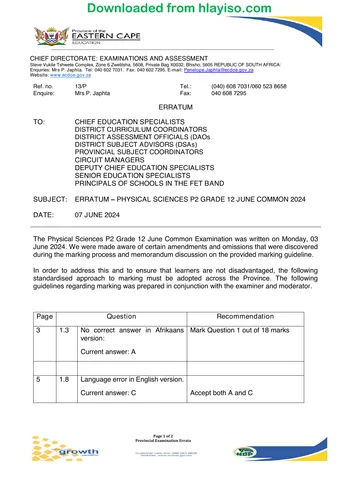
Physical Sciences P2_Erratum_June Common 2024_hlayiso.com_.pdf
Memorandum
PHYS SCIENCES P1 MEMO GR12 SEPT 2024_Afr+English_hlayiso.com_.pdf
Memorandum
XHOSA VERSIONED MEMO EC PHYS SCIENCES P2 MEMO SEPT2024 FINAL_hlayiso.com_.pdf
Memorandum