
Downloaded from hlayiso.com
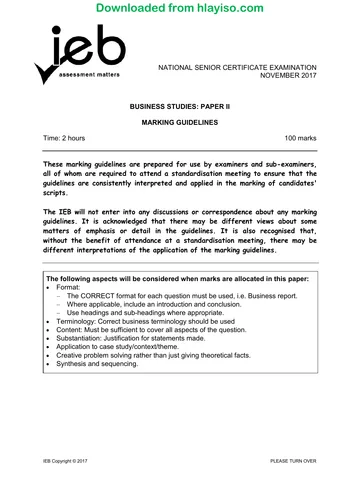
NATIONAL SENIOR CERTIFICATE EXAMINATION
NOVEMBER 2019
BUSINESS STUDIES: PAPER II
MARKING GUIDELINES
Time: 2 hours 100 marks
These marking guidelines are prepared for use by examiners and sub-examiners,
all of whom are required to attend a standardisation meeting to ensure that the
guidelines are consistently interpreted and applied in the marking of candidates'
scripts.
The IEB will not enter into any discussions or correspondence about any marking
guidelines. It is acknowledged that there may be different views about some
matters of emphasis or detail in the guidelines. It is also recognised that,
without the benefit of attendance at a standardisation meeting, there may be
different interpretations of the application of the marking guidelines.
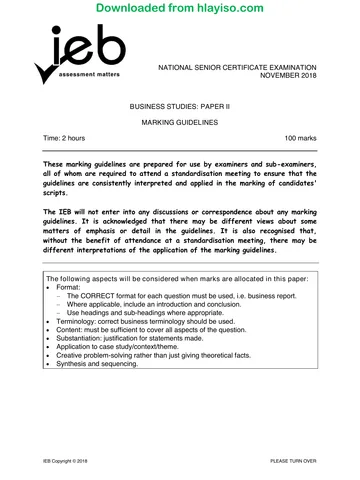
The following aspects will be considered when marks are allocated in this paper:
• Format:
– The CORRECT format for each question must be used, i.e. business report.
– Where applicable, include an introduction and conclusion.
– Use headings and sub-headings where appropriate.
• Terminology: correct business terminology should be used.
• Content: must be sufficient to cover all aspects of the question.
• Substantiation: justification for statements made.
• Application to case study/context/theme.
• Creative problem-solving rather than just giving theoretical facts.
• Synthesis and sequencing.
IEB Copyright © 2019 PLEASE TURN OVER
Skip to contentMemorandum 

View all

Business Studies Grade 12 IEB Paper 2 2019 Memo
IEB Grade 12 Business Studies Paper 2 memorandum from the 2019, 25 pages. Read online or get the free PDF download, question paper linked when available.
Publisher: IEB
Business Studies · Grade 12 · 2019. Memorandum, 25 pages. Read online or download the PDF.
- Subject
- Business Studies
- Grade
- Grade 12
- Document type
- Memorandum
- Year
- 2019
- Paper
- 2
- Publisher
- IEB
- Curriculum
- IEB
- Pages
- 25
- File size
- 346.1 KB
Loading document…
Loading document…
1 of 25
Document textSearch extracted text and jump to a page.
Downloaded from hlayiso.com
NATIONAL SENIOR CERTIFICATE: BUSINESS STUDIES: PAPER II – MARKING GUIDELINES Page 2 of 25
QUESTION 1
Fact marks are allocated as per the rubric for:
• Naming
• Explaining/justifying/motiving
• Examples
• Strategies to solve problems
• Current affairs
• 10 Additional facts – must add value to the discussion/argument(s)
Organisational Performance
Before one considers the problems in the business environment, and the strategies
which may be implemented to eliminate or reduce the impact of problems on the
performance of the business, it is important to look at what the business environment
entails.
With the macro environment, external business influences were identified using a
PE²STLE analysis:
• Political factors
• Economic factors
• Ethical factors
• Social/socio-economic factors
• Technological factors
• Legal environment
• Environmental factors
Porter's six forces model was used to look at the market environment and the influences
of various role players in the market environment:
• Level of rivalry/power of competitors
• Threat of new entrants
• Substitute products available
• Power of buyers
• Power of suppliers
• Complementary products
The micro environment includes the eight business functions:
• Purchasing department
• Production department
• Financial function
• Human Resources/Human Capital function
• Marketing department
• Public Relations
• Administrative function
• General Management
IEB Copyright © 2019 PLEASE TURN OVER
Downloaded from hlayiso.com
NATIONAL SENIOR CERTIFICATE: BUSINESS STUDIES: PAPER II – MARKING GUIDELINES Page 3 of 25
The importance of creative thinking and problem-solving techniques to identify
strategies to improve the overall performance of the business.
• In order to solve problems in a business context, sometimes one needs to be creative
and not only "think out of the box", but "think as if there is no box"! In other words, to
solve new problems, it is not good enough to bring old solutions to the table.
• Creative thinking in this context can be defined as "identifying a problem the consumer
is not even aware of yet and finding a way to solve that problem".
• The aim of finding creative solutions to business related problems is to create and
maintain a competitive advantage for the business. However, in today's fast
changing world, product life cycles are often becoming shorter and therefore the
business must constantly adapt to ensure customer needs are satisfied.
Different creative thinking and problem-solving techniques that can be used to
develop strategies for improving the performance of the business:
Pros and Cons chart
• This technique helps the manager to make a decision based on the advantages and
disadvantages of a specific option, for example:
Introducing a Fast food Instore Brand
PROs CONs
• Gives customers a wider choice • Do not have employee's knowledge
• May attract more customers with this knowledge base – cost of
employing an additional worker
• Have to build more space
• When the advantages and disadvantages are carefully considered or weighed up, a
decision can be made. The decision made may change, if circumstances at a later
stage change.
Decision Tree
• A decision tree is a visual representation (almost like a flow chart) of different
outcomes to a single event. It helps the decision maker to look at different options and
the consequences of each.
Value Chain Analysis
• In a business environment, the concept of adding value for the customer should be the
aim, because a business needs satisfied customers to be successful.
• In a manufacturing environment it is easy to see how and when value is added. Just
follow the process of raw material (input) being transformed into a valuable product
(output). In other instances, however, it may be more difficult to "see" the value added
when a service is rendered, i.e. people use time, knowledge and systems (input) to
create services (intangible output) for the customer.
• If one keeps in mind that there are internal customers (co-workers or the boss) and
external customers, it is important to look at the entire business process to decide
where value is added in a cost-effective manner to enhance the quality of the product
or service rendered.
• It has been recognised that if a business is involved in something that is not its core-
business strength, that particular activity will probably not add value to the business
process. In a case like this, it may be better to outsource the service.
IEB Copyright © 2019 PLEASE TURN OVER
Downloaded from hlayiso.com
NATIONAL SENIOR CERTIFICATE: BUSINESS STUDIES: PAPER II – MARKING GUIDELINES Page 4 of 25
The Delphi technique
• This technique is used as a method to obtain the opinions of experts on a particular
topic, without necessarily engaging with them face to face. Not considering the option
of consulting experts is often incorrectly regarded to be a cost saving measure.
• The real reason why experts are consulted in a situation where they interact, but
remain anonymous, is to prevent a situation where subjectivity and personal opinions
prevent members of the group from expressing their opinions/recommendations
critically.
• Information is analysed and relayed to the panel for a second round of discussions.
The panel then gets an opportunity to revise its conclusions based on the feedback
given by all the panel members except that each panellist's contribution remains
strictly anonymous. This helps to prevent a situation where the panellists are
influenced by the presence or input of each other, or where they simply agree (with the
rest of the panel) to avoid the appearance of being "stupid" (group think).
Resource-Based Approach
• The Resource-Based Approach to problem-solving states that the business should find
out which resources are of strategic importance to the business. These are the
resources that can assist the business to create a competitive advantage in the market
place.
• When a business is faced with a problem, it has to determine which resources are
needed to solve the problem such as the availability and costs of obtaining the
resources. If a scarce resource is needed and the business has this resource
available, it may give the business a competitive advantage. For example: Two
entrepreneurs aim to establish a chicken fast-food business as an added value at their
petrol stations. The one buys a Nando's franchise while the other does not. This
scarce resource (knowledge, expertise, and support from the franchisor, established
brand) will give the Nando's franchisee the competitive edge.
• Resources may include tangible and intangible elements. Tangible resources could
include scarce raw materials, financial resources, land and buildings (good location),
equipment, etc., while intangible assets may be patents, an established brand, skills
and a workforce with a good morale, and a reputation of superior customer service),
etc.
• Depending on available resources and/or the cost to obtain them, different approaches
to solving the problem may be considered.
Balanced Score Card
• The traditional BSC approach was developed by Kaplan and Norton. The reason for
developing the Balanced Score Card is to describe the key outcomes that the business
would like to "measure" (evaluate) in order to improve these outcomes.
• The BSC forces management to focus on issues that are important because they
create value in and for the business. Plans and strategies may then be developed to
create/maintain/improve the competitive advantage of the business.
• The elements of the (traditional) BSC that are used are finance, customer, internal
business perspective, and a learning and growth standpoint. Attempts are made to
identify and describe how each of these plays a critical role in the business.
− The financial perspective focuses on maximum utilisation of assets and
minimising costs in order to create shareholder value.
IEB Copyright © 2019 PLEASE TURN OVER
Downloaded from hlayiso.com
NATIONAL SENIOR CERTIFICATE: BUSINESS STUDIES: PAPER II – MARKING GUIDELINES Page 5 of 25
− The customer perspective focuses on how customers see the business and what
their expectations might be.
− The internal business perspective is focused on innovative products and
services, the management of operations and social investments to improve the
business.
− The learning and growth perspective looks at how employees in the business
can continue to improve and create value. This is done through intangible assets of
the business such as information capital (intellectual property) which is developed
by the human capital (employees). Leadership, accountability, culture and
teamwork are important components when developing a culture of lifelong learning
and development.
Strategies/plans of action on how a business can respond to challenges (trends
and crisis) in the internal and external business environments in order to create or
defend the business' competitive advantage.
In order to formulate a strategy to respond to changes in the business environment, it is
important that management keeps a close eye on events in both the internal and external
business environment. Remember:
• Internal environment: Eight Business functions/departments are evaluated by means of
(inter alia) SWOT (Strengths, Weaknesses), the Resource-Based Approach, the Value
Chain Analysis and Balanced Scorecard (BSC).
• External environment: Market environment (Porter's six forces) and macro
environment (elements of PE²STLE), as well as O & T in both the market and macro
environments.
Strategic management can be defined as:
• Top management analyses events that take place in the business environment. Some
of the events may be something that develops over time (a trend), while other events
may come as a surprise (crisis) to the business.
• The decisions and actions that are taken in response to the analysis. These decisions
and actions then form the strategies of the business.
In order to formulate and implement a successful strategic plan of action, management will
ask the question: "How can we create a competitive advantage in the market?" In order to
answer this question, the first step is to have a clear understanding of:
• What is the vision and mission of the business? The vision is a statement about what
your organisation wants to become, while your mission statement is a description of
what an organisation does or the purpose of the business.
• Once the vision and mission are formulated, the business will outline the long-term
and short-term objectives. When formulating the objectives, the future is the starting
point. The business cannot afford to react to future events only once they take place,
but should "force the future/create its own future". This is done by aligning the present
situation with what is desired in the future. This may mean this business has to
change immediately to "meet the future before it happens" by changing things
proactively. This pre-emptive approach means the business does not wait for the
change to happen, but initiates the change when it is seen as an opportunity for growth
and development. Strategic management enables the manager to make things
happen, rather than to watch things happen or to realise the bigger picture has been
missed.
IEB Copyright © 2019 PLEASE TURN OVER
Downloaded from hlayiso.com
NATIONAL SENIOR CERTIFICATE: BUSINESS STUDIES: PAPER II – MARKING GUIDELINES Page 6 of 25
• Once the objectives have been formulated, strategies are designed and implemented
to achieve the objectives. Although there are a variety of "formal strategies" (as
discussed in the section that follows), a strategy can be defined as any plan of action
to achieve the desired outcome.
Generic strategies:
• Low cost strategy
− The competitive advantage created by a low cost strategy is based on having the
lowest cost in the industry. In order to achieve this, the workforce has to be
committed to saving costs. This can be achieved if:
o The business has access to cheap raw materials (i.e. low input costs).
o Costs can be reduced through efficiency, using mass production, technology,
and re-engineering activities (i.e. low cost manufacturing).
o Activities that do not offer cost benefits must be discontinued or outsourced to
save costs. This strategy works best if there is a big market share which results
in high turnover volumes and therefore high revenue.
• Focus (niche market)
− Using a focus strategy to develop a competitive advantage means all efforts are
aimed at a specific market segment based on geography, culture, age, hobbies or
any other criteria that created a unique group of customers in the market. This
unique group will have different needs than the rest of the target market.
Customers must have distinct preferences that are catered for. This niche market
becomes the focus and presents opportunities for the business, because it is often
overlooked by competitors or viewed as not being "worthwhile". The niche must be
big enough or have growth potential to make it valuable.
o To achieve the successful implementation of a focus strategy, the business
must have expert knowledge of the niche market and the ability to develop the
products for this market segment.
• Differentiation
− All efforts are aimed at providing a unique product/service which will ensure
customer loyalty, as this may give the business the opportunity to charge a
premium price. The uniqueness may be based on factors such as:
o quality (real or perceived per brand name, image, etc.)
o after-sales support
o product features
o distribution or marketing efforts
o in order to base the business' competitive advantage on a differentiation
strategy, it must be difficult for competitors to copy. The key to a successful
differentiation strategy is the continuous redevelopment of products and/or
services to stay abreast of changes in the environment.
IEB Copyright © 2019 PLEASE TURN OVER
Downloaded from hlayiso.com
NATIONAL SENIOR CERTIFICATE: BUSINESS STUDIES: PAPER II – MARKING GUIDELINES Page 7 of 25
Corporate strategies:
• Corporate combination
− There are different options when a corporate combination strategy is implemented:
o A joint venture takes place where two or more businesses enter into an
agreement to combine resources in order to improve the functioning of both
businesses. For example, Engen garages enter into an agreement with
Woolworths Food to allow Woolworths space in the Engen shop to sell
Woolworths' products. This way when people fill up with petrol and want to buy
lunch, they may decide to stop at Engen, because it affords them a choice to do
both activities simultaneously, in ONE place. The same applies to Engen and
Wimpy sharing the premises, both businesses benefit from sharing resources
(premises).
Decline/Defensive strategies
When a business decides to scale down or reduce its operations or some of the products,
it follows a defensive or decline strategy.
• If a business decides to follow a retrenchment strategy, it reduces the size of the
business or reduces the diversity of products/service sold. This is done in order to
reduce expenses and thereby improve the financial position of the business.
Divestiture is part of a retrenchment strategy and involves the business selling off
some its operations because assets used in these operations are under-utilised and it
hampers the financial performance of the business. If Shell decided to sell all their
petrol tankers, it would be an example of divestiture (please note this is NOT
happening, but just an example!).
• If a business is bankrupt, it results in liquidation. This means all assets are sold to pay
for the debt of the business and the business ceases to exist.
Growth
When a growth strategy is implemented, the aim is to grow the business' turnover and
sales volume.
Market penetration: The existing Product development: This involves
market and existing products are taking a new product and offering it to an
used to expand. A business may use existing market. When internet banking
different tactics to achieve this. was introduced for the first time, it was an
Offering lower pricing or more intensive example of product development. There
distribution may convince existing was already a market for banking, but the
New MARKET Existing
consumers of an existing product to first bank which offered customers a
switch business. product to do their banking in a new way,
would attract customers from competitors
and thus grow the business. However, as
soon as competitors copied the "unique"
concept of internet banking, the competitive
advantage was lost.
Market development: When Pick n Diversification: The business enters a
Pay decided to expand to BP Petrol new market with a new product. It does
garages where the concept of retailers not mean the market or product does not
was not yet established, an existing exist at all, merely that this business has
product (food retailing) was taken into never sold this product to this market
a new market. before, and is doing this now to grow the
business.
IEB Copyright © 2019 PLEASE TURN OVER
Downloaded from hlayiso.com
NATIONAL SENIOR CERTIFICATE: BUSINESS STUDIES: PAPER II – MARKING GUIDELINES Page 8 of 25
Other possible strategies to improve the overall performance of the business:
• Revise business mission and/or revise objectives
− Already stated is the mission statement: It is a description of what the business
does or the purpose the business serves. If the business produces/supplies
merchandise which consumers no longer want, it is time to revise the business
mission. A business planning to revise its mission after consumer demand has
already changed, has waited too long.
− In the fast changing world that we live in, no business can afford to "wait and see"
what the future will bring. Management should be proactive in the approach to
possible changes in the market place and then align the mission and objectives of
the business with what is desired in the future. The business will need to revise the
mission and objectives immediately, to "meet the future before it happens".
• Allocate resources differently
− Resources in the business refer to employees, money, machines, time, raw
materials and even skills. Resources should be allocated where they are most
productive, in other words where they create the biggest competitive advantage
and generate the most profits.
− If the business has decided to revise the mission and objectives, it will have to
reconsider how resources are allocated in the business. And, if resources are
allocated to a task that does not add value, that task has either to be outsourced or
to be terminated, so the resources can be re-allocated to a more productive part of
the business' operations.
• Total Quality Management (TQM) and Total Customer Satisfaction
− No business will survive if it does not keep customers satisfied. TQM is a process
where everybody in the business is committed to thinking about how all actions
impact on the quality of all tasks and overall customer satisfaction.
− It is important to note that customer satisfaction refers to internal customers as well,
as the following example illustrates: The training division's customers are all the
employees who are trained in the business (i.e. an internal customer). If the training
department does not follow the philosophy of TQM, employees will lack the correct
knowledge to do their jobs and morale may be low because employees do not feel
empowered to do their jobs. This in turn will impact on production, marketing and all
other departments of the business where these employees work.
− In order to determine the quality of a product or service, inspections can be
conducted. Inspections refer to the process of measuring, examining or testing the
product or service or one or more components thereof. The results are compared to
predetermined specifications in order to assess if the quality is acceptable or not.
Inspections can either be carried out by looking at every product/service produced.
Sampling is a statistical method of quality control where a certain number of items
are tested from the entire production batch. If the tested samples are of a certain
quality (acceptable or not), it is assumed that all items will be of the same quality.
− Remember the business can only improve quality if there is awareness that
something is not right. Thus, it is in the interest of the business to ask customers for
feedback and to respond to the feedback to improve the quality of the product
and/or the service.
IEB Copyright © 2019 PLEASE TURN OVER
Downloaded from hlayiso.com
NATIONAL SENIOR CERTIFICATE: BUSINESS STUDIES: PAPER II – MARKING GUIDELINES Page 9 of 25
• Benchmarking
− Benchmarking is when the business looks at what is "best practice" in the industry.
This involves measuring the business' current performance with the standard it
should be achieving (best practice). If the business is underperforming, steps are
implemented to narrow or eliminate this underperformance gap (between how it is
being done and how it should be done).
• Financial ratios
− Solvency, return on investment/profitability and liquidity, are under the financial
function. These indicators may be used to devise a strategy/plan of action to
improve the function of the business.
• Performance appraisals (360°) and self-evaluation
− A Performance appraisal is a tool used to plan, evaluate and improve the
performance of employees.
− It is a planning tool because during the performance appraisal the employee and
his/her manager discuss and agree on performance targets.
− It is an evaluation tool because at the next appraisal the employee evaluates
his/her performance (self-evaluation), while the manager also evaluates the
employee's performance. Input may even be requested from other relevant parties
that the employee interacts with while performing the job. This may include
customers, suppliers, peers and subordinates. This is called a 360° performance
appraisal.
− It is a feedback tool because the achievement (or not) of targets is discussed and
action plans are developed to solve problems. If applicable, promotion opportunities
and career paths are also discussed.
• Continuous Skills Development
− We are living in an era where knowledge is the most important asset for any
business to have. The business should strive to create a culture where employees
are constantly growing and learning, because this will lead to continuous
improvement in the functioning of the business. Without on-going development of
employees' skills, the business will be in serious trouble. Just think how fast things
are changing around us. New technology, changes in legislation, new products
from competitors or changes in customer demand, all necessitate the staff
acquiring new skills.
− The business has to provide learning opportunities, but the employee also has to
take responsibility for his/her self-development to enable him/her to achieve
personal goals.
IEB Copyright © 2019 PLEASE TURN OVER
Downloaded from hlayiso.com
NATIONAL SENIOR CERTIFICATE: BUSINESS STUDIES: PAPER II – MARKING GUIDELINES Page 10 of 25
• Teamwork
− There are a number of reasons why teamwork is important to the success of the
business:
o Teamwork generates new ideas to improve the business.
o Team members may mentor one another or simply provide a soundboard for
bouncing off ideas.
o The collective team effort is what may make or break a business. Imagine how
upset a customer will be if he/she is told the only person available to assist her
is on leave.
o In a team there are many different types of intelligence and two heads have
always been better than one. One person's strength may compensate for
another's weakness.
o Teamwork may allow for division of labour, where each person gets to focus on
what he/she is good at.
IEB Copyright © 2019 PLEASE TURN OVER
Downloaded from hlayiso.com
NATIONAL SENIOR CERTIFICATE: BUSINESS STUDIES: PAPER II – MARKING GUIDELINES Page 11 of 25
QUESTION 2
Fact marks are allocated as per the rubric for:
• Naming
• Explaining/justifying/motiving
• Examples
• Strategies to solve problems
• Current Affairs
• 10 Additional facts – must add value to the discussion/argument(s)
Investment
When one looks at different investment opportunities available, it may at times be
overwhelming to decide which investment opportunity best suits a person or business.
There are criteria that can be used to determine the most suitable investment option
required at a particular point in time.
The following criteria will be used to evaluate each of the investment options:
• Risk
• Return on investment
• Time frames
Risk
• A high risk investment is expected to deliver a higher return on investment IF the
investment succeeds. A high risk investment could also result in a big loss if the
investment fails. This may be illustrated using a simple example: Someone takes
his/her money to the casino and bets all of it on "red" at the roulette table. If the ball
lands on red, the person gains a HIGH return on the investment. There is an equal risk
that the ball may land on "black" and then all the money is lost and there is a ZERO
return on the investment.
• A further idea relating to risk is the concept of diversification. Diversification means all
eggs are not kept in one basket. Consequently, not ONE of the investment vehicles
(options) below is used to hold all reserves, but rather that a COMBINATION of these
investment options is used to spread risks over different assets.
• The investor has the option to choose the degree of risk relative to the most suitable
investment option for him/her at that point in time.
Return on investment (ROI) can be described as a tool to measure the efficiency of the
investment. It is an indicator of what the investor will get back over and above the original
investment made.
Time frames (period of investment)
The longer the period of investment available to the investor, the greater the risks are that
the investor can afford to take. If someone wants to make provision for his/her retirement
and the person is currently 20 years old, he/she has another 45 years before retirement to
recover any potential losses. If someone, however, is already 50 years old and wants to
make provision for retirement, there is much less time before the retirement age; this
person clearly cannot afford to take too many risks regarding his/her investments.
IEB Copyright © 2019 PLEASE TURN OVER
Downloaded from hlayiso.com
NATIONAL SENIOR CERTIFICATE: BUSINESS STUDIES: PAPER II – MARKING GUIDELINES Page 12 of 25
Investment options/instruments:
Equities/shares:
Description
Equities are also known as shares in a company. Some companies are listed on the JSE
Ltd (hereafter just called JSE), but other companies are unlisted.
When we consider equities or shares, we are going to look at those in listed companies,
because information on the shares' performance is regularly available. If the company is
unlisted, it will not make information on the financial performance of the business available
to anybody but shareholders, banks, creditors and SARS – not to the general public.
Without this financial information, it will be impossible to evaluate whether the investment
has delivered acceptable returns.
The owners of shares (equities) each own a portion of the business. There are two
"options/methods" to become a shareholder in a company listed on the JSE:
• The shares were bought from the company when shares were issued the first time,
thus the person who bought the shares contributes capital to the business.
• The shares were bought on the JSE from a previous shareholder. The money paid for
the share is not going to the business, but to the person who sold his/her shares.
Shares bought and sold on the JSE have no impact on the capital available to the
business.
Risk
• The JSE (and other stock exchanges in the world) have strict rules for companies to
list on the stock exchange to protect investors and (hopefully) decrease the risk of
investing in these listed companies. Despite this, equities are still seen as a moderate
to high risk investment.
• Blue-chip shares are shares in high-end companies on the stock exchange and the
risk of acquiring shares in a blue-chip company is smaller than having shares in
another company. The ROI in these blue-chip companies is usually higher than in
other companies.
• Investors usually take smaller risks than people speculating with shares (see
discussion under time frame to understand the difference between these two groups of
people).
Return on investment (ROI)
When evaluating the ROI of shares bought in a listed company, there are two factors that
contribute to the ROI:
• Increase in share price
• Dividends
Shareholders will buy shares in the company with the expectation that:
• The share price will increase over a period of time (capital growth).
• Good dividends will be generated. Dividends are the profits of the company that are
divided among the shareholders, and are not taxed in the hands of the shareholder in
South Africa.
• A combination of the above occurs, as this usually helps to outperform inflation.
IEB Copyright © 2019 PLEASE TURN OVER
Downloaded from hlayiso.com
NATIONAL SENIOR CERTIFICATE: BUSINESS STUDIES: PAPER II – MARKING GUIDELINES Page 13 of 25
What will determine the price of a share on the stock market? The answer to this question
is quite simply: market forces, or otherwise known as demand and supply! As with any
other commodity that we buy, the price is determined by how many people want the
product (demand) and how much of the product is available (supply).
The question that now begs to be answered is: What determines demand and supply of a
particular share on the JSE? This answer is slightly more complicated. The following
factors will all impact on the demand for the share and therefore also the share price. This
means it will also have an impact on the overall return on the shareholders' investment
(ROI):
• The level of confidence in the state of the economy. When the economy is doing well,
investors will feel positive about investing on the JSE and they will be eager to buy
shares (bull market). If investors are pessimistic and they anticipate losses, they will
sell their shares (bear market).
• Government policies or new legislation will impact on the overall confidence in the
economy of the country and therefore the share prices. If, for example, there is
speculation about nationalisation (state takes over ownership of private assets),
shareholders will want to sell their shares and the share prices will drop.
• Industry performance will affect all the companies listed in that industry. Some
industries may be more attractive to investors than others. If an industry has recently
had negative publicity due to problems (strikes, out-dated technology) or positive
publicity owing to upcoming events (tourism industry will benefit if a world cup event is
won by South Africa), share prices in that industry may fall or increase.
• Financial performance of the business: sales, profits, financial ratios such as solvency,
liquidity, return on investment, and the dividends declared. The better the financial
performance of the business, the more likely the company is to declare good dividends
and as a result the share price is likely to increase.
• Management and the public's confidence in the management team. The higher the
confidence in the management team, the higher the demand will be for the shares and
share prices will increase.
• Social issues surrounding the company may, for example, include its image in terms of
environmentally-friendly manufacturing processes or the degree of involvement in
CSR. This may either have a positive or negative impact on share prices.
• Legal issues such as pending law suits or allegations of price fixing may have a
negative impact on the share price.
• Media coverage increases public awareness of the above developments, thereby
creating certain perceptions of the country, industry and/or company with investors and
potential investors; this in turn will have a direct impact on share prices.
Time frame of the investment
• Some people prefer to invest their money in shares with no short-term need to see
huge capital gains. The investor will invest in blue-chip shares where there is capital
growth (increase in share price) in the long term, and where dividends earned from the
share portfolio are often used to buy more blue-chip shares.
• People that speculate with shares approach the matter differently. Speculators buy
shares in companies that (in their opinion) will have a quick and significant increase in
the share price. The speculator will then sell the shares when there is an opportunity to
make a profit based on a higher share price. The speculator is not really concerned
with dividends.
IEB Copyright © 2019 PLEASE TURN OVER
Downloaded from hlayiso.com
NATIONAL SENIOR CERTIFICATE: BUSINESS STUDIES: PAPER II – MARKING GUIDELINES Page 14 of 25
Debentures:
Description
• Debentures are also sometimes called bonds (not to be confused with a mortgage
bond, which is a loan to buy fixed property).
• A debenture is a letter of credit (an "IOU") that a business sells in order to raise
borrowed capital for large projects.
• Debentures are usually not secured by specific assets. So if the company cannot
repay the debt (debenture) and it is liquidated, the debenture holders will not have a
preferential claim to assets. Having said this, people will be hesitant to buy debentures
in companies that are perceived to be at a high risk of liquidation.
• The debenture holder will receive interest on the amount of the debenture. If the
business issuing the debenture is perceived to be a high risk, a higher interest rate will
have to be offered to convince people to buy the debentures.
• Debenture holders can sell the debenture at any stage to other interested parties on
the JSE.
• Types of debentures:
− A redeemable debenture is repayable on a predetermined date.
− An irredeemable debenture is never paid back by the company, but will last
indefinitely with the debenture holder getting interest.
− A convertible debenture will be converted into shares at a predetermined date in
the future.
Risk
• When the debenture is sold, it is often sold at a fixed interest rate, which has benefits
and risks. Should interest rates drop, the debenture holder will be in the advantageous
position that he/she will earn the higher interest rate on the debenture than what the
banks offer. If, however, interest rates increase then the debenture holder may miss
out on earning higher interest rates offered by other opportunities. If the debenture is
sold at a variable interest rate (link at prime), this risk does not exist.
• Because debentures are usually unsecured financial instruments, there are always
risks of the business going bankrupt, with a consequent loss for the debenture holder
of his/her investment. The degree of this risk will be determined by the company's
financial strength; and of course, the degree of risk linked to the projects/type of
activity with which the business is involved.
• It carries a higher risk than investments at banks, but a lower risk than an investment
in shares, because creditors rank higher than owners to recoup their money in the
event of liquidation.
Return on investment (ROI)
• The company that issues the debenture is legally obliged to pay interest. This
increases the potential for a return on investment when compared to shareholders,
because the company does not have to declare dividends if the financial position does
not allow it.
• There is no capital growth associated with debentures, just a steady stream of interest.
• Because debentures are unsecured debt, the business has to offer a higher interest
rate to potential investors to compensate them for the higher risks.
• Remember interest income is taxable (above the threshold) and after tax is paid, the
ROI on debentures seldom beats inflation.
IEB Copyright © 2019 PLEASE TURN OVER
Downloaded from hlayiso.com
NATIONAL SENIOR CERTIFICATE: BUSINESS STUDIES: PAPER II – MARKING GUIDELINES Page 15 of 25
Time frame of the investment
• Debentures may be used as long-term financial instrument to earn interest until such
time as the debenture is redeemed.
Retirement Annuities and pension funds:
Description
• A retirement annuity (RA) is a policy that aims to provide an income to the person
when he/she reaches the age of 55. A monthly premium is paid and when the RA pays
out, it will be in a lump sum, combined with a monthly income. The amount of money
paid out when the RA matures, will depend on the period the premiums were paid
and/or how high the premiums were.
• The government cannot provide for all citizens to maintain a decent standard of living
on old age pensions, thus it wants to encourage people to make provision for their own
retirement. For this reason tax relief is given on RA premiums.
• Pension funds are created when all employees, belonging to the particular pension
fund, pool their contributions with a Pension fund administrator. This administrator then
invests the funds in such a manner that it will (hopefully) grow and exceed inflation.
When people reach retirement, they then receive a monthly pension (income) from the
fund. Contributions made to pension funds are deducted from salaries before taxable
income is calculated. The reason, once again, is that government wants to encourage
people to make provision for their own retirement income.
Risk
The risk associated with both a RA and a pension fund will depend on how and where the
administrators have invested the contributions of members.
We can also look at risk from a different perspective. Think how pension funds or RAs can
help individuals to manage their risk of not having sufficient income to survive once they
have retired (when they no longer earn a salary).
Both RAs and Pension funds are tools to make provision for an income when the
employee stops working and goes on pension. Unfortunately there are many people who
do not make sufficient provision for their pension and as a result they cannot maintain
their standard of living. The following points reflect some of the reasons why people may
not be financially secure when they reach retirement age:
• People wait too long before starting to make provision for retirement. Who wants to
think about saving money for some 30 or 40 years in the future?
• People generally live longer due to good medical care and, therefore, need to make
provision for a longer time after 65 (retirement age), when they will be without a salary.
• Getting older may also mean more money is needed for health care. Additional
provision should be made for these costs.
• People do not always consider the loss of benefits when they retire. They are happy if
their salary, at the time of retirement, matches the pension payment. What, however,
about the loss of a company car or housing subsidy when retirement is reached? One
would in such a case actually need MORE money from the pension fund/RA than the
last salary earned.
• When people change jobs, the pension built up at the previous job may be paid out.
People should immediately reinvest this money in the new pension fund, rather than
spending it on luxuries. Unfortunately, many do not reinvest their money.
IEB Copyright © 2019 PLEASE TURN OVER
Downloaded from hlayiso.com
NATIONAL SENIOR CERTIFICATE: BUSINESS STUDIES: PAPER II – MARKING GUIDELINES Page 16 of 25
Pension funds also have the option/benefit to help members to manage risks in terms of
death and/or disability, as it offers cover for both these events.
Return on investment (ROI)
• The ROI will be determined by the prudent decisions of the investment manager that
handled and invested the contributions. There are no guarantees and even if a specific
ROI is guaranteed by the RA fund/Pension fund, it is important to compare this to
inflation. Note: The figures regarding ROI given by the funds usually sound better than
what they really are, because the funds make "predictions" of what they are hoping to
achieve.
• Also be aware that most financial instruments (pension funds and RA included) will
have administrative costs and management fees which will reduce the ROI.
Time frame of the investment
From the above discussion under "Risk", it should be clear that provision for retirement, be
it in the form of a RA or a pension plan is something that should be started as soon as
possible and maintained for the entire 40 or 45 years that a salary will be earned as an
employee.
Endowments:
Description
• Endowments are a form of long-term saving. The saving can be in the form of a lump
sum investment and/or monthly contributions.
• The investor will get the full amount after a predetermined period when the policy
matures (usually 5 to 10 years), or in the case of death, the next of kin will receive the
investment immediately.
Risk
• When taking out an endowment policy, the investor can choose the risk profile he
would like to have – varying from high risk in an equity fund to a lower risk where a
more balanced investment approach is followed.
• If the investor has chosen to invest monthly contributions, it is possible (with some
insurers) to add a Contribution Waiver, which means if the investor suffers from a
serious illness or becomes disabled, consequently being unable to continue
contributing to the investment, the insurer will pay the monthly contributions on behalf
of the insured. This is a form of risk management that the insured can take out in the
event of adverse circumstances.
Return on investment (ROI)
• The ROI will depend on the risk profile chosen.
• There are management and admin fees that are deducted from the savings amount
that will reduce the ROI.
Time frame of the investment
The investment is usually for a period of between 5 and 10 years. It is thus a long-term
savings plan.
IEB Copyright © 2019 PLEASE TURN OVER
Downloaded from hlayiso.com
NATIONAL SENIOR CERTIFICATE: BUSINESS STUDIES: PAPER II – MARKING GUIDELINES Page 17 of 25
Offshore investments:
Description
• When one decides to invest locally, the decision has to be made about which
investment vehicle is most suitable.
• The same choices have to be made when investing in a different country (offshore).
• Offshore investments are, therefore, quite challenging, but worthwhile investment
options, if prudent choices are made.
Risk and Return on investment (ROI)
Some of the reasons for choosing to invest in an offshore account may include:
• Diversification (when referring to offshore investments) means that risks are spread
over different countries. Some countries are considered to have more stable markets
(developed countries) than others (emerging markets).
• Changes in exchange rates may make it more attractive to invest in another country.
The Rand has shown a tendency to depreciate against the major currencies of the
world – US Dollar, British Pound and the Euro. If the currency depreciates (get weaker)
it is favourable for someone with an investment in a foreign country. To illustrate how a
depreciating Rand can have a good ROI as a result, consider the following example:
Suppose John has invested R5 in the USA at a time when the exchange rate was
1$ = R5. This means he will have an investment = 1$. The exchange rate has since
depreciated to 1$ = R10. If John cashes his investment in now, he will get R10 for the
original R5 that he invested.
• There may be investment opportunities in other countries that do not exist in South
Africa. South Africa does not have oil and if an investor feels oil is a good investment
to make, he/she will have to buy shares in an oil company listed in another country.
• Someone may consider the option of emigration to a different country. Because of the
exchange control mechanisms in place in South Africa, it is only possible to take a
limited amount of money out of the country each year. It may then be a good idea to
begin to an investment portfolio in the foreign country.
Time frame of the investment
The only limitation in terms of time is the amount of money that may be taken out of the
country every year owing to exchange control by the Government. Offshore investments,
however, may be used as a long-term or short-term investment strategy.
Unit trusts:
Description
• Unit trusts can be described as a "basket of shares" that is trading on the stock
exchange.
• When buying unit trusts, the investor will indicate the type of risk profile that is
acceptable to him/her.
• Unit trusts are managed by a fund manager that is responsible for looking after that
specific fund.
• A unit trust fund can be diversified over various industries on the JSE or between
various companies within a particular industry. The person buying the unit trusts
decides which option he/she wants to invest in.
• Unit trusts can be bought with a lump sum, monthly contributions or a combination of
the two.
IEB Copyright © 2019 PLEASE TURN OVER
Downloaded from hlayiso.com
NATIONAL SENIOR CERTIFICATE: BUSINESS STUDIES: PAPER II – MARKING GUIDELINES Page 18 of 25
Risk
The options available to choose from may vary from a high risk equity fund where all funds
are invested in shares, to a stable fund where risks are reduced by diversifying
investments between equities, international markets and even investing in some low risk
money market instruments.
Return on investment (ROI)
• A good unit trust investment will outperform inflation over the medium term of 3 to 5
years.
• The rate of return will depend on the risk option that was chosen, but will ultimately
depend on how well the fund manager has invested the money.
Time frame of the investment
Investing in unit trusts is usually a medium to long-term investment.
Collectibles:
Description
• Examples of collectables may include antiques, coins, artwork, stamps, jewellery and
Kruger Rands.
• When collectables are chosen, it is important to have a good understanding of the
market where these items are bought and sold.
• The market for collectables in South Africa is limited when compared to the rest of the
world, but with technology this is becoming less of a problem.
Risk
• To deal in collectables requires a high level of knowledge and expertise.
• Any damage to something like a stamp collection, artwork or antiques will drastically
diminish the value.
Return on investment (ROI)
• If the article is truly a collectable, the value of the article will increase over time
(provided there is no damage).
• The disadvantage of this type of investment is that there is no monthly source of
income for the investor.
Time frame of the investment
• The markets for true collectables are not really volatile and this type of investment
generally shows growth over a long period.
• Of course it is possible to make a profit over a short period of time if an item was
bought at a low price, e.g. an unknown artist suddenly becomes famous because he/
she was "discovered". Or, a piece of antique furniture, bought at a pawn shop that
does not know the value of the article, is subsequently sold at a handsome profit.
Generally, these finds are the exception to the rule and sheer luck for the investor.
IEB Copyright © 2019 PLEASE TURN OVER
Downloaded from hlayiso.com
NATIONAL SENIOR CERTIFICATE: BUSINESS STUDIES: PAPER II – MARKING GUIDELINES Page 19 of 25
Notice deposits:
Fixed deposits:
Description
• A fixed deposit is opened with the bank when a fixed amount of money is invested for
a fixed (predetermined) time at an interest rate that can either be fixed or changes as
the prime rate changes.
• Fixed deposits are long-term investments and the money may only be withdrawn when
the maturity date is reached or when the investor dies. If the investor wants to
withdraw the funds before the maturity date, a penalty will be charged.
Risk
Money invested with the bank generally has a very low risk. The investment can only be
"lost" if the bank is liquidated. It has happened in South Africa that banks have been
liquidated in the past, a relatively rare event. However, take note of the situation where
African Bank was placed under Curatorship in Augustus 2014 to understand that even
money in the bank carries some risk.
Return on investment (ROI)
• The interest rate offered on a fixed deposit will differ from bank to bank. It will also
depend on the amount of money invested. Generally the longer the time frame and the
higher the amount invested, the higher the interest rate will be. Despite this, it can only
be hoped that the fixed deposit (even with cumulative interest) will exceed inflation.
Unfortunately, it is often not the case.
• The only capital growth achieved with a fixed deposit is if interest on the fixed deposit
is capitalised (re-invested). Cumulative interest is then earned on the original fixed
deposit and the interest that was reinvested.
• If the investor decides that the interest must be paid out to him/her to supplement
his/her income, there will be no capital growth.
• The return on investment with a fixed deposit is usually low, but then, so is the risk
associated with the fixed deposit.
Time frame of the investment
Fixed deposits can be from a year to 10 years (or even longer). The longer the time frame
of the investment, the higher the interest rate usually is.
Money market accounts:
Description
• A Money market account is a form of short-term investment and it is becoming
increasingly popular.
• It is easy to gain access to money market accounts in the short-term, because they are
very liquid. An example of a money market account is a call account, where money is
invested "indefinitely". The investor only has to give notice that he/she wants to
withdraw funds in the future. A 32-day call account has a notice period of 32 days.
Risk and Return on investment (ROI)
Money market accounts have a low risk, but offer a lower interest rate than longer-term
investments.
IEB Copyright © 2019 PLEASE TURN OVER
Downloaded from hlayiso.com
NATIONAL SENIOR CERTIFICATE: BUSINESS STUDIES: PAPER II – MARKING GUIDELINES Page 20 of 25
The interest rate on money market accounts usually outperforms normal savings
accounts.
This makes them attractive options for short-term investors.
Time frame of the investment
A money market account is a short-term investment option, ranging in time periods of
about a month to a year.
Insurance
When people talk about insurance, they usually refer to both insurance and assurance.
• INsurance is IN case something happens (e.g. fire, theft, flood, etc.). These events
may or may not take place, but in order to manage the risk IN case they do occur, the
insured wants to be INdemnified (placed in the same financial position he/she was in
before the incident).
• AS sure as we are human beings living on planet Earth, we will all retire after we have
worked or it is possible that death may come first. We can manage the risk of our loved
ones being without income if we die, or the risk of being unable to maintain a decent
standard of living after retirement, through ASsurance.
By taking out insurance or assurance, the insured (an individual or business) pays a
monthly premium to transfer the risk to the insurer.
Insurable and non-insurable risks
Some risks are UNinsurable and some of them are so expensive to insure, that it is
UNaffordable to insure against these risks. Some of these risks are:
• War and associated risks are generally uninsurable as insurance companies regard it
as a risk that should be managed by the Government (it should be prevented).
• One risk, that is generally considered to be uninsurable, is bad debt. There is,
however, insurance available against bad debt, but it is one of those risks that is
almost unaffordable.
• Business risks, such as price fluctuations due to time intervals (between the time that
the goods are ordered and the time they are received), are not covered by means of a
traditional insurance policy. The business may, however, decide to hedge against such
risks, but that is not part of our syllabus.
• If trading inventory becomes obsolete or outdated due to changes in fashion, it is a
business risk that is not insurable.
• Technology changes at quite a rapid pace and constant improvements are made to
machinery and the production processes. A business cannot take out insurance
against machines becoming outdated. Leasing, however, is an option to prevent being
stuck with outdated equipment.
• No one can take out insurance against committing an illegal act. For example, I cannot
take out an insurance policy against a penalty imposed for a traffic offence.
IEB Copyright © 2019 PLEASE TURN OVER
Downloaded from hlayiso.com
NATIONAL SENIOR CERTIFICATE: BUSINESS STUDIES: PAPER II – MARKING GUIDELINES Page 21 of 25
Types of insurance:
Compulsory insurance:
Unemployment Insurance Fund (UIF)
• The Unemployment Insurance Amendment Bill (2013) changes certain issues that
were covered by the Unemployment Insurance Act of 2001.
• The Unemployment Insurance Fund (UIF) gives short-term relief to workers when they
are unemployed, or if they are unable to work because of maternity leave or illness. It
also provides relief to the dependants of a deceased employee who has contributed to
the fund.
• Contributions are made by both the employee and employer. 1% of the gross salary is
deducted from the employee's salary and an equal amount is contributed by the
employer who is responsible for paying this amount to SARS. The ceiling amount (limit
for the purposes of calculating contributions) is currently (2015) R14 872 per month.
• The following people are excluded from UIF insurance:
− Employees who work less than 24 hours a month
− Employees who earn commission only
• Civil servants and foreigners working in the country were previously excluded. Now
some foreigners are covered by UIF. Employees on learnerships are also included.
• Domestic workers are INCLUDED in UIF and the employer must ensure he/she
registers with the Department of Labour.
• The maximum amount that will be paid to the unemployed worker is 58% of the
monthly salary, provided he/she has already contributed for at least 4 years to UIF
(new amendments to the Act, talk about 5days worked is equal to one days claim). The
claim will not be paid for more than 238 days. In the case of maternity leave the
maximum number of days that the mother can claim for is 121 days.
• Maternity leave can be claimed, at a flat rate of 66%, provided all requirements of the
Act have been meet.
Compensation for Occupational Injuries and Diseases Act (COIDA)
• This was previously known as the Workmen's Compensation Fund.
• If an employee is injured at work or becomes sick or disabled as a result of his/her job,
the person is entitled to claim compensation from the COIDA. It is also possible for
families or dependants of a breadwinner to claim, if he/she has died as a result of a
work-related accident or disease.
• Every employer registers with the Compensation Fund and pays an annual fee based
on the employee's earnings and the risks associated with that particular job.
• The amount of compensation paid to an employee is calculated as a percentage of the
salary that the employee was earning at the time.
• When will claims not be paid?
− Privately employed domestic workers cannot claim, but domestic workers
employed by a hotel or guest house may claim.
− Members of the South African National Defence Force or South African Police
Services are not covered by COIDA, because they have their own separate fund.
− If the employee is booked off for three days or less due to the incident, the fund will
not pay.
− If the claim is older than 12 months from the date of the incident or when the
diagnosis was made, automatic rejection of the claim occurs.
IEB Copyright © 2019 PLEASE TURN OVER
Downloaded from hlayiso.com
NATIONAL SENIOR CERTIFICATE: BUSINESS STUDIES: PAPER II – MARKING GUIDELINES Page 22 of 25
Road Accident Fund (RAF)
• The Road Accident Fund (RAF) is compulsory insurance that covers all users of South
African roads.
• The RAF assists people injured in a motor vehicle accident and will pay for
rehabilitation and medical claims.
• The RAF provides indemnity to the person guilty of causing the accident; this prevents
the person injured, or his/her family, from lodging a claim against the guilty party.
• The RAF will pay in the following instances:
− Any person injured in a motor vehicle accident, whether it is the driver, a passenger
or a pedestrian
− The family of a deceased victim may also claim
• Contributions to the fund are included in the petrol/diesel price.
Non-compulsory insurance
There are a variety of insurance policies available to businesses and individuals. Different
insurance companies may offer short-term insurance policies that differ from one another.
What is given below is a generalisation, as it is acknowledged that differences between
policies may exist.
When insurance is taken out, the insured pays a premium to the insurer (e.g. Sanlam,
First for Women, MiWay, Auto and General, Outsurance, etc.) to cover the risk of a
specific event that may occur. Premiums for these insurance policies will depend on the
personal needs, the risk profile of the customer, but also on the value of the assets that
are insured.
Fire insurance
• Although fire insurance is listed in some books as a separate insurance policy, insuring
against fire will usually form part of other insurance policies:
− Fire damage to the structure of a house or building is usually included in the
insurance made compulsory by banks, when they finance a bond for the building.
− Fire causing damage to a vehicle will be included in the vehicle insurance.
− The content of the house or building will be covered against fire by the
householder's insurance.
• The more flammable a product (thatch roof or inventory such as wood, paper, gas,
etc.), the higher the risk and therefore the higher the premium.
• The nature of the surrounding buildings may also have an impact on the risk and
premium. If the building (house or business) that is insured is next to a garage (selling
petrol or diesel) there will be a high risk associated with the insurance and therefore, a
high premium payable.
General business insurance/commercial insurance
Business insurance is probably one of the most important decisions the entrepreneur or
manager has to consider in order to protect the business from losses caused by
unforeseen circumstances. These circumstances may include theft (shoplifting), burglary
(forced entry), public liability if a customer slips on a wet floor and sustains an injury while
in the shop (called liability insurance), and damages from fire or elements of nature.
Insurance contracts relating to insurance for inventory (trading stock) will include an "iron
safe clause". This requires the insured (business) to keep a record of stock on hand in a
safe that is fireproof and that cannot be destroyed by the fire. It is no longer required to
keep back-up records in a fireproof safe on the premises, as technology enables stock
records to be kept off-site.
IEB Copyright © 2019 PLEASE TURN OVER
Downloaded from hlayiso.com
NATIONAL SENIOR CERTIFICATE: BUSINESS STUDIES: PAPER II – MARKING GUIDELINES Page 23 of 25
The business also has to be aware that in extreme circumstances there may be a total or
partial loss of income if the business cannot operate while repairs are being done. This
loss of income can also be covered in a Commercial insurance policy.
Household insurance
A Household policy usually includes all types of assets that form part of every household
that is at risk due to events such as burglary, accidents or losses caused by fire, lightning,
floods, etc. Assets may range from furniture, electrical items, clothing, toys, sports
equipment, and tools to gardening equipment. If the insured has visitors, their belongings
may also be covered if provision was made for it in the policy. Liability insurance is
usually also included as part of the household insurance. This will cover the home owner
against losses or injuries sustained by people visiting or working on the premises.
Vehicle insurance
When we talk about vehicle insurance, we normally distinguish between two options:
• Fully comprehensive: Fully comprehensive insurance means the insured's car and
the other vehicle will be repaired in the case of an accident. Damage caused by fire will
be covered or if the car is stolen the insured will be indemnified (put in the same
financial position than before the loss occurred). It is important to remember that items
such as expensive sound systems, laptops and other expensive items must be
specified separately to avoid these assets not being covered by the insurance policy.
Insurers can work out a tailor-made solution to cover the individual needs of the
insured.
• Third-party, fire and theft: The older the vehicle, the less the value. If a vehicle is
relatively old, it may not be financially viable to continue paying fully comprehensive
insurance, because the chances are the insurance company will write off the vehicle if
it is damaged and not pay out a decent value. In such a case, if the driver (of the old
vehicle) is to blame for an accident that caused damage to another very expensive car,
at the very least, the damage to the other car (third party) should be paid by his/her
insurance company. This type of insurance also pays out if the car is stolen or
damaged in a fire.
We have already mentioned that the premium paid on insurance will be determined by the
value of the asset and the risk. It is interesting to note that male drivers under the age of
25 are classified as a very high risk and that their car insurance premiums are usually very
expensive!
Money in transit insurance
If a business handles a lot of cash, it may be prudent (wise) to take out Money in transit
insurance to cover any potential losses that may occur between the business and the
bank. Some businesses prefer not to take this risk and will outsource the transportation of
the money to a third party such a Coin Security company (which will definitely have this
type of insurance).
Fidelity insurance
Fidelity insurance is taken out to protect the business against financial losses caused by
dishonest employees. Theft of money or fraud may be covered. If there are only one or
two people in the business handling money or working with finances, the policy may be
taken out to cover individual employees (their names are specified on the policy). If a large
number of staff members need to be covered, a floating policy may be taken out where
specific positions (jobs), rather than individual people are covered.
IEB Copyright © 2019 PLEASE TURN OVER
Downloaded from hlayiso.com
NATIONAL SENIOR CERTIFICATE: BUSINESS STUDIES: PAPER II – MARKING GUIDELINES Page 24 of 25
LOWER ORDER THINKING RUBRIC (60% WEIGHTING)
CRITERIA 0 1 2 Question 1 Question 2
Format Not meeting the correct standard Partially correct format Correct format
0 1 2 3
Terminology No use of business terminology Isolated/limited use of business Good use of business Outstanding use of business
terminology terminology terminology
Content (number of Maximum 50 facts. Divide by two to get mark out of 25. Marks are inter alia given for mentioning the fact, explanations of facts or
relevant facts) statements, relevant examples, expansion of acronyms. NOTE: Listed facts that are not explained = max 4 marks (8 facts)
Subtotal: (30 marks) 1A 2A
HIGHER ORDER THINKING RUBRIC (40% WEIGHTING)
If all SECTIONS have not been completed, the judgment is based on the amount of expected information.
E.g. A candidate substantiating one section well, but not answering the other cannot qualify for a "majority of statements" mark.
CRITERIA 0 1 2 3 4 Question 1 Question 2
Substantiation No attempt at Very limited Less than half of the The majority of the The majority of the
(justification for substantiation. substantiation. statements are statements are statements are
statements made) substantiated. substantiated. thoroughly substantiated
showing breadth and/or
depth of understanding.
0 1 2 3 4
Application to context/ Superficial reference Continuous reference is Continuous reference is Examples are relevant to Examples are relevant to
industry based on the case made to the case made to the case the case study/context the case study/context
study/context given study/context given with study/context given with given and fully integrated given and fully integrated
(Just keep mentioning some applicable several examples that into the response into the response
the name of the business examples given. are fully integrated into showing understanding showing understanding
repeatedly without the answer. of the issues at hand. of the issues at hand.
relevant examples). Reference is made to Current affairs are fully
current affairs. integrated into the
response.
IEB Copyright © 2019 PLEASE TURN OVER
Downloaded from hlayiso.com
NATIONAL SENIOR CERTIFICATE: BUSINESS STUDIES: PAPER II – MARKING GUIDELINES Page 25 of 25
0 1 2 3 4 5 6
Creative problem- No understanding Identification of Identification of Good insight and Good insight and Good insight and Good insight and
solving of the problem the problem and the problem with understanding of understanding of understanding of understanding of
and no solution an incorrect/poor breadth but no half the problem the majority of the the holistic the holistic
given. solution depth (superficial). with solutions problem(s) with problem with problem with
suggested. offered showing solutions offered solutions offered solutions offered
depth of showing depth of which are fully which are fully
understanding OR understanding OR discussed, discussed,
less than half in half in breadth and showing showing breadth
breadth and depth. understanding on and depth of
depth. all aspects OR the understanding.
majority in breadth
and depth.
0 1 2 3 4 5 6
Synthesis None of the At least one of the Any two of the Any three of the Any four of the Any five of the All six of the
criteria as listed criteria fulfilled. criteria fulfilled. criteria fulfilled. criteria fulfilled. criteria fulfilled. criteria are
below are met. fulfilled.
1. Introduction – don't just re-write question, but shows an understanding of the "link" between the topics.
2. Conclusion – this should be a logical affirmation of the points raised.
3. Flow of thought, i.e. paragraphs leading into one another.
4. Integration of topics given in the question.
5. Integration of question with other business related topics to enhance the quality of the answer.
6. Arguments are developed.
Subtotal: (20 marks) 1B 2B
TOTAL
Total: 100 marks
IEB Copyright © 2019
Study this subject
Revise the topics in this paper, then practise them question by question.
- Grade 12 Business Studies notes
CAPS revision notes with worked examples.
- Business Studies questions by topic
Past exam questions sorted by CAPS topic, with memos where available.
- Grade 12 Business Studies quizzes
Short topic quizzes with instant feedback.
- All Grade 12 Business Studies past papers
Past papers by year, with memos where available.
- Grade 12 IEB past papers
More Business Studies and other subjects in this collection.
Recommended for this subject
More papers and memos for this grade and subject.
MemorandumIEB
Business Studies Grade 12 IEB Paper 1 2019 Memo
MemorandumIEB
Business Studies Grade 12 IEB Paper 1 2018 Memo
MemorandumIEB
Business Studies Grade 12 IEB Paper 2 2018 Memo
MemorandumIEB
Business Studies Grade 12 IEB Paper 1 2017 Memo
MemorandumIEB
Business Studies Grade 12 IEB Paper 2 2017 Memo
MemorandumIEB
Business Studies Grade 12 IEB Paper 1 2017 Memo
Related documents
Question paperIEB
Business Studies Grade 12 IEB Paper 2 2019 Question Paper
Question paperIEB
Business Studies Grade 12 IEB P2 2019 Question Paper (Afrikaans)
Question paperIEB
Business Studies Grade 12 IEB P2 2019 Question Paper (Afrikaans)
MemorandumIEB
Business Studies Grade 12 IEB Paper 2 2016 Memo
Question paperIEB
Business Studies Grade 12 IEB Paper 1 2019 Question Paper
Question paperIEB
Business Studies Grade 12 IEB P1 2019 Question Paper (Afrikaans)
More from Grade 12 Business Studies
Question paperIEB
Business Studies Grade 12 IEB P1 2019 Question Paper (Afrikaans)
Question paperIEB
Business Studies Grade 12 IEB Paper 1 2018 Question Paper
Question paperIEB
Business Studies Grade 12 IEB Paper 2 2018 Question Paper
Question paperIEB
Business Studies Grade 12 IEB Paper 1 2017 Question Paper
Question paperIEB
Business Studies Grade 12 IEB Paper 2 2017 Question Paper
Question paperIEB