
Downloaded from hlayiso.com
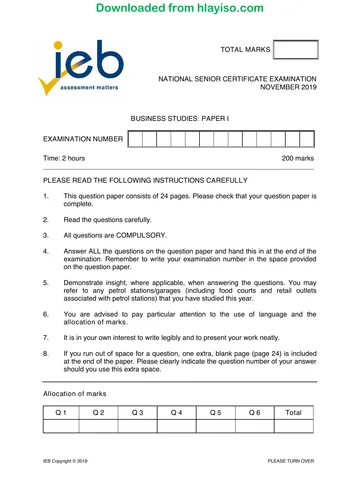
NATIONAL SENIOR CERTIFICATE EXAMINATION
NOVEMBER 2019
BUSINESS STUDIES: PAPER I
MARKING GUIDELINES
Time: 2 hours 200 marks
These marking guidelines are prepared for use by examiners and sub-examiners,
all of whom are required to attend a standardisation meeting to ensure that the
guidelines are consistently interpreted and applied in the marking of candidates'
scripts.
The IEB will not enter into any discussions or correspondence about any marking
guidelines. It is acknowledged that there may be different views about some
matters of emphasis or detail in the guidelines. It is also recognised that,
without the benefit of attendance at a standardisation meeting, there may be
different interpretations of the application of the marking guidelines.
IEB Copyright © 2019 PLEASE TURN OVER
Skip to contentMemorandum 
View all

Business Studies Grade 12 IEB Paper 1 2019 Memo
IEB Grade 12 Business Studies Paper 1 memorandum from the 2019, 18 pages. Read online or get the free PDF download, question paper linked when available.
Publisher: IEB
Business Studies · Grade 12 · 2019. Memorandum, 18 pages. Read online or download the PDF.
- Subject
- Business Studies
- Grade
- Grade 12
- Document type
- Memorandum
- Year
- 2019
- Paper
- 1
- Publisher
- IEB
- Curriculum
- IEB
- Pages
- 18
- File size
- 300.4 KB
Loading document…
Loading document…
1 of 18
Document textSearch extracted text and jump to a page.
Downloaded from hlayiso.com
NATIONAL SENIOR CERTIFICATE BUSINESS STUDIES: PAPER I – MARKING GUIDELINES Page 2 of 18
SECTION A
QUESTION 1 Multiple Choice
1.1 B
1.2 D
1.3 A
1.4 A
1.5 D
1.6 B
1.7 C
1.8 D
1.9 C
1.10 A
QUESTION 2 Match the columns
2.1 G
2.2 B
2.3 D
2.4 J
2.5 A
2.6 O
2.7 H or A
2.8 M
2.9 K
2.10 I
QUESTION 3
3.1 laissez-faire
3.2 Excess
3.3 Benchmarking
3.4 Retain
3.5 Global Reporting Initiative / GRI
IEB Copyright © 2019 PLEASE TURN OVER
Downloaded from hlayiso.com
NATIONAL SENIOR CERTIFICATE BUSINESS STUDIES: PAPER I – MARKING GUIDELINES Page 3 of 18
SECTION B
QUESTION 4
Required: Supply the missing information in each of the following schematic diagrams.
4.1 Macro challenges faced by a PETROL STATION franchise in South Africa
Macro challenge Describe why the element in the first Provide a different strategy for
column could be a challenge each of the macro challenges
identified in the first column
• Economic growth and development rates in The suggested strategy must link with
4.1.1 Economic the country, and the direct consequence of the given challenge.
these factors: the improvement (or (Consider any relevant strategy to
deterioration) of the standard of living of overcome the challenge)
the people of the country.
• Inflation rates: inflation is the continuous
and significant increase in the general
price level of goods and services.
• The higher the inflation rate, the lower the
purchasing power the monetary unit will
be.
• Interest rates: the rate at which people or
businesses borrow money from the bank
or the percentage return on investment
when saving money in the bank.
• High interest rates make it difficult for
businesses to borrow money to expand.
• Exchange rates, i.e. the strength of the
local currency vs. the currencies of other
countries.
• If the rand depreciates against another
currency, it will become more expensive to
import from that country.
• High unemployment rates mean people do
not have money and as a result,
businesses suffer lower profits.
• Taxes such as income tax, VAT, import
duties, etc.
(Consider any other relevant economic
challenge)
(Minimum of 1 mark, has to show why it is a
challenge for a petrol station)
• The number of single parents providing for The suggested strategy must link with
4.1.2 Social a family. the given challenge.
• HIV/Aids infection and diseases such as (Consider any relevant strategy to
TB and malaria. overcome the challenge)
• Levels of literacy/education which hamper
the development of a career and the ability
to ask for a decent wage / salary.
• High levels of unemployment rates
• Personal safety and crime.
• The changing role of women in society in
certain cultures.
• Cultural and ethnical attitudes / traditions.
(Consider any other relevant social
challenge)
(Minimum of 1 mark, has to show why it is a
challenge for a petrol station)
IEB Copyright © 2019 PLEASE TURN OVER
Downloaded from hlayiso.com
NATIONAL SENIOR CERTIFICATE BUSINESS STUDIES: PAPER I – MARKING GUIDELINES Page 4 of 18
• Rapid development of issues surrounding The suggested strategy must link with
social media. the given challenge.
• Automation of different processes, (Consider any relevant strategy to
requiring less use of lower-skilled (and overcome the challenge)
4.1.3 thus cheaper manual labour).
Technological • Advances in online money transfers
(internet banking, electronic fund
transfers).
• Quicker sales transactions in the fuel
forecourts through EPOSSE (Electronic
Point of Sales Scanning Equipment as
opposed to manual pricing) at pay points.
• Product innovation through Research and
Development (R & D).
(Consider any other relevant technological
challenge)
(Minimum of 1 mark, has to show why it is a
challenge for a petrol station)
Possible strategies that could apply to question 4.1.1 – 4.1.3
Give credit if the candidates mention the following strategies in their answers
(where appropriate)
• Growth strategies (e.g. market penetration, product development, market
development, diversification)
• Decline/Defensive strategies (e.g. divesture strategy, liquidation strategy and
retrenchment strategy)
• Corporate combination strategies (e.g. joint ventures, mergers, takeovers)
• Generic strategies (e.g. low-cost strategy, differentiation strategy, focus strategy)
• Integration (e.g. forward integration, backward integration, horizontal integration)
• Revising business mission
• Establish or revise objectives
• Allocate resources differently
Note: Candidate cannot just give the name of the strategy – there must be an
explanation with the strategy.
IEB Copyright © 2019 PLEASE TURN OVER
Downloaded from hlayiso.com
NATIONAL SENIOR CERTIFICATE BUSINESS STUDIES: PAPER I – MARKING GUIDELINES Page 5 of 18
4.2 Triple bottom line/Integrated reporting by Vivo Energy Ltd (Controlling
company of Shell and Engen Garages)
THREE elements of triple Discuss, with the aid of an example for each
bottom line/integrated element, how Vivo Energy Ltd can comply with the
reporting triple bottom line/integrated reporting requirement
• The financial statements of Vivo Energy Ltd are
4.2.1 The earning of profit externally audited, thus ensuring that the
(bottom line) requirements of the Companies Act are met.
• The auditors' comment on the fact that the profits
and facts contained in the annual report are a true
reflection of the financial performance of the
business.
• The company has also complied with the relevant
risk assessment and ethical requirements of the
Companies Act.
• Examples: profits are necessary to cover the
operating expenses of the company.
• Profits are necessary to give shareholders a return
on their investments.
(Consider any other relevant example of how Vivo
Energy Ltd complies with the element)
• The company has a commitment to its franchisees
4.2.2 Management of the and provides training programs to them on issues of
people/stakeholders recruitment, development of management
of the organisation competencies, marketing and branding, health
issues, etc.
• Vivo Energy Ltd is of the belief that the communities
they serve should be better off because of their
presence.
• Example: the franchisees invest in locality projects,
e.g. KIDS an employee driven initiative resulting in
employees making donations of gifts to children in
need during the Christmas season or being involved in
other CSR projects in the community.
(Consider any other relevant example of how Vivo
Energy Ltd complies with the element)
• Vivo Energy Ltd has taken upon itself the revamping
4.2.3 The sustainability of of its logistics and manufacturing operations to
the environment in increase productivity and efficiency.
which the company • Example: in striving for this efficiency there is a
operates movement towards environmental sustainability, i.e.
recycling and the use of renewable resources/solar
power energy.
(Consider any other relevant example of how Vivo
Energy Ltd complies with the element)
(Mark the first three elements only)
IEB Copyright © 2019 PLEASE TURN OVER
Downloaded from hlayiso.com
NATIONAL SENIOR CERTIFICATE BUSINESS STUDIES: PAPER I – MARKING GUIDELINES Page 6 of 18
4.3 Discuss how Sasol Ltd could use the following principles of good corporate
governance to meet stakeholder expectations.
4.3.1 Accountability
• Accountability refers to a person taking responsibility for his or her own
actions.
• When managers/directors of Sasol Ltd make poor business decisions or
act unethically and his/her actions result in a financial loss to the
company, then the manager/director must be held accountable for his/her
poor decision making.
• In so doing they are role models to the rest of the employees.
• The board of directors of the company could offer incentives for
employees to be accountable, e.g. impose a lesser disciplinary outcome
if employees are accountable for their actions.
(Consider any other relevant point on how Sasol Ltd could use the
principle of accountability to meet stakeholder expectations.)
4.3.2 Transparency
• Decisions taken at Sasol Ltd must be taken in accordance with a set of
rules
• and with which everybody is familiar and
• that these rules are understood by everybody.
(Consider any other relevant point on how Sasol Ltd could use the
principle of transparency to meet stakeholder expectations.)
4.4 4.4.1 Discuss how a change in procedures at a fuel-forecourt business could
lead to conflict amongst employees.
• Employees like to have a routine to their work as this brings familiarity.
• Changes in procedures bring uncertainty and even at times distrust of
management decisions.
• Workers can resist this change which could lead to conflict.
(Consider any other relevant point on how change in procedures at a
fuel-forecourt business could lead to conflict amongst employees.)
4.4.2 Discuss how the manager of a fuel-forecourt business, could deal with
change in procedures, to minimise the impact of conflict amongst
employees.
• Management must have consultation with all affected parties before the
change in procedures is implemented.
• Management must explain why the change is important to the success of
the business.
• A two-way communication strategy makes employees feel valued and
contributes to high levels of buy-in.
• Training of employees in the new procedure will allow employees to feel
confident and enable them to cope better.
(Consider any other relevant suggestion on how a manager of the
fuel-forecourt business could deal with change in procedures to
minimise the impact of conflict amongst employees.)
IEB Copyright © 2019 PLEASE TURN OVER
Downloaded from hlayiso.com
NATIONAL SENIOR CERTIFICATE BUSINESS STUDIES: PAPER I – MARKING GUIDELINES Page 7 of 18
4.5 Suggest, with a different strategy for each, how Head Office could deal with
each of the following unethical business practices if they occur at a fuel-
forecourt shop.
4.5.1 Sexual harassment
• The business should have a clearly defined policy on sexual harassment,
• including the procedure to follow should the employee feel they are the
victim of sexual harassment,
• as well as the penalties for being found guilty of this offence.
(Consider any other relevant fact dealing with sexual harassment
as an unethical business practice)
4.5.2 Inappropriate gifts accepted by employees
• Most businesses expect employees to declare all gifts that they have
received.
• They may even stipulate that no employee may receive a gift greater in
value than R… (a certain value).
(Consider any other relevant fact dealing with inappropriate gifts accepted by
employees as an unethical business practice)
4.5.3 False advertising
• Heavy penalties will be imposed on franchisees who are guilty of false
advertising.
• Could have workshops to teach franchisees on application of appropriate
advertising techniques that are ethical.
• Have a toll free line where customers can highlight instances of false
advertising or where they can offer suggestions on how to avoid this
unethical practice.
(Consider any other relevant fact dealing with false advertising as an
unethical business practice)
Note for Question 4.5
Candidates may not repeat the strategy given for each unethical practice.
IEB Copyright © 2019 PLEASE TURN OVER
Downloaded from hlayiso.com
NATIONAL SENIOR CERTIFICATE BUSINESS STUDIES: PAPER I – MARKING GUIDELINES Page 8 of 18
4.6 4.6.1 A petrol station franchisor is considering whether to spend additional
funds on
• customer service training for its employees or
• to invest in a fast-food franchise linked to the petrol station.
You are required to:
• assist the franchisor with his decision by completing a pros and
cons chart for the two options.
• motivate your final decision.
Answer the question in the following table.
Pros and Cons Chart
Customer Service training for its employees
Pros Cons
• Higher productivity from employees • Increased training expenditure
• Improved morale • Issues with the training, e.g. training manuals
• Greater customer satisfaction insufficient, inadequate facilitator of the
• Higher profits training, etc. …
• Improved brand image • Employees will have to take time off for the
training
• Not all employees may be trained – could
cause resentment
(Consider any other relevant pro) (Consider any other relevant con)
Invest in a fast-food franchise linked to petrol station
Pros Cons
• The franchisor can expand the original • The franchisor may find the continuous
business concept. training and support of the franchisees difficult
• The franchisor gains capital when the and demanding.
franchises are sold. • The franchisor does not have direct control
• The franchisor will also know that franchisees over franchisees,
who have invested their own capital when they • yet the success of the franchise depends on
purchased the franchise will in all probability the success of the individual franchisees.
• be motivated to make a success of the
business.
(Consider any other relevant pro) (Consider any other relevant con)
Your final decision and motivation:
(Consider any 2 relevant points on the motivation for the choice)
The candidate must give a decision for marks to be allocated.
The candidate cannot give both options as a final decision.
The motivation given cannot be a repeat of the elements mentioned in either of the pros or cons.
4.6.2 Suggest ONE problem the petrol station franchisor could face when
using the pros and cons chart as a creative problem-solving tool.
•
There could be bias when deciding what a pro is and what a con is.
•
The franchisor may not have experience in using the technique.
•
The process could be time consuming and
•
opportunities for taking action may be lost.
•
The technique is only two-dimensional – but the problem faced is multi-
faceted.
(Consider any other relevant problem that the petrol station franchisor could
face when using the pros and cons chart as a creative problem solving tool.)
IEB Copyright © 2019 PLEASE TURN OVER
Downloaded from hlayiso.com
NATIONAL SENIOR CERTIFICATE BUSINESS STUDIES: PAPER I – MARKING GUIDELINES Page 9 of 18
QUESTION 5
5.1 The impact of labour legislation on employers and employees at Sasol Ltd.
5.1.1 (a) Describe the purpose of the Labour Relations Act 66 of 1995.
The Labour Relations Act has as its main aims to:
• enforce the fundamental rights relating to labour issues that are
guaranteed in the Constitution.
• promote economic development, labour peace, social justice and
democracy in the workplace.
• provide a framework for collective bargaining to solve labour
disputes.
(Consider any other relevant facts on the purpose of the
Labour Relations Act 66 of 1995)
(b) Describe the impact of the Labour Relations Act 66 of 1995 on
employers and employees of Sasol garages.
Positive implications:
• The LRA ensures that international labour standards are applied in
the South African labour context.
• The LRA gives clear guidelines on how labour disputes can be
resolved.
Negative implications:
• Trade unions have a lot of power in South Africa and it appears
that they sometimes forget that they are meant to protect the
rights of employees and not become involved in politics and other
issues under the pretext of implementing the LRA.
• All businesses have to comply with Labour Legislation.
• It could be costly for the business to employ the services of a
labour consultant to help them with the compliance.
• Ignorance of the law is no excuse in the eyes of the law.
(Consider any other relevant facts on the potential impact of the Labour
Relations Act 66 of 1995 on employers and employees of Sasol garages)
5.1.2 Discuss TWO possible advantages for Sasol Limited if there are
appropriate disciplinary/grievance procedures in place in the business.
• A disciplinary policy provides guidelines and
• informs the employee on what is acceptable behaviour and
• what the expected standards are that should be met,
• as well as what consequences will ensue if behaviour is unacceptable.
• A grievance procedure allows the employee the opportunity to resolve a
grievance (problem)
• related to their employment
• by communicating with the employer about the problems via a
predetermined procedure and structure.
• Employers feel confident that they know what their boundaries are with
regards to their work expectations.
IEB Copyright © 2019 PLEASE TURN OVER
Downloaded from hlayiso.com
NATIONAL SENIOR CERTIFICATE BUSINESS STUDIES: PAPER I – MARKING GUIDELINES Page 10 of 18
•
Having these procedures in place ensures that everyone is treated fairly
as there is transparency with disciplinary protocol.
(Consider any other relevant advantages in Sasol Limited having appropriate
disciplinary/grievance procedures in place in its business)
5.2 Explain why a Code of Ethics is important in a garage forecourt business.
• A code of ethics communicates the ethical vision of the business, but also
covers specific issues that govern day to day behaviour.
• A code of ethics creates a common framework for all business decisions so that
everybody understands what acceptable behaviour is (and what is not).
• The code sets out the correct and desired behaviour/procedure for business
and employees in different situations.
• The code will spell out consequences of unethical behaviour. This reinforces the
concept of accountability in the business.
• It helps protect a business if an employee breaches the code.
• The code will help new employees to understand what acceptable behaviour is
and what will not be tolerated.
• It allows the business an opportunity to create a positive image for the business.
In so doing it gives the business a competitive advantage in the eyes of the
public.
• The code of ethics may also be used to guide the business and employees
regarding the importance of Corporate Social Responsibility.
• Any element linked to the code of ethics.
(Consider any other relevant point why a Code of Ethics is important in a
fuel forecourt business.)
5.3 Human Capital Function at Sasol Ltd.
5.3.1 Explain why the initial screening of applicants, is an important step in
the selection process.
• Usually the business will receive more applications than there are
available posts.
• Having a set of criteria at this stage will allow the HR manager to conduct
an initial sift and eliminate candidates who do not meet the criteria.
• The process ensures that unnecessary time and money is not wasted on
candidates who do not fill the desired criteria.
• Only the best suited candidates can be asked to come for the interview.
• Consider background checks.
(Consider any other relevant point on why the initial screening of
applicants is an important step in the selection process.)
5.3.2 Describe the purpose of an interview in the selection process.
• To get more information from the applicant in order to assess his/her
suitability for the job; and
• To give more information about the business, the job, and the conditions
of employment to the applicant.
• To see that the goals / vision of the candidate align to the business goals
/ vision.
IEB Copyright © 2019 PLEASE TURN OVER
Downloaded from hlayiso.com
NATIONAL SENIOR CERTIFICATE BUSINESS STUDIES: PAPER I – MARKING GUIDELINES Page 11 of 18
5.3.3 Describe the tests that candidates could be required to undergo as part
of the selection process.
• Ability/trade tests indicate what tasks the applicant can currently
perform and what tasks he might be able to perform in future, given the
opportunity through training.
• Psychometric tests, which include personality and interest tests,
measure the applicant's motivation and intelligences and
• Work sample tests are literally samples of work to be found in a certain
job and are designed to measure what the applicant can do and at what
skill level.
• Medical examination it is important to note that the Employment Equity
Act (Section 7) states clearly that no medical examination may be
required unless it is an inherent requirement of the job.
(A maximum of three marks can be allocated if the candidate only lists
the types of tests.)
5.3.4 Explain the possible disadvantages when Sasol Ltd uses external
recruitment.
• The employees that are externally recruited will need an extensive
induction process that could be costly and time consuming.
• There could be resentment from internal employees who may feel that
they have been overlooked – this could result in conflict.
• It will take some time for the new recruits to become accustomed to the
work ethic and culture of the organisation.
• Workshops may be needed to ease the new recruits into becoming
familiar with these requirements.
• With an internal recruitment you have a track record of the capabilities of
the recruit as well as their strengths and weaknesses.
• This is not the case with an external recruit. You have to base your
decision on what references say – this may not always be a reliable
source.
(Consider any other relevant disadvantage of external recruitment)
5.3.5 Discuss the possible advantages when Sasol Ltd uses a performance
appraisal as part of staff development.
• As a planning tool
‒ During the performance appraisal, performance targets can be
agreed to between the employer and the employee.
• As an evaluation tool
‒ At the next appraisal meeting the performance can be jointly
evaluated between the employer and the employee.
‒ There is an opportunity to discuss discrepancies between
‒ the self-evaluation and the evaluation done by the manager.
IEB Copyright © 2019 PLEASE TURN OVER
Downloaded from hlayiso.com
NATIONAL SENIOR CERTIFICATE BUSINESS STUDIES: PAPER I – MARKING GUIDELINES Page 12 of 18
•
As a feedback tool
‒ If targets were not met, reasons must be discussed.
‒ Both parties can air their concerns and
‒ a plan can be set in motion to remedy the situation.
‒ Opportunity for promotion and career paths can be discussed.
(Consider any other relevant advantage when Sasol Ltd uses a performance
appraisal on its employees.)
5.4 The market environment of Sasol Ltd.
Describe how the following elements of Porter's Six Forces model will impact
on the ability of Sasol Ltd to create and maintain a competitive advantage in
the fuel industry. In each case, give strategies on how Sasol Ltd can respond
to the challenges.
5.4.1 Threat of new entrants
• Not only current competitors "steal" customers,
• there may be a challenge from a new business
• that sees an opportunity to make money by entering the market.
• An existing business will see any potential new business as a threat to its
market share and profits.
• The business, therefore, tries to build "barriers" (strategies) to prevent
new businesses from entering the market successfully.
Examples of barriers to keep new entrants out of the market:
• A business may also register a patent
• to deter a potential new business from selling a similar product.
• Large sums of money may be spent on advertising and having
promotions
• where products or services are sold at a lower price,
• making it difficult for a new business to enter the market.
(Consider any other relevant point on how the threat of new entrants of
Porter's Six Forces model will impact on the ability of Sasol Ltd to
maintain a competitive advantage in the fuel industry)
5.4.2 Power of the buyer
• The buyer may be a wholesaler ordering from a manufacturer, or a
retailer buying the products for his shop or even the consumer who has
to spend his or her hard-earned money at your business.
• If the buyers are not respected, and
• offered poor value for money,
• buyers may decide to support a different business.
IEB Copyright © 2019 PLEASE TURN OVER
Downloaded from hlayiso.com
NATIONAL SENIOR CERTIFICATE BUSINESS STUDIES: PAPER I – MARKING GUIDELINES Page 13 of 18
When a retailer sells to the final consumer, the following aspects may need
some consideration:
• What type of product/service is being offered?
‒ A consumer, for example, may be prepared to travel a greater
distance to buy specialty goods in order to get exactly what he / she
wants.
‒ Convenience goods (such as groceries) and select goods do not
justify travelling longer distances,
‒ and the consumer may be happy to settle for a different brand or a
substitute product.
• Is the consumer brand-loyal, or
• is the consumer prepared to swop brands if he/she can get a better deal?
• Price sensitivity – in some instances buyers may be happy to pay more
for a product or service
• if it is delivered, has a guarantee or is conveniently available, etc.
• "Snob-value" or the image associated with the product or service often
may influence where the consumer makes the purchase.
(Consider any other relevant point on how Power of the buyer of Porter's
Six Forces model will impact on the ability of Sasol Ltd to maintain a
competitive advantage in the fuel industry.)
Possible strategies that could apply to question 5.4.1 – 5.4.2
Give credit if the candidates mention the following strategies in their
answers (where appropriate)
• Growth strategies (e.g. market penetration, product development, market
development, diversification)
• Decline / Defensive strategies (e.g. divesture strategy liquidation strategy
and retrenchment strategy)
• Corporate combination strategies (e.g. joint ventures, mergers,
takeovers)
• Generic strategies (e.g. low-cost strategy, differentiation strategy, focus
strategy)
• Integration (e.g. forward integration, backward integration, horizontal
integration)
• Revising business mission
• Establish or revise objectives
• Allocate resources differently
Note: Candidate cannot just give the name of the strategy there must
be an explanation with the strategy.
IEB Copyright © 2019 PLEASE TURN OVER
Downloaded from hlayiso.com
NATIONAL SENIOR CERTIFICATE BUSINESS STUDIES: PAPER I – MARKING GUIDELINES Page 14 of 18
QUESTION 6
6.1 6.1.1 Evaluate how Shell South Africa uses the product policy to maintain a
competitive advantage. Use evidence from the extract to support your
argument.
The product policy of Shell South Africa may include the following:
• The choice of a product and the scope of the product range;
‒ Convenience goods where customers are usually not very brand-
loyal and
‒ they want to make the purchase as speedily and easily as possible, for
example standard grocery items / confectionary items and cool drinks
‒ When the business sells these products, it will implement different
marketing strategies
‒ to those of a business selling select or speciality goods, because
different factors will influence the consumer's decision to buy.
‒ The life cycle of the product will have an impact on how the product
is marketed by the business.
• The design, style, the size and the colour of the product or products;
• The packaging of the product;
‒ It helps to protect the product and
‒ may make it easier to stack the items on the shelves.
‒ It helps to identify the manufacturer by displaying the name, trade
mark and brand.
‒ It gives the consumer valuable information on the ingredients used in
the manufacturing of the product.
‒ It helps to target different segments of the target market.
• The trademark and labelling of the product;
• Which products will be purchased or manufactured by Shell;
• The service and / or after-sales services which will accompany the
product
‒ Services are intangible.
‒ When a service is marketed, it could be an individual service that is
being sold (e.g. checking the oil, water in the engine, tyre pressure)
‒ or the service could form part of the overall product on offer (e.g.
Shell offering to wash your windscreen while petrol is being put in
your car).
(Consider any other relevant facts that evaluate how Shell South Africa
uses the product policy to maintain a competitive advantage)
6.1.2 What are the possible advantages for Shell South Africa to develop a
strong brand?
• Inspires customer loyalty leading to repeat sales and word-of mouth
recommendation.
• Branded items can normally command higher prices, especially if the
brand is the market leader.
• Helps with business' appearance and image.
• Adds credibility and increases confidence in the business.
• If the trade mark is registered no other manufacturer may use it,
IEB Copyright © 2019 PLEASE TURN OVER
Downloaded from hlayiso.com
NATIONAL SENIOR CERTIFICATE BUSINESS STUDIES: PAPER I – MARKING GUIDELINES Page 15 of 18
•
which protects the business from imitation products;
•
An already well-established brand name makes it easier to add new
products to the range, i.e. brand stretching and brand extension
(Consider any other advantages in Shell South Africa having a strong brand)
6.1.3 Describe how the buyer uses the stimulus-response model to make
buying decisions.
• Problem recognition / Stimulus*,
‒ i.e. the buyer becomes aware that he/she has an unfulfilled need
‒ or that the product/service that currently meets the need,
‒ may soon have to be replenished.
‒ The task of the Marketing function is to increase consumer
awareness
‒ of desired needs or needs as yet unknown.
• Search for information
‒ During this phase the consumer may consult with friends, family,
acquaintances, sales people, advertisements
‒ via mass media, consumer forums or even own knowledge based on
previous experiences, to gather information.
• Evaluate different alternatives*
‒ When different alternatives are considered, the consumer may
consciously or sub-consciously
‒ use different criteria such as
‒ the features of the product,
‒ the benefits of the product or
‒ even emotional considerations such as "how green is the product"
‒ or the status associated with the product.
• The consumer then makes a purchasing decision* regarding what
to buy:
‒ the product choice,
‒ brand choice,
‒ retailer choice,
‒ when to buy the product and
‒ how much he/she will spend.
(Consider any other relevant fact on how the buyer uses the
stimulus-response model to make buying decisions)
6.1.4 Discuss the impact of the "right to disclosure of information" from the
Consumer Protection Act on the marketing department of Shell South
Africa.
• Consumers have the right to receive all information in plain and
understandable language.
• All prices of goods and services need to be disclosed before purchase.
• Labelling should be accurate and contain a trade description.
IEB Copyright © 2019 PLEASE TURN OVER
Downloaded from hlayiso.com
NATIONAL SENIOR CERTIFICATE BUSINESS STUDIES: PAPER I – MARKING GUIDELINES Page 16 of 18
•Consumers have the right to any disclosure by intermediaries and
•ask for the identification of people delivering, installers and other related
parties.
• The language used should be appropriate for the target market and
• easily understood.
• Prices have to be visible to consumers.
• If an incorrect price is displayed, i.e. lower than what it should be the
consumer can insist on paying that price.
(Consider any other relevant fact on the right to disclosure of information)
6.2 Discuss what methods employers could use to communicate organisational
goals to their employees.
• Employers could use the induction of new staff as an opportunity to highlight
organisational goals.
• Employers could make use of internal memos or notice boards or agendas of
meetings to give information on organisational goals.
• Employers could even make use of interpreters or outline the goals in different
languages.
• Employers could organise team-building events or annual general meetings or
promotional events where the focus is brainstorming of ideas to generate
strategies to achieve the goals.
• Demonstrate / lead by example
(Consider any other relevant methods employers could use to
communicate organisational goals to their employees)
6.3 6.3.1 Discuss the possible negative implications of a strike in the petroleum
industry. You can refer to the impact on the petrol stations, employees
or customers.
• There will be negative consequences on the image of the business.
• Often strike action is associated with violence and intimidation.
• There is loss of productivity, profits suffer and
• the share price may see a drop in market value.
• There may be a decline in franchisees buying into the franchise.
• There may be loss of income to the workers and
• it may get worse if the strike action is prolonged.
(Consider any other disadvantages faced by the workers of Ceppwawu when
they undertook strike action against their employers)
6.3.2 Describe other alternative forms of industrial action that the members
of Ceppwawu could have undertaken to air their grievances.
• A go-slow takes place when workers still work, but they decrease their
rate of productivity.
• Work-to-rule is a form of industrial action where workers do no more or
no less than the minimum requirements described by the rules of a
workplace.
• Intermittent strikes take place when employees stop and start the same
strike, often extending it over a period of time.
IEB Copyright © 2019 PLEASE TURN OVER
Downloaded from hlayiso.com
NATIONAL SENIOR CERTIFICATE BUSINESS STUDIES: PAPER I – MARKING GUIDELINES Page 17 of 18
• When employees refuse to work any overtime, it is a form of industrial
action known as overtime bans.
• Picketing refers to a situation where striking workers demonstrate in a
public place outside of the workplace. Only a registered trade union may
organise a picket, and it must meet the requirements as stipulated in
Code of Good Practice on Picketing issued by NEDLAC.
• Include elements such as conciliation, mediation, arbitration going
to a Workplace forum
(Consider any other relevant facts on other alternative forms
of industrial action that the members of Ceppwawu could have
undertaken to air their grievances.)
6.4 Discuss THREE possible benefits for Shell South Africa when a business
involves itself in CSR programmes. Use examples to illustrate your answer.
• Media attention and positive publicity, e.g. through social media.
• A better functioning society, because some of the socio-economic issues have
be addressed.
• Making a sustainable difference in the lives of people, e.g. improvements in
infrastructure.
• Scoring more points on the JSE FTSE Responsibility Index.
• A positive image for the business as one with a sound corporate governance
record.
• It unites team members / employees in a common goal to achieve expectations
over and above their official job, e.g. the creation of team synergy.
(Consider any other relevant points on the benefits for Shell South Africa when the
business involves itself in CSR programmes.)
6.5 Provide suggestions on how petrol garage owners can deal with some or all
of these system failures.
The back-office system failures mentioned:
• Inaccurate Speed point reconciliations
• Theft of petrol and diesel
• Poorly defined cash-up processes
• Inaccuracies regarding VAT calculations
Possible suggestions to deal with these system failures:
• Have CCTV footage to monitor the petrol pumps to see who has access to the
wet stock.
• Have clearly defined policies to highlight responsibilities of employees dealing
with cash.
• Have a qualified person to do the recons for VAT.
• There needs to be segregation of duties between employees handling cash and
employees completing the accounting records.
• Rotate the speed points half-way through the day and do more daily recons.
IEB Copyright © 2019 PLEASE TURN OVER
Downloaded from hlayiso.com
NATIONAL SENIOR CERTIFICATE BUSINESS STUDIES: PAPER I – MARKING GUIDELINES Page 18 of 18
•Have incentives for employees who whistle-blow on other employees involved
in irregular unethical acts.
• Try to standardise systems for various businesses operating in the same fuel
forecourt.
• Supply training to improve deficiencies in the cash-up processes and
spreadsheets.
(Consider any other relevant suggestions on how petrol garage owners can deal
with these system failures).
(Candidates can either give suggestions for one particular system failure OR
general suggestions that would be applicable to all the mentioned system
failures)
Total: 200 marks
IEB Copyright © 2019
Study this subject
Revise the topics in this paper, then practise them question by question.
- Grade 12 Business Studies notes
CAPS revision notes with worked examples.
- Business Studies questions by topic
Past exam questions sorted by CAPS topic, with memos where available.
- Grade 12 Business Studies quizzes
Short topic quizzes with instant feedback.
- All Grade 12 Business Studies past papers
Past papers by year, with memos where available.
- Grade 12 IEB past papers
More Business Studies and other subjects in this collection.
Recommended for this subject
More papers and memos for this grade and subject.
MemorandumIEB
Business Studies Grade 12 IEB Paper 2 2019 Memo
MemorandumIEB
Business Studies Grade 12 IEB Paper 1 2018 Memo
MemorandumIEB
Business Studies Grade 12 IEB Paper 2 2018 Memo
MemorandumIEB
Business Studies Grade 12 IEB Paper 1 2017 Memo
MemorandumIEB
Business Studies Grade 12 IEB Paper 2 2017 Memo
MemorandumIEB
Business Studies Grade 12 IEB Paper 1 2017 Memo
Related documents
Question paperIEB
Business Studies Grade 12 IEB Paper 1 2019 Question Paper
Question paperIEB
Business Studies Grade 12 IEB P1 2019 Question Paper (Afrikaans)
Question paperIEB
Business Studies Grade 12 IEB P1 2019 Question Paper (Afrikaans)
MemorandumIEB
Business Studies Grade 12 IEB Paper 1 2016 Memo (Afrikaans)
Question paperIEB
Business Studies Grade 12 IEB Paper 2 2019 Question Paper
Question paperIEB
Business Studies Grade 12 IEB P2 2019 Question Paper (Afrikaans)
More from Grade 12 Business Studies
Question paperIEB
Business Studies Grade 12 IEB P2 2019 Question Paper (Afrikaans)
Question paperIEB
Business Studies Grade 12 IEB Paper 1 2018 Question Paper
Question paperIEB
Business Studies Grade 12 IEB Paper 2 2018 Question Paper
Question paperIEB
Business Studies Grade 12 IEB Paper 1 2017 Question Paper
Question paperIEB
Business Studies Grade 12 IEB Paper 2 2017 Question Paper
Question paperIEB