
Downloaded from hlayiso.com
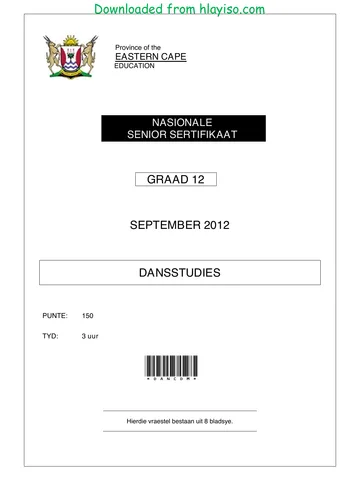
Province of the
EASTERN CAPE
EDUCATION
NATIONAL
SENIOR CERTIFICATE
GRADE 12
SEPTEMBER 2012
DANCE STUDIES
MARKS: 150
TIME: 3 hours
*DANCDM*
This question paper consists of 8 pages.
Skip to contentQuestion paper 
View all
Dance Studies Grade 12 Eastern Cape Mock 2012 Question Paper
Grade 12 Dance Studies question paper from the Eastern Cape Mock Exam 2012, 8 pages. Read online or get the free PDF download, memo linked when available.
Dance Studies · Grade 12 · Eastern Cape Mock Exam · 2012. Question paper, 8 pages. Read online or download the PDF.
- Subject
- Dance Studies
- Grade
- Grade 12
- Document type
- Question paper
- Year
- 2012
- Exam period
- Eastern Cape Mock Exam
- Curriculum
- CAPS
- Pages
- 8
- File size
- 130.3 KB
Loading document…
Loading document…
1 of 8
Document textSearch extracted text and jump to a page.
Downloaded from hlayiso.com
2 DANCE STUDIES (SEPTEMBER 2012)
INSTRUCTIONS AND INFORMATION
1. This paper consists of THREE sections.
SECTION A – History
SECTION B – Music
SECTION C – Anatomy and Health Care
2. Read through the whole paper carefully before answering it.
3. Number the answers correctly according to the numbering system used in this
question paper.
4. Leave THREE lines after each QUESTION.
5. Start EACH SECTION on a NEW page.
6. Marks are NOT allocated according to the principle of ‘one mark per one fact’,
but according to the quality of the answer.
7. Write neatly and legibly.
Downloaded from hlayiso.com
(SEPTEMBER 2012) DANCE STUDIES 3
SECTION A: HISTORY
QUESTION 1
1.1 Write an entry in your journal explaining your understanding of the function of
improvisation when choreographing your dance work. (4)
1.2 Name and explain THREE choreographic elements that you may use in your
choreography. (6)
1.3 Give ideas of how you would use the following theatrical elements in your
choreography:
1.3.1 Music (2)
1.3.2 Props and costume (2)
1.3.3 Set design and lighting (2)
1.3.4 Technology (2)
1.3.5 Text (2)
[20]
QUESTION 2
Select ONE of the prescribed INTERNATIONAL CHOREOGRAPHERS and their
dance work from the list below that you have studied this year and WRITE A
LETTER to a friend telling him/her about it. Include the following information:
2.1 Title of the work and choreographer. Describe the choreographer’s
background and training. (5)
2.2 What inspired Bruce to choreograph Ghost Dances? (3)
2.3 Name the composer/artists, music genre/style or accompaniment used in this
dance work. Describe the set design and costumes used. (6)
2.4 Briefly describe the dance styles used in this dance work. (2)
2.5 In your opinion, what is the relevance/importance of the work? (2)
2.6 Written in a letter format. (2)
[20]
Downloaded from hlayiso.com
4 DANCE STUDIES (SEPTEMBER 2012)
BELOW ARE THE PRESCRIBED CHOREOGRAPHERS AND THEIR DANCE
WORKS
INTERNATIONAL CHOREOGRAPHER DANCE WORKS
George Balanchine Appollo or Agon
Alvin Ailey Revelations
Martha Graham Appalachian Spring or Lamentation
Christopher Bruce Ghost Dancers or Rooster
Marius Petipa and Lev Ivanhof Swan Lake
Vaslav Nijinski Le Sacre du Printemps
Paul Taylor Esplanade
QUESTION 3
In this question you should NOT write about a dance from the prescribed
works.
3.1 Write an article for an African Arts magazine explaining how performing an
indigenous South African dance in a theatrical setting on a stage differs from
dancing it in its original context in the community.
3.1.1 Give your article a suitable (catchy) title and include the name of the
Indigenous cultural dance you have learnt. (2)
3.1.2 Describe the dance and the kind of rituals included in the event and
draw attention to the symbolism used in this dance. (8)
3.1.3 Compare the purpose of performing the dance in the TWO different
settings – theatrical and cultural. (5)
3.1.4 Remember to write your answer as an article. Do not use numbering. (1)
3.2 Explain FOUR common elements found in ritual dances. (4)
[20]
QUESTION 4
Your school is about to receive a grant from the government for R5 000,00 which is
to be used for an upliftment project for young people in your school or community.
Write a proposal to your principal motivating why this money/grant should be given
to the Dance Studies department. In your proposal include the following:
4.1 A clear explanation of how this money will be used for the upliftment of young
people.
4.2 Give reasons what the benefits will be to the participants/young people.
4.3 Explain how this project will be organised – who will be involved.
[10]
TOTAL SECTION A: 70
Downloaded from hlayiso.com
(SEPTEMBER 2012) DANCE STUDIES 5
SECTION B: MUSIC
QUESTION 5
5.1 For each of the time signatures below, WRITE 4 BARS OF MUSIC using semi
breves, minims, crochets, quavers, semi quavers or rests.
5.1.1 3
4 (4)
5.1.2 4
4 (4)
5.2 How can music influence a dance or choreography piece? (2)
[10]
QUESTION 6
6.1 Are the statements below TRUE or FALSE? Write the correct answer next to
the appropriate number.
6.1.1 The violin is a brass instrument. (1)
6.1.2 The African drum belongs to the Membranophone category. (1)
6.1.3 The triangle is one example of a percussion instrument. (1)
6.1.4 Chordophones are instruments with strings. (1)
6.1.5 Tenor is a voice instrument. (1)
6.1.6 Electronic instruments are keyboards. (1)
6.2 Use the appropriate words from the box below to answer the following
sentences. Write the correct word next to the correct number.
KORA VIOLIN JEMBE DRUM
CLARINET PICCOLO
KRAK CELLO MARIMBA
6.2.1 Name TWO traditional classical instruments. (2)
6.2.2 Name TWO traditional African instruments. (2)
[10]
TOTAL SECTION B: 20
Downloaded from hlayiso.com
6 DANCE STUDIES (SEPTEMBER 2012)
SECTION C: ANATOMY AND HEALTH CARE
QUESTION 7
Read the description of the location of the muscles in the first column then write the
name of the muscle/muscle group and give ONE anatomical action of the muscle.
Write only the correct answer next to the appropriate number.
7.1 The upper arm/ 7.1.1 Give the name 7.1.2 Give ONE
shoulder. Gives the of the muscle. anatomical action.
shoulder its rounded
appearance. (2)
7.2 The neck. It moves 7.2.1 Give the name 7.2.2 Give ONE
the head. of the muscle. anatomical action. (2)
7.3 The inside upper thigh. 7.3.1 Give the name 7.3.2 Give ONE
The longest muscle in of the muscle. anatomical action.
the body. (2)
7.4 The back of the lower 7.4.1 Give the name 7.4.2 Give ONE
leg. It gives the calf its of the muscle. anatomical action.
rounded appearance. (2)
7.5 This is a group of 7.5.1 Give the name 7.5.2 Give ONE
muscles that runs up of the muscle. anatomical action.
the spine in layers. (2)
7.6 The back upper arm. 7.6.1 Give the name 7.6.2 Give ONE
of the muscle. anatomical action. (2)
7.7 In the bottom. It is 7.7.1 Give the name 7.7.2 Give ONE
also the largest muscle of the muscle. anatomical action.
in the body. (2)
7.8 A group of muscles in 7.8.1 Give the name 7.8.2 Give ONE
the front upper thigh. of the muscle. anatomical action.
They all cross the
knee joint. (2)
7.9 Multiple-choice – write only the number of the question and letter of the
answer you have chosen in your ANSWER BOOKLET.
7.9.1 Dorsi flexion is when ...
A the muscles are contracting.
B you lift the metatarsal off the floor.
C the leg is turned out. (1)
7.9.2 Ankle supination is when ...
A the toes are pointing.
B the foot is sickled.
C movement is below or towards the feet. (1)
Downloaded from hlayiso.com
(SEPTEMBER 2012) DANCE STUDIES 7
7.9.3 Muscles are attached to bone by ...
A a sheath.
B a ligament.
C a tendon. (1)
7.9.4 A movement towards the midline of the body is ...
A flexion.
B extension.
C adduction. (1)
[20]
QUESTION 8
Mary is complaining of pain and discomfort in her knees during practical lessons
and finds it difficult to fully participate. The pain continues after class and seems to
be getting worse.
8.1 Identify and classify the type of injury Mary may have incurred. (1)
8.2 Identify which connective tissue/s may be involved. (1)
8.3 List the most likely cause/s of the injury. (4)
8.4 Discuss the prevention of, and immediate to long term treatment of this type
of injury. (4)
8.5 List the general complications following an injury and how it affects your
training. (5)
[15]
QUESTION 9
9.1 What is flexibility? (2)
9.2 Why do you think flexibility is important in a dancers training? (3)
9.3 How do you increase/improve flexibility? (5)
[10]
Downloaded from hlayiso.com
8 DANCE STUDIES (SEPTEMBER 2012)
QUESTION 10
10.1 Describe good posture and alignment in dance. (2)
10.2 Name THREE of the main muscles responsible for a strong core. (3)
10.3 Explain why core stability is important in dance. (3)
10.4 How can CORE STRENGTH be achieved while training? (3)
10.2 What is the importance of hydration (water), for a dancer and how does it
affect the body? (4)
[15]
TOTAL SECTION C: 60
GRAND TOTAL: 150
Study this subject
Revise the topics in this paper, then practise them question by question.
- Grade 12 Dance Studies notes
CAPS revision notes with worked examples.
- Dance Studies questions by topic
Past exam questions sorted by CAPS topic, with memos where available.
- All Grade 12 Dance Studies past papers
Past papers by year, with memos where available.
- Grade 12 past papers
More Dance Studies and other subjects in this collection.
Recommended for this subject
More papers and memos for this grade and subject.
Question paper
Dance Studies Grade 12 NSC June 2025 Question Paper (English)
Question paper
Dance Studies Grade 12 NSC November 2025 Question Paper
Question paper
Dance Studies Grade 12 NSC November 2025 Question Paper
Question paper
Dance Studies Grade 12 November 2024 NSC Question Paper
Question paper
Dance Studies Grade 12 November 2024 NSC Question Paper
Question paper
Dance Studies Grade 12 November 2024 NSC MG Question Paper
Related documents
Question paper
Dance Studies Grade 12 Eastern Cape Mock 2012 Question Paper
Memorandum
Dance Studies Grade 12 Eastern Cape Mock 2012 Memo
Question paper
Dance Studies Grade 12 NSC November 2012 Question Paper
Question paper
Dance Studies Grade 12 NSC November 2012 Question Paper
Question paper
Dance Studies Grade 12 Eastern Cape Mock 2018 QP (Afr)
Question paper
Dance Studies Grade 12 Eastern Cape Mock 2018 QP (Afr)
More from Grade 12 Dance Studies
Annual teaching plan
Gr 12 Dan Stu ATP 2023 24
Memorandum
Dance Studies Grade 12 NSC June 2025 Memo (English)
Memorandum
Dance Studies Grade 12 NSC November 2025 Memo
Memorandum
Dance Studies Grade 12 NSC November 2025 Memo
Question paper
Dance Studies Grade 12 November 2024 NSC MG Question Paper
Memorandum