
Downloaded from hlayiso.com
NATIONAL
SENIOR CERTIFICATE
GRADE 11
NOVEMBER 2018
TAKE NOTE: This examination booklet must reach all schools three weeks before the
end of TERM 3: 3–10 SEPTEMBER 2018
DESIGN P2 (PRACTICAL)
MARKS: 100
TIME: TOPIC 1: (50) VISUAL JOURNAL – Preparation starts three weeks
before the end of TERM 3, during the September holiday,
and during TERM 4.
TOPIC 2: (50) FINAL PRODUCT – Supervised production time of
12–24 hours towards the end of TERM 4 during the Grade
11 Final Examination.
This question paper consists of 21 pages.
This question paper must be printed in full colour.
Skip to contentQuestion paper 
View all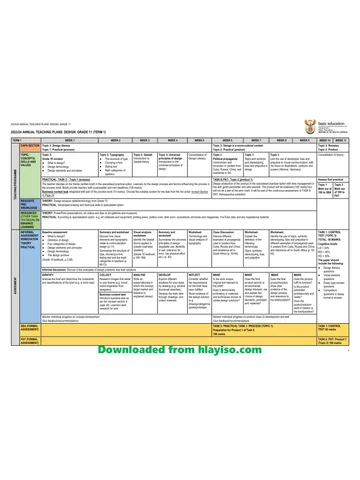
Design Grade 11 P2 Eastern Cape November 2018 QP (Eng)
Grade 11 Design Paper 2 question paper from the Eastern Cape November 2018 (English), 21 pages. Read online or get the free PDF download, memo linked when available.
Design · Grade 11 · Eastern Cape November · 2018 · English. Question paper, 21 pages. Read online or download the PDF.
- Subject
- Design
- Grade
- Grade 11
- Language
- English
- Document type
- Question paper
- Year
- 2018
- Exam period
- Eastern Cape November
- Paper
- 2
- Curriculum
- CAPS
- Pages
- 21
- File size
- 2.1 MB
Loading document…
Loading document…
1 of 21
Document textSearch extracted text and jump to a page.
Downloaded from hlayiso.com
2 DESIGN P2 (EC/NOVEMBER 2018)
INSTRUCTIONS TO THE TEACHER
1. This practical paper should be given to the learners THREE WEEKS BEFORE
THE END OF TERM 3 so that they may receive guidance with regard to their
brief/theme selection and can start with the Visual Journal Process (TOPIC 1)
during the September school holiday.
2. TIME ALLOCATION:
VISUAL JOURNAL PROCESS (TOPIC 1):
Practical process/preparation commencing three weeks before the end of
TERM 3 and continuing through the September holiday into TERM 4.
FINAL PRODUCT (TOPIC 2):
Practical product completed only at school during TERM 4 for an estimated 24
hours (at least 12 hours but no longer than 24 hours) and only once the Visual
Journal Process (TOPIC 1) has been completed.
3. It is recommended that teachers request their school to schedule 12–24 hours
over a number of days towards the end of TERM 4 and/or during the Final Grade
11 Examination for completion of the Final Product (TOPIC 2).
Possible format spread over a number of days:
3 days of 8 hours (8:00–16:00) [24 hours]
4 days of 6 hours (8:00–14:00) [24 hours]
4. This practical examination consists of one paper with two optional briefs/themes.
Learners must choose ONE of the two briefs/themes.
It is required that the learner complies with the following TWO parts of this question
paper:
The examination Visual Journal (TOPIC 1) [50 marks]
The examination Final Product (TOPIC 2) [50 marks]
TOTAL: 100 MARKS
5. The learner should choose ONE of the following design categories:
Visual Communication/Information Design and Digital Design
Surface Design and Two-dimensional Craft Design
Product Design and Three-dimensional Craft Design
Environmental Design
Copyright reserved Please turn over
Downloaded from hlayiso.com
(EC/NOVEMBER 2018) DESIGN P2 3
GRADE 11 TERM PLANNER
- - - Calendar to assist in the planning of practical dates and times:
Important Term Dates:
Receive Design P2 Practical: 3–10 September 2018
Schools Close (Term 3): 28 September 2018
Schools Open (Term 4): 9 October 2018
Grade 11 Provincial Examinations begin: ____________________ (fill in)
Final Practical Examination Dates (12–24 hours):
Date 1:____________________ (fill in)
Date 2:____________________ (fill in)
Date 3:____________________ (fill in)
Copyright reserved Please turn over
Downloaded from hlayiso.com
4 DESIGN P2 (EC/NOVEMBER 2018)
LEAVE THIS PAGE BLANK.
Copyright reserved Please turn over
Downloaded from hlayiso.com
(EC/NOVEMBER 2018) DESIGN P2 5
GRADE 11 EXHIBITION MARK
Grade 11 learners may request a re-mark of their TERM 1, TERM 2 and TERM 3
Visual Journal (TOPIC 1) and Final Products (TOPIC 2).
TERM 1 – Visual Journal (40) and/or Final Product (50)
and/or Research Task (10)
TERM 2 – Visual Journal (40) and/or Final Product (50)
and/or Research Task (10)
TERM 3 – Visual Journal (40) and/or Final Product (50)
and/or Research Task (10)
This retrospective exhibition mark constitutes 25% of the learner’s end-of-year
final report mark.
A learner may request a re-mark on the grounds that he/she has:
Submitted the Visual Journal/Source Book and/or Final Product AFTER the
marking due-date for that term.
Submitted the 3 x research tasks AFTER the marking due-date for that term.
Re-submitted by adding to/re-working their Visual Journal (TOPIC 1) with
regard to the criteria listed in this booklet on Page 6–7.
Re-submitted by adding to/re-working their Final Product(s) (TOPIC 2) with
regard to the criteria listed in this booklet on Page 8.
Copyright reserved Please turn over
Downloaded from hlayiso.com
6 DESIGN P2 (EC/NOVEMBER 2018)
INSTRUCTIONS TO THE LEARNER: VISUAL JOURNAL PROCESS
This examination booklet refers to two main topics:
Visual Journal Process (TOPIC 1) and the
Final Product (TOPIC 2)
The Visual Journal has the same weighting as the Final Product so spend an equal
amount of time on both – 50 marks for the Visual Journal and 50 marks for the Final
Product.
1. The cover page only of the brief/theme you choose must be cut out and
pasted into your Visual Journal at the start.
2. Concept: The next step is to clearly indicate your intention/concept through
brainstorming, miniature sketches and/or a written essay (rationale).
3. Reference Material: Explore as many different options as you research and
collect reference material for your theme in the form of life-drawings, original
photography, images from magazines and newspapers, etc. These must be
creatively presented and displayed in your Visual Journal so that you can
show your understanding of the value of layout and design in your Visual
Journal (Presentation).
4. Your reference material may be in a collage format – this format is not
essential, however.
5. Remember that your reference material must have additional accompanying
notes or comments to further explain your thinking process and make clear
your intentions.
6. Drawings: Your Visual Journal must show evidence of drawings based on
your reference material. It is important that you personalise these by re-
drawing them and creating original designs. Direct copying (plagiarism)
of an image or design that is not your own will be heavily penalised.
Extreme importance is placed on the process of transforming your reference
material.
7. You are required to develop a variety of compositional rough drawings
before you complete a drawing of what your final product will look like.
8. A final drawing of what your final product will look like must be presented at
the end of your Visual Journal. It is recommended that this is a pencil tonal
drawing or a full-colour version.
Copyright reserved Please turn over
Downloaded from hlayiso.com
(EC/NOVEMBER 2018) DESIGN P2 7
Design in context:
1. Presentation: It is required that you present your design in context. What this
means is that you must show how your final product functions in a ‘life-like’
space/environment.
This is important in the areas of Two-Dimensional Surface Design (Textile
design, gift-wrap, mosaic, wall paper, beadwork or any ‘flat’ design) and Three-
Dimensional Product Design (basketry, ceramics, furniture, jewellery,
wirework, fashion or any other three-dimensional design).
2. This must be shown in your Visual Journal through (a) drawing/collage/
photography/digital manipulation or incorporated within your final product
(TOPIC 2).
Suggestions for design in context may include the following:
Interior setting such as the inside of a room in a home, office or any
commercial space
An exterior environment on a building or in a landscape
On printed media such as newspapers, magazines, billboards etc.
On an item of clothing, furniture or linen etc.
Physically interacting with a person in some way
3. Identify the target market for your product design through factors such as age,
gender, income, demographics, competitors in the market, culture, faith and
religion, which similar products people prefer, and safety.
4. In your Visual Journal there must be a clear documented journey from the
start of your brainstorm/essay to a completed final drawing. No steps must
be left out.
Guidelines for Three-Dimensional Product Designs:
1. If you design a three-dimensional product, orthographic diagrams (front view,
top view, side view) as well as a final mock-up drawing must be present in your
Visual Journal.
2. Detailed measurements must be used to indicate the final scale. Final
assembly instructions must also be described.
3. You must explain your choice of construction material(s) (wood, metal,
plastic, wire, paper, etc.) for your Final Product and explain how the properties
of the chosen material (strength, hardness, toughness, flexibility,
corrosion resistance, waterproofing, etc.) improves the function of your product.
Copyright reserved Please turn over
Downloaded from hlayiso.com
8 DESIGN P2 (EC/NOVEMBER 2018)
INSTRUCTIONS TO THE LEARNER: FINAL PRODUCT
1. Your Visual Journal process (TOPIC 1) work must be completed before the
start of your Final Product (TOPIC 2).
2. Your teacher may guide you with the production of your final design but will
strongly encourage you to make your own decisions regarding your final
processes.
3. Your Final Product must show evidence of 12–24 hours of work. Your teacher
must make sure that there is enough time for you to complete your final
product in the time allocated.
4. Your Final Product may NOT be done at home and may NOT leave the
classroom.
5. You must show an advanced degree of technical skill in the medium
(drawing, painting, printing, ceramics; etc.) that you choose. It is therefore
advisable that you produce a design in the design discipline that you have
been taught using the medium(s) that you are skilled at.
6. If you produce a two-dimensional product (wallpaper; poster; CD cover; book
jacket, etc.) its total size MUST be slightly larger than an A3. The size of a
three-dimensional design depends on the function of the object(s) being
made.
7. If you produce a three-dimensional product as a flat template (packaging, book
jacket, wrapping paper) it must be constructed and assessed as a
functional three-dimensional Final Product.
8. If your Final Product in any way incorporates a printed digital image there
must be evidence of the original drawing(s)/design(s) in your Visual Journal.
Your original designs may be scanned or photographed for your printed digital
image and must be present for your exhibition remark.
9. Any two- or three-dimensional designs based merely on craft processes
without any functional value such as decoupage, pottery, needlework etc. for
decorative purposes will be penalised.
Copyright reserved Please turn over
Downloaded from hlayiso.com
(EC/NOVEMBER 2018) DESIGN P2 9
LEAVE THIS PAGE BLANK.
Copyright reserved Please turn over
Downloaded from hlayiso.com
10 DESIGN P2 (EC/NOVEMBER 2018)
2018 MARKING RUBRIC/GUIDELINES:
The rubric below is the suggested marking rubric that teachers may make use of for
the marking of the Visual Journal Process (TOPIC 1) and the Final Product (TOPIC 2).
This is to ensure standardisation with regard to marking across all schools in the
Eastern Cape Province. This must be pasted in at the end of the Visual Journal.
----------------------------------------------------------
GRADE 11: NOVEMBER P2 – PRACTICAL
VISUAL JOURNAL PROCESS (TOPIC 1)
CRITERIA
Expression of intention and rationale: (Concepts/Creativity)
Thought processes; Pushing the boundaries of design; Critical and 10
analytical thinking; Idea generation
Evidence of research: Experimentation and exploration of
10
source/inspirational material; Investigation
Technical ability: Skills, execution, experimentation and exploration of
10
media
Evidence of detailed planning and presentation: Showing all the steps
and planning towards a final design from the start, to a completed final 20
drawing; Problem solving
TOTAL: 50
FINAL PRODUCT (TOPIC 2)
CRITERIA
Creativity/Originality/Interpretation in terms of the concept, function
and solutions that are relevant to the brief. Does it communicate
20
effectively? Is the product successful/marketable/ contemporary/
relevant/smart/on trend?
Evidence of design involvement: Interpretation and appropriate use of
10
the chosen design elements and principles
Technique and craftsmanship: Method/Making; Competence in chosen
10
materials and techniques
Professional presentation and time management (12–24 hours)
Is it complete? Is it neat? Are there still areas that need work? Does it 10
look rushed and untidy?
TOTAL: 50
Copyright reserved Please turn over
Downloaded from hlayiso.com
(EC/NOVEMBER 2018) DESIGN P2 11
BRIEF/THEME 1: PHOBIA
What is a phobia and what are the different kinds of phobias?
A phobia is defined as the fear of a situation, activity, or thing that causes one to want
to avoid it. There are three categories of phobias which include social phobia (fear of
meeting new people, or other social situations), agoraphobia (fear of being in an
outside or inside space) and specific phobias (fear of particular items).
Phobias are largely underreported because many phobia sufferers find ways to avoid
the situations of which they are phobic. These illnesses are not unusual and are
thought to affect up to 28 out of every 100 people.
Some of the more common phobias include fears of public speaking (social anxiety
disorder); open spaces (agoraphobia); closed-in spaces (claustrophobia); clowns
(coulrophobia); spiders (arachnophobia); needles (aichmophobia); snakes
(ophidiophobia); germs (mysophobia); having dental work done (dentophobia).
Fears of midgets, haunted houses, helmets, pickles, and feet are just a few of the less
common phobias and may be considered weird or strange by some, but can be just as
debilitating as those phobias that are more common.
What is the difference between a fear and a phobia?
The distinction generally is that a fear is rational, but when it becomes irrational
(unreasonable or unfounded) it is a phobia. Having been fuelled by our imagination,
every fear will have a degree of irrationality to it but a phobia goes further than general
fear, causing phobic people to constantly worry that they will encounter the object/
situation that they fear. Time and energy is often used to actively avoid the object of
fear – and if they do come across it, they endure high levels of distress, anxiety,
nausea and potentially even panic attacks.
A list of the various types of phobias can be found at the following websites:
http://phobialist.com/
https://www.fearof.net/
Acrophobia Sciophobia Demophobia Acousticophobia
Fear of heights Fear of shadows Fear of crowds Fear of noise
YOUR TASK:
Create a design based on an irrational fear – phobia. Your design must exhibit or display a
negative or unpleasant experience towards the type of phobia(s).
Copyright reserved Please turn over
Downloaded from hlayiso.com
12 DESIGN P2 (EC/NOVEMBER 2018)
LEAVE THIS PAGE BLANK.
Copyright reserved Please turn over
Downloaded from hlayiso.com
(EC/NOVEMBER 2018) DESIGN P2 13
The images that follow reflect examples of:
Visual Communication/Information Design and Digital Design
Surface Design and Two-dimensional Craft Design
Product Design and Three-dimensional Craft Design
Chiropterophobia – Fear of bats Coulrophobia
– Fear of clowns
Necrophobia – Fear of the dead
Thalassophobia – Fear of sea creatures
Copyright reserved Please turn over
Downloaded from hlayiso.com
14 DESIGN P2 (EC/NOVEMBER 2018)
Lachanophobia Mycosis Trypophobia Herpetophobia
– Fear of mushrooms – Fear of holes – Fear of reptiles
Pogonophobia – Fear of beards
Linonophobi – Fear of string
Copyright reserved Please turn over
Downloaded from hlayiso.com
(EC/NOVEMBER 2018) DESIGN P2 15
LEAVE THIS PAGE BLANK.
Copyright reserved Please turn over
Downloaded from hlayiso.com
16 DESIGN P2 (EC/NOVEMBER 2018)
BRIEF/THEME 2: FLUID MOVEMENT
Copyright reserved Please turn over
Downloaded from hlayiso.com
(EC/NOVEMBER 2018) DESIGN P2 17
The Joy Of Movement
There’s a certain joy in the ability to move
this is reflected when we get in the groove
Take for example the urge to dance to a beat
using the whole body while upright on our feet.
It would be very depressing if one couldn’t move
and this wouldn’t be hard at all for one to prove;
as we get so many things done with this ability
that not having it would be known as a futility.
All creatures in the world exhibit some movement
for them to be alive regardless of their predicament;
whether they swim, fly, crawl, walk or even run
depending on their situation this has to be done.
Even the simple act of breathing is a major event
involving the passage of air in and out to prevent
a gradual slow asphyxiation that results in death
for any creature when they happen to lose breath.
The intake of food whether it be solid, liquid or gas
is another way movement takes place in our body mass
so that it can be converted into energy to facilitate
its movement or survival in life regardless of state.
Casual observation reveals that wherever things are
in this universe and no matter if either close or far,
they’re always in some constant state of movement
underlying their individual existence and placement.
The joy of movement is in experiencing one’s freedom
That culminates in self-realisation and wisdom.
Written by George Krokos, 2016
YOUR TASK:
Using the poem and accompanying images as inspiration, create a design that reflects a
sense of fluid movement.
Copyright reserved Please turn over
Downloaded from hlayiso.com
18 DESIGN P2 (EC/NOVEMBER 2018)
LEAVE THIS PAGE BLANK.
Copyright reserved Please turn over
Downloaded from hlayiso.com
(EC/NOVEMBER 2018) DESIGN P2 19
The Art Nouveau Movement (1890–1901) was a design movement defined by many
motifs but none more so than the Whiplash line. Taking inspiration from the natural
world, sinuous, organic lines and whiplash curves displayed dynamic and flowing
movement throughout the architecture, painting, sculpture and other forms of design.
The designs from female architect Zaha Hadid (1950–2016) are a formal expression of
the continuous flow and movement of water, evoking continuous transformation.
Copyright reserved Please turn over
Downloaded from hlayiso.com
20 DESIGN P2 (EC/NOVEMBER 2018)
ENVIRONMENTAL DESIGN:
PRODUCT DESIGN AND THREE-DIMENSIONAL CRAFT DESIGN:
SURFACE DESIGN AND TWO-DIMENSIONAL CRAFT DESIGN:
Copyright reserved Please turn over
Downloaded from hlayiso.com
(EC/NOVEMBER 2018) DESIGN P2 21
VISUAL COMMUNICATION/INFORMATION DESIGN AND DIGITAL DESIGN:
Copyright reserved Please turn over
Study this subject
Revise the topics in this paper, then practise them question by question.
- Grade 11 Design notes
CAPS revision notes with worked examples.
- Design questions by topic
Past exam questions sorted by CAPS topic, with memos where available.
- All Grade 11 Design past papers
Past papers by year, with memos where available.
- Grade 11 past papers
More Design and other subjects in this collection.
Recommended for this subject
More papers and memos for this grade and subject.
Question paper
Design Grade 11 Paper 1 Eastern Cape November 2018 Question Paper
Question paper
Design Grade 11 Paper 1 Eastern Cape November 2018 Question Paper
Question paper
Design Grade 11 P1 Eastern Cape November 2018 QP (Eng)
Question paper
Design Grade 11 P1 Eastern Cape November 2017 QP (Eng)
Question paper
Design Grade 11 Eastern Cape November 2016 Question Paper
Question paper
Design Grade 11 Paper 1 Eastern Cape November 2016 Question Paper
Related documents
Memorandum
Design Grade 11 Paper 1 Eastern Cape November 2018 Memo (English)
Memorandum
Design Grade 11 Paper 1 Eastern Cape November 2017 Memo (English)
Question paper
Design Grade 11 Paper 1 Eastern Cape November 2015 Question Paper
Question paper
Design Grade 11 Paper 1 Eastern Cape November 2015 Question Paper
Question paper
Design Grade 11 Paper 1 Eastern Cape November 2014 Question Paper
Question paper
Design Grade 11 Paper 1 Eastern Cape November 2014 Question Paper
More from Grade 11 Design
Annual teaching plan
Gr 11 Des ATP 2023 24
Memorandum
Design Grade 11 Eastern Cape November 2016 Memo
Memorandum
Design Grade 11 Paper 1 Eastern Cape November 2016 Memo
Memorandum
Design Grade 11 Paper 1 Eastern Cape November 2015 Memo
Memorandum
Design Grade 11 Paper 1 Eastern Cape November 2015 Memo
Memorandum