
PROVINCIAL ASSESSMENT
GRADE 10
PHYSICAL SCIENCES: CHEMISTRY (P2)
NOVEMBER 2024
MARKS: 100
TIME: 2 hours
This question paper consists of 10 pages and 2 data sheets.
Copyright reserved Please turn over
Skip to contentAll 2024 papers 
View all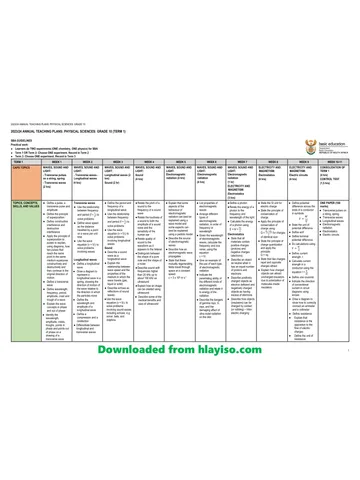
Physical Sciences Grade 10 P2 North West November 2024 QP
Grade 10 Physical Sciences Paper 2 question paper from the North West November Exam 2024 (English), 12 pages. Read online or download the free PDF.
Physical Sciences · Grade 10 · North West November Exam · 2024 · English. Question paper, 12 pages. Read online or download the PDF.
- Subject
- Physical Sciences
- Grade
- Grade 10
- Language
- English
- Document type
- Question paper
- Year
- 2024
- Exam period
- North West November Exam
- Paper
- 2
- Curriculum
- CAPS
- Pages
- 12
- File size
- 701.1 KB
Free to read online, no sign-up needed
Loading document…
Loading document…
1 of 12
This exam
North West November Exam 2024
- Paper 1Question paper
- Paper 2Question paper
Questions in this paper
Document textSearch extracted text and jump to a page.
Physical Sciences/P2 2 NW/November 2024
Grade 10
INSTRUCTIONS AND INFORMATION
Read the following instructions carefully before answering the questions.
1. This question paper consists of EIGHT questions. Answer ALL the questions
in the ANSWER BOOK.
2. Start the answers to EACH question at the top of a NEW page.
3. Number the answers correctly according to the numbering system used in this
question paper.
4. Leave ONE line between two sub-questions, e.g., between QUESTION 2.1
and QUESTION 2.2
5. You may use a non-programmable calculator.
6. You may use appropriate mathematical instruments.
7. Show ALL formulae and substitutions in ALL questions.
8. Round off your FINAL numerical answers to a minimum of TWO decimal
places.
9. Give brief motivations, discussions, etc. where required.
10. You are advised to use the DATA SHEETS.
11. Write neatly and legibly.
Copyright reserved Please turn over
Physical Sciences/P2 3 NW/November 2024
Grade 10
QUESTION 1: MULTIPLE-CHOICE QUESTIONS
Various options are provided as possible answers to the following questions. Each
question has only ONE correct answer. Choose the answer and write only the letter
(A–D) next to the question numbers (1.1 to 1.7) in the ANSWER BOOK, e.g. 1.8 E.
1.1 The process when a solid substance change directly to gaseous phase is
called …
A evaporation.
B condensation.
C sublimation.
D boiling. (2)
1.2 Which ONE of the following substances is a pure substance?
A Steel
B Sulphur
C Juice
D Salt water (2)
1.3 Which ONE of the following represents the electronic structure of Phosphorus
(P).
A 1s22s22p63s2
B 1s22s22p63s23p3
C 1s22s22p63s23p5
D 1s22s22p63s23p6 (2)
1.4 In which ONE of the following compounds do covalent bond occur between
elementary particles?
A Sodium chloride
B Mercury
C Ammonia
D Carbon (2)
Copyright reserved Please turn over
Physical Sciences/P2 4 NW/November 2024
Grade 10
1.5 What is the percentage of hydrogen in a molecule of hydrogen peroxide with
molar mass of 34 g.mol-1, if one mole of hydrogen reacts with one mole of
oxygen?
A 72,72 %
B 94,12 %
C 11,11 %
D 5,88 % (2)
1.6 If 30 g of reactant A reacts completely with 25 g of reactant B, which ONE of the
following statements is CORRECT?
A The total mass of the products will be equal to 55 g.
B The total mass of products for any unreacted reactants will be less than 55 g.
C The total mass of products for any unreacted reactants will be greater than
55 g.
D The total mass of products for any unreacted reactants will be 55 g. (2)
1.7 Two identical flasks are filled with different gasses at the same temperature and
pressure. One flask contains ozone (O3) and the other an unknown gas X.
The mass of the ozone gas in the flask is 0,48 g and the mass of gas X in the
flask is 0,34 g. Gas X is:
A O2
B SO2
C H2S
D NH3 (2)
[14]
Copyright reserved Please turn over
Physical Sciences/P2 5 NW/November 2024
Grade 10
QUESTION 2
2.1 In the table below are different substances. Use the following substances to
answer the questions that follow.
SUBSTANCES
A Cobalt
B Gold
C Phosphorus
D Silicon
E Air
F Ammonium nitrate
2.1.1 Identify the ELEMENT that has a dull surface and cannot conduct
electricity. (1)
2.1.2 Identify ONE substance that is ductile. (1)
2.1.3 Which element has magnetic properties? (1)
2.1.4 Identify the element that is a metalloid. (1)
2.1.5 Write down the chemical formula for substance F (Ammonium nitrate). (2)
2.2 The base of a frying pan is made from aluminium while the handle is made of
hard plastic.
2.2.1 What benefit does the base of the pan, made from aluminium, have? (1)
2.2.2 Why would the handle of the pan be made of plastic? (1)
[8]
Copyright reserved Please turn over
Physical Sciences/P2 6 NW/November 2024
Grade 10
QUESTION 3
Grade 10 learners conducted an experiment to determine the heating curve of water by
using ice cubes. The experiment was set up as shown below.
X
3.1 Define the term temperature. (2)
3.2 Name the apparatus labelled X. (1)
3.3 Why is it important to continuously stir the melting ice with a glass rod? (1)
3.4 The graph below shows the results of the experiment.
3.4.1 Name the process taking place between t1 and t2. (1)
3.4.2 Will the water particles move SLOWER or FASTER between t2 and t3
when compared to the movement of the particles between 0 and t 1?
Give a reason for your answer. (2)
3.4.3 Will the potential energy between t3 and t4 INCREASE, DECREASE or
REMAIN THE SAME? (1)
3.4.4 Can the particles be compressed between t4 and t5? Answer YES or NO
only. (1)
3.4.5 The forces between particles of ethanol are weaker than those in water.
Will the boiling point for ethanol be GREATER THAN or LESS THAN
100 C under the same standard conditions? (1)
[10]
Copyright reserved Please turn over
Physical Sciences/P2 7 NW/November 2024
Grade 10
QUESTION 4
4.1 Naturally occurring oxygen consists of three isotopes indicated below:
ISOTOPE PERCENTAGE ABUNDANCE (%)
O-16 99,76
O-17 0,04
O-18 X
4.1.1 Define isotopes. (2)
4.1.2 What percentage abundance does O-18 occupy? (2)
4.1.3 Calculate the relative atomic mass of oxygen. (4)
4.2 Aluminium is a metal and a good conductor of electricity.
4.2.1 Name the type of bonding between the aluminium atom that makes it
a good conductor of electricity. (1)
4.2.2 State AND explain another one property of aluminium that can be
attributed to the type of bond identified. (2)
Aluminium reacts with nitrogen according to the following reaction equation:
Aℓ + N2 AℓN
4.2.3 Name the product that forms. (2)
4.2.4 Use Lewis diagrams to show how the product is formed. (4)
[17]
Copyright reserved Please turn over
Physical Sciences/P2 8 NW/November 2024
Grade 10
QUESTION 5
The graph below shows the first ionisation energies of the elements of period 3 in the
periodic table.
5.1 Define ionisation energy. (2)
5.2 Describe the general trend in the first ionisation energies from sodium to argon. (1)
5.3 Explain the difference in the first ionisation energies of magnesium and
chlorine. (4)
5.4 How will the SECOND ionisation energy of sodium compare to its FIRST
ionisation energy? Choose from GREATER THAN, EQUAL TO or LESS
THAN. Explain your answer. (4)
[11]
Copyright reserved Please turn over
Physical Sciences/P2 9 NW/November 2024
Grade 10
QUESTION 6
6.1 Classify the following as a PHYSICAL or CHEMICAL change.
6.1.1 Iron metal is melted. Explain your answer. (2)
6.1.2 Grey hair is dyed to a red colour. (1)
6.1.3 A car rusts. (1)
6.2 The balanced equation for the reaction is:
2 Pb(NO3)2(s) 2 PbO(s) + 4 NO2(g) + O2(g)
6.2.1 What type of reaction is shown above? (1)
6.2.2 By use of a calculation prove that the law of conservation of mass is
TRUE for this reaction. (5)
6.2.3 When 6,62 g of lead nitrate [ Pb(NO3)2 ] is heated, 4,46 g of solid is
produced. What is the mass of gas that will be produced? (2)
6.3 Balance the following reaction equation:
NH3(g) + O2(g) NO(g) + H2O(ℓ) (2)
[14]
QUESTION 7
7.1 Calculate the concentration of a solution prepared by dissolving 5,85 g of
sodium chloride in enough water to make a 500 cm3 solution. (4)
7.2 Explain the concept of water of crystallisation and give the formula of a
common hydrated salt. (3)
7.3 A learner heats 5 g of a hydrated salt until all the water of crystallisation has
evaporated, leaving 3 g of the anhydrous salt. Determine the percentage
of water of crystallisation in the hydrated salt. (2)
[9]
Copyright reserved Please turn over
Physical Sciences/P2 10 NW/November 2024
Grade 10
QUESTION 8
There are several steps in the production of fertelisers. In the third step, nitrogen
dioxide is absorbed by water to produce nitric acid. Nitric acid and ammonia can
react together in an acid-base process to form the salt, ammonium nitrate, which is
soluble in water.
3 NO2(g) + H2O(ℓ) 2 HNO3(aq) + NO(g)
NH3(ℓ) + HNO3(ℓ) NH4NO3(s)
8.1 Define mole. (2)
8.2 Give the scientific name of nitric acid. (1)
8.3 Calculate the:
8.3.1 molecular mass of ammonium nitrate. (2)
8.3.2 number of moles of ammonium nitrate if 15 g of it was formed. (3)
8.3.3 volulme of 12 g of nitrogen oxide at STP. (5)
8.3.4 number of nitrogen atoms present in 2 moles of ammonium nitrate. (4)
[17]
TOTAL: 100
Copyright reserved
Physical Sciences/P2 1 NW/November 2024
Grade 10
DATA FOR PHYSICAL SCIENCES GRADE 10
PAPER 2 (CHEMISTRY)
Copyright reserved Please turn over
Physical Sciences/P2 2 NW/November 2024
Grade 10
Copyright reserved
Study this subject
Recommended for this subject
Memorandum
Physical Sciences Grade 10 P2 Gauteng June 2024 Memo (Eng)
Question paper
Physical Sciences Grade 10 P2 Gauteng November 2020 QP (Eng)
Question paper
Physical Sciences Grade 10 P2 2020 QP (Eng)
Question paper
Physical Sciences Grade 10 P2 2019 QP (Eng)
Question paper
Physical Sciences Grade 10 P2 Gauteng June 2018 QP (Eng)
Question paper
Physical Sciences Grade 10 P2 Gauteng June 2016 QP (Eng)
More from Grade 10 Physical Sciences
Annual teaching plan
Gr 10 Phys Sci ATP 2023 24
Question paper and memo
Physical Sciences Grade 10 Eastern Cape June 2025 QP & Memo
Question paper and memo
Physical Sciences Grade 10 Free State June 2025 Paper & Memo
Question paper and memo
Physical Sciences Grade 10 P1 KZN November 2025 Paper & Memo
Question paper and memo
Physical Sciences Grade 10 Limpopo March Test 2025 QP & Memo
Question paper and memo