
Mock
hlayiso mock exams
Practice Series:
Grade 10 Exam Preparation
WWW.HLAYISO.COM
NATIONAL
SENIOR CERTIFICATE
GRADE 10
HISTORY
NOVEMBER EXAMINATION 2026 (MOCK)
MARKS: 150
TIME: 3 hours
This question paper consists of 9 pages and an addendum of 13 pages.
Copyright reserved Please turn over
Skip to contentAll 2026 papers 
View all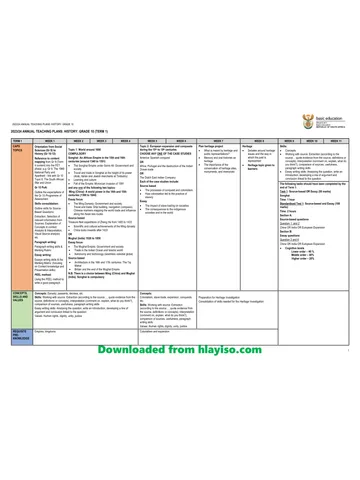
History Grade 10 P1 November Mock Exam 2 2026 QP (Eng)
Grade 10 History Paper 1 question paper from the November Mock Exam 2 2026 (English), 9 pages. Read online or download the free PDF.
History · Grade 10 · November Mock Exam 2 · 2026 · English. Question paper, 9 pages. Read online or download the PDF.
- Subject
- History
- Grade
- Grade 10
- Language
- English
- Document type
- Question paper
- Year
- 2026
- Exam period
- November Mock Exam 2
- Paper
- 1
- Publisher
- Hlayiso
- Curriculum
- CAPS
- Pages
- 9
- File size
- 144.0 KB
Free to read online, no sign-up needed
Loading document…
Loading document…
1 of 9
This exam
November Mock Exam 2 2026
- Paper 1Question paperAddendumMemo
Document textSearch extracted text and jump to a page.
History 2 Hlayiso/Gr 10 Mock 2026
NSC Mock
INSTRUCTIONS AND INFORMATION
1. This question paper consists of SECTION A and SECTION B based on the prescribed
content framework in the CAPS document.
SECTION A: SOURCE-BASED QUESTIONS
QUESTION 1: TRANSFORMATIONS IN SOUTHERN AFRICA AFTER
1750
QUESTION 2: COLONIAL EXPANSION AFTER 1750: THE MINERAL
REVOLUTION
QUESTION 3: THE SOUTH AFRICAN WAR AND UNION
SECTION B: ESSAY QUESTIONS
QUESTION 4: TRANSFORMATIONS IN SOUTHERN AFRICA AFTER
1750: THE EMERGENCE OF THE BASOTHO KINGDOM
UNDER MOSHOESHOE
QUESTION 5: COLONIAL EXPANSION AFTER 1750: THE CAUSES OF
THE GREAT TREK
QUESTION 6: THE SOUTH AFRICAN WAR AND UNION: BLACK
SOUTH AFRICANS AND THE SOUTH AFRICAN WAR
2. SECTION A consists of THREE source-based questions. Source material that is
required to answer these questions can be found in the ADDENDUM.
3. SECTION B consists of THREE essay questions.
4. Answer THREE questions as follows:
4.1 At least ONE must be a source-based question and at least ONE
must be an essay question.
4.2 The THIRD question may be either a source-based question or an
essay question.
5. You are advised to spend ONE hour per question.
6. When answering the questions, you should apply your knowledge, skills and insight.
7. You will be disadvantaged by merely rewriting the sources as answers.
8. Number the answers correctly according to the numbering system used in this question
paper.
9. Write neatly and legibly.
Copyright reserved Please turn over
History 3 Hlayiso/Gr 10 Mock 2026
NSC Mock
SECTION A: SOURCE-BASED QUESTIONS
Answer at least ONE question, but not more than TWO questions, in this section. The source
material that is required to answer these questions is contained in the ADDENDUM.
QUESTION 1: HOW DID SHAKA TRANSFORM THE ZULU CHIEFDOM INTO A
POWERFUL KINGDOM BETWEEN 1816 AND 1828?
Study Sources 1A, 1B, 1C and 1D and answer the questions that follow.
1.1 Refer to Source 1A.
1.1.1 Name Shaka’s mother, according to the source. (1 x 1) (1)
1.1.2 Which chief, according to the source, made Shaka a commander in
his army? (1 x 1) (1)
1.1.3 Give TWO reasons from the source why Shaka’s early years were
difficult. (2 x 1) (2)
1.1.4 Using the information in the source and your own knowledge, explain
why the support of Dingiswayo was important for Shaka’s rise to
power. (2 x 2) (4)
1.1.5 What does the source imply about the way in which Shaka became
chief of the Zulu in about 1816? (1 x 2) (2)
1.2 Read Source 1B.
1.2.1 Name the short stabbing spear that Shaka introduced, according to
the source. (1 x 1) (1)
1.2.2 Define the term amabutho in your own words. (1 x 2) (2)
1.2.3 List THREE ways, according to the source, in which Shaka enforced
discipline in the army. (3 x 1) (3)
1.2.4 Why do you think Shaka did not allow members of a regiment to
marry until he gave them permission? (2 x 2) (4)
1.2.5 Explain how Shaka’s treatment of defeated chiefdoms helped to build
a Zulu nation. (1 x 2) (2)
1.3 Study Source 1C.
1.3.1 Identify the part of the formation that attacked the enemy from the
front. (1 x 1) (1)
1.3.2 What, according to the diagram, was the task of the regiments in the
‘loins’? (1 x 2) (2)
1.3.3 Explain how the ‘cow-horn’ formation helped the Zulu army to defeat
its enemies. (1 x 2) (2)
1.3.4 Explain the limitations of this diagram to a historian researching the
battles that were fought by Shaka’s army. (1 x 2) (2)
Copyright reserved Please turn over
History 4 Hlayiso/Gr 10 Mock 2026
NSC Mock
1.4 Refer to Sources 1B and 1C. Explain how the information in Source 1C
supports the evidence in Source 1B regarding the training and organisation
of Shaka’s army. (1 x 2) (2)
1.5 Consult Source 1D.
1.5.1 Name TWO traders, according to the source, who later wrote
accounts of their time in Natal. (2 x 1) (2)
1.5.2 Give TWO reasons from the source why the traders may have
exaggerated Shaka’s cruelty. (2 x 1) (2)
1.5.3 Comment on the reliability of the traders’ accounts as evidence for a
historian studying Shaka’s rule. (2 x 2) (4)
1.5.4 Explain why many historians today regard Shaka as a nation builder.
(1 x 2) (2)
1.5.5 In which year, according to the source, was Shaka murdered?
(1 x 1) (1)
1.6 Using the information in the relevant sources and your own knowledge, write
a paragraph of about EIGHT lines (about 80 words) explaining how Shaka
transformed the Zulu chiefdom into a powerful kingdom between 1816 and
1828. (8)
[50]
Copyright reserved Please turn over
History 5 Hlayiso/Gr 10 Mock 2026
NSC Mock
QUESTION 2: HOW DID THE DISCOVERY OF DIAMONDS AND GOLD CHANGE THE
LIVES OF BLACK SOUTH AFRICANS BETWEEN 1867 AND 1899?
Study Sources 2A, 2B, 2C and 2D and answer the questions that follow.
2.1 Refer to Source 2A.
2.1.1 In which year, according to the source, were large deposits of
diamonds discovered at Kimberley? (1 x 1) (1)
2.1.2 Define the term mineral revolution in your own words. (1 x 2) (2)
2.1.3 List THREE groups of people who, according to the source, came to
work on the diamond fields. (3 x 1) (3)
2.1.4 Why do you think Britain supported Waterboer’s claim and annexed
Griqualand West in 1871? (2 x 2) (4)
2.1.5 Explain why chiefs encouraged young men to work on the diamond
fields. (1 x 2) (2)
2.2 Read Source 2B.
2.2.1 Give TWO reasons from the source why the mine owners introduced
closed compounds. (2 x 1) (2)
2.2.2 Define the term migrant labour in your own words. (1 x 2) (2)
2.2.3 Using the information in the source and your own knowledge, explain
how the compound and pass systems controlled the lives of black
workers. (2 x 2) (4)
2.2.4 Comment on why white workers were not placed in compounds.
(1 x 2) (2)
2.3 Study Source 2C.
2.3.1 Name TWO areas, according to the map, from which migrant workers
travelled to the mines. (2 x 1) (2)
2.3.2 Identify the mining centre, shown on the map, where gold was
discovered in 1886. (1 x 1) (1)
2.3.3 Explain why railway lines were built from the coast to Kimberley and
the Witwatersrand by 1895. (1 x 2) (2)
2.3.4 Explain the usefulness of this map to a historian researching the
system of migrant labour. (1 x 2) (2)
Copyright reserved Please turn over
History 6 Hlayiso/Gr 10 Mock 2026
NSC Mock
2.4 Consult Source 2D.
2.4.1 List THREE social groups, according to the source, that developed
on the Witwatersrand. (3 x 1) (3)
2.4.2 Define the term job colour bar in the context of the gold mines.
(1 x 2) (2)
2.4.3 Explain why the mine owners wanted to keep the wages of black
workers low. (2 x 2) (4)
2.4.4 Comment on why colonial governments and the Boer republics
demanded that black men pay taxes in money. (1 x 2) (2)
2.5 Refer to Sources 2B and 2D. Explain how the information in Source 2D is
similar to the evidence in Source 2B regarding the position of white and black
workers on the mines. (1 x 2) (2)
2.6 Using the information in the relevant sources and your own knowledge, write
a paragraph of about EIGHT lines (about 80 words) explaining how the
discovery of diamonds and gold changed the lives of black South Africans
between 1867 and 1899. (8)
[50]
Copyright reserved Please turn over
History 7 Hlayiso/Gr 10 Mock 2026
NSC Mock
QUESTION 3: WHY WAS THE NATIVES LAND ACT OF 1913 A TURNING POINT IN
THE DISPOSSESSION OF BLACK SOUTH AFRICANS?
Study Sources 3A, 3B, 3C and 3D and answer the questions that follow.
3.1 Refer to Source 3A.
3.1.1 On which date, according to the source, did the Natives Land Act
come into force? (1 x 1) (1)
3.1.2 Define the term segregation in your own words. (1 x 2) (2)
3.1.3 List THREE provisions (terms) of the Natives Land Act, according to
the source. (3 x 1) (3)
3.1.4 Why do you think white farmers supported the passing of the Natives
Land Act? (2 x 2) (4)
3.1.5 Explain why the Natives Land Act could not be enforced in the Cape
in the same way as in the rest of the country. (1 x 2) (2)
3.2 Read Source 3B.
3.2.1 Explain what Plaatje meant when he wrote that the black South
African had become ‘a pariah in the land of his birth’. (1 x 2) (2)
3.2.2 Give TWO hardships, according to the source, that evicted families
experienced in 1913. (2 x 1) (2)
3.2.3 Define the term eviction in the context of the Natives Land Act.
(1 x 2) (2)
3.2.4 Comment on the reliability of Plaatje’s account of the effects of the
Natives Land Act. (2 x 2) (4)
3.3 Study Source 3C.
3.3.1 What percentage of the population, according to the graph, were
black Africans in 1911? (1 x 1) (1)
3.3.2 What percentage of the land, according to the graph, was set aside
for black Africans by the Natives Land Act? (1 x 1) (1)
3.3.3 Explain what the information in the graph reveals about the fairness
of the Natives Land Act. (1 x 2) (2)
3.3.4 Explain the limitations of this graph to a historian researching the
effects of the Natives Land Act on black families. (1 x 2) (2)
Copyright reserved Please turn over
History 8 Hlayiso/Gr 10 Mock 2026
NSC Mock
3.4 Consult Source 3D.
3.4.1 Name TWO members, according to the source, of the SANNC
deputation that went to London in 1914. (2 x 1) (2)
3.4.2 Explain the term deputation in the context of the SANNC’s response
to the Natives Land Act. (1 x 2) (2)
3.4.3 Why do you think the British government refused to interfere in the
matter of the Natives Land Act? (2 x 2) (4)
3.4.4 Comment on why the outbreak of the First World War weakened the
SANNC’s campaign against the Act. (1 x 2) (2)
3.5 Refer to Sources 3A and 3C. Explain how the information in Source 3C
supports the evidence in Source 3A regarding the division of land under the
Natives Land Act. (2 x 2) (4)
3.6 Using the information in the relevant sources and your own knowledge, write a
paragraph of about EIGHT lines (about 80 words) explaining why the Natives
Land Act of 1913 was a turning point in the dispossession of black South
Africans. (8)
[50]
Copyright reserved Please turn over
History 9 Hlayiso/Gr 10 Mock 2026
NSC Mock
SECTION B: ESSAY QUESTIONS
Answer at least ONE question, but NOT more than TWO questions, in this section.
Your essay should be about THREE pages long.
QUESTION 4: TRANSFORMATIONS IN SOUTHERN AFRICA AFTER 1750 – THE
EMERGENCE OF THE BASOTHO KINGDOM UNDER MOSHOESHOE
‘Moshoeshoe relied more on diplomacy than on military strength to build and protect the
Basotho kingdom between 1820 and 1870.’
Critically discuss this statement. Use relevant historical evidence to support your line of
argument.
[50]
QUESTION 5: COLONIAL EXPANSION AFTER 1750 – THE CAUSES OF THE GREAT
TREK
Explain to what extent the Great Trek (1835–1845) was caused by the dissatisfaction of
Dutch-speaking farmers with British rule at the Cape, rather than by their need for land.
Use relevant historical evidence to support your line of argument.
[50]
QUESTION 6: THE SOUTH AFRICAN WAR AND UNION – BLACK SOUTH AFRICANS
AND THE SOUTH AFRICAN WAR
‘Black South Africans played an important part in the South African War (1899–1902) and
suffered greatly because of it, but they gained nothing from the peace that followed.’
Do you agree with this statement? Use relevant historical evidence to support your line of
argument.
[50]
TOTAL: 150
Copyright reserved
Study this subject
Recommended for this subject
Addendum
History Grade 10 P1 November Mock 2026 Addendum (English)
Memorandum
History Grade 10 Paper 1 November Mock 2026 Memo (English)
Question paper
History Grade 10 P1 Eastern Cape November 2020 QP (Eng)
Addendum
History Grade 10 P1 Eastern Cape November 2020 Addendum
Memorandum
History Grade 10 P1 Eastern Cape November 2020 Memo (Eng)
Question paper
History Grade 10 NSC Term 1 Controlled Test 2023 QP (Eng)
More from Grade 10 History
Annual teaching plan
Gr 10 His ATP 2023 24
Question paper and memo
History Grade 10 Eastern Cape March Test 2025 Paper & Memo
Question paper and memo
History Grade 10 Eastern Cape March Test 2025 Paper & Memo
Addendum
History Grade 10 North West November 2024 Addendum (English)
Addendum
History Grade 10 Gauteng March Test 2023 Addendum (English)
Addendum