
NATIONAL
SENIOR CERTIFICATE
GRADE 10
NOVEMBER 2020
HISTORY (VERSION 1)
MARKING GUIDELINE
(EXEMPLAR)
MARKS: 150
This marking guideline consists of 20 pages.
Skip to contentAll 2020 papers 
View all
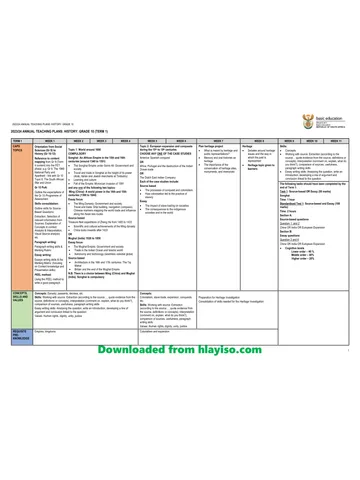
History Grade 10 P1 Eastern Cape November 2020 Memo (Eng)
Grade 10 History Paper 1 memorandum from the Eastern Cape November 2020 (English), 20 pages. Read online or download the free PDF.
History · Grade 10 · Eastern Cape November · 2020 · English. Memorandum, 20 pages. Read online or download the PDF.
- Subject
- History
- Grade
- Grade 10
- Language
- English
- Document type
- Memorandum
- Year
- 2020
- Exam period
- Eastern Cape November
- Paper
- 1
- Curriculum
- CAPS
- Pages
- 20
- File size
- 691.6 KB
Free to read online, no sign-up needed
Loading document…
Loading document…
1 of 20
This exam
Eastern Cape November 2020
Questions in this paper
Document textSearch extracted text and jump to a page.
2 HISTORY (EC/NOVEMBER 2020)
1. SOURCE BASED QUESTIONS
1.1 The following cognitive levels were used to develop source-based questions:
WEIGHTING
COGNITVE
HISTORICAL SKILLS OF
LEVELS
QUESTIONS
• Extract evidence from sources
LEVEL 1 • Selection and organisation of relevant 40%
(L1) information from sources (20)
• Define historical concepts/terms
• Interpretation of evidence from sources
LEVEL 2 40%
• Explain information gathered from sources
(L2) (20)
• Analyse evidence from sources
• Interpret and evaluate evidence from the
sources
• Engage with sources to determine their
LEVEL 3 20%
usefulness, reliability, bias and limitations
(L3) (10)
• Compare and contrast interpretations and
perspectives presented in sources and draw
independent conclusions
1.2 The following information indicates how the source-based questions are
assessed:
• In the marking of source-based questions, credit needs to be given to any
valid and relevant viewpoints, arguments, evidence or examples.
• In the allocation of marks, emphasis should be placed on how the
requirements of the questions have been addressed.
• In the marking guideline, the requirements of the questions (skills that need
to be addressed) as well as the level of the questions are indicated in italics.
1.3 Assessment procedures for source-based questions
• Use a tick (✓) for each correct answer
• Pay attention to the mark scheme e.g. (2 x 2) translates to two reasons
which are given two marks each (✓✓ ✓✓); (1 x 2) translates to one reason
and is given two marks (✓✓)
• If a question carries 4 marks then indicate by placing 4 ticks ✓✓✓✓
Copyright reserved Please turn over
(EC/NOVEMBER 2020) HISTORY 3
Paragraph question
Paragraphs are to be assessed globally (holistically). Both the content and
structure of the paragraph must be taken into account when awarding a mark.
The following steps must be used when assessing a response to a paragraph
question:
• Read the paragraph and place a bullet (•) at each point within the text
where the candidate has used relevant evidence to address the question.
• Re-read the paragraph to evaluate the extent to which the candidate has
been able to use relevant evidence to write a paragraph.
• At the end of the paragraph indicate the ticks (✓) that the candidate has
been awarded for the paragraph; as well as the level (1, 2 or 3) as
indicated in the holistic rubric and a brief comment e.g.
_________________ . ____________________________ . __________
✓✓✓✓
Level 2
Used mostly relevant evidence to write a basic paragraph.
• Count all the ticks for the source-based question and then write the mark
on the right hand bottom margin e.g. 32
50
• Ensure that the total mark is transferred accurately to the front/back cover
of the answer script.
2. ESSAY QUESTIONS
2.1 The essay questions require candidates to be able to structure their
argument in a logical and coherent manner. They need to select, organise and
connect the relevant information so that they are able to present a reasonable
sequence of facts or an effective argument to answer the question posed. It is
essential that an essay have an introduction, a coherent and balanced body of
evidence, and a conclusion.
2.2 Marking of essays questions
• Markers must be aware that the content of the answer will be guided by the
textbooks in use at the particular centre.
• Candidates may have any other relevant introduction and/or conclusion
than those included in a specific essay marking guideline for a specific
essay.
• When assessing open-ended source-based questions, learners should be
credited for any other relevant answer.
Copyright reserved Please turn over
4 HISTORY (EC/NOVEMBER 2020)
2.3 Global assessment of the essay
The essay must be assessed holistically (globally). This approach requires the
teacher to score the overall product as a whole, without scoring the component
parts separately. This approach encourages the learner to offer an individual
opinion by using selected factual evidence to support an argument. The
learners will not be required to simply regurgitate ‘facts’ in order to achieve a
high mark. This approach discourages learners from preparing ‘model’
answers and reproducing them without taking into account the specific
requirements of the question. Holistic marking of the essay credits learners’
opinions supported by evidence. Holistic assessment, unlike content-based
marking, does not penalise language inadequacies as the emphasis is on the
following:
• The construction of argument
• The appropriate selection of factual evidence to support such argument
• The learner’s interpretation of the question
2.4 Assessment procedures of the essay
2.4.1 Keep the synopsis in mind when assessing essays.
2.4.2 During the first reading of the extended writing, ticks need to be awarded for a
relevant introduction (indicated by a bullet in memorandum); each of the main
points/aspects that is properly contextualised (also indicated by bullets in the
memorandum); and a relevant conclusion (indicated by a bullet in the
memorandum) e.g. in an answer where there are 5 main points there will be 7
ticks.
2.4.3 The following additional symbols can also be used:
• Introduction, main aspects and conclusion not properly
contextualised
• Wrong statement
• Irrelevant statement
• Repetition R
• Analysis A√
• Interpretation I√
2.5 The matrix
2.5.1 Use of the analytical matrix in the marking of essay.
In the marking of essays, with reference to page 6, the given criteria shown in
the matrix should be used. In assessing the extended writing note should be
taken of both the content and presentation. At the point of intersection of the
content and presentation based on the seven competency levels, a mark
should be awarded.
Copyright reserved Please turn over
(EC/NOVEMBER 2020) HISTORY 5
(a) The first reading of an essay will be to determine to what extent the main
aspects have been covered and to
allocate the content level (on the C LEVEL 4
matrix).
(b) The second reading of essay will relate to the level (on the matrix) of
presentation. C LEVEL 4
P LEVEL 3
(c) Allocate an overall mark with the use
C LEVEL 4
of the matrix. 26–27
P LEVEL 3
Copyright reserved Please turn over
6 HISTORY (EC/NOVEMBER 2020)
MARKING MATRIX FOR ESSAY: TOTAL: 50
LEVEL 7 LEVEL 6 LEVEL 5 LEVEL 4 LEVEL 3 LEVEL 2 LEVEL 1
Very well planned and Very well planned Well planned Planned and Shows some Attempts to Little or no
structured essay. and structured and constructed evidence of a structure an attempt to
PRESENTATION Good synthesis of essay. Developed structured an argument. planned and answer. structure
information. a relevant line of essay. Evidence constructed Largely the essay.
Developed an original, argument. Attempts to used to some argument. descriptive or
well balanced and Evidence used to develop a extent to Attempts to some attempt
independent line of defend the clear support the sustain a line at developing
argument with the use argument. Attempts argument. line of of argument. a line of
of evidence and to draw an Conclusion argument. Conclusions argument. No
CONTENT sustained and independent drawn from Conclusions not clearly attempt to
defended the conclusion from the the evidence reached supported by draw a
argument throughout. evidence to support to support based on evidence. conclusion.
Independent the line of the line of evidence.
conclusion is drawn argument. argument.
from evidence to
support the line of
argument.
LEVEL 7
Question has been
fully answered.
Content selection 47–50 43–46
fully relevant to
line of argument.
LEVEL 6
Question has been
answered.
Content selection
43–46 40–42 38–39
relevant to a line of
argument
LEVEL 5
Question
answered to a
great extent.
Content
38–39 36–37 34–35 30–33 28–29
adequately
covered and
relevant.
LEVEL 4
Question
recognisable in
answer. Some 30–33 28–29 26–27
omissions or
irrelevant content
selection.
LEVEL 3
Content selection
does not relate to
the question, but
does not answer it,
or does not always
26–27 24–25 20–23
relate to the
question.
Omissions in
coverage.
LEVEL 2
Question
inadequately 20–23 18–19 14–17
addressed.
Sparse content.
LEVEL 1
Question
inadequately
addressed or not 14–17 0–13
at all. Inadequate
or irrelevant
content.
*Guidelines for allocating a mark for Level 1:
• Question not addressed at all/totally irrelevant content; no attempt to structure the essay =0
• Question includes basic and generally irrelevant information; no attempt to structure the essay = 1–6
• Question inadequately addressed and vague; little attempt to structure the essay = 7–13
Copyright reserved Please turn over
(EC/NOVEMBER 2020) HISTORY 7
SECTION A: SOURCE-BASED QUESTIONS
QUESTION 1: HOW DID SHAKA, A WARRIOR, CONSOLIDATE A
POWERFUL ZULU KUNGDOM?
1.1 1.1.1 [Extraction of evidence from the Source 1A – L1]
• Nandi (1 x 1) (1)
1.1.2 [Interpretation of evidence from Source 1A – L2]
• He grew up without a father. (1 x 2) (2)
1.1.3 [Extraction of evidence from Source 1A – L1]
• (a) Dingiswayo
• (b) Zwide (2 x 1) (2)
1.1.4 [Interpretation of evidence from Source 1A – L2]
• He was ordered to serve as one of the Mthethwa regiments.
• His bravery and ambitions.
• He wanted to rule over boys who bullied him as a child.
• He was talented and courageous.
• His dream to become a chief someday.
• Any other relevant answer (2 x 2) (4)
1.1.5 [Interpretation of evidence from Source 1A – L2]
• He saw his ambitions and mentored him to be great leader.
• He trained him to become a great warrior.
• He motivated his charisma.
• He appointed him to be the chief after his father’s death.
• Any other relevant answer. (2 x 2) (4)
1.2 1.2.1 [Extraction of evidence from Source 1B – L1]
• KwaBulawayo (1 x 1) (1)
1.2.2 [Extraction of evidence from Source 1B – L1]
• at the place of the murder (1 x 1) (1)
1.2.3 [Explanation of historical concept from Source 1B – L2]
• Running away of groups of people fearing Shaka’s cruelty.
• Any other relevant answer (1 x 2) (2)
1.2.4 [Extraction of evidence from Source 1B – L1]
• Zwangendaba
• Mzilikazi
• Soshangane (3 x 1) (3)
Copyright reserved Please turn over
8 HISTORY (EC/NOVEMBER 2020)
1.2.5 [Extraction of evidence from Source 1C – L2]
• Massive transfer of economic potential to a centralised state was
developed.
• Cattle wealth was greatly improved.
• Development of pride of belonging to the unequalled military power
of Zulu. (3 x 1) (3)
1.2.6 [Interpretation and analysis of evidence from Source 1C – L2]
• Mass killing of people
• Forced migration / Mfecane
• Famine and chaos
• New groups formed
• Any other relevant answer (2 x 2) (4)
1.3 Use Source 1C.
1.3.1 [Extraction of evidence from Source 1C – L1]
• Henry Francis Fynn
• Francis Farewell (2 x 1) (2)
1.3.2 [Extraction of evidence from Source 1C – L1]
• He was curious about their technological developments.
• He was anxious to learn about their warfare.
• He was interested in their culture.
• He was alert to the advantages that their trade might bring to
them. (3 x 1) (3)
1.3.3 [Extraction of evidence from Source 1C – L1]
• He gave white traders most favoured treatment.
• He gave them land.
• He permitted them to build a settlement at Port Natal.
• He was capable of generosity. (2 x 1) (2)
1.3.4 [Extraction of evidence from Source 1C – L1]
• Cruel tyrant
• Undisputed and almighty ruler (2 x 1) (2)
1.3.5 [Interpretation and analysis of evidence from Source 1C – L2]
• They wanted to take over the control of Port Natal.
• They wanted to use the friendship they created with Shaka to their
advantage.
• They wanted to learn more about his kingdom.
• Any other relevant answer (1x 2) (2)
1.4 1.4.1 [Interpretation and analysis of evidence from Souirce 1D – L2]
• It shows a well-trained Zulu warrior.
• They carried assegai/spears and shields.
• Zulu warrior did not wear shoes for mobility.
• Any other relevant answer (1 x 2) (2)
Copyright reserved Please turn over
(EC/NOVEMBER 2020) HISTORY 9
1.4.2 [Comparisons of sources and ascertaining similarities between
Sources 1D and Source 1A – L3]
• Source 1D shows a well-trained Zulu warrior
Source 1A spoke about how Shaka was skillful and daring
• Source 1D shows one of Shaka’s warriors wearing no shoes
Source 1A spoke about how Shaka was cruel, talented and
courageous
• Both sources show how powerful and brave warriors were.
• Any other relevant response (2 x 2) (4)
1.5 [Interpretation, evaluation and synthesis of evidence from relevant
sources – L3]
Candidates could include the following aspects in their response:
• Shaka’s upbringing led him to be the warrior he was. (own
knowledge)
• He was skillful and daring (Source 1A)
• Shaka combined Ndwandwe, Mthethwa and Zulu to form a
powerful Zulu kingdom (Source1A)
• Shaka founded a capital for the Zulu kingdom (Source 1B)
• Shaka developed a great military system through economic and
social changes in the Zulu kingdom (Source 1B)
• Shaka allowed white traders to settle in his kingdom so that he
could get more information to develop his kingdom (Source1C)
• He was a cruel tyrant who was undisputed but had generosity (kind
and friendly). (Source 1C)
• Shaka’s soldiers were always fit and ready to attack. (Source 1D)
• Shaka’s soldiers ran over thorny grounds, used a short spear to
attack on close range and had a long shield to protect them from
the enemy. (own knowledge)
• Any other relevant response
Use the following rubric to allocate marks:
• Uses evidence in an elementary manner, e.g. MARKS
little or no understanding of how Shaka, a
LEVEL 1 warrior, consolidate a powerful Zulu kingdom.
• Uses evidence partially or cannot write a 0–2
paragraph.
• Evidence is mostly relevant and relates to a MARKS
great extent on the topic, e.g. shows some
understanding of how Shaka, a warrior,
LEVEL 2 consolidate a powerful Zulu kingdom. 3–4
• Uses evidence in a very basic manner to
write a paragraph
• Uses relevant evidence, e.g. demonstrates a MARKS
thorough understanding of how Shaka, a
warrior, consolidate a powerful Zulu kingdom.
LEVEL 3
• Uses evidence very effectively in an organised 5–6
paragraph that shows an understanding of the
topic. (6)
[50]
Copyright reserved Please turn over
10 HISTORY (EC/NOVEMBER 2020)
QUESTION 2: HOW DID BRITISH COLONIALISM IMPACT ON THE LIVES OF
THE PEOPLE IN THE CAPE COLONY?
2.1 2.1.1 [Explanation of historical concept from Source 2A – L1]
• The policy or practice of acquiring full or partial political control
over another country, occupying with settlers, and exploiting it
economically. (1 x 2) (2)
2.1.2 [Extraction of evidence from Source 2A – L1]
• Two stranger spirits (1 x 1) (1)
2.1.3 [Extraction of evidence from Source 2A –L1]
• They must slaughter their cattle.
• They must destroy their corn. (2 x 1) (2)
2.1.4 [Extraction of evidence from Source 2A – L1]
• A small minority of Xhosas, known as amagogotya, refused to
slaughter their cattle. (1 x 1) (1)
2.1.5 [Interpretation and analysis of evidence from Source 2A – L2]
• Xhosa people starved
• They worked as slave-like labourers for the British
• Xhosa chiefs were imprisoned
• People were left without leaders
• Xhosa land was alienated for White settlement
• Massive programme of intensive recruitment of Blacks were
instigated by the Governor.
• Any other relevant response. (Any 2 x 2) (4)
2.2 2.2.1 [Extraction of evidence from Source 2B – L1]
• Khoi-khoi or Hottentots (1 x 1) (1)
2.2.2 [Extraction of evidence from Source 2B – L1]
• To fight discrimination and exploitation.
• They forbade racial discriminatory laws.
• They demanded equality before the law. (2 x 1) (2)
2.2.3 [Interpretation and analysis of the evidence from Source 2B – L2]
• Boers no longer had power over Coloured people.
• They lost a pool of labourers
• Boers were not used to being equal to Coloureds.
• Boers felt that there was a real need for moving out of the Cape.
• Any other relevant response (2 x 2) (4)
Copyright reserved Please turn over
(EC/NOVEMBER 2020) HISTORY 11
2.3 2.3.1 [Extraction of evidence from Source 2C – L1]
• They hoped to establish a settlement of their own free from the
British influence and interference.
• They moved away from colonial administration of the British
• Those who trekked were semi-nomadic pastoralists who wanted
large areas of land. (3 x 1) (3)
2.3.2 [Extraction of evidence from Source 2C – L1]
• They did not want to adopt English as an official language
• They resented and were unhappy. (2 x 1) (2)
2.3.3 [Extraction of evidence from Source 2C – L1]
• They wanted to get a free and safe haven
• They moved away from colonial rule
• Introduction of Ordinance 50
• Role played by the Christian missionaries
• Abolition of slave trade
• Anglicisation (4 x 1) (4)
2.3.4 [Interpretation and analysis of evidence from Source 2C – L2]
• They were farmers
• They wanted to be self-employed
• They did not want to work for British colonists
• Any other relevant response (2 x 2) (4)
2.3.5 [Interpretation and analysis of evidence from Source 2C – L2]
• They did not recognise the Africans as their equals
• They regarded Africans as slaves
• They regarded them as an inferior race
• Any other relevant response (2 x 2) (4)
2.4 2.4.1 [Extraction of evidence from Source 2D – L1]
• Nongqawuse and Nonkosi (2 x 1) (2)
2.4.2 [Interpretation and analysis of evidence from Source 2D – L2]
• It shows the people that came with the prophecy.
• It shows Nongqawuse and Nonkosi.
• It shows the prophetesses.
• It shows the incident that happened in 1856–1857
• Any other relevant answer (2 x 2) (4)
2.4.3 [Interpretation and usefulness of the evidence from Source 2D – L3]
• It shows the prophetesses that were responsible for the Xhosa
cattle-killing in 1856–1857.
• It shows Nongqawuse and Nonkosi who came with the prophecy.
• Their prophecy led to the cattle-killing by the Xhosas with the hope
that they were going to defeat the British people.
• Any other relevant response (2 x 2) (4)
Copyright reserved Please turn over
12 HISTORY (EC/NOVEMBER 2020)
2.5 [Interpretation, evaluation and synthesis of evidence from relevant sources –
L3]
Candidates could include the following aspects in their responses:
• Xhosa were forced to work for the whites (Source 2A)
• All those who did not want to work for the whites were arrested (own
knowledge)
• Ordinance 50 was introduced (Source 2B)
• Hottentots had equal rights to whites (Source 2B)
• Hottentots given freedom (Source 2B)
• The Boers left the Cape for safe haven (Source 2C)
• Cape was anglicised which angered the Boers (Source 2C)
• Blacks worked for whites after the cattle-killing incident (own knowledge)
• Land conflict between the Boers and the Xhosa (own knowledge)
• Frontier wars also had an impact on the lives of the Boers (own
knowledge)
• The prophecy put the Xhosas in a disadvantage of being exploited by
British.(Source2D)
• Any other relevant response
Use the following rubric to allocate marks:
• Uses evidence in an elementary manner, e.g. MARKS
shows or no little understanding of how 0–2
the British colonialism impact on the
LEVEL 1
people of the Cape Colony.
• Uses evidence partially or cannot write a
paragraph.
• Evidence is mostly relevant and relates to a MARKS
great extent on the topic, e.g. shows some 3–4
understanding of how the British Colonialism
LEVEL 2
impact on the people of the Cape Colony.
• Uses evidence in a very basic manner to write
a paragraph.
• Uses relevant evidence, e.g. demonstrates a MARKS
thorough understanding of how the British 5–6
colonialism impact on the people of the Cape
LEVEL 3 Colony.
• Uses evidence very effectively in an organised
paragraph that shows an understanding of the
topic. (6)
[50]
Copyright reserved Please turn over
(EC/NOVEMBER 2020) HISTORY 13
QUESTION 3: HOW DID THE SOUTH AFRICAN WAR AFFECT THE LIVES
OF BOTH THE BOERS AND THE BLACK SOUTH AFRICANS IN
THE CONCENTRATION CAMPS DURING THE YEARS 1899-1902?
3.1 3.1.1 [Extraction of evidence from Source 3A – L1]
• Transvaal
• Orange Free (2 x 1) (2)
3.1.2 [Extraction of evidence from Source 3A – L1]
• 11 October 1899 (1 x 1) (1)
3.1.3 [Extraction of evidence from Source 3A – L1]
• Khoi
• San
• Zulu
• Xhosa
• Tsonga
• Swati (Any 4 x 1) (4)
3.1.4 [Interpretation and analysis of evidence from Source 3A – L2]
• It was a war between the Boers and British
• It was a war between Afrikaans and English-speaking people
• Any other relevant answer (1 x 2) (2)
3.1.5 [Interpretation and analysis of evidence from Source 3A – L2]
• They hoped to gain a right to vote
• They hoped to gain their land
• They hoped to gain equality and freedom
• Any other relevant answer (2 x 2) (4)
3.2 3.2.1 [Definition of historical concepts from Source 3B – L1]
• A military strategy used by British to burn the farms of the Boers.
(1 x 2) (2)
3.2.2 [Extraction of evidence from Source 3B – L1]
• Medical neglect
• Exposure to diseases due to over population
• Malnutrition
• Infectious diseases (3 x 1) (3)
3.2.3 [Interpretation and analysis of evidence from Source 3B – L2]
• White people were given more preference or attention than Blacks.
• Black food rations were smaller and poorer than those in white
camps.
• Black people had to build their own accommodation.
• Emily Hobhouse, a reformer, only visited white camps.
• Any other relevant answer (1 x 2) (2)
3.2.4 [Interpretation and analysis of evidence from Source 3B – L2]
• It marked the end of the war between the Boers and British.
• It marked the defeat of the Afrikaners by British.
• Peace negotiations between the Boers and British.
• Any other relevant response (2 x 2) (4)
Copyright reserved Please turn over
14 HISTORY (EC/NOVEMBER 2020)
3.3 3.3.1 [Extraction of evidence from Source 3C – L1]
• Frail
• Weak (2 x 1) (2)
3.3.2 [Extraction of evidence from Source 3C – L1]
• Her father had not surrendered.
• He had not betrayed his people. (2 x 1) (2)
3.3.3 [Extraction of evidence from Source 3C – L1]
• Scanty ration of food dealt out raw
• Lack of fuel to cook
• Lack of water for drinking, cooking and washing
• Lack of soap, brushes and other instruments of personal cleanliness
• Lack of bedding or of beds to keep the body off the bare earth
• Lack of warm clothing (Any 4 x 1) (4)
3.3.4 [Interpretation and analysis of evidence from Source 3C – L2]
• There was deep hatred between the British and the Boers
• Both wanted total control of South Africa
• Britain wanted the control of the raw materials/mineral resources
that were found in the Boer republics.
• Boers regarded Britain as a greedy country who did not have the
best interest of South Africa at heart.
• Any other relevant response (2 x 2) (4)
3.4 3.4.1 [Interpretation and analysis of evidence from Source 3D – L2]
• It shows that the people were dying in numbers in the camps
• It shows devastating conditions that led to high death rate
• People were buried in trenches
• There was no dignified burial
• Any other relevant response (2 x 2) (4)
3.4.2 [Comparison of sources and ascertaining similarities between
Sources 3B and 3D – L3]
• Source 3B shows high death rate due to malnutrition, medical
neglect and infectious diseases.
• Source 3D shows number of corpses or dead bodies.
• Both sources show high death rate in the camps.
• Both sources shows black people were dying in higher numbers
than white people in the camps.
• Any other relevant answer (2 x 2) (4)
Copyright reserved Please turn over
(EC/NOVEMBER 2020) HISTORY 15
3.5 [Interpretation, evaluation and synthesis of evidence from relevant sources –
L3]
Candidates could include the following aspects in their responses:
• Different population groups were involved in the war (Source 3A)
• Blacks were removed from the farms to concentration camps (own
knowledge)
• There was medical neglect, malnutrition, exposure to infectious diseases
(Source 3B)
• There was over population (own knowledge)
• Boers were defeated and the Treaty of Vereeniging was signed
• (Source 3B)
• Blacks were not given a right to vote as promised (own knowledge)
• Boer women were also put in concentration camps (Source 3C)
• The Boer women camps were overcrowded with no basic medical care
(Source 3C)
• Deep hatred between the Boers and British grew (own knowledge)
• Women did not feel safe and decided to join the army (own knowledge)
• Black people were dying in numbers in the camps (Source 3D)
• Black people were buried in trenches (Source 3D)
• Any other relevant response
Use the following rubric to allocate marks:
• Uses evidence in an elementary manner, e.g. MARKS
shows little or no understanding of how the South 0–2
African War affected the lives of both Boers and
LEVEL 1 the Black South Africans during the years
1899–1902.
• Uses evidence partially or cannot write a
paragraph.
• Evidence is mostly relevant and relates to a great MARKS
extent on the topic, e.g. shows some 3–4
understanding of how the South African War
LEVEL 2 affected the lives of both the Boers and the Black
South Africans during the years 1899–1902.
• Uses evidence in a very basic manner to write a
paragraph.
• Uses relevant evidence, e.g. demonstrates a MARKS
thorough understanding of how the South African 5–6
War affected the lives of both the Boers and the
Black South Africans during the years
LEVEL 3 1899–1902.
• Uses evidence very effectively in an organised
paragraph that shows an understanding of the
topic. (6)
[50]
Copyright reserved Please turn over
16 HISTORY (EC/NOVEMBER 2020)
SECTION B: ESSAY QUESTIONS
Answer at least ONE question, but not more than TWO questions from this section.
QUESTION 4: TRANSFORMATION IN SOUTHERN AFRICA AFTER 1750 – THE
EMEGENCE OF THE SOTHO KINGDOM UNDER KING
MOSHOESHOE
[Plan and construct an original argument based on relevant evidence using analytical
and interpretive skills.]
SYNOPSIS
Candidates need to state whether they agree or disagree with the statement and
explain why. The emphasis should be on how Moshoeshoe strategised, showed
diplomacy and built his nation. Candidates must support their given line of argument
with relevant historical evidence.
MAIN ASPECTS
Candidates should include the following aspects:
Introduction: Candidates must indicate if they agree or disagree with the statement.
ELABORATION:
• Moshoehoe strenghtened his nation by modernising and compromising
• He educated his people
• He promoted Christianity to modernise his people
• The missionaries had a great influence on the shape of the Basotho nation
• He acquired knowledge and technology to protect his nation from Boer and British
attacks
• Thaba Bosiu was the centre of his kingdom where his people felt safe
• Thaba Bosiu was not easily accessible
• Moshoeshoe also modernised his military.
• He bought horses and illegal firearms
• He had a powerful and formidable army of mounted riflemen.
• He allowed the Boers to stop at Caledon valley as guests
• He protected weak people and gave them land
• Moshoeshoe supported peole who were impoverished
• He used the Mafisa system which loaned people cattle
• He realised the value of Europeans
• He recognised powerful leaders and did not try to fight them or compete for land
with them
• He lived peacefully with both his neighbours and trekboers
• When Trekboers asked for assistance on attacking the Ndebele, he refused.
• Moshoeshoe traded well with the Boers
• He received guns from the Boers in exchange for grain and cattle.
• When the Boers were not happy with the Napier Treaty, Moshoeshoe loaned an
area of land to them.
• Moshoeshoe negotiated with Sir George Grey as he avoided another battle with
the British after defeating them, fearing for his downfall.
• Any other relevant response.
Conclusion: Candidates should tie up their argument with a relevant conclusion.
[50]
Copyright reserved Please turn over
(EC/NOVEMBER 2020) HISTORY 17
QUESTION 5: COLONIAL EXPANSION AFTER 1750 – CO-OPERATION AND
CONFLICT ON THE HIGHVELD
[Plan and construct an argument based on evidence using analytical and
interpretative skills – L1]
SYNOPSIS
Candidates need to ascertain to what extent did Britain tried to resolve the conflict in
the Highveld. Candidates must support their given line of argument with relevant
historical evidence.
MAIN ASPECTS
Candidates should include the following aspects in their response:
• Introduction: Candidates need to discuss the role played by the Brish to resolve
the conflict in the Highveld.
ELABORATION:
• Moshoeshoe occupied the Highveld and the arrival of Boers and British changed
the Basotho fortunes
• The conflict among the three nations was the land
• When the Boers arrived in the Highveld, Moshoeshoe let them use the land in the
Caledon Valley
• At first the Basotho and Boers lived peacefully
• However, in the 1830s Basotho were under pressure from different groups living in
that area
• The Boer population increased and demand for land was growing
• In 1843 Napier and Moshoeshoe signed a Treaty of Friendship
• Boers were unhappy, and to avoid conflict, and Moshoeshoe leased them land
• In 1850 Major Warden drew a new boundary favouring the Boers
• The White settlers received basically all the land they requested
• The Griquas the Tlokwa and the Barolong also wanted part of the land
• The Boers increased in numbers and needed more land
• Moshoeshoe realised that he was not a match with the Boers and sought protection
from the British
• He made a treaty with the British and agreed on a border for the Sotho kingdom,
which included the Caledon River valley
• Moshoeshoe gave up a piece of triangle of land between the Caledon and the
Orange Rivers for White settlement
• Henry Warden, a British agent, granted four of Moshoeshoe’s sub chiefs
independence from his authority
• Warden’s plan was to divide and rule
• The Warden Line destroyed the Basothos and Moshoe refused to accept the
Warden Line
• Raids and stealing of cattle continued and Moshoeshoe was blamed
• This led to a war between Moshoeshoe and the British
• The British were defeated twice by the Basotho
• Bloemfontein Convention led to the independence of Orange Free State
• Area between Vaal and Orange Rivers was given to the Boers
• Moshoeshoe was not consulted and this caused further conflict
Copyright reserved Please turn over
18 HISTORY (EC/NOVEMBER 2020)
• Basotho raided cattle from Boer farmers and this led to a series of wars
between the Boers and the Sotho
• The British supplied the Boers with arms and banned the sale of arms to the
Basotho
• A second Sotho Boer war of 1865–1869 had disastrous results for Moshoeshoe
• He lost support and loyalty from his subordinate chiefs
• Moshoeshoe asked for British protection so as to keep the Basotho land
• In 1868 the Sotho kingdom was declared a British colony called Basotoland
• Moshoeshoe managed to save his kingdom from being taken over by the
trekkers
• Any other relevant response
Conclusion: Candidates must tie up their argument with a relevant response. [50]
Copyright reserved Please turn over
(EC/NOVEMBER 2020) HISTORY 19
QUESTION 6: SOUTH AFRICAN WAR AND THE UNION – THE NATIVE LAND
ACT OF 1913
[Plan and construct an argument based on evidence using analytical and interpretative
skills – L1]
SYNOPSIS
Candidates need to critically discuss how the Native Land Act f 1913 affected the
lives of the South Africans.
MAIN ASPECTS
Candidates should include the following aspects:
• Introduction: Candidates need to critically discuss the social and economic impacts
of the Native Land Act.
ELABORATION
• The government passed the Native Land Act of 1913 as pressure was put by
politically powerful white farmers. Before the Land Act was passed many black
farmers had become successful sharecroppers .
• They farmed the land and sold the crops they produced
• The introduction of the Land Act had detrimental effects to the sharecroppers
• The Land Act stopped sharecropping
• Sharecroppers were forced to work for the white farmers or went to mines
• Some farmers at first refused to work for the whites and took their livestock and
went to the reserves
• They were forced to sell the stock to survive as there was not enough land for the
livestock
• The Land Act ended the chances of Africans ever becoming successful
commercial farmers in competition with whites
• Socially, the Land act affected the blacks badly
• Blacks were evicted with their livestock
• They wandered around in all types of weather conditions
• The law stated that giving a landless black person a place to stay could cause you
to face penalty of 100 pounds or imprisonment
• The land allocated to Africans was not enough
• The reserves were overcrowded and far away from the cities
• The land in the reserves was not suitable for agriculture due to soil erosion
• Conditions in the reserves were very poor with malnutrition and increase of
diseases
• The reserves were far away from medical care centres which led to high rate of
infant mortality
• They often killed or sold their weakening livestock
• The amount of land allocated to blacks was insufficient
• The reaction to the Land Act, SANNC was the first organisation to fight the Act
• Sol Plaatjie and other other SANNC members went to rural areas to investigate the
hardships caused by the Land Act
• They witnessed the African people’s suffering under the Act
• The members of SANNC called several times for the repealing of the Act but to no
avail
Copyright reserved Please turn over
20 HISTORY (EC/NOVEMBER 2020)
• In 1914 SANNC sent a delegation to the Prime Minister, Louis Botha to protest
against the Act but that was also unsuccessful
• SANNC travelled to Britain to present their grievances to the British government
• This attempt was unsuccessful as British government refused to intervene
• SANNC was established to fight the discrimination against black South Africans
• The Land Act was the forerunner of the apartheid system, numerous discriminatory
laws were passed such as the Urban Areas Act of 1923, to intensify segregation in
1924 the ‘civilised labour policy’ was passed, the Bantustan policy and the Group
Areas Act in the 1950s
• This had a severe negative impact on the majority of the population while it
benefitted the ehite minority
• Any other relevant response
Conclusion: Candidates need to tie up their argument with a relevant conclusion [50]
TOTAL: 150
Copyright reserved Please turn over
Study this subject
Recommended for this subject
Addendum
History Grade 10 P1 Eastern Cape November 2020 Addendum
Memorandum
History Grade 10 Eastern Cape November 2018 Memo (English)
Memorandum
History Grade 10 Eastern Cape November 2017 Memo (English)
Question paper
History Grade 10 P2 2020 QP (Eng)
Addendum
History Grade 10 Eastern Cape November 2017 Addendum (Eng)
Question paper
History Grade 10 Eastern Cape November 2017 QP (Eng)
More from Grade 10 History
Addendum
History Grade 10 P1 November Mock 2026 Addendum (English)
Question paper
History Grade 10 P1 November Mock 2026 Question Paper (Eng)
Addendum
History Grade 10 P1 November Mock Exam 2 2026 Addendum (Eng)
Question paper
History Grade 10 P1 November Mock Exam 2 2026 QP (Eng)
Annual teaching plan
Gr 10 His ATP 2023 24
Question paper and memo