
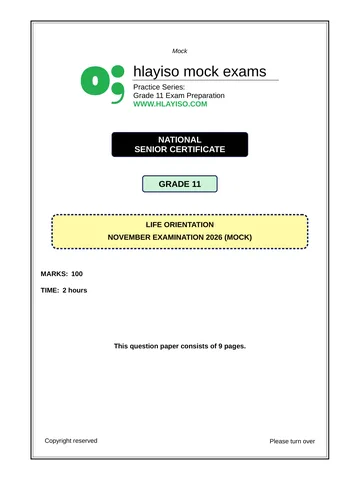
hlayiso mock exams
Practice Series:
Grade 11 Exam Preparation
WWW.HLAYISO.COM
NATIONAL
SENIOR CERTIFICATE
GRADE 11
LIFE ORIENTATION
NOVEMBER EXAMINATION 2026 (MOCK)
MARKING GUIDELINES
MARKS: 100
These marking guidelines consist of 11 pages.
Copyright reserved Please turn over
Skip to contentAll 2026 papers View all
Life Orientation Grade 11 P1 November Mock 2026 Memo (Eng)
Grade 11 Life Orientation Paper 1 memorandum from the November Mock Exam 2026 (English), 11 pages. Read online or download the free PDF.
Life Orientation · Grade 11 · November Mock Exam · 2026 · English. Memorandum, 11 pages. Read online or download the PDF.
- Subject
- Life Orientation
- Grade
- Grade 11
- Language
- English
- Document type
- Memorandum
- Year
- 2026
- Exam period
- November Mock Exam
- Paper
- 1
- Publisher
- Hlayiso
- Curriculum
- CAPS
- Pages
- 11
- File size
- 154.5 KB
Free to read online, no sign-up needed
Loading document…
Loading document…
1 of 11
This exam
November Mock Exam 2026
- Paper 1Question paperMemo
Document textSearch extracted text and jump to a page.
Life Orientation 2 Hlayiso/Mock 2026
NSC – Marking Guidelines
NOTES TO MARKERS
• These marking guidelines are not exhaustive. Accept any other relevant, correct answer
that shows understanding, and use professional judgement.
• Each ✓ represents ONE mark.
• For (2 x 2), (3 x 2) and (4 x 2) questions, award ONE mark for stating a relevant point
and ONE mark for explaining, discussing or giving an example of it. A point that is only
stated earns ONE mark.
• Questions in SECTIONS B and C must be answered in full sentences. Do not award the
second mark for single words or lists where an explanation is required.
• SECTION C: if a candidate answered all THREE questions, mark only the first TWO
questions answered.
• Do not penalise a candidate twice for the same error. Do not award marks for repeated
points.
• Sensitive questions (substance abuse, GBV): accept respectful, factually correct
answers from the candidate’s own experience or context.
SECTION A
QUESTION 1
1.1 1.1.1 C ✓ (5 x 1) (5)
1.1.2 A ✓
1.1.3 B ✓
1.1.4 C ✓
1.1.5 C ✓
1.2 1.2.1 Lifelong learning ✓ (5 x 1) (5)
1.2.2 Community-based organisation (CBO) ✓
1.2.3 Gender roles ✓
1.2.4 Admission Point Score (APS) ✓
1.2.5 Climate change ✓
1.3.1 Informs citizens about current events and government decisions so (2 x 1) (2)
that they can make informed choices (e.g. when voting) ✓
Acts as a “watchdog” by exposing corruption and abuse of power ✓
Gives a voice to ordinary people and communities/allows different
opinions to be heard ✓
Educates the public about their rights and responsibilities ✓
Encourages public debate and participation ✓
Holds leaders accountable ✓
[ANY TWO]
1.3.2 It spreads revision over the available time so that work is not left to (1 x 2) (2)
the last minute/cramming is avoided ✓✓
It gives the learner a sense of control because every subject has
enough time allocated, which reduces anxiety ✓✓
It builds in breaks, rest and sleep so that the learner does not burn
out ✓✓
[ANY ONE]
Copyright reserved Please turn over
Life Orientation 3 Hlayiso/Mock 2026
NSC – Marking Guidelines
1.3.3 Growing demand for digital/ICT skills (e.g. coding, data analysis) ✓ (2 x 1) (2)
Automation and artificial intelligence replacing some routine jobs ✓
More contract, freelance and “gig” work ✓
Remote/hybrid work arrangements ✓
High youth unemployment/fewer formal-sector jobs ✓
Demand for scarce and critical skills, e.g. artisans, engineers,
health workers ✓
Growth of entrepreneurship and self-employment ✓
Growth in the green economy (e.g. renewable energy) ✓
[ANY TWO]
1.3.4 South Africans of different races, cultures and languages support (1 x 2) (2)
the same national team, which creates a shared national identity
and pride ✓✓
Major sporting events bring people together in stadiums and fan
parks, breaking down barriers between groups ✓✓
Successful national teams and sports stars serve as role models of
unity and teamwork ✓✓
Development programmes give young people from all communities
equal opportunities to take part ✓✓
[ANY ONE]
1.3.5 They teach shared moral values such as respect, honesty, (2 x 1) (2)
compassion and ubuntu ✓
Interfaith dialogue/cooperation promotes tolerance and
understanding between groups ✓
Religious organisations run community projects, e.g. feeding
schemes, shelters and care for the sick ✓
They provide support and counselling to individuals and families in
times of need ✓
They speak out against injustice and promote peace and
reconciliation ✓
Religious freedom protected by the Constitution allows people to
practise their beliefs side by side ✓
[ANY TWO]
[20]
TOTAL SECTION A: 20
Copyright reserved Please turn over
Life Orientation 4 Hlayiso/Mock 2026
NSC – Marking Guidelines
SECTION B
QUESTION 2
2.1 Definition: behaviour/actions that increase the chance of harm or (1 + 3) (4)
negative consequences to one’s own health, safety or well-being, or
to that of others ✓
Examples: abusing alcohol or drugs/binge drinking ✓; unprotected
sex/having multiple sexual partners ✓; drinking and driving or
getting into a car with a drunk driver ✓; reckless driving/not wearing
a seatbelt ✓; meeting online strangers alone ✓; sharing explicit
images online ✓; smoking/vaping ✓; gang activity/carrying
weapons ✓; unsafe dieting ✓
[ANY THREE]
2.2 Curiosity/wanting to experiment ✓ (2 x 1) (2)
To cope with stress, problems at home or emotional pain ✓
Boredom/lack of recreational activities ✓
Easy access to and availability of substances ✓
Family members who use substances (role models) ✓
Media and advertising glamorise alcohol use ✓
Low self-esteem/to feel more confident ✓
Rebellion/to feel grown-up ✓
Do not accept peer pressure (mentioned in the extract). [ANY TWO]
2.3 Alcohol and dagga affect concentration and memory, so he will (2 x 2) (4)
struggle to learn and his marks will continue to drop ✓✓
Arriving late and absenteeism (e.g. after weekend gatherings)
mean that he misses lessons and work ✓✓
Substance use lowers fitness, stamina and coordination, so his
sporting performance will suffer ✓✓
Missing practices may lead to him losing his place in the first team
or being suspended ✓✓
Moodiness and irritability may cause conflict with teachers and
coaches, leading to disciplinary action ✓✓
He may lose opportunities such as sports bursaries or selection for
higher teams ✓✓
Learners who use substances at school may face suspension and
lose study time ✓✓
[ANY TWO]
Copyright reserved Please turn over
Life Orientation 5 Hlayiso/Mock 2026
NSC – Marking Guidelines
2.4 Say “No” clearly and firmly with confident body language, e.g. “No (2 x 2) (4)
thanks, I don’t want to go” ✓✓
Use “I”-statements to explain her feelings, e.g. “I feel uncomfortable
at parties where people use drugs” ✓✓
Suggest an alternative activity, e.g. invite friends to a movie or
sports event instead ✓✓
Repeat her refusal calmly (“broken record”) without making
excuses or getting aggressive ✓✓
Walk away/leave the conversation if she is pressured further ✓✓
Stand by her values and choose friends who respect her decisions
✓✓
[ANY TWO]
2.5 Include age-appropriate substance-abuse education in LO lessons (3 x 2) (6)
and awareness campaigns, so learners understand the risks ✓✓
Provide counselling and referral through the school-based support
team/social workers so that learners who use substances get help
early ✓✓
Offer extra-mural, sport and cultural activities so learners have
positive ways to spend free time ✓✓
Set up peer-support or mentorship programmes where trained
learners support others ✓✓
Involve parents through workshops on recognising the warning
signs and communicating with teenagers ✓✓
Enforce school rules and policies on substances, e.g. searches,
consistent consequences combined with support ✓✓
The community and police (e.g. community policing forums) can act
against illegal sales/shebeens selling alcohol to minors ✓✓
Create safe recreational spaces, e.g. youth centres and community
sports leagues ✓✓
[ANY THREE]
[20]
Copyright reserved Please turn over
Life Orientation 6 Hlayiso/Mock 2026
NSC – Marking Guidelines
QUESTION 3
3.1 Levels: Xitsonga HL 5, English FAL 6, Mathematical Literacy 7, Life (2 x 1) (2)
Sciences 4, Geography 5, Tourism 6 ✓
APS = 5 + 6 + 7 + 4 + 5 + 6 = 33 ✓
(Award 1 mark for correct levels/adding six subjects without LO; 1
mark for the answer 33.)
3.2 BA (Tourism Management) ✓ (2 x 1) (2)
BEd (Foundation Phase Teaching) ✓
Diploma in Nature Conservation ✓
[ANY TWO]
3.3 The BSc requires Mathematics at level 4 and does not accept (1 x 2) (2)
Mathematical Literacy; Nomsa takes Mathematical Literacy, so she
does not meet the subject requirement, even though her APS is
high enough ✓✓
3.4 TVET college ✓ (2 x 1) (2)
University of technology ✓
Private higher education institution/college ✓
Learnership/apprenticeship ✓
Skills programme/short course ✓
Distance-learning institution ✓
Gap year/volunteering programme ✓
[ANY TWO]
3.5 A bursary is money awarded (often based on merit or need) that (1 x 2) (2)
does not have to be repaid if the conditions are met, e.g. passing or
working for the sponsor, whereas a study loan must be paid back,
usually with interest, after studying ✓✓
3.6 New technology changes the way jobs are done, so workers must (2 x 2) (4)
keep updating their skills to stay employable ✓✓
Some jobs disappear because of automation, so people need to
retrain for new careers ✓✓
New careers are created (e.g. in data science and renewable
energy) that require new knowledge ✓✓
Lifelong learning increases opportunities for promotion and higher
earnings ✓✓
It builds adaptability and confidence to cope with change ✓✓
It supports entrepreneurship and self-employment when formal jobs
are scarce ✓✓
[ANY TWO]
Copyright reserved Please turn over
Life Orientation 7 Hlayiso/Mock 2026
NSC – Marking Guidelines
3.7 Work hard to improve her marks, especially Life Sciences (level 4), (3 x 2) (6)
so that her APS increases and she becomes competitive ✓✓
Apply early to several institutions and programmes before the
closing dates, including a back-up option ✓✓
Apply for funding early, e.g. NSFAS, bursaries from companies,
government departments or the university ✓✓
Research the exact entry requirements of her chosen programme
and attend open days/career exhibitions ✓✓
Make sure all documents are ready, e.g. certified ID copy and
Grade 11 results ✓✓
Draw up a study timetable and get extra help/tutoring where she
needs it ✓✓
Gain relevant experience through job-shadowing or volunteering to
strengthen applications ✓✓
[ANY THREE]
[20]
TOTAL SECTION B: 40
Copyright reserved Please turn over
Life Orientation 8 Hlayiso/Mock 2026
NSC – Marking Guidelines
SECTION C
QUESTION 4
4.1 The behaviours, attitudes, responsibilities and expectations that a (1 x 2) (2)
society or culture considers appropriate for males and females,
which are learnt rather than biologically determined ✓✓
4.2 “boys don’t cry” ✓ (2 x 1) (2)
“a real man must be in control of his girlfriend” ✓
Girls are expected to cook and clean (while brothers play soccer) ✓
“girls do not need to study further because they will get married” ✓
[ANY TWO]
4.3 Young men learn to hide their feelings, which can lead to stress, (2 x 2) (4)
anxiety and depression ✓✓
They may not ask for help or go for counselling because they see it
as weakness ✓✓
Bottled-up emotions may come out as anger, aggression or
violence ✓✓
They may turn to alcohol or drugs to cope with their feelings ✓✓
Untreated depression can increase the risk of self-harm ✓✓
It may damage relationships because they cannot communicate
their emotions ✓✓
[ANY TWO]
4.4 Physical abuse ✓ (2 x 1) (2)
Sexual abuse/rape/sexual harassment ✓
Emotional/psychological abuse ✓
Verbal abuse ✓
Economic/financial abuse ✓
Stalking/intimidation ✓
Online/cyber abuse, e.g. sharing intimate images without consent ✓
Femicide ✓
[ANY TWO]
4.5 Fear of the abuser/threats of further violence ✓✓ (2 x 2) (4)
Financial dependence on the abuser, e.g. for housing or food ✓✓
Shame, guilt or self-blame/fear of being judged by family and
community ✓✓
Lack of trust in the police or justice system/fear of not being
believed ✓✓
Pressure from family or culture to keep the matter private ✓✓
Lack of knowledge about where to get help or not having access to
services ✓✓
Male survivors may fear being ridiculed ✓✓
[ANY TWO]
Copyright reserved Please turn over
Life Orientation 9 Hlayiso/Mock 2026
NSC – Marking Guidelines
4.6 Teach learners about gender equality, consent, healthy (3 x 2) (6)
relationships and their rights in LO lessons ✓✓
Have and enforce a clear policy against sexual harassment,
bullying and violence, with safe reporting systems ✓✓
Give boys and girls equal opportunities and duties, e.g. in sport,
leadership and classroom tasks ✓✓
Run awareness campaigns, e.g. during the 16 Days of Activism for
No Violence against Women and Children ✓✓
Provide counselling and refer survivors to social workers and
support organisations ✓✓
Train teachers to recognise signs of abuse and to avoid gender
stereotyping ✓✓
Start dialogue/clubs where boys discuss positive masculinity with
role models ✓✓
[ANY THREE]
[20]
QUESTION 5
5.1 Water pollution (sewage in the river) ✓ (2 x 1) (2)
Land/soil pollution (illegal dumping of refuse and rubble) ✓
Plastic pollution ✓
[ANY TWO]
5.2 Sewage contains bacteria and viruses; swimming in or using the (2 x 2) (4)
water spreads diseases such as diarrhoea and cholera ✓✓
Contaminated water used for washing causes skin infections and
rashes ✓✓
Dumped refuse attracts rats, flies and mosquitoes that spread
disease ✓✓
Children may be injured by sharp objects/rubble or drown in the
river ✓✓
Polluted water may contaminate food gardens or livestock, which
people then eat ✓✓
Rotting waste causes bad smells and toxic chemicals that may
affect breathing ✓✓
[ANY TWO]
5.3 (a) Food security: droughts, heatwaves and irregular rainfall (2 x 2) (4)
reduce crop yields and kill livestock, so food becomes scarce and
more expensive ✓✓
(b) Low-lying communities: more frequent and heavier storms
cause floods that damage houses and property, displace people
and spread water-borne diseases ✓✓
(Accept other relevant answers for each.)
5.4 The Constitution (Bill of Rights) gives everyone the right to an (1 x 2) (2)
environment that is not harmful to their health or well-being;
dumping and sewage leaks make the river a health hazard, so this
right is not being protected ✓✓
Copyright reserved Please turn over
Life Orientation 10 Hlayiso/Mock 2026
NSC – Marking Guidelines
5.5 Steps must be practical and logically sequenced. Examples: (4 x 2) (8)
Investigate the problem: map dumping sites and take photographs
of the sewage leaks as evidence ✓✓
Report the broken sewage pipes and illegal dumping to the ward
councillor/municipality and request repairs and waste removal ✓✓
Run an awareness campaign (posters, social media, community
meetings) on the health dangers and on not swimming in the river
✓✓
Organise a clean-up day with residents, NGOs and local
businesses ✓✓
Ask the municipality for skips/refuse bins and regular collection ✓✓
Start a recycling project to reduce waste ✓✓
Plant trees/indigenous plants along the river banks and monitor the
river regularly ✓✓
Evaluate progress and follow up with the authorities ✓✓
[ANY FOUR]
[20]
QUESTION 6
6.1 Organised groups of citizens and organisations that are (1 x 2) (2)
independent of government and business (e.g. NGOs, CBOs,
religious groups, unions) and that act together to promote shared
interests and influence decisions ✓✓
6.2 Ward councillor ✓ (2 x 1) (2)
Ward committee ✓
Local municipality/municipal roads or traffic department ✓
School governing body (SGB)/principal ✓
Community policing forum (CPF)/local police ✓
Parents/residents’ association ✓
NGOs or CBOs dealing with road safety ✓
Provincial department of transport ✓
[ANY TWO]
6.3 Identify the problem clearly and decide what action is requested ✓ (4 x 1) (4)
Find out which authority is responsible (e.g. municipality) and who
the petition must be addressed to ✓
Write the petition: heading, description of the problem and a clear
request ✓
Collect signatures with names, contact details/addresses ✓
Hand in (lodge) the petition with the relevant authority/councillor
and keep a copy ✓
Follow up on the response/progress ✓
[ANY FOUR]
Copyright reserved Please turn over
Life Orientation 11 Hlayiso/Mock 2026
NSC – Marking Guidelines
6.4 The community radio station can inform many residents about the (2 x 2) (4)
danger and the campaign ✓✓
Media coverage puts public pressure on the municipality to act
quickly ✓✓
Social media can mobilise support and collect signatures online ✓✓
Interviews give learners and parents a platform to share their
experiences/voices ✓✓
The media can follow up and report on whether promises are kept
(accountability) ✓✓
[ANY TWO]
6.5 Young people learn about their rights and responsibilities as active (2 x 2) (4)
citizens ✓✓
Issues that affect youth, e.g. their safety, are brought to the
attention of decision-makers ✓✓
It develops leadership, communication and teamwork skills ✓✓
It strengthens democracy because decisions reflect the needs of all
groups ✓✓
It builds confidence that they can bring about change, instead of
feeling powerless ✓✓
It prepares them to vote and participate responsibly as adults ✓✓
[ANY TWO]
6.6 False information/rumours may spread and damage the credibility (2 x 2) (4)
of the campaign ✓✓
Learners may face cyberbullying, trolling or negative comments ✓✓
Personal information or photos of learners could be shared, which
threatens their privacy and safety ✓✓
Online support (“likes”) does not always lead to real
action/signatures ✓✓
Not all residents have smartphones or data, so some people are
excluded ✓✓
Posts may be seen as defamatory or disrespectful towards officials,
leading to conflict or disciplinary action ✓✓
(Award marks for critical evaluation, not just listing.) [ANY TWO]
[20]
TOTAL SECTION C: 40
GRAND TOTAL: 100
Copyright reserved
Study this subject
Recommended for this subject
More from Grade 11 Life Orientation
Question paper
Life Orientation Grade 11 November 2023 Question Paper
Question paper and memo
Life Orientation Grade 11 November 2022 Paper & Memo
Question paper
Life Orientation Grade 11 North West June 2019 QP
Question paper
Life Orientation Grade 11 November 2019 Question Paper
Question paper
Life Orientation Grade 11 November 2019 Question Paper
Question paper