
Mock
hlayiso mock exams
Practice Series:
Grade 12 NSC Preparation
WWW.HLAYISO.COM
NATIONAL
SENIOR CERTIFICATE
GRADE 12
TECHNICAL SCIENCES P2
MOCK EXAMINATION 2026
MARKS: 75
TIME: 1½ hours
This question paper consists of 9 pages and 4 data sheets.
Copyright reserved Please turn over
Skip to contentAll 2026 papers 
View all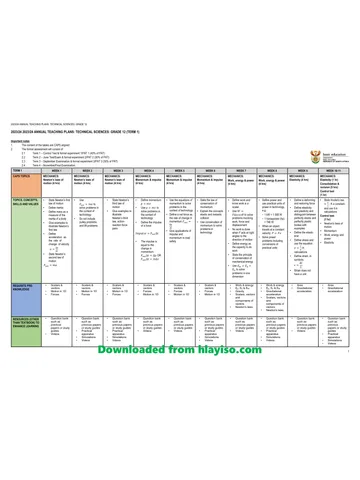
Technical Sciences Grade 12 P2 NSC November Mock 2026 QP
Grade 12 Technical Sciences Paper 2 question paper from the NSC November Mock Exam 2026 (English), 13 pages. Read online or download the free PDF.
Technical Sciences · Grade 12 · NSC November Mock Exam · 2026 · English. Question paper, 13 pages. Read online or download the PDF.
- Subject
- Technical Sciences
- Grade
- Grade 12
- Language
- English
- Document type
- Question paper
- Year
- 2026
- Exam period
- NSC November Mock Exam
- Paper
- 2
- Publisher
- Hlayiso
- Curriculum
- CAPS
- Pages
- 13
- File size
- 166.5 KB
Free to read online, no sign-up needed
Loading document…
Loading document…
1 of 13
This exam
NSC November Mock Exam 2026
- Paper 1Question paperMemo
- Paper 2Question paperMemo
Document textSearch extracted text and jump to a page.
Technical Sciences/P2 2 Hlayiso/Mock 2026
NSC Mock
INSTRUCTIONS AND INFORMATION
1. Write your centre number and examination number in the appropriate spaces on the
ANSWER BOOK.
2. This question paper consists of SIX questions. Answer ALL the questions in the
ANSWER BOOK.
3. Start EACH question on a NEW page in the ANSWER BOOK.
4. Number the answers correctly according to the numbering system used in this question
paper.
5. Leave ONE line between two subquestions, e.g. between QUESTION 2.1 and
QUESTION 2.2.
6. You may use a non-programmable calculator.
7. You are advised to use the attached DATA SHEETS.
8. Round off your FINAL numerical answers to a minimum of TWO decimal places.
9. Give brief motivations, discussions, etc. where required.
10. Write neatly and legibly.
Copyright reserved Please turn over
Technical Sciences/P2 3 Hlayiso/Mock 2026
NSC Mock
QUESTION 1: MULTIPLE-CHOICE QUESTIONS
Various options are provided as possible answers to the following questions. Choose the
answer and write only the letter (A–D) next to the question numbers (1.1 to 1.5) in the
ANSWER BOOK, e.g. 1.6 D.
1.1 Which ONE of the following compounds is an UNSATURATED hydrocarbon?
A C 3 H8
B C 3 H6
C C3 H7 OH
D CH3 COOH (2)
1.2 The IUPAC name of the compound with the condensed structural formula
CH3 CH(Cℓ)CH2 CH3 is …
A 3-chlorobutane.
B 1-chlorobutane.
C 2-chloropropane.
D 2-chlorobutane. (2)
1.3 Which ONE of the following types of intermolecular forces occurs between
ethanol molecules, but NOT between ethane molecules?
A Hydrogen bonds
B London forces
C Covalent bonds
D Ionic bonds (2)
1.4 In a galvanic cell, oxidation takes place at the …
A cathode, which is the positive electrode.
B anode, which is the positive electrode.
C anode, which is the negative electrode.
D cathode, which is the negative electrode. (2)
Copyright reserved Please turn over
Technical Sciences/P2 4 Hlayiso/Mock 2026
NSC Mock
1.5 Biodiesel is an alternative fuel that is produced mainly from …
A crude oil.
B vegetable oils and animal fats.
C coal.
D natural gas. (2)
[10]
Copyright reserved Please turn over
Technical Sciences/P2 5 Hlayiso/Mock 2026
NSC Mock
QUESTION 2 (Start on a new page.)
The letters A to F in the table below represent six organic compounds.
H H
A CH3 CH2 CH(CH3 )CH2 CH3 B
H C C C C H
H H H H
H H O
C Propyl ethanoate D
H C C C O H
H H
E 2-bromo-2-methylpropane F CH3 CH2 CH2 CH2 OH
2.1 Define the term homologous series. (2)
2.2 Write down the LETTER that represents a compound that:
2.2.1 Is a haloalkane (1)
2.2.2 Contains a carboxyl group (1)
2.2.3 Is unsaturated (1)
2.3 Write down the IUPAC name of compound A. (2)
2.4 Write down the IUPAC name of compound B. (2)
2.5 Refer to compound B and write down its:
2.5.1 Molecular formula (1)
2.5.2 General formula of the homologous series to which it belongs (1)
2.6 Compound C is an ester.
2.6.1 Draw the STRUCTURAL FORMULA of compound C. (2)
2.6.2 Write down the IUPAC name of the ALCOHOL that is used to
prepare compound C. (1)
[14]
Copyright reserved Please turn over
Technical Sciences/P2 6 Hlayiso/Mock 2026
NSC Mock
QUESTION 3 (Start on a new page.)
Learners investigate the boiling points of three organic compounds with similar molar masses.
Their results are shown in the table below.
COMPOUND MOLAR MASS (g·mol–1 ) BOILING POINT (◦ C)
A Butane 58 –0,5
B Propan-1-ol 60 97
C Ethanoic acid 60 118
3.1 Define the term boiling point. (2)
3.2 Give a reason why this is a fair comparison. (1)
3.3 Write down the independent variable in this investigation. (1)
3.4 Explain the difference between the boiling points of compounds A and B by
referring to the TYPE and STRENGTH of the intermolecular forces and the
ENERGY needed. (3)
3.5 Which compound (A, B or C) has the HIGHEST vapour pressure at room
temperature? (1)
3.6 Give a reason for the answer to QUESTION 3.5. (2)
3.7 Both compounds B and C have hydrogen bonds between their molecules.
Explain why compound C has a higher boiling point than compound B. (2)
[12]
Copyright reserved Please turn over
Technical Sciences/P2 7 Hlayiso/Mock 2026
NSC Mock
QUESTION 4 (Start on a new page.)
The flow diagram below shows reactions in which propene is used as the starting compound.
Compound X
Compound Y
(an alcohol) 2
Reac
tion a ction
H2 O 1 Re r
/H S
2 O
HB
4 H H
H C C C H
H H
Propene
Re
n3 act
eactio st ion
4
R taly
/ ca
H2
Propane Polypropene
Reaction 5: excess O2
CO2 + H2 O
4.1 Write down the TYPE of reaction represented by:
4.1.1 Reaction 1 (1)
4.1.2 Reaction 3 (1)
4.2 Compound Y is the MAJOR product of reaction 2. Write down the:
4.2.1 IUPAC name of compound Y (2)
4.2.2 STRUCTURAL FORMULA of compound Y (2)
4.3 Write down the NAME or FORMULA of a catalyst that can be used in reaction
3. (1)
4.4 Use MOLECULAR FORMULAE to write down a balanced chemical equation
for reaction 5. (3)
4.5 Reaction 4 produces the polymer polypropene.
4.5.1 Define the term polymer. (2)
4.5.2 Write down the type of polymerisation that takes place in reaction 4. (1)
4.5.3 State ONE everyday use of polypropene. (1)
[14]
Copyright reserved Please turn over
Technical Sciences/P2 8 Hlayiso/Mock 2026
NSC Mock
QUESTION 5 (Start on a new page.)
A small factory in Ekurhuleni electroplates steel keys with nickel to protect them. The simplified
diagram below shows the cell that is used. Electrode P is the steel key and electrode Q is a
bar of pure nickel. The electrolyte is a nickel(II) sulphate solution, NiSO4 (aq).
DC source
Q
P
NiSO4 (aq)
5.1 Define the term electrolytic cell. (2)
5.2 Which electrode, P or Q, must be connected to the NEGATIVE terminal of the
DC source? (1)
5.3 Write down the half-reaction that takes place at electrode P. (2)
5.4 Write down the half-reaction that takes place at electrode Q. (2)
5.5 How will the concentration of the Ni2+ (aq) ions in the electrolyte change
while the cell is in operation? Write down only INCREASES, DECREASES
or REMAINS THE SAME. (1)
5.6 Explain the answer to QUESTION 5.5. (2)
5.7 Give TWO reasons, other than improving its appearance, why the steel key
is electroplated with nickel. (2)
[12]
Copyright reserved Please turn over
Technical Sciences/P2 9 Hlayiso/Mock 2026
NSC Mock
QUESTION 6 (Start on a new page.)
Learners set up the galvanic cell shown below under standard conditions. An aluminium
electrode is placed in a solution containing Aℓ3+ (aq) ions, and a copper electrode is placed in
a solution containing Cu2+ (aq) ions.
V
X
Aℓ Cu
Aℓ3+ (aq) Cu2+ (aq)
6.1 Define the term galvanic cell. (2)
6.2 Write down ONE function of component X. (1)
6.3 Which electrode, Aℓ or Cu, is the ANODE? (1)
6.4 Write down the half-reaction that takes place at the anode. (2)
6.5 Write down the cell notation for this cell. (3)
6.6 Calculate the initial emf of the cell. (4)
[13]
TOTAL: 75
Copyright reserved
Technical Sciences/P2 1 Hlayiso/Mock 2026
NSC Mock
DATA FOR TECHNICAL SCIENCES GRADE 12
PAPER 2
TABLE 1: PHYSICAL CONSTANTS
NAME SYMBOL VALUE
Standard pressure pθ 1,01× 10⁵ Pa
Standard temperature Tθ 0 °C / 273 K
TABLE 2: FORMULAE
Emf Eθcell = Eθcathode – Eθanode
or
Ecell = Ereduction – Eθoxidation
θ θ
or
Ecell = Eoxidising agent – Eθreducing agent
θ θ
Copyright reserved Please turn over
Technical Sciences/P2 2 Hlayiso/Mock 2026
NSC Mock
TABLE 3: THE PERIODIC TABLE OF ELEMENTS
1 2 13 14 15 16 17 18
(I) (II) 3 4 5 6 7 8 9 10 11 12 (III) (IV) (V) (VI) (VII) (VIII)
1 2
Atomic number
2,1 H He
1 KEY 4
29
3 4 5 6 7 8 9 10
1,0 1,5
Electronegativity 1,9 Cu Symbol
2,0 2,5 3,0 3,5 4,0
Li Be B C N O F Ne
7 9 63,5 11 12 14 16 19 20
11 12 13 14 15 16 17 18
0,9 Na 1,2 Mg 1,5 Aℓ 1,8 Si 2,1 P 2,5 S 3,0 Cℓ Ar
Approximate relative atomic mass
23 24 27 28 31 32 35,5 40
19 20 21 22 23 24 25 26 27 28 29 30 31 32 33 34 35 36
0,8 K 1,0 Ca 1,3 Sc 1,5 Ti 1,6 V 1,6 Cr 1,5 Mn 1,8 Fe 1,8 Co 1,8 Ni 1,9 Cu 1,6 Zn 1,6 Ga 1,8 Ge 2,0 As 2,4 Se 2,8 Br Kr
39 40 45 48 51 52 55 56 59 59 63,5 65 70 73 75 79 80 84
37 38 39 40 41 42 43 44 45 46 47 48 49 50 51 52 53 54
0,8 Rb 1,0 Sr 1,2 Y 1,4 Zr Nb 1,8 Mo 1,9 Tc 2,2 Ru 2,2 Rh 2,2 Pd 1,9 Ag 1,7 Cd 1,7 In 1,8 Sn 1,9 Sb 2,1 Te 2,5 I Xe
86 88 89 91 92 96 101 103 106 108 112 115 119 122 128 127 131
55 56 57 72 73 74 75 76 77 78 79 80 81 82 83 84 85 86
0,7 Cs 0,9 Ba La 1,6 Hf Ta W Re Os Ir Pt Au Hg 1,8 Tℓ 1,8 Pb 1,9 Bi 2,0 Po 2,5 At Rn
133 137 139 179 181 184 186 190 192 195 197 201 204 207 209
87 88 89
0,7 Fr 0,9 Ra Ac
226
58 59 60 61 62 63 64 65 66 67 68 69 70 71
Ce Pr Nd Pm Sm Eu Gd Tb Dy Ho Er Tm Yb Lu
140 141 144 150 152 157 159 163 165 167 169 173 175
90 91 92 93 94 95 96 97 98 99 100 101 102 103
Th Pa U Np Pu Am Cm Bk Cf Es Fm Md No Lr
232 238
Copyright reserved Please turn over
Technical Sciences/P2 3 Hlayiso/Mock 2026
NSC Mock
TABLE 4A: STANDARD REDUCTION POTENTIALS
Half-reactions Eθ (V)
F2 (g) + 2e– ⇌ 2F– + 2,87
Co3+ + e– ⇌ Co2+ + 1,81
H2 O2 + 2H+ + 2e– ⇌ 2H2 O + 1,77
MnO–4 + 8H+ + 5e– ⇌ Mn2+ + 4H2 O + 1,51
Cℓ2 (g) + 2e– ⇌ 2Cℓ– + 1,36
Cr2 O2– + – 3+
7 + 14H + 6e ⇌ 2Cr + 7H2 O + 1,33
+ –
O2 (g) + 4H + 4e ⇌ 2H2 O + 1,23
MnO2 + 4H+ + 2e– ⇌ Mn2+ + 2H2 O + 1,23
Pt2+ + 2e– ⇌ Pt + 1,20
Br2 (ℓ) + 2e– ⇌ 2Br– + 1,07
NO–3 + 4H+ + 3e– ⇌ NO(g) + 2H2 O + 0,96
Hg2+ + 2e– ⇌ Hg(ℓ) + 0,85
Ag+ + e– ⇌ Ag + 0,80
NO3 + 2H+ + e– ⇌ NO2 (g) + H2 O
– + 0,80
Fe3+ + e– ⇌ Fe2+ + 0,77
O2 (g) + 2H+ + 2e– ⇌ H2 O2 + 0,68
Increasing strength of oxidising agents
I2 + 2e– ⇌ 2I–
Increasing strength of reducing agents
+ 0,54
Cu+ + e– ⇌ Cu + 0,52
SO2 + 4H+ + 4e– ⇌ S + 2H2 O + 0,45
2H2 O + O2 + 4e– ⇌ 4OH– + 0,40
Cu2+ + 2e– ⇌ Cu + 0,34
SO4 + 4H+ + 2e– ⇌ SO2 (g) + 2H2 O
2– + 0,17
Cu2+ + e– ⇌ Cu+ + 0,16
Sn4+ + 2e– ⇌ Sn2+ + 0,15
S + 2H+ + 2e– ⇌ H2 S(g) + 0,14
2H+ + 2e– ⇌ H2 (g) 0,00
Fe3+ + 3e– ⇌ Fe – 0,06
Pb2+ + 2e– ⇌ Pb – 0,13
Sn2+ + 2e– ⇌ Sn – 0,14
Ni2+ + 2e– ⇌ Ni – 0,27
Co2+ + 2e– ⇌ Co – 0,28
Cd2+ + 2e– ⇌ Cd – 0,40
Cr3+ + e– ⇌ Cr2+ – 0,41
Fe2+ + 2e– ⇌ Fe – 0,44
Cr3+ + 3e– ⇌ Cr – 0,74
Zn2+ + 2e– ⇌ Zn – 0,76
2H2 O + 2e– ⇌ H2 (g) + 2OH– – 0,83
Cr2+ + 2e– ⇌ Cr – 0,91
Mn2+ + 2e– ⇌ Mn – 1,18
Aℓ3+ + 3e– ⇌ Aℓ – 1,66
Mg2+ + 2e– ⇌ Mg – 2,36
Na+ + e– ⇌ Na – 2,71
Ca2+ + 2e– ⇌ Ca – 2,87
Sr2+ + 2e– ⇌ Sr – 2,89
Ba2+ + 2e– ⇌ Ba – 2,90
Cs+ + e– ⇌ Cs – 2,92
K+ + e– ⇌ K – 2,93
Li+ + e– ⇌ Li – 3,05
Copyright reserved Please turn over
Technical Sciences/P2 4 Hlayiso/Mock 2026
NSC Mock
TABLE 4B: STANDARD REDUCTION POTENTIALS
Half-reactions Eθ (V)
Li+ + e– ⇌ Li – 3,05
K+ + e– ⇌ K – 2,93
Cs+ + e– ⇌ Cs – 2,92
Ba2+ + 2e– ⇌ Ba – 2,90
Sr2+ + 2e– ⇌ Sr – 2,89
Ca2+ + 2e– ⇌ Ca – 2,87
Na+ + e– ⇌ Na – 2,71
Mg2+ + 2e– ⇌ Mg – 2,36
Aℓ3+ + 3e– ⇌ Aℓ – 1,66
Mn2+ + 2e– ⇌ Mn – 1,18
Cr2+ + 2e– ⇌ Cr – 0,91
2H2 O + 2e– ⇌ H2 (g) + 2OH– – 0,83
Zn2+ + 2e– ⇌ Zn – 0,76
Cr3+ + 3e– ⇌ Cr – 0,74
Fe2+ + 2e– ⇌ Fe – 0,44
Cr3+ + e– ⇌ Cr2+ – 0,41
Increasing strength of oxidising agents
Cd2+ + 2e– ⇌ Cd
Increasing strength of reducing agents
– 0,40
Co2+ + 2e– ⇌ Co – 0,28
Ni2+ + 2e– ⇌ Ni – 0,27
Sn2+ + 2e– ⇌ Sn – 0,14
Pb2+ + 2e– ⇌ Pb – 0,13
Fe3+ + 3e– ⇌ Fe – 0,06
2H+ + 2e– ⇌ H2 (g) 0,00
S + 2H+ + 2e– ⇌ H2 S(g) + 0,14
Sn4+ + 2e– ⇌ Sn2+ + 0,15
Cu2+ + e– ⇌ Cu+ + 0,16
SO4 + 4H+ + 2e– ⇌ SO2 (g) + 2H2 O
2– + 0,17
Cu2+ + 2e– ⇌ Cu + 0,34
2H2 O + O2 + 4e– ⇌ 4OH– + 0,40
SO2 + 4H+ + 4e– ⇌ S + 2H2 O + 0,45
Cu+ + e– ⇌ Cu + 0,52
I2 + 2e– ⇌ 2I– + 0,54
O2 (g) + 2H+ + 2e– ⇌ H2 O2 + 0,68
Fe3+ + e– ⇌ Fe2+ + 0,77
NO–3 + 2H+ + e– ⇌ NO2 (g) + H2 O + 0,80
Ag+ + e– ⇌ Ag + 0,80
Hg2+ + 2e– ⇌ Hg(ℓ) + 0,85
NO–3 + 4H+ + 3e– ⇌ NO(g) + 2H2 O + 0,96
Br2 (ℓ) + 2e– ⇌ 2Br– + 1,07
Pt2+ + 2e– ⇌ Pt + 1,20
MnO2 + 4H+ + 2e– ⇌ Mn2+ + 2H2 O + 1,23
O2 (g) + 4H+ + 4e– ⇌ 2H2 O + 1,23
Cr2 O2– + – 3+
7 + 14H + 6e ⇌ 2Cr + 7H2 O + 1,33
Cℓ2 (g) + 2e ⇌ 2Cℓ–
– + 1,36
MnO–4 + 8H+ + 5e– ⇌ Mn2+ + 4H2 O + 1,51
H2 O2 + 2H+ + 2e– ⇌ 2H2 O + 1,77
Co3+ + e– ⇌ Co2+ + 1,81
F2 (g) + 2e– ⇌ 2F– + 2,87
Copyright reserved
Study this subject
Recommended for this subject
Memorandum
Technical Sciences Grade 12 P1 NSC November Mock 2026 Memo
Question paper
Technical Sciences Grade 12 P2 Eastern Cape June 2024 QP
Question paper
Technical Sciences Grade 12 P2 Gauteng Prelim 2024 QP (Eng)
Question paper
Technical Sciences Grade 12 P2 Eastern Cape June 2023 QP
Question paper
Technical Sciences Grade 12 P2 Eastern Cape Mock 2023 QP
Question paper
Technical Sciences Grade 12 P2 GP Prelim 2023 QP (Eng)
More from Grade 12 Technical Sciences
Annual teaching plan
Gr 12 Tech Sci ATP 2023 24
Memorandum
Technical Sciences Grade 12 P1 Eastern Cape Mock 2025 Memo
Memorandum
Technical Sciences Grade 12 P2 Eastern Cape Mock 2025 Memo
Errata
Technical Sciences Grade 12 P1 Eastern Cape June 2024 Errata
Memorandum
Technical Sciences Grade 12 P1 Eastern Cape June 2024 Memo
Memorandum