
Mock
hlayiso mock exams
Practice Series:
Grade 12 NSC Preparation
WWW.HLAYISO.COM
NATIONAL
SENIOR CERTIFICATE
GRADE 12
TECHNICAL SCIENCES P1
MOCK EXAMINATION 2026
MARKS: 150
TIME: 3 hours
This question paper consists of 14 pages and 3 data sheets.
Copyright reserved Please turn over
Skip to contentAll 2026 papers 
View all
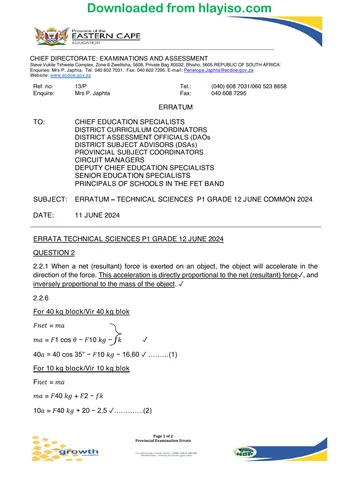
Technical Sciences Grade 12 P1 NSC November Mock 2026 QP
Grade 12 Technical Sciences Paper 1 question paper from the NSC November Mock Exam 2026 (English), 17 pages. Read online or download the free PDF.
Technical Sciences · Grade 12 · NSC November Mock Exam · 2026 · English. Question paper, 17 pages. Read online or download the PDF.
- Subject
- Technical Sciences
- Grade
- Grade 12
- Language
- English
- Document type
- Question paper
- Year
- 2026
- Exam period
- NSC November Mock Exam
- Paper
- 1
- Publisher
- Hlayiso
- Curriculum
- CAPS
- Pages
- 17
- File size
- 205.0 KB
Free to read online, no sign-up needed
Loading document…
Loading document…
1 of 17
This exam
NSC November Mock Exam 2026
- Paper 1Question paperMemo
- Paper 2Question paperMemo
Document textSearch extracted text and jump to a page.
Technical Sciences/P1 2 Hlayiso/Mock 2026
NSC Mock
INSTRUCTIONS AND INFORMATION
1. Write your centre number and examination number in the appropriate spaces on the
ANSWER BOOK.
2. This question paper consists of TEN questions. Answer ALL the questions in the
ANSWER BOOK.
3. Start EACH question on a NEW page in the ANSWER BOOK.
4. Number the answers correctly according to the numbering system used in this question
paper.
5. Leave ONE line between two subquestions, e.g. between QUESTION 2.1 and
QUESTION 2.2.
6. You may use a non-programmable calculator.
7. You may use appropriate mathematical instruments.
8. You are advised to use the attached DATA SHEETS.
9. Show ALL formulae and substitutions in ALL calculations.
10. Round off your FINAL numerical answers to a minimum of TWO decimal places.
11. Give brief motivations, discussions, etc. where required.
12. Write neatly and legibly.
Copyright reserved Please turn over
Technical Sciences/P1 3 Hlayiso/Mock 2026
NSC Mock
QUESTION 1: MULTIPLE-CHOICE QUESTIONS
Various options are provided as possible answers to the following questions. Choose the
answer and write only the letter (A–D) next to the question numbers (1.1 to 1.10) in the
ANSWER BOOK, e.g. 1.11 D.
1.1 The property of a body to resist any change in its state of rest or of uniform
motion in a straight line is called …
A mass.
B inertia.
C momentum.
D impulse. (2)
1.2 A 2 kg block is placed on a horizontal surface with negligible friction. Two
horizontal forces of 10 N and 6 N are applied simultaneously to the block, as
shown below.
6N 10 N
2 kg
Which ONE of the following CORRECTLY describes the motion of the block?
The block moves …
A with constant velocity to the right.
B with increasing acceleration to the right.
C at a constant acceleration of 8 m·s–2 to the right.
D at a constant acceleration of 2 m·s–2 to the right. (2)
1.3 The impulse of the net force acting on an object is equal to the … of the object.
A change in momentum
B momentum
C rate of change in momentum
D change in kinetic energy (2)
Copyright reserved Please turn over
Technical Sciences/P1 4 Hlayiso/Mock 2026
NSC Mock
1.4 A learner of mass 60 kg runs up a flight of stairs with a vertical height of 4 m
in 8 s. The average power that the learner develops against gravity is …
A 30 W
B 240 W
C 294 W
D 2 352 W (2)
1.5 Which ONE of the following liquids has the HIGHEST viscosity at room
temperature?
A Water
B Petrol
C Methylated spirits
D Honey (2)
1.6 Hooke’s law states that, within the limit of proportionality, the stress in a
material is …
A directly proportional to the strain.
B inversely proportional to the strain.
C equal to the strain.
D independent of the strain. (2)
1.7 The pressure that a liquid at rest exerts at a certain depth does NOT depend
on the …
A depth below the surface of the liquid.
B shape of the container.
C density of the liquid.
D gravitational acceleration. (2)
1.8 Which ONE of the following types of electromagnetic radiation has the
HIGHEST frequency?
A Infrared
B Visible light
C X-rays
D Ultraviolet (2)
Copyright reserved Please turn over
Technical Sciences/P1 5 Hlayiso/Mock 2026
NSC Mock
1.9 The capacitance of a parallel-plate capacitor will INCREASE when the …
A distance between the plates is increased.
B distance between the plates is decreased.
C area of the plates is decreased.
D potential difference across the plates is increased. (2)
1.10 Which ONE of the following devices converts mechanical energy into
electrical energy?
A Generator
B Electric motor
C Transformer
D Capacitor (2)
[20]
Copyright reserved Please turn over
Technical Sciences/P1 6 Hlayiso/Mock 2026
NSC Mock
QUESTION 2 (Start on a new page.)
A worker at a warehouse in Durban pulls a crate of mass 80 kg across a ROUGH horizontal
concrete floor. He uses a light, inextensible rope that makes an angle of 25◦ with the horizontal
and applies a constant force of 300 N, as shown in the diagram below.
300 N
80 kg 25◦
The crate accelerates to the right at 0,6 m·s–2 .
2.1 State Newton’s Second Law of Motion in words. (2)
2.2 Draw a labelled free-body diagram showing ALL the forces acting on the crate. (4)
2.3 Calculate the magnitude of the frictional force acting on the crate. (5)
2.4 Calculate the magnitude of the normal force acting on the crate. (3)
2.5 Hence, calculate the coefficient of kinetic friction between the crate and the
floor. (3)
2.6 The worker now pulls the crate with the same force of 300 N, but keeps the
rope HORIZONTAL.
How will the magnitude of the frictional force acting on the crate change?
Write down only INCREASES, DECREASES or REMAINS THE SAME. (1)
2.7 Explain the answer to QUESTION 2.6. (2)
[20]
Copyright reserved Please turn over
Technical Sciences/P1 7 Hlayiso/Mock 2026
NSC Mock
QUESTION 3 (Start on a new page.)
During a road-safety demonstration, a car of mass 1 200 kg moving at 20 m·s–1 due east
collides with a stationary bakkie of mass 1 800 kg. After the collision, the two vehicles move
together as one unit. Ignore the effects of friction.
at rest
E
20 m·s–1
1 200 kg 1 800 kg
3.1 Define the term momentum in words. (2)
3.2 Calculate the momentum of the car BEFORE the collision. (3)
3.3 Calculate the velocity of the car-bakkie unit immediately after the collision. (4)
3.4 Use a calculation to determine whether the collision is ELASTIC or
INELASTIC. (4)
3.5 The collision lasts for 0,15 s. Calculate the magnitude of the average net force
that the bakkie exerts on the car. (3)
3.6 Name TWO safety features in modern cars that reduce injuries to passengers
during collisions. (2)
[18]
Copyright reserved Please turn over
Technical Sciences/P1 8 Hlayiso/Mock 2026
NSC Mock
QUESTION 4 (Start on a new page.)
4.1 A learner pushes a lawnmower of mass 25 kg along a straight, horizontal
lawn. She applies a force of 120 N along the handle, which makes an angle
of 40◦ with the horizontal, as shown below. The lawnmower moves 15 m at a
CONSTANT VELOCITY.
120 N
40◦
25 kg
4.1.1 Define the term work. (2)
4.1.2 Calculate the work done by the applied force on the lawnmower. (3)
4.1.3 What is the NET work done on the lawnmower? Give a reason for
the answer. (2)
4.2 A box of mass 15 kg is released from rest at the top of a smooth (frictionless)
delivery chute in a factory. The top of the chute is 3,5 m above the floor, as
shown below.
15 kg
3,5 m
floor
4.2.1 State the principle of conservation of mechanical energy in words. (2)
4.2.2 Calculate the gravitational potential energy of the box at the top of
the chute. (3)
4.2.3 Calculate the speed of the box when it reaches the bottom of the
chute. (4)
4.3 An electric motor on a building site lifts a load of mass 500 kg vertically
upwards at a CONSTANT VELOCITY of 0,8 m·s–1 .
Calculate the average power delivered by the motor. (3)
4.4 Convert the answer to QUESTION 4.3 to horsepower (1 hp = 746 W). (1)
[20]
Copyright reserved Please turn over
Technical Sciences/P1 9 Hlayiso/Mock 2026
NSC Mock
QUESTION 5 (Start on a new page.)
A steel cable of a small crane has an original length of 4,0 m and a cross-sectional area of
5,0× 10⁻⁵ m2 . When the cable supports a load of 20 000 N, it extends by 8,0 mm. Assume
that the cable obeys Hooke’s law.
5.1 Define the term stress. (2)
Calculate the:
5.2 Stress in the cable (3)
5.3 Strain in the cable (3)
5.4 Young’s modulus of elasticity of the steel (3)
5.5 The graph below shows how the stress in a sample of a metal changes with
strain until the sample breaks.
C
Stress (Pa)
B
A
O Strain
Write down the letter (A, B or C) that represents the ELASTIC LIMIT of the
metal. (1)
5.6 Define the term viscosity. (2)
5.7 How does the viscosity of engine oil change as the engine warms up? Write
down only INCREASES, DECREASES or REMAINS THE SAME. (1)
[15]
Copyright reserved Please turn over
Technical Sciences/P1 10 Hlayiso/Mock 2026
NSC Mock
QUESTION 6 (Start on a new page.)
6.1 State Pascal’s law in words. (2)
6.2 A hydraulic car lift in a workshop has a small piston with a diameter of 4 cm
and a large piston with a diameter of 32 cm, as shown below. A car of mass
1 500 kg rests on the platform of the large piston. Ignore the masses of the
pistons and platform.
F1
1 500 kg
32 cm
4 cm
oil
small piston large piston
Calculate the magnitude of the minimum force, F1 , that must be applied to
the small piston to lift the car. (5)
6.3 A diver is working on a ship’s hull at a depth of 12 m below the surface of the
sea. The density of seawater is 1 025 kg·m–3 .
Calculate the pressure exerted by the seawater on the diver at this depth. (3)
[10]
Copyright reserved Please turn over
Technical Sciences/P1 11 Hlayiso/Mock 2026
NSC Mock
QUESTION 7 (Start on a new page.)
Right-angled glass prisms are used in periscopes and binoculars to turn light through 90◦ .
The diagram below shows a ray of light entering a right-angled glass prism perpendicular to
face PQ. The ray strikes face PR at point O at an angle of incidence of 45◦ .
The critical angle for the glass-air boundary is 42◦ .
P
normal
incident ray O
45◦
air glass
Q R
7.1 Define the term refraction. (2)
7.2 A ray of light travels from air into glass at an angle of incidence greater than
0◦ . Write down TWO changes that occur to the light ray as it crosses the
boundary. (2)
7.3 Define the term critical angle. (2)
7.4 Name the phenomenon that takes place at point O. (1)
7.5 State TWO conditions that must be met for the phenomenon named in
QUESTION 7.4 to occur. (2)
7.6 Name ONE other practical application of the phenomenon named in
QUESTION 7.4. (1)
[10]
Copyright reserved Please turn over
Technical Sciences/P1 12 Hlayiso/Mock 2026
NSC Mock
QUESTION 8 (Start on a new page.)
8.1 A microwave oven uses electromagnetic waves with a frequency of 2,45 GHz
to heat food.
8.1.1 Calculate the wavelength of these microwaves. (3)
8.1.2 Calculate the energy of ONE photon of these microwaves. (3)
8.1.3 Name ONE type of electromagnetic radiation that has a HIGHER
frequency than microwaves. (1)
8.2 The diagram below shows an object placed in front of a lens at a distance
greater than 2F from the lens.
lens
object
2F F F 2F
8.2.1 Name the type of lens shown in the diagram. (1)
8.2.2 Write down THREE properties of the image that is formed. (3)
[11]
Copyright reserved Please turn over
Technical Sciences/P1 13 Hlayiso/Mock 2026
NSC Mock
QUESTION 9 (Start on a new page.)
9.1 A parallel-plate capacitor consists of two metal plates, each with an area of
0,02 m2 , separated by a distance of 0,5 mm. Air is used as the dielectric. The
capacitor is connected to a 12 V battery and is fully charged.
9.1.1 Define the term capacitance. (2)
9.1.2 Calculate the capacitance of the capacitor. (3)
9.1.3 Calculate the charge stored on one plate of the capacitor. (3)
9.2 In the circuit below the battery has an emf of 12 V and negligible internal
resistance. Resistor R1 = 4 Ω is connected in series with resistors R2 = 6 Ω
and R3 = 12 Ω, which are connected in parallel. The resistance of the ammeter
and the connecting wires can be ignored.
R1
A
12 V R2 R3
Calculate the:
9.2.1 Total (equivalent) resistance of the circuit (3)
9.2.2 Reading on the ammeter (3)
9.2.3 Power dissipated in resistor R1 (3)
[17]
Copyright reserved Please turn over
Technical Sciences/P1 14 Hlayiso/Mock 2026
NSC Mock
QUESTION 10 (Start on a new page.)
10.1 The simplified diagram below represents a generator. The coil is rotated in the
magnetic field between the poles of a magnet, and the current is delivered to
a light bulb.
rotation
coil
N S
X Y
light bulb
10.1.1 Name the component labelled X. (1)
10.1.2 State Faraday’s law of electromagnetic induction in words. (2)
10.1.3 Write down the energy conversion that takes place in a generator. (1)
10.2 A cellphone charger contains a transformer that steps the mains voltage of
230 V down to 12 V. The primary coil has 1 150 turns.
Calculate the number of turns on the secondary coil. (3)
10.3 Explain why this transformer is a step-down transformer by referring to the
number of turns on the coils. (2)
[9]
TOTAL: 150
Copyright reserved
Technical Sciences/P1 1 Hlayiso/Mock 2026
NSC Mock
DATA FOR TECHNICAL SCIENCES GRADE 12
PAPER 1
TABLE 1: PHYSICAL CONSTANTS
NAME SYMBOL VALUE
Acceleration due to gravity g 9,8 m·s–2
Speed of light in a vacuum c 3,0× 10⁸ m·s–1
Planck’s constant h 6,63× 10⁻³⁴ J·s
Electron mass me 9,11× 10⁻³¹ kg
Permittivity of free space ε0 8,85× 10⁻¹² F·m–1
TABLE 2: FORMULAE
FORCE
Fnet = ma p = mv
fmax
s = µs N fk = µk N
Fnet ∆t = ∆p Fg = mg
∆p = mvf – mvi
∆x ∆v
v= a=
∆t ∆t
WORK, ENERGY AND POWER
W = F∆x cos θ U = mgh or Ep = mgh
K = 12 mv2 or Ek = 12 mv2 ME = Ek + Ep
W
Pave = Fvave P=
∆t
Copyright reserved Please turn over
Technical Sciences/P1 2 Hlayiso/Mock 2026
NSC Mock
ELASTICITY, VISCOSITY AND HYDRAULICS
F ∆L
σ= ε=
A L
σ F1 F2
=K =
ε A1 A2
F
P= P = ρ gh
A
ELECTROSTATICS
Q ε A
C= C= 0
V d
CURRENT ELECTRICITY
V
R= Rs = R1 + R2 + . . .
I
1 1 1
= + +...
Rp R 1 R 2
W
W = VQ P=
∆t
W = VI∆t P = VI
W = I2 R∆t P = I2 R
V2 ∆t V2
W= P=
R R
Copyright reserved Please turn over
Technical Sciences/P1 3 Hlayiso/Mock 2026
NSC Mock
ELECTROMAGNETISM
∆Φ
Φ = BA ε = –N
∆t
Vs Ns
=
Vp Np
WAVES, SOUND AND LIGHT
1
v = fλ T=
f
c
E = hf or E = h
λ
Copyright reserved
Study this subject
Recommended for this subject
Question paper
Technical Sciences Grade 12 P1 Eastern Cape Prelim 2024 QP
Question paper
Technical Sciences Grade 12 P1 Gauteng Prelim 2024 QP (Eng)
Question paper
Technical Sciences Grade 12 P1 Eastern Cape June 2023 QP
Question paper
Technical Sciences Grade 12 P1 Eastern Cape Mock 2023 QP
Question paper
Technical Sciences Grade 12 P1 GP Prelim 2023 QP (Eng)
Question paper
Technical Sciences Grade 12 P1 Eastern Cape Mock 2022 QP
More from Grade 12 Technical Sciences
Annual teaching plan
Gr 12 Tech Sci ATP 2023 24
Memorandum
Technical Sciences Grade 12 P1 Eastern Cape Mock 2025 Memo
Memorandum
Technical Sciences Grade 12 P2 Eastern Cape Mock 2025 Memo
Errata
Technical Sciences Grade 12 P1 Eastern Cape June 2024 Errata
Memorandum
Technical Sciences Grade 12 P1 Eastern Cape June 2024 Memo
Question paper