1
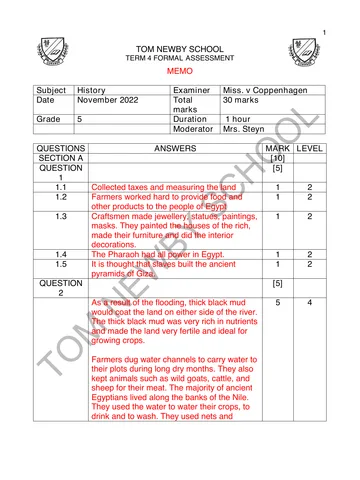
TOM NEWBY SCHOOL TEST
Subject History Examiner Mrs. v Coppenhagen
Date June 2021 Total marks 30 marks
Grade 5 Duration 1 hour
Moderator Miss Botha
Special instructions/ 1. Write as many details as possible.
Equipment 2. Read and answer ALL questions thoroughly.
3. Write neatly and legibly in blue pen.
4. Use a pencil for any drawings.
5. Good luck! Think before you INK!
This assessment has been compiled using notes and information contained in the Tom Newby School resource
material. The marking memorandum has been compiled accordingly. While alternative responses will be given
due acknowledgement, the official memorandum will be considered a priority document to ensure uniformity of
marking.
Name: Surname: Class:
SECTION A [10]
QUESTION 1: MATCH COLUMNS [5]
Match column B with column A. Write the letter of the answer that you have selected next to
the number of the answer grid, e.g.1.1 F
COLUMN A COLUMN B
1.1 Barter A The head person in charge of a group of people/tribe.
1.2 Initiation B To exchange one item for another without the use of
money.
1.3 Chiefdom C Payment in cattle made by a bridegroom to the bride’s
family for the bride before a wedding.
1.4 Chief D A ritual or series of rituals that must be performed in
order to qualify as a member of a group of people.
Many rituals are kept secret from people who are not
part of that group.
1.5 Lobola E A group of people/villagers that decide to form a bigger
group and choose one leader (chief) to manage all the
villages.
You're offline
Skip to contentQuestion paper View all
Grade 5 History Exam June 2021
History · Grade 5 · June Exam · 2021. Question paper, 6 pages. Read online or download the PDF.
- Subject
- History
- Grade
- Grade 5
- Document type
- Question paper
- Year
- 2021
- Exam period
- June Exam
- Pages
- 6
- File size
- 444.4 KB
Loading document…
Loading document…
1 of 6
Document textSearch extracted text and jump to a page.
2
Answer Grid
1.1 1.2 1.3 1.4 1.5
(5)
QUESTION 2 – DEFINTIONS [5]
Write a suitable description/explanation for each of the following:
2.1 Subsistence farmer (1)
__________________________________________________________________________
__________________________________________________________________________
__________________________________________________________________________
2.2 Overgrazed (1)
__________________________________________________________________________
__________________________________________________________________________
__________________________________________________________________________
2.3 Iron Age (1)
__________________________________________________________________________
__________________________________________________________________________
__________________________________________________________________________
2.4 Village (1)
__________________________________________________________________________
__________________________________________________________________________
__________________________________________________________________________
2.5 Homestead (1)
__________________________________________________________________________
__________________________________________________________________________
__________________________________________________________________________
3
SECTION B – ROCK ART [10]
QUESTION 3
Read the information about the South African Coat of Arms and the Linton Rock Art Panel.
Answer the questions that follow.
The South African flag, the national anthem and the coat of arms are all symbols of our
identity as South Africans. The coat of arms is a collection of pictures on a shield, with a
motto. The motto is a short sentence that tells us about the beliefs of our country. The
shield is a symbol of protection. The pictures on the shield are symbols of things that are
special about our country. San rock art is part of our coat of arms.
The people in the centre of the coat of arms come from a San rock art painting called the
Linton Panel. A section of rock art was removed from a farm called Linton in the Eastern
Cape. It was sent to the South African Museum in Cape Town, where it is on display. The
panel is kept inside to protect it from the sun, wind and rain and from people who might
damage it.
(Platinum Social Sciences, 2012, P. Ranby, B. Johannesson, R. Versfeld, M. Slamang, B.) Roberts)
3.1 Why were the San figures and motto used in the South African coat of arms? (1)
_________________________________________________________________________
3.2 Write the motto in the coat of arms and describe what it means. (2)
__________________________________________________________________________
__________________________________________________________________________
__________________________________________________________________________
3.3 Explain why the motto is appropriate for South Africa. (1)
__________________________________________________________________________
3.4 What does it mean to preserve an artifact? (2)
__________________________________________________________________________
__________________________________________________________________________
__________________________________________________________________________
4
3.5 The Linton Panel was taken to the museum in Cape Town. Name the province where
the city of Cape Town is based. (1)
__________________________________________________________________________
3.6 The coat of arms are all symbols. Describe the word symbol. (1)
__________________________________________________________________________
3.7 Choose two words from the options below to describe what the two San figures in the
coat of arms stand for: Unity, Strength, Transformation or Contentment. (2)
__________________________________________________________________________
SECTION C – THE FIRST FARMERS IN SOUTHERN AFRICA [10]
QUESTION 4
Complete the following activities about the first farmers in South Africa, the San and the
Khoikhoi.
4.1 Write a paragraph explaining how the first farmers in South Africa lived differently to
hunter-gatherers. Explain how they lived in their communities, shape of their houses,
their work ethic and how some villages formed chiefdoms. (4)
__________________________________________________________________________
__________________________________________________________________________
__________________________________________________________________________
__________________________________________________________________________
__________________________________________________________________________
__________________________________________________________________________
__________________________________________________________________________
__________________________________________________________________________
__________________________________________________________________________
__________________________________________________________________________
__________________________________________________________________________
__________________________________________________________________________
5
4.2 Explain the role of each of the following members of the village in early African farming
societies:
a) Men and boys (1)
_____________________________________________________________________
b) Woman (1)
_____________________________________________________________________
c) Children (1)
_____________________________________________________________________
4.3 Write down three things that the chief did in early farming societies. (3)
__________________________________________________________________________
__________________________________________________________________________
__________________________________________________________________________
GRAND TOTAL [30]
6
Analysis of History Grade 5 Exam (Teacher use only)
Name of learner:__________________________________
ALLOCATED MARK LEARNERS MARK
SECTION A [10]
QUESTION 1 5
QUESTION 2 5
ALLOCATED MARK LEARNERS MARK
SECTION B [10]
QUESTION 3 10
ALLOCATED MARK LEARNERS MARK
SECTION C [10]
QUESTION 4 10
TOTAL [30]
Recommended for this subject
Published documents with matching subject and grade metadata.
Related documents
Matched using subject, grade, language, document type and exam metadata.
More from Grade 5 History
Explore more published documents in this catalogue.