1
TOM NEWBY SCHOOL
TEST
Subject History Examiner Mrs. v Coppenhagen
Date June 2022 Total marks 30 marks
Grade 5 Duration 1 hour
Moderator Mrs M. Steyn
QUESTIONS ANSWERS MARK LEVEL
SECTION A [10]
QUESTION
1
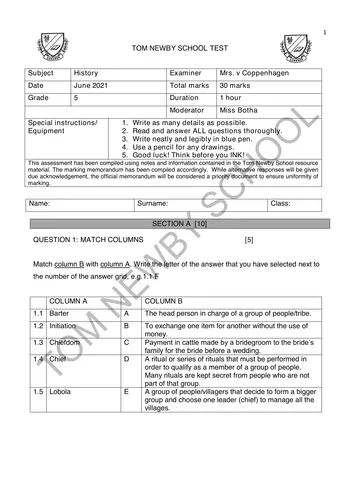
1.1 E 1 1
1.2 D 1 1
1.3 A 1 1
1.4 B 1 1
1.5 C 1 1
QUESTION
2
2.1 To exchange one item for another without the 1 2
use of money.
2.2 If the land has too many animals feeding on it 1 2
or if the same area is grazed for too long,
then there is no time for the grass to recover
and it does not grow back.
2.3 The period in history when people made and 1 2
used iron tools and weapons.
2.4 People who have no fixed home and move 1 2
from place to place.
2.5 A group of households. 1 2
SECTION B [10]
QUESTION
3
3.1 The Khoikhoi thought the San were inferior to 1 3
them because the San did not keep livestock.
3.2 They competed for game. 1 3
3.3 The San became the Khoikhoi’s servants. 1 3
3.4 The Khoikhoi were herders. 3 5
-They kept their cattle.
-They had a chief
Tom Newby School. June 2022 Assessment.
You're offline
Skip to contentMemorandum View all
Grade 5 History Memo June 2022
History · Grade 5 · June Exam · 2022. Memorandum, 3 pages. Read online or download the PDF.
- Subject
- History
- Grade
- Grade 5
- Document type
- Memorandum
- Year
- 2022
- Exam period
- June Exam
- Pages
- 3
- File size
- 150.0 KB
Loading document…
Loading document…
1 of 3
Document textSearch extracted text and jump to a page.
2
- Big group of 100 people.
San – Hunter gatherers.
-Nomadic
-Hunted for food.
-Had no leader or chief
-seen as equal
-group of 25 men and women.
3.5 The San moved around every season to find 4 5
the plants and animals that they needed.
Today, people live in one place. The San
hunted and gathered their own food. Today,
most people buy food from shops or farmers.
The San used resources carefully and in a
sustainable way. Today, people use and own
more than they need.
SECTION C [10]
QUESTION
4
4.1 Accept reasonable answers. Learners’ 4 5
answers must include mention of the social,
political, and economic structures. For
example.
-In a farming village, a man was the head of a
homestead. Each of the wives had her own
household, which was part of the homestead.
-Each village had a leader or headman. A
few villages together formed a chiefdom with
a chief.
-Each homestead grew its own crops and had
its own animals.
4.2 a) Men and boys were responsible 3 4
for hunting as well as looking after and
tending to the animals and protecting the tribe
members from wild animals.
b) Women looked after the crops and took
care of weeding in the fields. They also
cooked, cleaned and collected water.
Tom Newby School. June 2022 Assessment.
3
c) Children did not go to school; they learnt
their roles and skills from adults in the
community.
4.3 They were good areas for growing crops. 2 4
They had good grazing for livestock.
4.4 Wealth 1 2
TOTAL [30]
Tom Newby School. June 2022 Assessment.
Recommended for this subject
Published documents with matching subject and grade metadata.
Related documents
Matched using subject, grade, language, document type and exam metadata.
More from Grade 5 History
Explore more published documents in this catalogue.