Downloaded from hlayiso.com
1
TOM NEWBY SCHOOL ANSWER SCRIPT
Subject Life Orientation Examiner G Mynhardt and M Hudson
Date 20 November 2018 Total marks 70
Session Duration 2 hours
Grade 7 Moderator W Pienaar
Special instructions/ Answer on the answer script.
Equipment
This assessment has been compiled using notes and information contained in the Tom Newby School resource material. The
marking memorandum has been compiled accordingly. While alternative responses will be given due acknowledgement, the
official memorandum will be considered a priority document to ensure uniformity of marking.
Bloom’s Taxonomy Level Analysis
Section A
Question 1 Level 1 Question 6 Level 2
Question 2 Level 2 Question 7 Level 2
Question 3 Level 1 Question 8 Level 2
Question 4 Level 2
Question 5 Level 1
Section B
Question 1 Level 2 Question 6 Level 5
Question 2 Level 2 Question 7 Level 3
Question 3 Level 2 Question 8 Level 4
Question 4 Level 3 Question 9 Level 1
Question 5 Level 5
Section C
Question 1, 2 and 3 Levels 2, 3, 4, 5 and 6
________________________________________________________________________
SECTION A [28]
Question 1 (5) Level 1
1.1 a 1.2 c 1.3 c 1.4 d 1.5 a
Question 2 (6x½=3) Level 2
2.1 Passive 2.2 Aggressive 2.3 Assertive
2.4 Passive 2.5 Aggressive 2.6 Assertive
Question 3 (4x½=2) Level 1
3.1 Exhaust fumes
3.2 Industrial pollution
3.3 Second hand smoke
3.4 Litter
Skip to contentAll 2018 papers 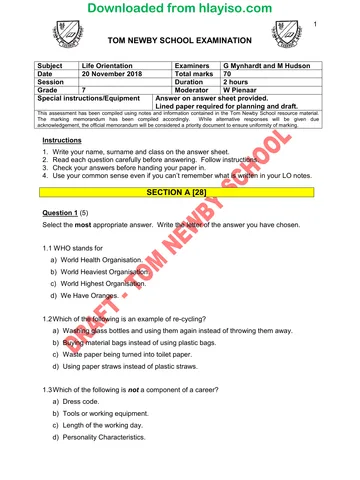
View all
Life Orientation Grade 7 November 2018 Memo
Grade 7 Life Orientation memorandum from the November Exam 2018, 5 pages. Read online or get the free PDF download, question paper linked when available.
Life Orientation · Grade 7 · November Exam · 2018. Memorandum, 5 pages. Read online or download the PDF.
- Subject
- Life Orientation
- Grade
- Grade 7
- Document type
- Memorandum
- Year
- 2018
- Exam period
- November Exam
- Curriculum
- CAPS
- Pages
- 5
- File size
- 180.4 KB
Free to read online, no sign-up needed
Loading document…
Loading document…
1 of 5
This exam
November Exam 2018
- Other filesQuestion paperMemo
Document textSearch extracted text and jump to a page.
Downloaded from hlayiso.com
2
Question 4 (5x½=2½) Level 2
4.1 Myth
4.2 Fact
4.3 Myth
4.4 Myth
4.5 Myth
Question 5 (3x½=1½) Level 1
5.1 Heroin, Morphine, 5.2 Marijuana, Alcohol 5.3 Tik, caffeine, ecstasy,
Opium nicotine, cocaine
Question 6 (6x1=6) Level 2
6.1 f 6.2 d 6.3 a 6.4 b 6.5 c 6.6 e
Question 7 (12x½=6) Level 2
Vegetables/legumes/beans Cabbage, bamboo shoots, mushrooms
Fruit Mulberries, oranges
Grain foods Rice, whole wheat biscuits, pasta
Protein Chicken, lobster
Dairy Cheese, yoghurt
Question 8 (4x½=2) Level 2
8.1 e 8.2 d 8.3 c 8.4 a
SECTION B [28]
Question 1 (2) Level 2
Suggested answer:
Pay attention in class and take notes. This strategy ensures that the information is already
being processed and learnt.
Question 2 (2) Level 2
2.1 If you realise that you're unhappy with something about yourself that you can
change, then start today. If it's something you can't change (like your height), then
start to work toward loving yourself the way you are.
2.2 Accept that you will make mistakes because everyone does. Mistakes are part of
learning. Remind yourself that a person's talents are constantly developing, and
everyone excels at different things.
Question 3 (8) Level 2
3.1 Hinduism
Central figure: Brahman
Sacred Spaces and Places: A Hindu place of worship is called a mandir or temple.
The spirit or spark of God is found in different forms in different objects or creatures and
can be male or female. The presence of God in these things is called a deity. A temple
Downloaded from hlayiso.com
3
is dedicated to a particular god or goddess (deity). The temple is the god's home on
earth. The most holy part of the temple is an inner shrine called a garbhargriha with a
statue to the god or goddess
Religious Principles: The fundamental teaching of Hinduism is that a human being's
basic nature is not confined to the body or the mind. The spirit or spark of god is within
us and also within everything we see. Anyone who takes the trouble to undergo the
necessary training to purify and refine the mind and senses can begin to feel the truth
of this. This training can take various forms and is known as yoga ("union"- union of the
individual self with this inner spirit).
Sacred Symbols and Texts: The philosophy, religion, and customs of the ancient
Aryans are recorded in their sacred texts known as the Vedas. These texts were initially
handed down by word of mouth from teacher to student. The basic teachings of
Hinduism are contained in the last portion of the Vedas and are known as the Vedanta
(the "end or concluding portion of the Vedas”)
3.2 Judaism
Central figures: Abraham and God
Sacred Spaces and Places: Israel is a sacred place to Jewish people. Jews who do
not live there try to visit at some point in their lives. Jewish people worship in places
called synagogues.
Religious Principles: There are 10 main laws laid out in the scriptures. These are the
rules for good living that were given, by God, to a man called Moses while he was on a
mountain called Sinai. They are the same as the commandments followed by Christians.
Sacred Symbols and Texts: Jewish people believe in the rules and guidance given in
their holy scriptures called the TeNaKH. It is made up of 2 parts: Torah and Talmud.
Question 4 (2) Level 3
For many years, cigarette advertisers sold their product by portraying cigarette smoking as
a ‘sophisticated’, ‘manly’ or ‘mature’ activity. People took up smoking because they wanted
to be like the people they saw in the adverts. The adverts did not mention the dangers of
smoking. The same applies to alcohol.
Today, cigarette companies cannot advertise their products in newspapers, magazines or
on T.V. They are also required, by law, to put a warning on all of the packets of cigarettes
that are sold. Unfortunately, there are still some addictive substances, like alcohol, that are
promoted directly through advertising of some kind.
Question 5 (2) Level 5
When teenagers go through puberty, their friends become very important. They need to feel
like they belong and they want to look and act the same way as their peers. The fact that
everybody else is doing is often seen as a good reason to try something new or potentially
dangerous.
Question 6 (2) Level 5
Any reasonable answer.
Downloaded from hlayiso.com
4
Question 7 (2x2=4) Level 3
7.1 THE RIGHT TO A CLEAN ENVIRONMENT
The Government’s Duty: To put laws in place that prevent companies from polluting
the environment.
Your Duty: Any reasonable answer.
7.2 THE RIGHT OF ACCESS TO HEALTH CARE, FOOD AND WATER
The Government’s Duty: To provide clean running water and garbage removal
services.
Your Duty: Any reasonable answer.
Question 8 (2) Level 4
Anorexia nervosa isn't really about food. It's an unhealthy way to try to cope with emotional
problems. When you have anorexia nervosa, you often equate thinness with self-worth.
Question 9 (2x2=4) Level 1
Do’s
• Protect the person from injury (remove harmful objects from nearby).
• Cushion their head.
• Look for an epilepsy identity card or identity jewellery.
• Aid breathing by gently placing them in the recovery position once the seizure has
finished (see pictures).
• Stay with the person until recovery is complete.
• Be calmly reassuring.
Don't’s
• Restrain the person’s movements.
• Put anything in the person’s mouth.
• Try to move them unless they are in danger.
• Give them anything to eat or drink until they are fully recovered.
• Attempt to bring them round.
-------------------------------------------------------------------------------------------------------
SECTION C [14]
Question 1 (8) Levels 2, 3, 4, 5 and 6
Introduction
Should make it clear that the essay is about environmental health problems in South Africa
and that, as individuals, we can make a difference. The can refer to the starfish story to
make their point.
Content paragraphs
• Should have a clear explanation of what the environmental health issue is and what
dangers it poses.
• Should have a useful contribution to a solution that is ‘do-able’ at an individual or
community level.
Downloaded from hlayiso.com
5
Conclusion
Should conclude that individuals can make a difference, even if it is only a small contribution.
Many small contributions can make a big change.
Question 2 (6) Level 2, 5 and 6
2.1 Dineo agreed to meet somebody that she had met on-line at a shopping centre.
She went to the meeting on her own.
She did not tell anybody where she was going.
2.2 Dineo’s parents did not make sure that they understood enough about computers.
They did not check who she was interacting with, on-line.
They did not keep track of Dineo’s movements and who she was meeting with.
2.3 Run away.
2.4 Report ‘Ishmael’ to the authorities/Facebook.
2.5 Dineo was flattered - no other boy had ever asked her out.
Question 3 (6) Level 2, 4, 5 and 6
3.1 Any reasonable answer and reason.
3.2 Any reasonable answer and reason.
3.3 Any reasonable answer and reason.
3.4 Any reasonable opinion and substantive quote.
Study this subject
Recommended for this subject
Question paper
Life Orientation Grade 7 November 2018 Question Paper
Question paper
Life Orientation Grade 7 June 2018 Question Paper
Question paper
Life Orientation Grade 7 November 2020 Question Paper
Question paper
Life Orientation Grade 7 November 2019 Question Paper
Question paper
Life Orientation Grade 7 November 2019 Question Paper
Question paper