Bedfordview Primary School
November Controlled Test
Name: Memorandum Grade 7:
Subject: History
Examiner: Mr S. Visser Date: 19 November 2021
Moderator: Miss N. Robben Time Allocation: 1 hour
INSTRUCTIONS
1. An extra 10 minutes will be provided for reading.
2. Write neatly and legibly.
3. Answer in the spaces provided.
4. This paper consists of 8 pages.
Question 1 2 3 4 5 6 7 8 9 TOTAL
%
Allocated mark 4 6 4 6 5 5 5 5 10 50
Learner’s mark
Moderated mark
1 2 3 4 5 6 7
0 – 29% 30 – 39% 40 – 49% 50 – 59% 60 – 69% 70 – 79% 80 – 100%
Section 1: Colonisation of the Cape [25 marks]
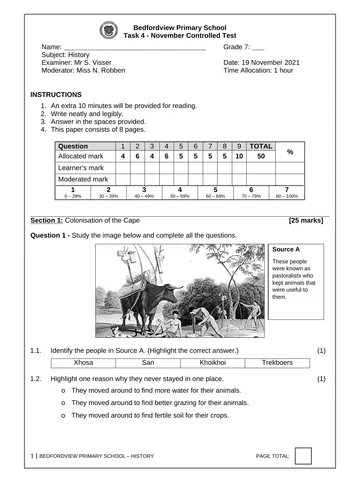
Question 1 - Study the image below and complete all the questions.
Source A
These people
were known as
pastoralists who
kept animals that
were useful to
them.
a) Identify the people in Source A. (Highlight the correct answer.) (1)
Xhosa San Khoikhoi Trekboers
b) Highlight one reason why they never stayed in one place. (1)
o They moved around to find more water for their animals.
o They moved around to find better grazing for their animals.
o They moved around to find fertile soil for their crops.
1 | BEDFORDVIEW PRIMARY SCHOOL – HISTORY PAGE TOTAL:
Skip to contentAll 2021 papers 
View all
Social Sciences Grade 7 November 2021 Memo
Grade 7 Social Sciences memorandum from the November Exam 2021, 8 pages. Read online or get the free PDF download, question paper linked when available.
Social Sciences · Grade 7 · November Exam · 2021. Memorandum, 8 pages. Read online or download the PDF.
- Subject
- Social Sciences
- Grade
- Grade 7
- Document type
- Memorandum
- Year
- 2021
- Exam period
- November Exam
- Curriculum
- CAPS
- Pages
- 8
- File size
- 1018.7 KB
Free to read online, no sign-up needed
Loading document…
Loading document…
1 of 8
This exam
November Exam 2021
Document textSearch extracted text and jump to a page.
c) Explain what happened to their way of life after the Dutch started to establish permanent
farms. You must mention two facts. (2)
The Khoikhoi lost all their livestock because there was no grazing land left for them.
Some Khoikhoi moved further north, and others joined the San.
Some Khoikhoi started to work for the free burghers. [Any two]
Question 2 - Look at the map below and answer all the questions.
Source B
A journey from the
Netherlands to Batavia
lasted between 6 months
and 1 year. The journey
was extremely long
because the ships relied
on the winds.
a) Which trading company used this trading route? (Highlight the correct answer.) (1)
COV VOC VCO OVC
b) Select a possible reason for the VOC’s decision to use the Cape as a stopping point.
(Highlight only one answer.) (1)
o It is exactly halfway between the Netherlands and Australia.
o It is exactly halfway between America and Batavia.
o It is exactly halfway between the Netherlands and Batavia.
c) State in which year they established a refreshment station at the Cape? (1)
1652 1657 1752 1672
d) Construct a list of three things Jan van Riebeeck had to establish at the Cape? (3)
Build a fort for protection.
Plant fruits and vegetables.
Build a hospital for the sick sailors.
Question 3 - Study the two sources about slavery at the Cape and answer the questions.
Source C
2 April 1654: It would be very much cheaper to have the agricultural work, seal-catching
and all the other necessary work done by slaves in return for plain food of rice and fish or
seal and penguin meat alone and without pay. The slaves could be obtained very
cheaply from Madagascar, together with rice in one voyage.
Adapted from: Journal of Jan van Riebeeck (Volume I) introductions and footnotes by HB Thom, Van Riebeeck Society
2 | BEDFORDVIEW PRIMARY SCHOOL – HISTORY PAGE TOTAL:
Source D
The only people who saw the event – at least the only ones who were prepared to talk – were
Maarten’s fellow slaves. They said that, sometime earlier, Maarten had run away, but was
caught. Crugel ordered him to spend the night chained to a wagon and then whipped him with
a sjambok.
After this, Maarten ran away again, was caught again, and was whipped once more. This
time, he died. The surgeon agreed with what the slaves said. The court convicted and fined
Crugel.
The court also ordered that the slaves who had given evidence against him must be sold to
new owners.
This source has been adapted from Oxford Successful Social Sciences.
a) Which source tells us that the VOC relied on slaves? Motivate your answer. (2)
Source C – Jan Van Riebeeck describes the reasons why they need slaves at the
refreshment station. [Any relevant answer.]
b) Write two sentences to describe how Source D shows that slaves were often mistreated by
their owners. (2)
Source D clearly describes how slaves were brutally punished and then chained to the
wagons. The source also explains how the masters killed the slaves when they were
punished. Several masters also forced their slaves to watch while another slave was
punished. [Any two]
Question 4 - Read the Case Study about William Bleek and Lucy Lloyd and complete the
questions.
The work of William (Wilhelm) Bleek and Lucy Lloyd
In 1869 some San men, who were living in the Northern Cape, were arrested for stock
theft. The men were sent to the Breakwater prison in Cape Town.
In Cape Town, Dr Wilhelm Bleek from Germany, a man who studied languages, and
his sister-in-law, Ms Lucy Lloyd, interviewed the men. Three of the men could speak
/Xam, and also remembered how their parents and grandparents had lived as hunter-
gatherers.
It was arranged that the three men, //Kabbo, /Han#kass’o and Dia!kwain, would live at
the Bleek family home in Cape Town. Bleek and Lloyd slowly learned the /Xam
language and wrote it down, making up symbols for the ‘clicks’ in the language. Bleek
and Lloyd filled more than 130 notebooks with what the men told them, written in
/Xam. Later the English translations were added alongside the /Xam.
From these notebooks we have information and knowledge of /Xam beliefs and
stories, as well as the meaning of rock paintings. If this information had not been
written down by Bleek and Lloyd, it would have been lost forever.
Extract: Platinum Successful Social Sciences – Grade 7
3 | BEDFORDVIEW PRIMARY SCHOOL – HISTORY PAGE TOTAL:
a) Highlight the main reason why William Bleek came to the Cape. (1)
o He came to the Cape to marry Lucy Lloyd.
o He wanted to study the San language.
o He wanted to free the prisoners.
b) State why the three San men were arrested. (1)
o They stole crops from the farmers.
o They stole money from the colony.
o They stole animals from the farmers.
c) Do you think these men had a reason to steal from the farmers? Motivate your answer. (2)
YesThere were no more animals to hunt, and they were hungry. / The farmers took all the
hunting grounds, and the San were starving [Any one]
d) Do you think the work Bleek and Lloyd did was important to historians? Motivate your
answer. (2)
Yes, The San history and language would have been lost if they did complete their
work.
Question 5 –
The refreshment station grew from a small outpost to a colony under Jan van Riebeeck’s rule as
governor. Use the PEEL method to write a paragraph to explain how his decisions could be seen
as the start of a colony. (Use the rubric below as a guidline.)
4 3 2 1 0 Total
Layout The learner used the The learner did not
PEEL method use the PEEL method.
successfully and
included an opening
sentence and
conclusion.
Content The learner included 4 The learner included 3 The learner included 2 The learner included 1 No facts or incorrect
facts to discuss Jan facts to discuss Jan facts to discuss Jan fact to discuss Jan Van facts were included.
Van Riebeeck’s rule as Van Riebeeck’s rule as Van Riebeeck’s rule as Riebeeck’s rule as
governor. governor. governor. governor.
Jan van Riebeeck’s decisions at the refreshment station can be seen as the start of a colony
because he made several mistakes. He brought slaves to the Cape without the VOC’s
permission, and this allowed the station to produce more crops. Later he allowed some of
his men to become free burghers and the owned land at the Cape. This led to an increase in
the Dutch population because more VOC members returned to the Cape to live there as
permanent farmers. In 1672 he also allowed the French Huguenot to establish their own
towns and farms around the Cape. These decisions finally led to the establishment of a fully
functional colony.
4 | BEDFORDVIEW PRIMARY SCHOOL – HISTORY PAGE TOTAL:
Section 2: Co-operation and conflict on the frontiers of the Cape Colony. [15 marks]
Question 6 - Study the map below and complete the questions.
Source E
The Eastern Cape
frontier
a) Choose the best answer to complete the statement. (1)
A frontier is …
o a town where many people live.
o a border between different communities.
o a river.
b) Highlight the names of two British towns that were founded as the frontier expanded. (2)
Somerset Suurveld King William’s Town Grahamstown
c) Which area was fought over? Explain why people fought over the land. (2)
Zuurveld – this area had fertile soil where the grass was ideal for grazing.
Question 7 - Study the following events and place them in the correct chronological order. (5)
The first 4 events are in the correct order.
1779 – Start of the First Frontier War between the Xhosa and Dutch.
1793 – End of the Second Frontier War.
1799 – Last frontier war between the Xhosa and the Dutch.
1811 – The British take over the Zuurveld.
The last five events are in the incorrect chronological order. Number the events from 1-5 to put
them in the correct order.
1879 – The Xhosa lost all power and the British take control of all the land East of the Kei
5
River.
1834 – The British create “empty land” between the Fish and Keiskamma Rivers.
2
1853 – The British drove the Xhosa off the land between the Keiskamma and Kei Rivers.
4
1819 –The Fifth Frontier War starts.
1
1846 – The British and Xhosa fight over the land between the Keiskamma and the Kei 3
5 | BEDFORDVIEW PRIMARY SCHOOL – HISTORY PAGE TOTAL:
Rivers.
Question 8 - Study the two sources about Inboekelinge and answer the questions.
Source F
As Boers took over more and more land, they found they needed more labour. Most adult African men
still had their own land; they therefore had no interest to work on settler farms. In the short term, the
need for labour was solved by the inboekelinge system. This was nothing short of slavery. In 1868,
the Transvaal newspaper, De Rupublikein, spoke out against “whole wagon loads” of children
continually hawked around the country. There were men, both black and white, who had become
traders in children, kidnapping them in raids and selling them to Boers for domestic labour.
Source: Adapted from Spot On Social Sciences – Grade 7
Source G
Boer commandos carried out a series of raids on African homesteads in search of this black ivory of
thousands of children. Inboekelinge were welcomed by Boer households as they carried out several
different jobs. Some were used as herdsmen, ox-wagon leaders, diggers of irrigation canals,
constructors of dam and kraal walls and the builders of Boer houses.
Source: Adapted from Illustrated History of South Africa: The real story by C Saunders et al (eds), 1992
a) Highlight one reason why the inboekelinge system was started. (1)
o The Boers did not want to use servants anymore.
o The African men did not want to work for the Boers.
o The Boers did not want to employ any adults.
b) Name two types of work inboekelinge had to do. (2)
herdsmen, ox-wagon leaders, diggers of irrigation canals, constructors of dam and kraal
walls and the builders [Any two]
c) Highlight two reasons why the inboekelinge system seems like slavery. (2)
o The children volunteered to become slaves.
o The children were forcefully taken against their own free will.
o The children worked in return for freedom and a salary.
o The children were forced to work for the farmers.
Section 3: Essay- Co-operation and conflict on the eastern frontier of the Cape Colony [10 marks]
You are required to write an essay about the
Co-operation and conflict on the eastern
frontier.
Chief Maqoma was without a question the most renowned Xhosa chief in South Africa’s 19 th
century frontier wars. Write an essay to discuss Chief Maqoma as a person, warrior, and legacy.
6 | BEDFORDVIEW PRIMARY SCHOOL – HISTORY PAGE TOTAL:
Your essay should include the following:
How Chief Maqoma fought for and with his people during the frontier wars.
What Chief Maqoma is best known for.
The following rubric will be used to mark your essay.
3 2 1 0 Total
Opening The opening statement gives The opening statement does No opening statement was
statement a clear indication of what the not give a clear indication of included.
essay will be about. what the essay will be about.
Paragraph 1 Three facts were mentioned Two facts were mentioned Only one fact was mentioned No facts or incorrect facts
The warrior about Chief Maqoma as a about Chief Maqoma as a about Chief Maqoma as a were included.
warrior. warrior. warrior.
Paragraph 2 Three facts were mentioned Two facts were mentioned Only one fact was mentioned No facts or incorrect facts
The legacy about Chief Maqoma as a about Chief Maqoma as a about Chief Maqoma as a were included.
Xhosa legacy. Xhosa legacy. Xhosa legacy.
Conclusion The conclusion clearly The conclusion does not No conclusion was included.
summarizes the life of Chief clearly summarize the life of
Maqoma. Chief Maqoma.
Total marks /10
Important:
Please note that an essay planning sheet is included on the next page. Use the
page to carefully plan your essay. (Your planning is not for marks.)
Please complete the essay on the provided folio paper.
Facts to consider
Opening Learner should mention that Chief Maqoma was a great Xhosa leader and is still a
statement well-known figure in South African history
Paragraph 1 In 1834, faced with increased military pressure from the colony, Maqoma and Tyali
Chief Maqoma (his half-brother) had no alternative but to take up arms to prevent further
as a warrior dispossession.
Although conquered by colonial invasion in 1835, Maqoma remained the most
powerful Rharhabe chief and by 1837 a cost-conscious colonial office had ordered
British troops to withdraw from Xhosaland.
Maqoma used his skills as general and tactician to lead a guerrilla campaign in the
forested mountains and valleys of the Waterkloof that frustrated the most skilled
British officers.
Paragraph 2 And yet his name lives on.
Chief Maqoma Oral traditions and colonial and missionary documents reveal a man of
as a legacy considerable intellect and eloquence,
striving to maintain traditional social structures and the power of Xhosa nobility in
the face of colonial depredations and dispossession.
Maqoma is remembered for his extraordinary tenacity, flexibility and political and
martial skills, who tragically became the victim of an advancing colonial
steamroller.
Conclusion The learner should use this opportunity to link all the paragraphs to the opening
statement.
7 | BEDFORDVIEW PRIMARY SCHOOL – HISTORY PAGE TOTAL:
Essay Planning Page
Building the argument
Opening statement:
Your reasons and evidence
P E E L
Make your point. (Introduce the Support your point with evidence Explain how the evidence supports Link this point to the next point in
topic you are about to discuss.) or examples. your point. the following paragraph or back to
the main idea
Reason/
Paragraph 1
Reason/
Paragraph 2
Strong conclusion
Concluding statement:
I now believe…
Clearly…
It is clear to me…
I agree that…
8 | BEDFORDVIEW PRIMARY SCHOOL – HISTORY PAGE TOTAL:
Study this subject
Recommended for this subject
Question paper
Social Sciences Grade 7 November 2021 Question Paper
Question paper
Social Sciences Grade 7 November 2021 Question Paper
Question paper
Social Sciences Grade 7 November 2021 Question Paper
Question paper
Social Sciences Grade 7 November 2021 Question Paper
Question paper
Social Sciences Grade 7 November 2021 Question Paper
Question paper