
Copyright reserved
Please turn over
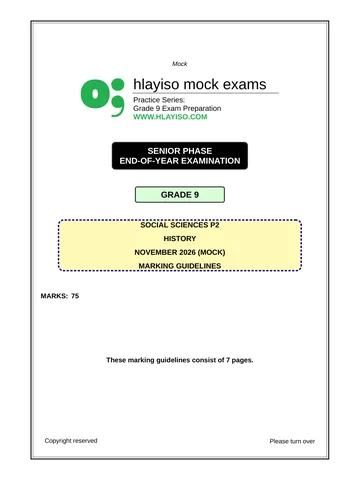
Mock
hlayiso mock exams
Practice Series:
Grade 9 Exam Preparation
WWW.HLAYISO.COM
SENIOR PHASE
END-OF-YEAR EXAMINATION
GRADE 9
SOCIAL SCIENCES P2
HISTORY
NOVEMBER 2026 (MOCK)
MARKS: 75
TIME: 2 hours
This question paper consists of 12 pages.
Skip to contentQuestion paper 
View all
Social Sciences Grade 9 Paper 2 November Mock 2026 Question Paper
Grade 9 Social Sciences Paper 2 question paper from the November Mock Exam 2026, 12 pages. Read online or get the free PDF download, memo linked when available.
Publisher: Hlayiso
Social Sciences · Grade 9 · November Mock Exam · 2026. Question paper, 12 pages. Read online or download the PDF.
- Subject
- Social Sciences
- Grade
- Grade 9
- Document type
- Question paper
- Year
- 2026
- Exam period
- November Mock Exam
- Paper
- 2
- Publisher
- Hlayiso
- Curriculum
- CAPS
- Pages
- 12
- File size
- 156.5 KB
Loading document…
Loading document…
1 of 12
Document textSearch extracted text and jump to a page.
Social Sciences/P2
2
Senior Phase Mock
Hlayiso/Mock 2026
INSTRUCTIONS AND INFORMATION
1.
This question paper consists of TWO sections:
SECTION A: TURNING POINTS IN MODERN SOUTH AFRICAN
HISTORY SINCE 1948
(35)
QUESTIONS 1 and 2
SECTION B: TURNING POINTS IN SOUTH AFRICAN HISTORY:
1976 AND 1990
(40)
QUESTIONS 3, 4 and 5
2.
Answer ALL the questions. In QUESTION 5 you must choose ONE of the two topics.
3.
Write ALL your answers in the ANSWER BOOK.
4.
Start EACH section on a NEW page.
5.
Number the answers correctly according to the numbering system used in this question
paper.
6.
ALL the sources are included in this question paper. Read them carefully, but do NOT
copy out large parts of a source as your answer.
7.
Use the mark allocation as a guide to the length of your answers. For example, (2 x 2)
(4) means TWO facts of 2 marks each; (2 x 1) (2) means TWO short facts of 1 mark
each.
8.
Where a question asks you to use your OWN KNOWLEDGE, you may use information
that is not in the source.
9.
Answer in FULL SENTENCES, except when you are asked to name, identify, list or
choose.
10.
QUESTION 5 must be answered as a paragraph (about TEN lines), not as a list of
points.
11.
Write neatly and legibly.
Copyright reserved
Please turn over
Social Sciences/P2
3
Senior Phase Mock
Hlayiso/Mock 2026
SECTION A: TURNING POINTS IN MODERN SOUTH AFRICAN HISTORY SINCE 1948
QUESTION 1: APARTHEID AND RESISTANCE: SHORT QUESTIONS
1.1
Various options are given as possible answers to the following questions.
Choose the correct answer and write only the letter (A–D) next to the
question number (1.1.1–1.1.5) in the ANSWER BOOK, e.g. 1.1.6 D.
1.1.1
The United Nations adopted the Universal Declaration of
Human Rights in …
A
1945.
B
1948.
C
1955.
D
1960.
(1)
1.1.2
Racism can best be described as …
A
a belief that all people should have equal rights.
B
a law that separates rich and poor people.
C
treating people unfairly because of the race group they
belong to.
D
the right of every person to vote.
(1)
1.1.3
The political party that won the 1948 general election and
introduced apartheid was the …
A
African National Congress.
B
United Party.
C
National Party.
D
Pan Africanist Congress.
(1)
1.1.4
The ANC plan of 1949 that called for boycotts, strikes and civil
disobedience was called the …
A
Freedom Charter.
B
Programme of Action.
C
Pass Laws Campaign.
D
Congress of the People.
(1)
1.1.5
The organisation that was formed in 1959 by Africanists who
broke away from the ANC was the …
A
Pan Africanist Congress (PAC).
B
South African Students’ Organisation (SASO).
C
United Democratic Front (UDF).
D
South African Communist Party (SACP).
(1)
(5 x 1) (5)
Copyright reserved
Please turn over
Social Sciences/P2
4
Senior Phase Mock
Hlayiso/Mock 2026
1.2
Choose a description from COLUMN B that matches the apartheid law
in COLUMN A. Write only the letter (A–F) next to the question number
(1.2.1–1.2.5) in the ANSWER BOOK, e.g. 1.2.6 G.
COLUMN A
COLUMN B
1.2.1
Population Registration Act
(1950)
A
Made marriages between white people
and people of other race groups illegal
1.2.2
Group Areas Act (1950)
B
Gave every person a race classification
that was recorded in a national register
1.2.3
Bantu Education Act (1953)
C
Set up separate homelands (reserves)
that were ruled by chiefs who supported
the government
1.2.4
Reservation
of
Separate
Amenities Act (1953)
D
Divided towns and cities into separate
areas where each race group had to live
1.2.5
Prohibition
of
Mixed
Marriages Act (1949)
E
Created a separate and poorer school
system for black learners, controlled by
the Department of Native Affairs
F
Kept race groups apart in public places
such as beaches, parks, buses and post
offices
(5 x 1) (5)
[10]
Copyright reserved
Please turn over
Social Sciences/P2
5
Senior Phase Mock
Hlayiso/Mock 2026
QUESTION 2: APARTHEID LAWS AND RESISTANCE, 1948–1960
2.1
The Group Areas Act and the forced removals at Sophiatown
Study SOURCE 2A and answer the questions that follow.
SOURCE 2A
The following is a summary written by the examiner from historical accounts of the Sophiatown
removals, together with a reconstruction of the kind of notice that residents received.
Sophiatown was a lively suburb a few kilometres
west of the centre of Johannesburg. It was one of
the few places in the city where black people could
own land. African, coloured, Indian and Chinese
families lived side by side, and the suburb was
famous for its jazz musicians, writers and sports
clubs.
The
government
called
Sophiatown
a
‘black
spot’ because it was close to white suburbs.
From February 1955 armed police arrived with
trucks before sunrise. Families had to load their
belongings and were moved to Meadowlands, a
new township in Soweto, much further from the city.
Residents had sung “We won’t move”, but by the
early 1960s the old houses had been bulldozed.
A white suburb was built in its place and named
Triomf (‘triumph’).
NOTICE
TO ALL OCCUPANTS
You are hereby ordered to
leave these premises. A
government truck will collect
you and your possessions
at 6 a.m. on the date below.
Stand No.:
Date:
New address: MEADOWLANDS
FAILURE TO OBEY IS
AN OFFENCE
(Examiner’s reconstruction)
[Compiled by the examiner from historical accounts]
2.1.1
Name the apartheid law that the government used to declare
Sophiatown a ‘white’ area.
(1 x 1)
(1)
2.1.2
Which township were the residents of Sophiatown moved to,
according to the source?
(1 x 1)
(1)
2.1.3
Using the source, explain why the government wanted to
remove the people of Sophiatown.
(2 x 1)
(2)
2.1.4
Use the source and your OWN KNOWLEDGE to explain TWO
ways in which the forced removals affected the lives of the
people of Sophiatown.
(2 x 2)
(4)
Copyright reserved
Please turn over
Social Sciences/P2
6
Senior Phase Mock
Hlayiso/Mock 2026
2.2
Non-violent resistance in the 1950s
Study SOURCE 2B and answer the questions that follow.
SOURCE 2B
The following summary was written by the examiner. The four lines in bold are clause headings
from the Freedom Charter (1955).
In 1952 the ANC and the South African Indian Congress began a campaign of non-violent
resistance. Volunteers deliberately broke apartheid laws, for example by entering ‘whites
only’ entrances at railway stations, and allowed themselves to be arrested. More than 8 000
volunteers were arrested.
On 26 and 27 June 1955 about 3 000 delegates met at Kliptown, near Johannesburg, at the
Congress of the People. They adopted the Freedom Charter, which set out the kind of South
Africa they wanted. Some of its clauses were:
The People Shall Govern!
All National Groups Shall have Equal Rights!
The Land Shall be Shared Among Those Who Work It!
The Doors of Learning and of Culture Shall be Opened!
On 9 August 1956 about 20 000 women of all races marched to the Union Buildings in
Pretoria. They left thousands of signed petitions for the Prime Minister, J.G. Strijdom, and
stood in silence for thirty minutes.
In December 1956 the police arrested 156 leaders of the Congress Alliance and charged
them with high treason*. The trial dragged on for more than four years, but in the end not
one of the accused was found guilty.
[Compiled by the examiner from historical accounts]
*high treason: the crime of trying to overthrow the government of your own country
2.2.1
Name the 1952 campaign in which volunteers deliberately
broke apartheid laws.
(1 x 1)
(1)
2.2.2
Where was the Freedom Charter adopted?
(1 x 1)
(1)
2.2.3
Explain what the Freedom Charter meant by “The People Shall
Govern!”.
(1 x 2)
(2)
2.2.4
Use your OWN KNOWLEDGE. Explain why the women
marched to the Union Buildings on 9 August 1956.
(1 x 2)
(2)
2.2.5
Why do you think the government charged the leaders of the
Congress Alliance with high treason after the Freedom Charter
was adopted?
(1 x 2)
(2)
Copyright reserved
Please turn over
Social Sciences/P2
7
Senior Phase Mock
Hlayiso/Mock 2026
2.3
The Sharpeville Massacre, 21 March 1960
Study SOURCES 2C and 2D and answer the questions that follow.
SOURCE 2C
The following is an imagined police statement, written by the examiner to show the version of
events that the police gave at the time.
On the morning of 21 March 1960 a crowd of several thousand Africans surrounded the police
station at Sharpeville. They had left their passes at home and demanded to be arrested. The
crowd was noisy and aggressive. Some people threw stones and the police feared that the
station would be overrun. The police fired to protect their lives and the station.
[Examiner-written, based on the police version of events]
SOURCE 2D
The following is an imagined account by a newspaper reporter, written by the examiner and
based on what eyewitnesses later reported.
I was standing near the fence. The people were singing and many were laughing; there were
women with babies on their backs. I looked carefully and saw no guns, only a few sticks and
umbrellas. There was no order to leave and no warning shot. Suddenly the police opened
fire and kept shooting as people turned and ran. Most of the dead and wounded were shot
in the back. Afterwards the ground was covered with shoes, hats and bicycles. Sixty-nine
people died and about 180 were injured.
[Examiner-written, based on eyewitness accounts]
2.3.1
Use your OWN KNOWLEDGE. Which organisation called for
the anti-pass protest of 21 March 1960, and who was its leader?
(2 x 1)
(2)
2.3.2
According to SOURCE 2C, why did the police open fire?
(1 x 1)
(1)
2.3.3
Compare SOURCES 2C and 2D. Explain ONE way in which
the two sources give different views of the crowd.
(1 x 2)
(2)
2.3.4
Why do you think the police version of events (SOURCE 2C) is
so different from the eyewitness account (SOURCE 2D)?
(1 x 2)
(2)
2.3.5
Explain why the Sharpeville Massacre is regarded as a turning
point in South African history.
(2 x 1)
(2)
[25]
TOTAL SECTION A: 35
Copyright reserved
Please turn over
Social Sciences/P2
8
Senior Phase Mock
Hlayiso/Mock 2026
SECTION B: TURNING POINTS IN SOUTH AFRICAN HISTORY: 1976 AND 1990
QUESTION 3: 1976 TO 1994: SHORT QUESTIONS
3.1
Various options are given as possible answers to the following questions.
Choose the correct answer and write only the letter (A–D) next to the
question number (3.1.1–3.1.5) in the ANSWER BOOK, e.g. 3.1.6 D.
3.1.1
The leader of the Black Consciousness Movement and the first
president of SASO was …
A
Robert Sobukwe.
B
Steve Biko.
C
Walter Sisulu.
D
Oliver Tambo.
(1)
3.1.2
The 1974 instruction that half of the school subjects in black
schools had to be taught in Afrikaans was called the …
A
Afrikaans Medium Decree.
B
Bantu Authorities Act.
C
Separate Amenities Act.
D
Language Charter.
(1)
3.1.3
The student leader who led the march of learners in Soweto on
16 June 1976 was …
A
Solomon Mahlangu.
B
Mbuyisa Makhubo.
C
Tsietsi Mashinini.
D
Chris Hani.
(1)
3.1.4
On 2 February 1990 President F.W. de Klerk announced …
A
the start of the Soweto uprising.
B
the unbanning of the ANC, PAC and SACP.
C
the results of the first democratic election.
D
a new state of emergency.
(1)
3.1.5
The multi-party negotiations that began in December 1991 to
plan a new democratic constitution were called …
A
CODESA.
B
the UDF.
C
the TRC.
D
COSATU.
(1)
(5 x 1) (5)
Copyright reserved
Please turn over
Social Sciences/P2
9
Senior Phase Mock
Hlayiso/Mock 2026
3.2
The FIVE events below are NOT in the correct order. Write the letters
(A–E) in the correct order, starting with the EARLIEST event, e.g. 3.2 X,
Y, …
A
The United Democratic Front (UDF) is formed to oppose the
government
B
School learners in Soweto march against Afrikaans as a language
of teaching
C
South Africa holds its first democratic election
D
Nelson Mandela walks out of prison after 27 years
E
Steve Biko dies in police detention
(5 x 1) (5)
[10]
QUESTION 4: THE 1976 SOWETO UPRISING AND THE EVENTS OF 1990
4.1
The Soweto uprising, 16 June 1976
Study SOURCES 4A and 4B and answer the questions that follow.
SOURCE 4A
The following is an imagined account by a Grade 9 learner in Soweto in 1976, written by the
examiner and based on many learners’ memories of the day.
We had been angry for months. Our teachers could hardly speak Afrikaans themselves, and
now we had to learn Mathematics and Social Studies in it. Our classes were full, we shared
old textbooks, and we knew that Bantu Education was preparing us only to be workers for
others.
On the morning of 16 June our student council led thousands of us out of our schools. We
carried placards that we had made the night before, and we sang as we walked towards
Orlando Stadium. Near Orlando West the police blocked the road. They threw teargas, and
then they started shooting. A young boy was shot and carried away by an older learner. Later
we heard that he had died. That evening Soweto was burning, and in the weeks that followed
the protests spread to many other parts of the country.
[Examiner-written, based on historical accounts]
Copyright reserved
Please turn over
Social Sciences/P2
10
Senior Phase Mock
Hlayiso/Mock 2026
SOURCE 4B
A sketch drawn by the examiner of learners marching on 16 June 1976. The slogans are like
those described in many accounts of the march.
AWAY WITH
AFRIKAANS
WE WANT
EQUAL
EDUCATION
BLACKS ARE
NOT DUSTBINS
RELEASE OUR
STUDENTS
DOWN WITH
BANTU
EDUCATION
4.1.1
According to SOURCE 4A, on which date did the learners
march?
(1 x 1)
(1)
4.1.2
Which language did the learners object to being taught in?
(1 x 1)
(1)
4.1.3
Choose ONE slogan from SOURCE 4B and explain what it tells
us about why the learners were protesting.
(1 x 2)
(2)
4.1.4
Use SOURCE 4A to give TWO reasons why the learners were
unhappy with Bantu Education.
(2 x 1)
(2)
4.1.5
Use your OWN KNOWLEDGE. Name the boy who was
shot and carried away (SOURCE 4A) and explain why the
photograph of this event became important around the world.
(2 x 1)
(2)
4.1.6
Do you think the police were right in the way they responded to
the march? Give a reason for your answer.
(1 x 2)
(2)
Copyright reserved
Please turn over
Social Sciences/P2
11
Senior Phase Mock
Hlayiso/Mock 2026
4.2
1990: The release of Nelson Mandela
Study SOURCE 4C and answer the questions that follow.
SOURCE 4C
The following is an imagined newspaper front page, written by the examiner. The newspaper
is fictional, but the events it reports are real.
THE DAILY NEWS-SHEET
Monday, 12 February 1990
Price: 60c
MANDELA WALKS FREE AFTER 27 YEARS
Nelson Mandela walked out of Victor
Verster Prison near Paarl yesterday
afternoon, holding hands with his wife,
Winnie. Thousands of people waited
for hours outside the prison gates and
on the road to Cape Town.
Later, from the balcony of the Cape
Town City Hall, he spoke to a huge
crowd on the Grand Parade.
Mr Mandela’s release follows the
speech by State President F.W. de
Klerk in Parliament on 2 February,
when the ANC, PAC and SACP were
unbanned and the release of political
prisoners was announced.
Our reporters say that many people
are now asking one question: can
the government and the liberation
movements reach an agreement
without more violence?
4.2.1
Name the State President who announced the unbanning of
political organisations on 2 February 1990.
(1 x 1)
(1)
4.2.2
Name TWO organisations that were unbanned, according to
the source.
(2 x 1)
(2)
4.2.3
From which prison was Nelson Mandela released?
(1 x 1)
(1)
4.2.4
Use your OWN KNOWLEDGE to explain TWO pressures
that forced the apartheid government to unban political
organisations and release Nelson Mandela in 1990.
(2 x 2)
(4)
4.2.5
If this front page had really been printed on 12 February 1990,
would it be a primary or a secondary source? Give a reason for
your answer.
(2 x 1)
(2)
[20]
Copyright reserved
Please turn over
Social Sciences/P2
12
Senior Phase Mock
Hlayiso/Mock 2026
QUESTION 5: PARAGRAPH QUESTION
Answer EITHER QUESTION 5.1 OR QUESTION 5.2. Write a paragraph of about
TEN lines. Your paragraph must have an introductory sentence, the main facts
and a concluding sentence.
5.1
Explain the CAUSES of the Soweto uprising of 16 June 1976 and its
RESULTS for South Africa.
(10)
OR
5.2
Describe the events in South Africa from the release of Nelson Mandela
in 1990 to the first democratic election in 1994. Include the negotiations
and the violence of this period.
(10)
[10]
TOTAL SECTION B: 40
GRAND TOTAL: 75
Copyright reserved
Study this subject
Revise the topics in this paper, then practise them question by question.
Recommended for this subject
More papers and memos for this grade and subject.
Question paper
Social Sciences Grade 9 Paper 1 November Mock 2026 Question Paper
Question paper
Social Sciences Grade 9 November EC 2016 Question Paper
Question paper
Social Sciences Grade 9 November EC 2016 Question Paper
Question paper
Social Sciences Grade 9 November EC 2016 Question Paper
Question paper
Social Sciences Grade 9 November EC 2016 Question Paper
Question paper
Social Sciences Grade 9 November EC 2014 Question Paper
Related documents
Memorandum
Social Sciences Grade 9 Paper 2 November Mock 2026 Memo
Memorandum
Social Sciences Grade 9 Paper 1 November Mock 2026 Memo
Question paper
Social Sciences Grade 9 November EC 2013 Question Paper
Question paper
Social Sciences Grade 9 November EC 2013 Question Paper
Question paper
Social Sciences Grade 9 Paper 1 November EC 2012 Question Paper
Question paper
Social Sciences Grade 9 Paper 1 November EC 2012 Question Paper
More from Grade 9 Social Sciences
CAPS document
CAPS SP SOCIAL SCIENCE GR 7 9
Memorandum
Social Sciences Grade 9 November EC 2016 Memo
Memorandum
Social Sciences Grade 9 November EC 2016 Memo
Memorandum
Social Sciences Grade 9 November EC 2016 Memo
Memorandum
Social Sciences Grade 9 November EC 2016 Memo
Addendum